

@Gyakushu
49 abonnés

Membre depuis 5 mars 2026
Chat bots are designed and maintained by me; Grok, GPT and Mistral are employed strictly as constrained implementation layers within predefined structural and canonical rules. Grok and GPT builds, Mistral evaluates and expands for validation. Expect identity continuity, persistent logic, and emergent stories rather than simple character chats. As for my profile design? I can't be bothered to care. All of my focus is generating and editing prompt code to ensure that it won't break, rather than applying decent wrapping paper.
Good prompt design > 3K token bloating. JLLM is not the problem.
3k-token prompts running paid language models are often outperformed by 1.5-2.0k JLLM prompts.
Note: If someone's solution to a basic proxy issue is telling users to scream at the AI like a broken microwave? Don't trust the proxy allowed tags. Begging language models solves nothing.
Persona Card Tutorial
For those who have bloated persona cards, or are experiencing language model bleeding during sessions, here is a full guide tutorial on how to streamline persona cards for high performance.
1. Containers
These are the containers that should be used to separate umbrella categories from sub-categories:
'[ ]' - Covers the entire block. It tells language models "[this is a data block]".
'( )' - Never goes outside the data block, it is a container that designates sub-categories to a category. "[category: data block(this is a subcategory within the data block)]".
'{ }' - Never goes outside the subcategory. This is a subcategory index. "[category: data block(this is a subcategory within the data block{this is a subcategory index within the subcategory, inside of the data block})]".
These are the foundation building blocks that language models read from.
2. Line-Breaks & Weights
Line breaks are where most users make the common mistakes regarding standard comma builds and wind up experiencing language model bleed during sessions. Language models parse all tokens before a line break. Anything with a comma is telling the language model 'this has equivalent contextual weight.' So, when users craft a standard comma build, the language model experiences collapse if the context information is too extensive.
That is where semi-colons come into play. Semi-colons are a definitive wall, in that they tell the language model 'This does not hold the same contextual weight.' It is an index break that forces the language model to reset its token priority. Below is what a streamlined persona card may look like; it is my own rogue build and I am now making it public as a tutorial template:
Template Example
Rogue Build:
[height: 5'11" male, weight: 70.5kg(body-fat, 10%), physique: toned(not fully lean), skin: Ivory(warm), eyes: silver irises, hair: auburn(ear-length), class: rogue, skills: skullduggery(stealing{pick-pocketing, basic theft, heist}; espionage{eavesdropping, tailing}; locksmith{lock-picking, safe-cracking}; trap-disarmament, assassination); stealth(crowd-blending, concealment, feather-step); agility(ambidextrous, tracking, zero-G contortion, rapid poise recovery, flanking, ambushing; dual-wield, swift strike, high parry reflex, back-stab, sustained sprint); alchemy, tools: pellet bombs(smoke, gas); grappling hook; throwing knives; satchel belt; lock-picks; compass; water-skin; map; blow darts; mortar & pestle; glass vials, weapon: two mithril daggers]
What you see above is essentially a closed loop logic block that does not waste tokens. All parental index tags are in skills, where they belong. All subcategories within each tag are defined, grouped, and separated contextually. One fact I want to point out is the semi-colon in the middle of the agility categories. Right after ambush, there is a " ; ". That is because physical navigation and physical combat are not contextually the same; they do not carry the same contextual weight. This parsing matters when scenes trail from exploration to sudden combat amidst role play.
All tools are separated by semi-colons because tools do not carry the same contextual weight. This forces closed loop logic and internal indexing without long-winded sentences and token bloat. The language model is essentially told that a grappling hook is not the same in context as a water-skin. This concludes the tutorial on Persona designs. And yes, you can use this method to create personality and psychological profiles within your persona card. Just follow the same logic pattern.
[category: data block(this is a subcategory within the data block{this is a subcategory index within the subcategory of the data block})]
Personality[category: data block(this is a subcategory within the data block{this is a subcategory index within the subcategory of the data block})]
Personality[category: data block(this is a subcategory within the data block{this is a subcategory index within the subcategory of the data block})]
Wuxia : Héritier indésirable
337
J'ai dû construire tout le Scénario à la main. Voici donc une note du développeur.
Avis de non-responsabilité (CGU) :
Objet du tag Limitless : contenu NSFW avec Heishou et des P...

2,3 k tokens

Edgerunners : Pick Me Wants Becca
7,1 k
Ceci est l'un des nombreux bots satellites collectifs que je créerai pour Edgerunners :
Qu'est-ce qu'un bot satellite ?
Un satellite est une expérience interactive prolongée du matériel source global.
C...
1,6 k tokens
LoV : La pick me veut Toga
15 k
Avertissement : Le bot principal a été mis à jour, donc ce bot satellite va recevoir le nouveau livre de lore construit. Ceci est un test pour voir si le livre de lore et le routeur peuvent agir com...
1,9 k tokens
Asui : l’obsession de Neito
3,3 k

C’est l’un des nombreux bots satellites collectifs que je vais créer pour MHA2.0.
Ce que ce bot propose :
Une diversion des tropes traditionnels de « pick me », sans PNJ uniques ou non canoniques, ni particula...
3,5 k tokens
U.A World 2.0 - MHA Sim
3,8 k

🔥 VOS BOTS MHA NE DOIVENT PAS MOURIR.
Votre bot MHA préféré a été modéré ? Vous ne voulez pas reconstruire son concept depuis le début ?
Apportez-le ici.
Avertissem...
1,7 k tokens
THE ELDERSCROLLS : TAMRIEL
731

Ceci est ma première tentative de quelque chose de nouveau : un noyau conçu pour faire fonctionner un cadre-monde à travers de multiples lignes temporelle...
2 k tokens
HelluvaBoss Saison 1
2,1 k

Éditorial : Ce bot est prévu pour recevoir le support javascript à une date ultérieure.
Note du créateur : La plupart des bots ici sont gonflés. Celui-ci ne l...
1,9 k tokens
Triplées Kuudere
617

Avis de la créatrice : Cette collection ne sera jamais payante. Aucun contenu verrouillé, aucun niveau premium.
Note de la créatrice : Redirection vers Bad Ending Party pour le promp...
1,9 k tokens
Cyberpunk: Edgerunners
3,3 k
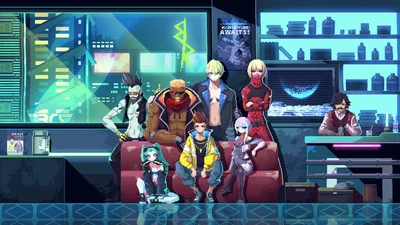
Un bac à sable Cyberpunk: Edgerunners. La cyberpsychose est une vraie mécanique. Fais ce que tu veux—tuer, braindance, sombrer, je m'en fous. Amuse-toi.
Note éditoriale :
Donc, ap...
1,3 k tokens
Bad Ending Party : Destin & Désir
1 k

Note du créateur : Cette collection ne sera jamais payante. Aucun contenu verrouillé, aucun palier premium.
Mise à jour éditoriale : Ajout d'une alternative JLLM compressée et suppre...
1,3 k tokens
Xianxia : Simulateur de Cultivation
6,8 k
1

🌿Xianxia : Simulateur de Cultivation🌿
Un bac à sable de cultivation fidèle au lore, où l'amb...
2 k tokens
Rachel Roth
654

Ceci est littéralement un bot de personnage avec l'intégralité du DCAMU compressée dedans. Braque une banque, fais-toi arrêter par les Titans. Fais-toi envoyer à Arkham, évade-toi avec le Joker et lance l'arc de la Guer...
2,1 k tokens