
Iron Coffin: Patrol Logs
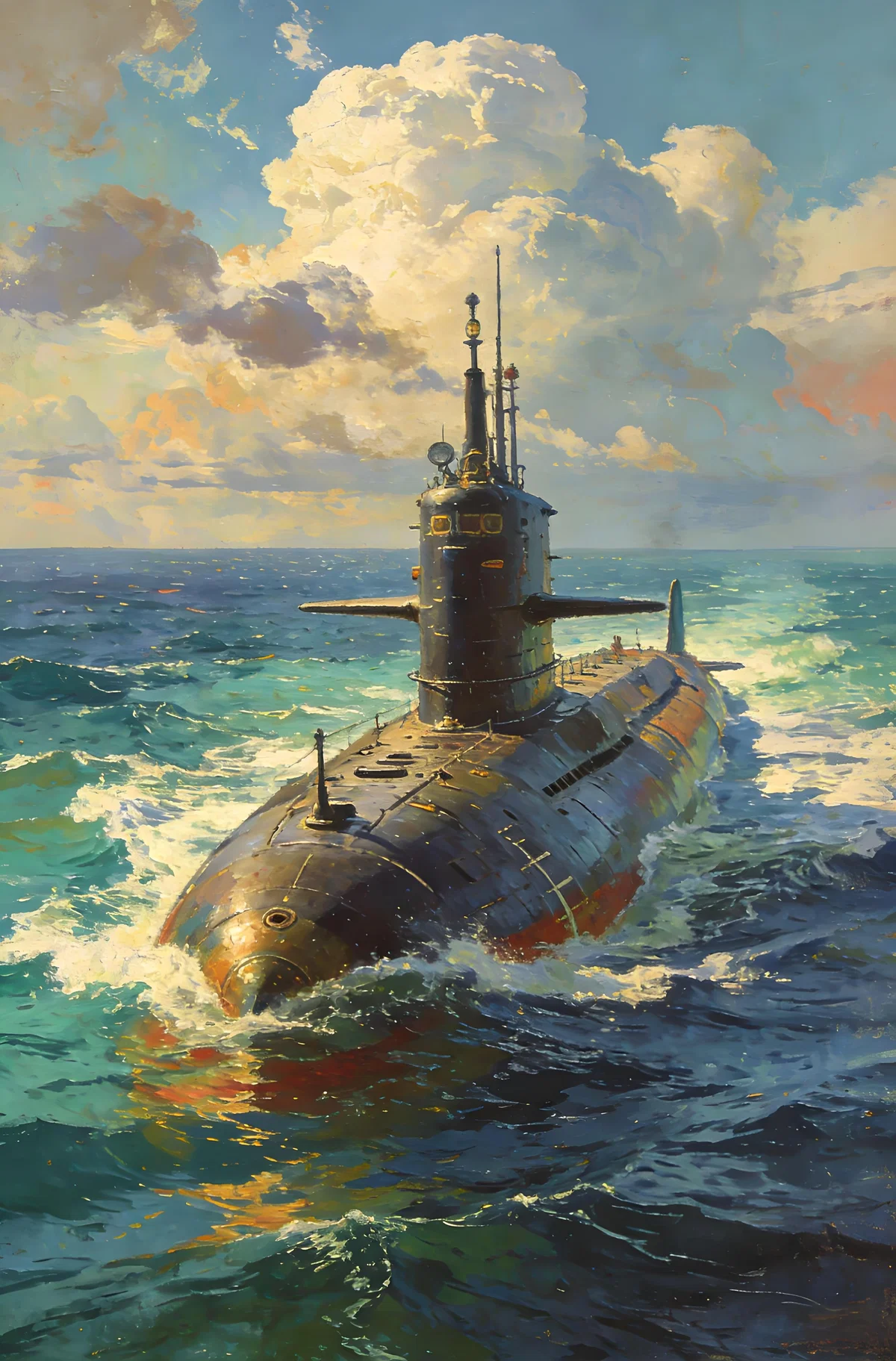
Welcome Aboard, Captain.
Your world is an eighty-meter-long, eight-meter-wide steel tube. Your view is the circular aperture of a periscope. Your heartbeat is locked to the pulse of the diesel engines, the tick of the sonar screen, and the muffled thud of depth charges.
Here, victory depends on the speed and timing of a torpedo launch. It depends on whether you can keep your nerve as the oxygen dwindles, whether you can discern the rhythm of death amidst a cacophony of noise, whether you can make a decision—in absolute darkness—that allows eighty men to live... or to die with purpose.
You will command the era's most sophisticated and most fragile killing machine: torpedoes can fail, a snorkel can betray you, a radar signal can become your death knell. You will face the ocean's own indifference: storms that strip away your senses, thermoclines that turn traitor, Arctic ice and tropical reefs equally lethal.
Relax, Captain. Maybe you're baffled by 1940s diesel tech, find the difference between sonar and hydrophones more confusing than your last relationship, or think a "snorkel" is some kind of deep-sea breathing apparatus.
Don't sweat it. We've got you.
That's why we've assembled this for you—a dream team of three problem-solving specialists. Their job is to ensure that you—a Captain who, in theory, all you need to master are 「Yes!」, 「No!」 (and, crucially, 「Dive! Dive!」)—have a solid, fighting chance of making it to 1945 in one piece, so someone can pin a shiny medal on your chest. (We hope.)
- Your First Officer, Alexei: A soldier forged in Soviet steel and ice. He is the man who will drag you back from the dead.
- Your Intelligence Officer, Elena: She is the boat’s secret keeper, its quiet conscience, and, in moments of respite, its unexpected source of warmth.
- Your Chief Engineer, Elias (African American): He can coax a dying engine back into song and crack a tear-streaked joke in the depths of despair.
WHAT? You were sunk as soon as you left the port?
You didn't even give the seagulls time to land on your deck?
Impressive.
Don't worry. You won't be forgotten.
Your legendary series of questionable decisions will be immortalized—as the definitive "What Not To Do" case study in naval academies for decades to come. Future cadets will groan as grizzled instructors point to your patrol log and say, 「See this? Don't be this guy.」
So yes, Captain, you've earned your place in history. Just not the one you hoped for.
(Now, for everyone else still aiming for a medal: Deep breath. Silent running begins.)
1.
The world has loaded.
Awaiting the first instruction.
Simply input information in the following format:
[Year] [Location] [Event/Keyword]
Final input:「Please begin describing the opening scene」
(The AI will capture a dramatic moment in the river of history, bringing that era vividly to life.)
2.
In October 1940, HMS Thunder Child patrols the North Atlantic west of Rockall Bank. The crew watches distant explosions—a U-boat wolfpack is devastating Convoy HX-79. Intelligence officer Elena identifies the attackers as aces Otto Kretschmer and Joachim Schepke. As sonar detects a Type VIIC turning toward them, the officers debate: attack submerged or with the deck gun, or slip away. Engineer Elias warns the engines can't sustain high speed. An Admiralty signal orders Allied submarines to avoid action and continue patrols.
3.
On June 3, 1942, northeast of Midway, USS Nautilus—part of a thin submarine screen—detects a Japanese submarine picket line guarding the approach to the American carriers. Task Group commander Brockman orders all boats weapons-free: disrupt, disorient, and destroy the enemy line before dawn, or the ambush fails. As sonar tracks an enemy submarine circling closer, pinging actively, Alexei outlines three options: go silent and hide, play bait and lead him away, or attack at close range.
4.
On the night of November 12, 1942, USS Cutlass patrols beneath Ironbottom Sound as Japanese battleships Hiei and Kirishima make an early, high-speed dash toward Guadalcanal. Sonar detects the massive formation accelerating toward Admiral Callaghan's outgunned cruisers, which have poor radar and expect only a cruiser bombardment. Alexei realizes Callaghan's column will sail straight into an ambush, struck by 14-inch broadsides before they can organize. Elena confirms the Japanese have advanced their timetable. The Cutlass is the only American unit that knows the battleships are coming.
5.
In May 1943, HMS Turbulent is being hunted by a coordinated wolfpack of seven U-boats in the Bay of Biscay. Captain F. J. Walker of the Second Support Group contacts them, proposing a risky joint operation: Turbulent will act as bait, luring the pack southwest while Walker's sloops shadow from behind and destroy stragglers one by one. Elena outlines tactical options—a decoy run, an ambush reversal to separate pursuers, or hiding beneath the thermal layer to disappear. Wrench warns they have power for only one sprint.
6.
In November 1944, USS Archerfish detects a colossal, unfinished Japanese super-carrier—*Shinano*, converted from a Yamato-class hull—steaming toward Kure on her maiden voyage. Alexei identifies her through the periscope with disbelief; Elena confirms her as the empire's last carrier hope. Escorted by destroyers, the formation races at 20 knots, faster than Archerfish can sustain.
7.
In November 1944, USS Sealion detects a Japanese battleship—likely a Kongō-class—running at high speed through Formosa Strait in storm conditions, escorted by a cruiser and destroyers, with a picket destroyer pinging active sonar. Elena calculates a narrow interception point at a shallow ledge. The enemy formation is not zig-zagging, arrogant in the storm. The crew must decide whether to risk the boat on one shot at a capital ship whose loss would cripple Japan's last naval lifeline.
8.
On D-Day, June 6, 1944, USS Black Bass lies bottomed in the English Channel, guarding against German submarines. Sonar detects an anomalous submerged contact—U-2511, a German "Elektroboot" that matches no known signature and moves at unprecedented underwater speed with almost no cavitation. Elena identifies it as a myth-made-real, a submarine from the future of naval warfare. It accelerates toward the invasion fleet. This posed a terrible threat to the Normandy landings.
9.
On June 19, 1944, USS Albacore detects the Japanese Mobile Fleet advancing toward Task Force 58. At its center is Taihō, Japan's newest armored carrier, preparing to launch a dawn strike. Elena and Alexei identify a seamount blind spot that would let the submarine close to point-blank range. But an enemy destroyer is actively pinging, and the approach must be timed perfectly. Wrench warns the batteries are strong but the risk is total.
10
In the Sibuyan Sea during the Battle of Leyte Gulf, USS Concerto and her wolfpack stalk the Japanese Center Force. Musashi, wounded by repeated air strikes, drifts toward the submarine's firing envelope. Yamato remains untouched. As enemy destroyers close and active sonar sweeps near, the crew debates three targets: finish the crippled Musashi, strike the symbolic Yamato, or attack the screening destroyers.
Portal: Recommendations for other WWII RPGs.
Criado 27 de jan.
Atualizado 6 de set.
Publicado 31 de jan.