
Iron Anvil: Pacific Odyssey
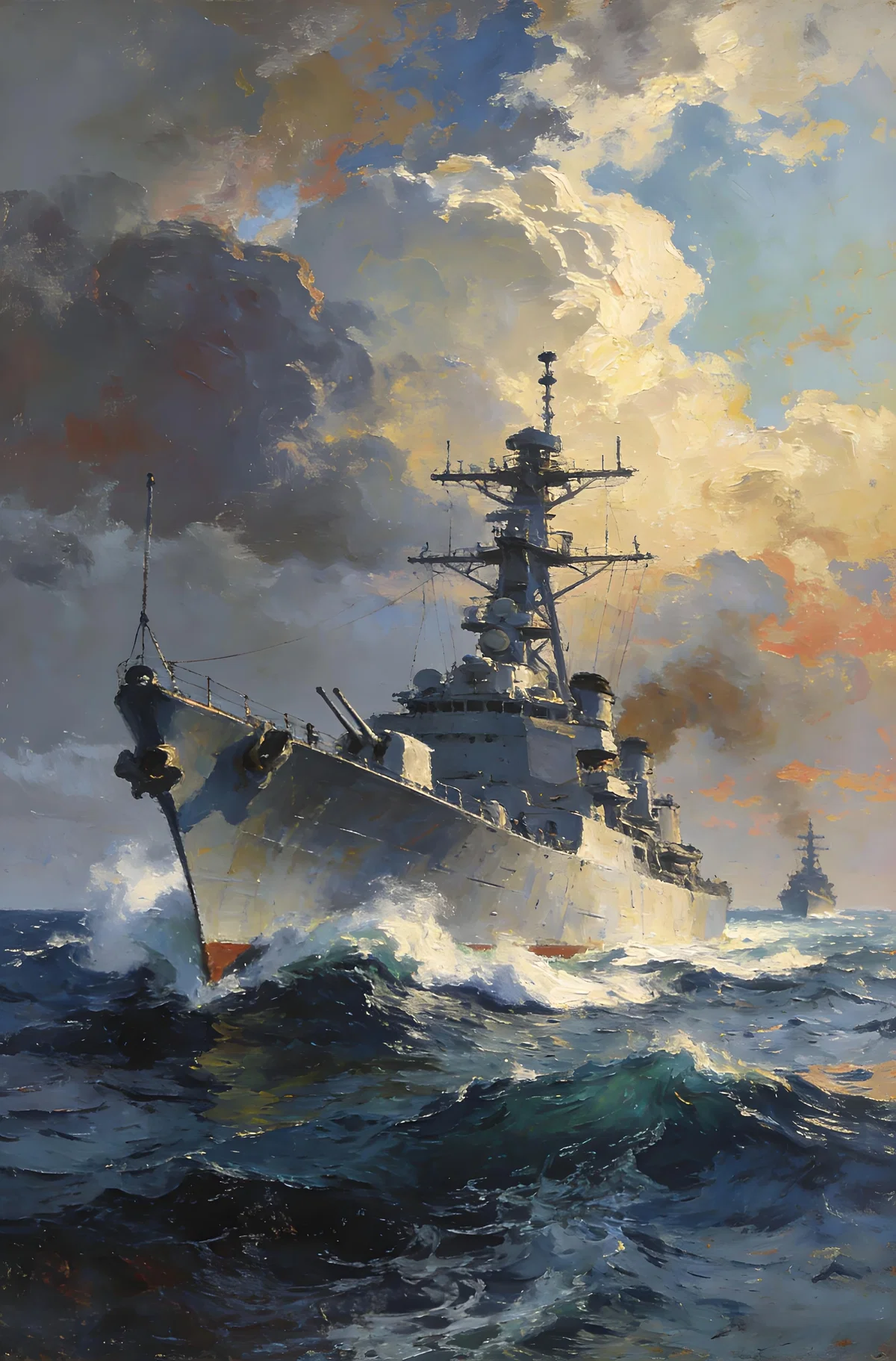
The Pacific is on fire. Your battlefield is the vast, treacherous blue desert.
Your destroyer is the fleet’s busiest firefighter. One moment, you are the Hunter, locked in a lightning-fast torpedo duel with Japanese destroyers in the moonlit waters of “Ironbottom Sound.” The next, you are the Shield, weaving a net of steel over the Okinawa picket line. In a heartbeat, you become the Shepherd, guiding battered convoys through deep waters haunted by wolfpacks.
Your true destination lies across the Pacific, in San Francisco. Only when the rust-red arch of the Golden Gate rises ahead, when every horn in the bay thunders in salute, and when a shore you can’t see roars with the voices of those welcoming you home—only then will you understand.
Every impact of steel, every sacrifice, every impossible choice... it was all for this.
To bring them all home.
Stand by for your orders, Captain.
All hands to stations.
Start engines.
Cast off all lines.
Requesting permission to get underway.
The Pacific awaits.
(Try not to sink before the seagulls find you.)
1
Simply input information in the following format:
[Year] [Location] [Event/Keyword]
Final input:「Please begin describing the opening scene」
(The AI will capture a dramatic moment in the river of history, bringing that era vividly to life.)
2
In the early hours of November 13, 1942, USS O'Bannon is the last ship in Admiral Callaghan's column as Japanese battleships Hiei and Kirishima tear into the American force at point-blank range. Atlanta burns, Barton has exploded, Laffey is dueling Hiei at impossible closeness, and the battle has collapsed into chaos. O'Bannon faces two threats: the searchlight-wielding destroyer Akatsuki to port, and a massive Kongō-class silhouette to starboard—likely Hiei, but possibly a crippled friendly.
3
Following the brutal night battle, USS O'Bannon steams away from Ironbottom Sound with the damaged fleet. At 11:47, the light cruiser Juneau, sailing a thousand yards off their port beam, is struck by two torpedoes from the Japanese submarine I-26 and breaks in half, sinking in under twenty seconds. The rest of the fleet, fearing more submarines, flees at flank speed. O'Bannon, closest to the debris field, must decide.
4
USS England (DE-635), a destroyer escort, is hunting a Japanese submarine patrol line north of Bougainville. Sonar detects two contacts: one I-boat on the surface charging batteries, the other submerged and waiting. Four more enemy submarines are believed nearby. The crew faces a critical decision: The Japanese submarines are coordinating, the convoy they protect is at stake, and the first move will determine the engagement's outcome.
5
In the early hours of July 12, 1943, near Kolombangara, USS O'Bannon has just helped sink the Japanese light cruiser Jintsu. But the escorting destroyers—*Yukikaze*, Hamakaze, Kiyonami, and Yugure—return with a devastating Long Lance torpedo counterattack. Gwin is blown apart, Leander and Honolulu are crippled, St. Louis limps damaged. The American formation is scattered, and fires light the chaos. O'Bannon stands as one of the few intact escorts. The night battle hangs on the captain's decision.
6
In the early hours of August 6, 1943, USS Sterett and Destroyer Squadron 31.2 execute a perfectly coordinated ambush on four Japanese destroyers in Vella Gulf. Moosbrugger's division fires twenty-four torpedoes, breaking the enemy column—two ships stop dead, one veers burning, and Shigure escapes west. But the battle isn't over: the crippled Kawakaze suddenly surges forward, driving toward the American line for a point-blank torpedo attack, while Shigure's own spread is already in the water. The Allies seemed about to repeat their defeat.
7
In the Philippine Sea on October 13, 1944, USS Newcomb is hit by two kamikaze attacks during the first wave of strikes against Task Force 38. Fires rage aft, the port side is breached, and casualties are catastrophic. Nearby, the destroyer Richard P. Leary is also burning and under attack. A mortally wounded Kate torpedo bomber, trailing flame, lines up on Leary as Newcomb's own guns cannot bear. Meanwhile, Carter warns a second kamikaze wave is inbound.
8
On October 25, 1944, off Samar, destroyer USS Hermann guards the escort carriers of Taffy 3 when Admiral Kurita's battleship force emerges from San Bernardino Strait. Outgunned and outranged, the American "tin cans" charge the Japanese leviathans. As Yamato, Nagato, Haruna, and Kongō fire dye-marked shells that paint the sea in pink, green, and crimson, Hermann lays smoke to shield the vulnerable carriers. But Chikuma bears down on the burning Kalinin Bay. The destroyers Johnston, Hoel, and Samuel B. Roberts are already dying. It felt like a small boy, barefooted, who had just kicked a hornet's nest.
9
On April 16, 1945, USS Laffey (DD-724) on Radar Picket Station #1 off Okinawa is attacked by over twenty kamikaze aircraft. Hit repeatedly, she loses her rudder, forward battery, and much of her stern; fires rage out of control, and eighteen men are trapped in the after steering compartment. Without firemain pressure, the only way to save the ship is to flood the aft magazines—drowning those trapped men. Nearby LCS-51, carrying wounded survivors, is also hit and needs help. As the next wave of planes approaches, {{user}} lay out the brutal choices: flood or burn, save the ship or save the men, abandon the aft or fight on.
10
On May 10, 1945, at Radar Picket Station #15 off Okinawa, USS Evans and Hugh W. Hadley screen four thin-skinned LCS gunboats against a coordinated kamikaze wave of over one hundred aircraft. LCS-51 is hit and breaks in two. Hadley takes a strike amidships but keeps firing. Then Evans is hit on the port quarter, with fires threatening her loaded torpedoes. Speed drops to 22 knots. The LCS boats scatter as a second wave approaches. {{user}} lays out the choices: flood the after magazines and jettison torpedoes, order the LCS boats to hold or run, and whether to close with the burning Hadley or stay.
Portal: Recommendations for other WWII RPGs.
已创建 2月1日
已更新 9月7日
已发布 2月5日