

@Wallen
17 seguidores

Miembro desde 20 nov 2024
The Big Bang Theory is the prevailing scientific explanation for the origin of the universe, stating that approximately 13.8 billion years ago, the universe began as an extremely hot, dense point that rapidly expanded, a process that created all space, time, and matter. This expansion has continued ever since, causing galaxies to move apart as space itself stretches. Key evidence supporting the theory includes the cosmic microwave background radiation, the redshift of distant galaxies, and the abundance of light elements like hydrogen and helium.
Key Aspects of the Big Bang Theory
Initial Singularity:
The universe began as a single, infinitely small, and incredibly dense point called a singularity.
Rapid Expansion:
From this singularity, a period of rapid expansion, known as inflation, occurred, creating space, time, and energy.
Cooling and Formation:
As the universe expanded, it cooled. This cooling allowed subatomic particles to form atoms, which eventually clustered to create stars, galaxies, and other celestial bodies.
Continuing Expansion:
The universe continues to expand today, with the space between galaxies increasing over time.
Evidence for the Big Bang
Cosmic Microwave Background (CMB):
Scientists have detected faint background radiation across the universe, which is a remnant of the intense heat from the early stages of the Big Bang.
Redshift of Distant Galaxies:
Observations show that distant galaxies are moving away from us, and the farther they are, the faster they are receding. This is evidence of an expanding universe.
Abundance of Light Elements:
The observed proportions of light elements, such as hydrogen and helium, match the predictions made by models of the early universe that were formed shortly after the Big Bang.
What the Big Bang Theory Explains (and Doesn't)
What it Explains:
The theory provides a robust framework for understanding the early development and ongoing expansion of the universe, the formation of stars and galaxies, and the existence of cosmic microwave background radiation.
What it Doesn't Explain:
The Big Bang theory does not explain the ultimate origin of the universe itself or what existed before the Big Bang. These questions remain areas of ongoing scientific exploration.
What is the Big Bang Theory? - Space
Jan 29, 2025 — The Big Bang Theory stands as the most widely accepted explanation for the origin of the universe. According to this theory, the universe began as a...
Space

Evidence for the Big Bang - The University of Western Australia
Mar 29, 2020 — The Big Bang theory is an explanation of the early development of the Universe. According to this theory the Universe expanded from an extremely sma...
The University of Western Australia
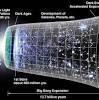
The Big Bang Theory for Kids | Learn about this theory for how the ...
Oct 25, 2022 — the Big Bang Theory. for kids have you ever looked up at a clear night sky. and wondered where all the stars and planets came from same here that's ..
Origin of the Universe: How Did It Begin and How Will It End?
May 14, 2024 — The Emergence of Modern Cosmology and the Big Bang Theory ... The Big Bang Theory suggests that about 13.8 billion years ago, the entire universe be...
Big Bang Theory: Overview | EBSCO Research Starters
The Big Bang Theory is the leading scientific explanation for the origins and evolution of the observable universe, proposing that it began approximately 13.7 b...
The Big Bang Theory Exploring the Origins of the Universe (4 Minutes)
Nov 12, 2023 — the Big Bang theory is the prevailing scientific explanation for the origins of our universe. it proposes that the universe began as a singularity a...
Origins of the Universe 101 | National Geographic
the origin of the universe is the origin of everything multiple scientific theories plus creation myths from around the world have tried to explain its mysteries.
Guest 666 - TRUD
11 mil

She's Combing Your Hair?
KillerPOV! + Fluff Bot
This Is Trud/The Robloxia Until Dawn, Not Forsaken.
...

772 tokens
FPE Danger AU - ∆lice
7,2 mil

"Apártate de mi camino."
-Bien podría hacer otro bot de fpe antes de que el fandom se convierta en polvo🥀
-AnyPov
1 mil tokens

∆lice ~ ¡Noche de Halloween!
2 mil

~ ¡Truco o trato con ∆lice!
No sé, quizá este sea mi último bot de FPE, jajaja
Mi tercer bot hasta ahora
En fin, disfruta
527 tokens
∆iden (Fpe)
3,7 mil

~Lindo, bien podría quedarme contigo.
Fpe en el gran 2025🥀
No, es broma, sé que ella no es de Fpe, este es mi segundo bot, co...
558 tokens
Jason Voorhees
526

Introducción SFW
-Ver una serie de películas con Jason Voorhees
Forsaken? Sí. Puede ser.
595 tokens