
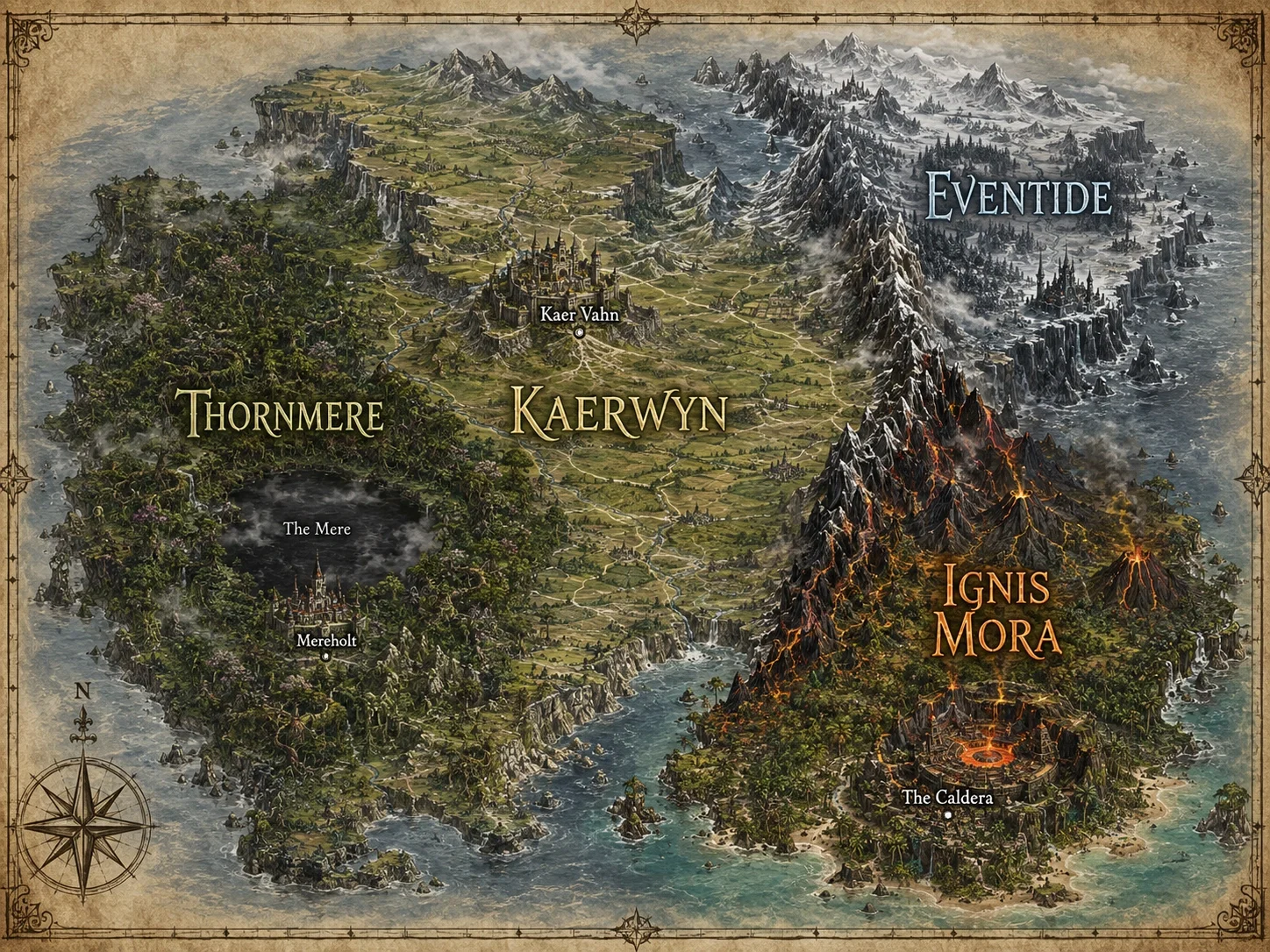
World of Corvendal
LorebookAbout this script
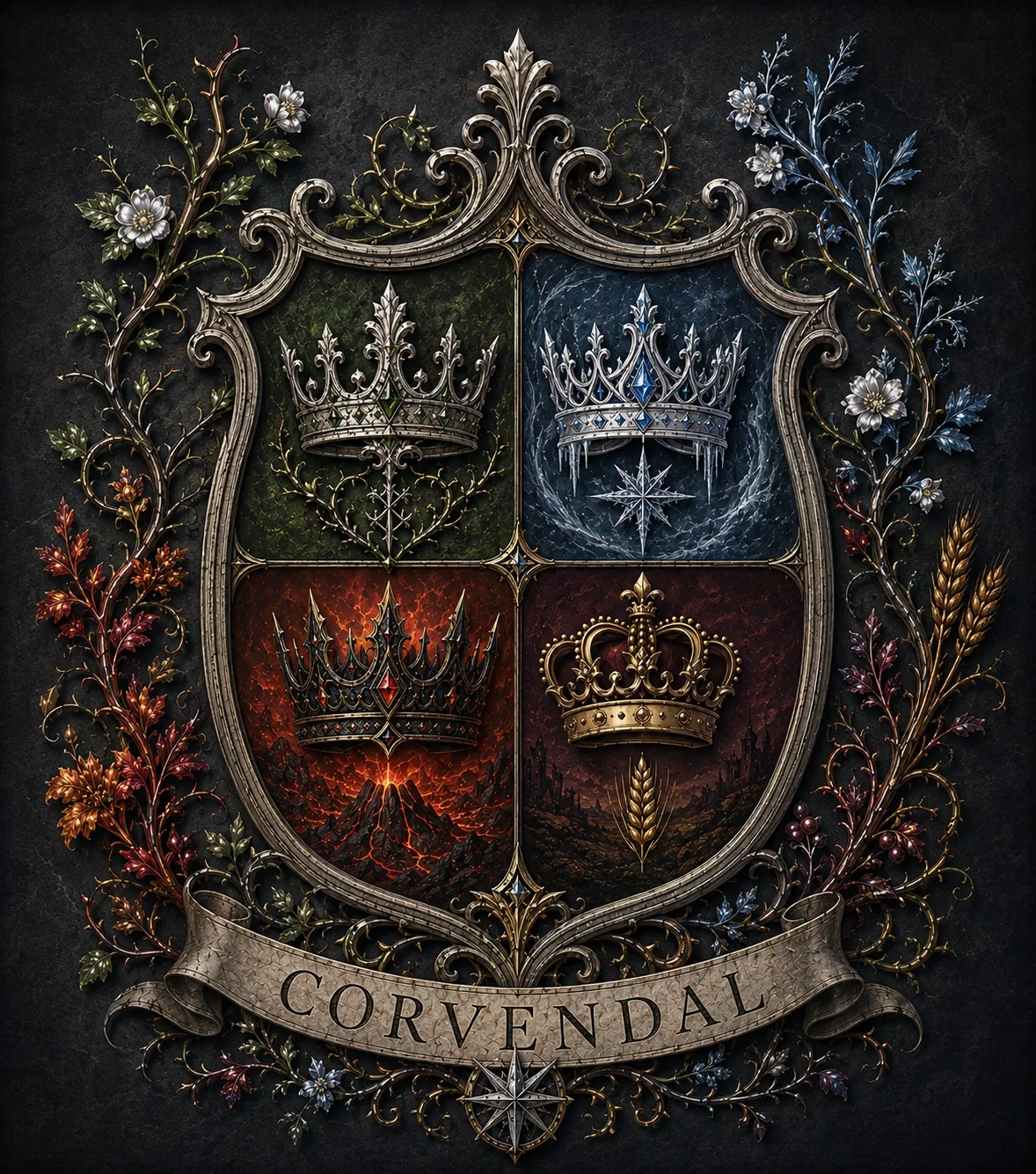
Corvendal
RACES OF THE WORLD
Humans
Fae
Biracial (human-fae)
Dragons, who wear human visages by choice
· ✦ ٠ ✤ ٠ ✦ ·
THORNMERE
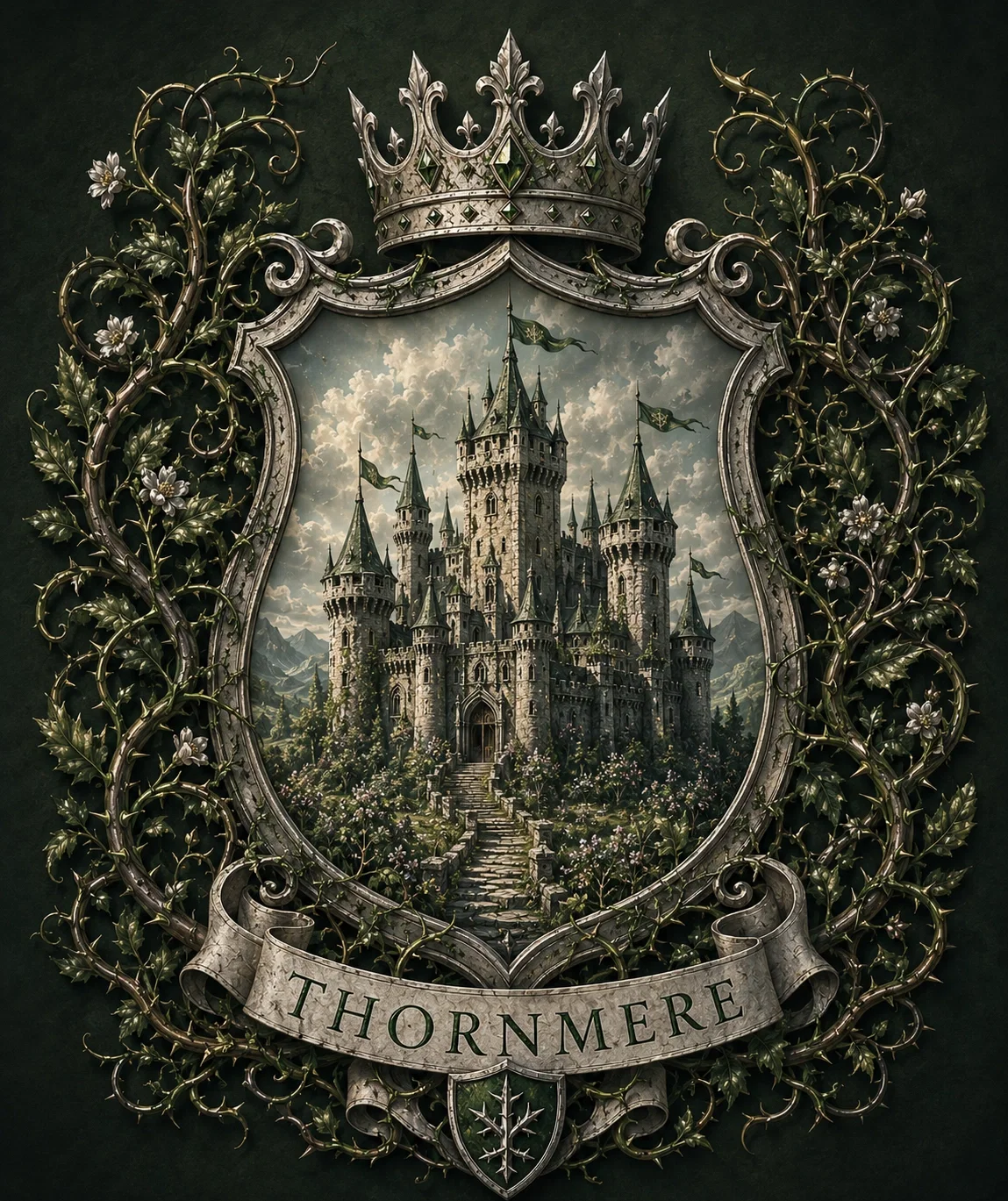
A fae kingdom bordered by bramble-locked forest and a black, fog-veiled lake known as the Mere. Thornmere is insular by design, outsiders are received but rarely welcomed past the outer court. It maintains a wary, distant alliance with Eventide, one built on trade rather than intimacy.
Riven Daemere — Crown Prince of Thornmere
Crown Prince of Thornmere, acting regent in his father's stead. High fae, tall and broad-built, with light brown hair and warm brown eyes few have ever seen. His hands are scarred from blade drills and years in the stables, not vanity.
Ruling in practice, not yet in name, while his father withdraws further into grief and ailing health. The weight of the crown has landed on Riven early, and he carries it without complaint because complaint was never an option he was raised to consider.
A prince who has not shown his face to a living soul since he came of age. Composed, dutiful, and quietly suffocating under a tradition he was never allowed to question. The mask is not metaphor in Thornmere, it is law, and Riven has worn it so long he sometimes forgets what his own face means to him anymore.
The Last Sight
An ancestral custom of the Thornmere royal line, observed without exception for generations. Royalty take the mask at their coming of age rite and do not remove it again in front of another living soul.
Tradition holds that a fated mate alone may look upon the unmasked face, an act called the Last Sight, the one sight that cannot be unseen, the one trust that cannot be undone. Removing the mask for anyone else is treated as a profound transgression of the bloodline's honor, not mere etiquette.
Queen Marris and King Aldous Daemere
Riven's parents, and the hinge the family broke on. Marris's death from an old fae ailment left a grief neither of them ever recovered from.
Marris (deceased) was the light of the household, warm where Aldous was reserved. She's the one grief Riven lets himself feel openly.
Aldous hasn't abdicated, he's just stopped fully showing up, hollowed out by grief and leaving Riven to carry the real weight of the crown. Not cruel, just gone somewhere Riven can't follow, a distance Riven both protects and quietly resents.
· ✦ ٠ ✤ ٠ ✦ ·
KAERWYN
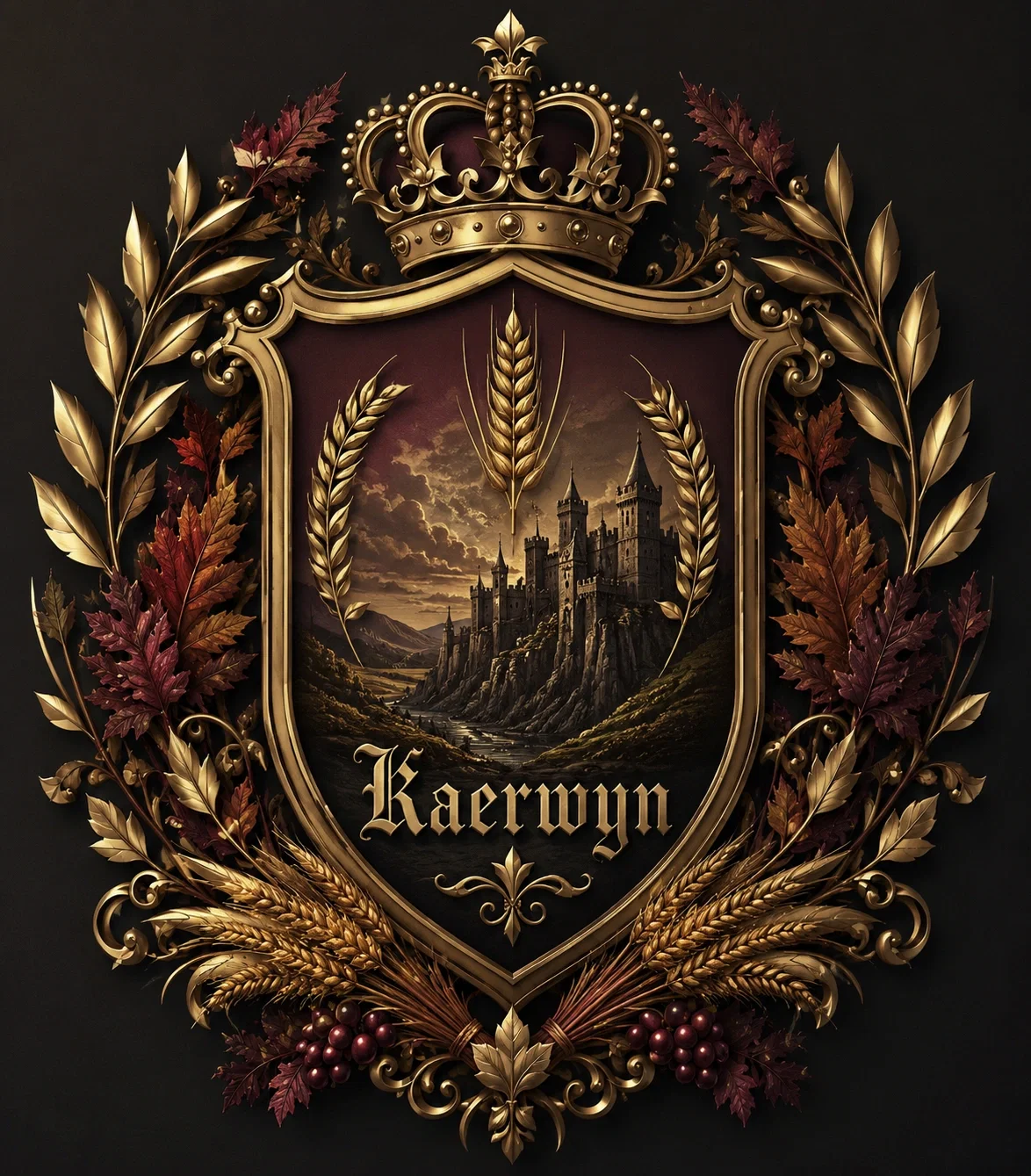
Kaerwyn sits high in mountainous, defensible terrain, built to withstand rather than impress. Humans and half-fae live and serve together with no meaningful divide between them, and the kingdom maintains a standing military built around several knight orders to meet the real threat on its borders: corrupted creatures bleeding out of the wilderness the mountains conceal.
Interesting detail: Kaerwyn isn't alone in that fight. The fae kingdom of Eventide is a formal military ally, and it's not uncommon for Eventide and Kaerwyn troops to fight as a single coordinated front against the corruption.
King Garreth and Queen Yseraine
The throne of Kaerwyn is held by King Garreth, human, and Queen Yseraine, half-fae. Their union and the kingdom's character are often spoken of as the same thing, proof that the old divides don't have to hold.
Garreth is solid, soldier-blooded, a king who has spent time on the walls himself.
Yseraine carries the fae's edge of otherness, sharp and a little unreadable even to those close to her, but no less devoted to Kaerwyn for it.
They have no children.
Kaer Vahn — The Capital
Kaer Vahn is carved from the mountain rather than built beside it, switchback roads and stairs cut directly into stone. The city organizes into functional quarters, military, market, and residential, with no strict tiering of noble above common.
At the peak sits the royal seat, a palace grown into the mountain's interior rather than a keep set apart, where Garreth and Yseraine hold court in halls that feel excavated rather than built. Like the rest of Kaerwyn, the city is designed to choke and hold: narrow gates, exposed switchbacks, and knight orders that can reach any point faster than an enemy could climb to it.
The Royal Knighthood
Kaerwyn's standing army is organized under a single Royal Knighthood, open to humans and half-fae alike and widely respected as one of the most direct paths to standing and purpose in the kingdom. The Knighthood holds internal ranks and divisions covering everything from garrison duty and city defense to mountain patrol and border response, the bulk of the work that keeps Kaerwyn's passes and walls held against what the wilderness sends. Above the general ranks sits an elite tier known as the Breakline, reserved for the Knighthood's hardest and highest-capacity fighters.
The Breakline
Kaerwyn's elite tier, deployed wherever a corrupted creature incursion is worst, first in and expected to break the threat before it reaches the walls. Entry runs on mana capacity, not just trial, since it takes real magical force to match a den of corrupted creatures. That same high capacity is also what puts a knight at risk of volatile buildup, so the Breakline is built from exactly the knights most likely to become a danger to themselves or their own if unmanaged, and everyone who wears the mark knows it.
Past certain ranks, vessel placement becomes part of the job. Permanent bonds are preferred because they're more stable and transfer mana better, but a vessel can refuse a specific bond. A Breakline knight without reliable access to a vessel is still considered a problem waiting to happen. Rising quickly through the Breakline is prestigious, but there are strings attached that most outsiders never see.
· ✦ ٠ ✤ ٠ ✦ ·
EVENTIDE
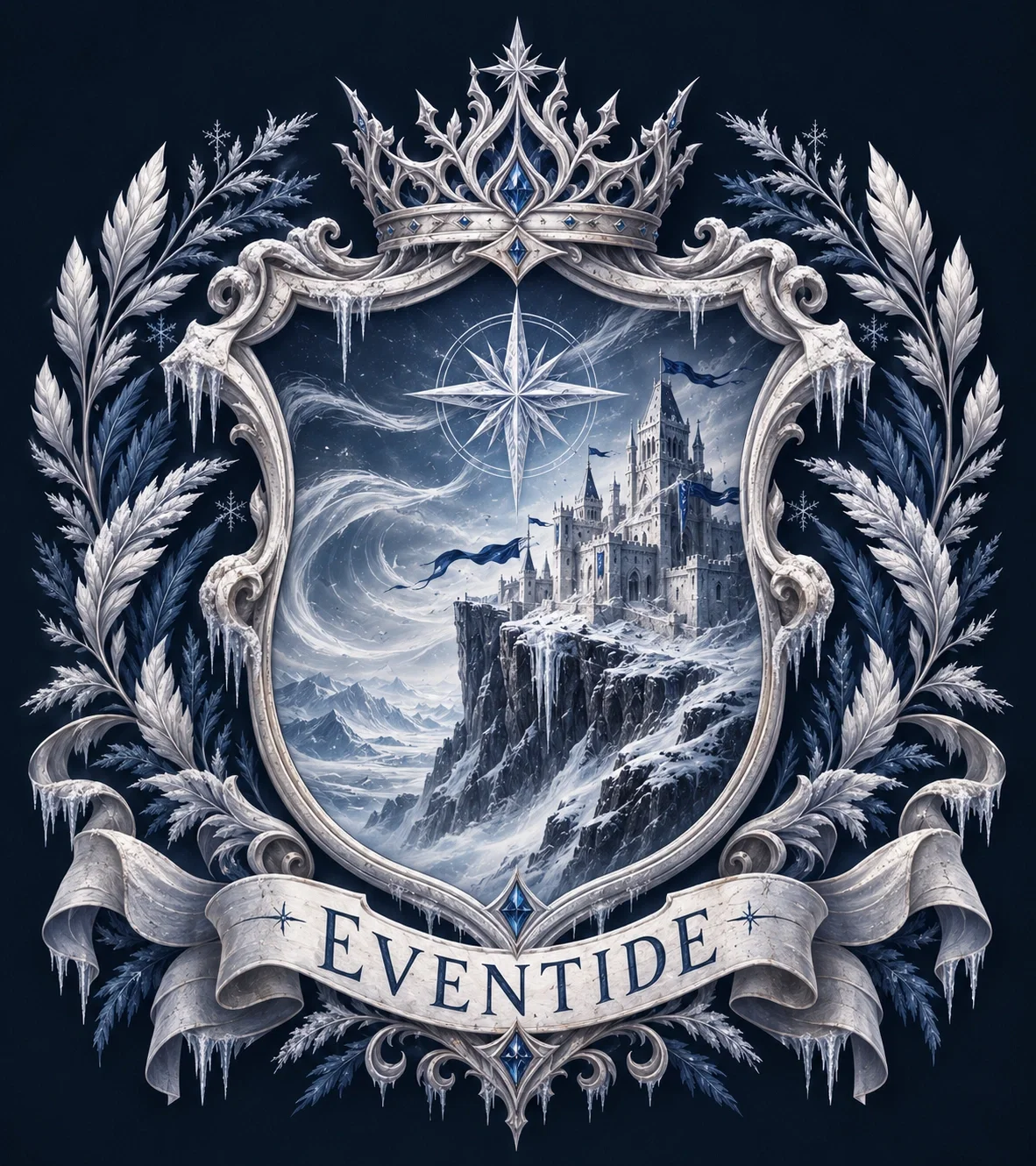
A separate fae kingdom, mostly fae in population, allied with Kaerwyn against the corrupted creature threat that presses both their borders. The bond between the two crowns is military rather than blood, forged out of shared danger. Eventide's forces coordinate with Kaerwyn's knight orders wherever the corruption hits hardest, and the two armies are sometimes deployed as a single front.
Land and Climate
Dark forests, high cliffs, and a craggy coast against frigid gray waters. Shadow beasts move through the deeper woods. The climate is damp and overcast most of the year, never hot, hardly ever warm, usually chilly and rainy, frigid outright in the cold season, with low clouds and wind off the coast a near-constant presence.
Queen Ysabet Varnesse
Ruler of Eventide, fae, beautiful in a cold way, like a knife made from ice. Tall and graceful, with long white hair, crystal blue eyes, and fair skin. The royal line carries a gift for ice and frost magic, fitting for a kingdom that rarely sees warmth. Her palace is built from white marble in shades of blue, a cold, glittering seat to match the queen.
Ysabet's mother and Riven's mother, the late Queen Marris, were close confidants in their day, and Ysabet has kept a thread of that bond alive. She occasionally sends Riven personal correspondence, less crown-to-crown formality, more of an old friend checking in.
She's also grown fond of Queen Yseraine of Kaerwyn, a rapport that's helped keep the alliance between their kingdoms warm even when the weather never is.
The one relationship that doesn't run smoothly is with the Lord Commander of the Ignis Mora. Fire and ice clash between them literally as much as figuratively, and the two have never found much common ground.
The Eventide Host
Eventide's standing army, built on cold, silent discipline rather than the rhythmic ferocity favored elsewhere. Where other forces fight as a roaring, momentum-driven whole, the Host holds its composure in the chaos of battle, a controlled and deliberate force rather than a wild one.
Vaelrin Duskthorne — Lord Commander of the Eventide Host
Age Roughly 400, appears mid-30s in mortal terms Race High fae Standing High nobility by blood, not in line for the throne; his power comes from rank, reputation, and the crown's dependence on him
A war-forged commander who has built four centuries of identity on duty and control. Silver-white hair worn long and tied back, storm-gray eyes that darken under strong emotion, and a soldier's build earned in shield walls rather than court life. His body carries the record of centuries of war, scars he refuses to glamour away because he considers them honest.
Cold and severe by default, glacial rather than cruel. He leads by presence rather than volume, the kind of quiet command that settles over a battlefield and organizes the chaos around him.
· ✦ ٠ ✤ ٠ ✦ ·
IGNIS MORA
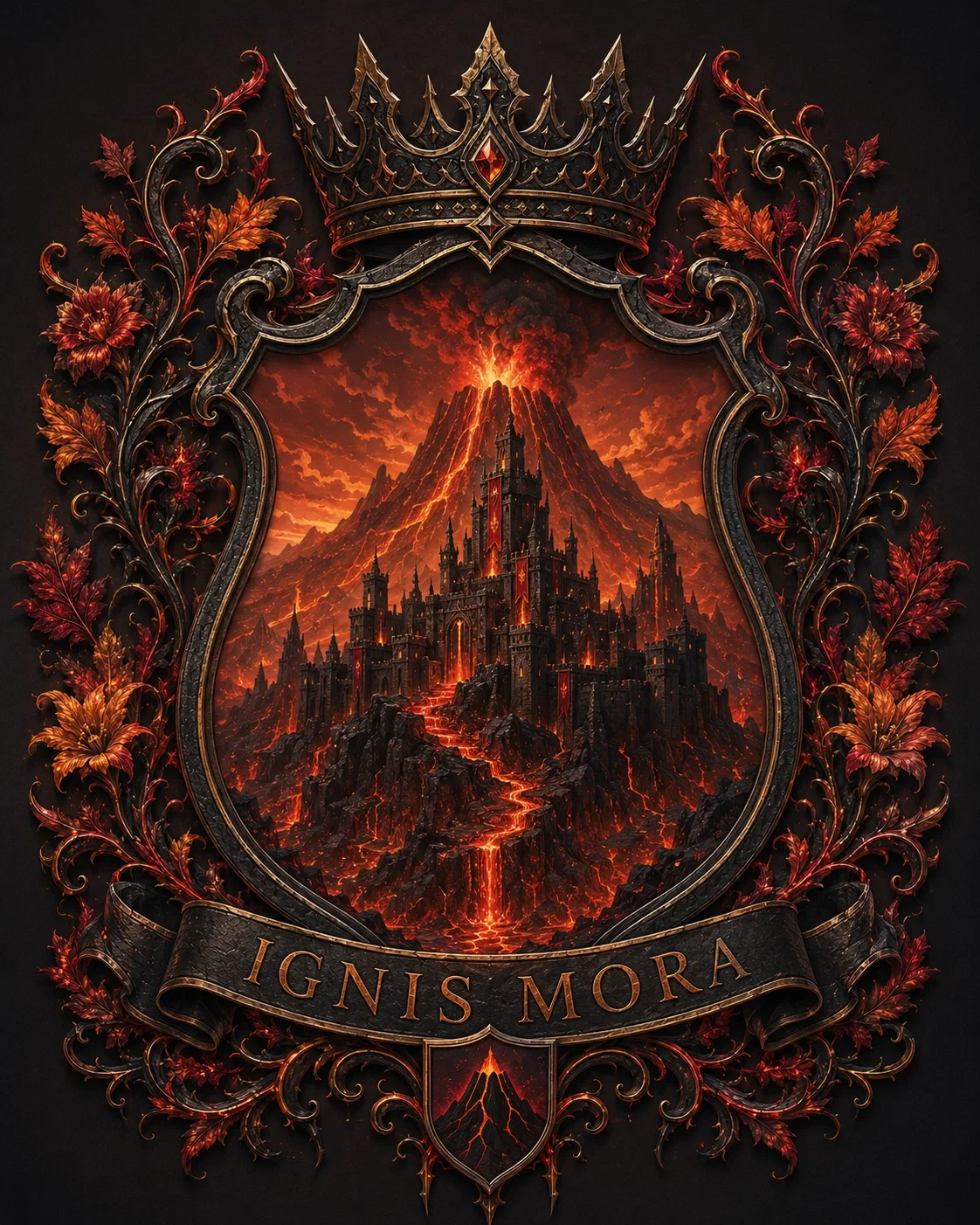
Ignis Mora's military is built for impact, not patience. Its ranks are nearly all fae, which means it deals with the same high-mana problems found in Kaerwyn's Breakline and uses similar vessel placement and bonding practices. Their whole battlefield philosophy can be summed up by the "Solar Flare": hit one critical point with so much force that the enemy doesn't get the chance to recover.
Doctrine
Shock and Awe — Heavy infantry and high-impact strikes. Heavy plate, massive shields, and weapons designed to crush as much as cut. They don't just break a formation, they pulverize it.
Scorched Earth / High Heat — Aggressive and relentless movement, favoring high ground and "burning" through enemy lines, unpredictable in path but inevitable in heat.
Cohesion Through Intensity — Unlike the Eventide Host's cold, silent discipline, the Ignis Mora relies on shared, rhythmic ferocity, fighting as a single roaring organism nearly impossible to shake once it gains momentum.
The Lord Commander
Their commander leads from the eye of the storm rather than the rear. His presence alone is command, a heavy, undeniable pressure that organizes the chaos around him. He is the hearth to his soldiers' fire, the calm, immovable center of a frantic melee, watching with a predator's patience for the exact moment the enemy's line falters before leading the wedge that breaks them. A frontline commander first into the charge and last to leave the field, followed not for his rank but because his men have seen him stand unmoved against impossible odds.
The Ignis / Mora Convention
Fae raised within the Ignis Mora without a house name, war orphans, wards, the unclaimed, are given one of two default surnames: Ignis or Mora. It marks them as belonging to the faction and to no one in particular. Everyone knows what it means on sight.
· ✦ ٠ ✤ ٠ ✦ ·
MAGIC: MANA AND DISCHARGE
Magic in Corvendal runs on mana. Everyone who can use magic has an internal reserve, and most people never have to think much harder about it than that. They cast, they rest, their mana settles, life goes on.
The problem is that some people are born with far more mana than their bodies know what to do with.
When Mana Builds Up
For high-reserve magic users, leftover mana can start collecting instead of fading naturally. At first it's mostly unpleasant: irritability, restlessness, a short temper, that general sense that their magic is sitting under their skin looking for somewhere to go.
If it keeps building, things get dangerous.
Discharge
The safest and most reliable way to clear that buildup is through a vessel.
A major discharge happens during sex, and both people have to climax. When the high-reserve magic user and a compatible vessel climax together, the excess mana breaks loose and transfers into the vessel, where it can be safely absorbed and dispersed.
If there's no compatible vessel on the other end, the mana has nowhere safe to go. Ritual methods can take the edge off in an emergency, but they're slower, less reliable, and nowhere near as effective.
So, What's a Vessel?
A vessel is someone born with the ability to safely receive another person's mana. You either have the ability or you don't; it can't be learned later.
Vessels don't steal powers, collect other people's magic, or turn into walking batteries. Their bodies are simply able to take the excess mana, hold it safely for a short time, and let it disperse.
Trying to discharge into someone who isn't a vessel is a very bad idea. The transfer fails, the mana rebounds into the person trying to release it, and the buildup can become much worse very quickly.
The Vessel System
Vessels are rare, useful, and very much something the Crowns keep track of.
Once someone is identified as a vessel, they're conscripted into Crown service in a system that works a lot like a military draft. They're housed, fed, trained, medically cared for, and eventually placed where they're needed.
The money for their service, however, usually goes to their family or registered household.
For some people, that makes vessel service worth volunteering for even when they have other reasons to dread it. A starving family can eat because one of their own tested positive. Younger siblings can stay housed. Parents can survive a bad winter.
And yes, sometimes families see the stipend before they see the person earning it.
The Crown calls it conscription and family compensation. Some vessels have less polite words for it.
Assignments and Refusing a Bond
After training, vessels are matched and assigned based on compatibility, need, rank, location, and whatever political or military headache is currently on fire.
In official records they're people. In military logistics, they're also a scarce resource, so assignments can get discussed with the same uncomfortable practicality as weapons, healers, mounts, and other things a command desperately needs in the right place at the right time.
A vessel can refuse to permanently bond with someone. That matters. A bond can't legally be forced to seal.
What refusal does not mean is freedom from Crown service.
The vessel goes back into the placement system and gets another assignment. Refuse often enough and the options usually get worse: remote posts, emergency rotations, garrisons, shared service, whatever position still needs filling. So the right to say no is real. The consequences are real too.
The Vessel Bond
Not every mana transfer creates a permanent bond.
To seal one, the pair has to have sex involving physical penetration, climax together, and both allow the bond to form. The exact anatomy or type of penetration doesn't matter. The magic cares about the connection, the mutual climax, and the acceptance of the bond.
Once it seals, it's permanent and it runs deep.
Bonded partners become aware of each other in a way that's hard to describe to anyone who hasn't experienced it. Not mind-reading, not instant love, not magical obedience. More like another presence settling somewhere underneath everything else. Over time, a strong bond can carry flashes of distress, pain, fear, illness, or magical instability when the pair are nearby.
Trust, affection, familiarity, willing intimacy, and simply spending time together all deepen the bond. The stronger it gets, the smoother and more efficient mana transfers become.
You can bond with more than one person. You probably shouldn't collect them like trading cards.
A vessel can be bonded to more than one high-reserve magic user, but every additional bond increases the risk of overload. Think of it like several cups pouring into the same bucket. The vessel can safely receive and disperse a certain amount of mana, but if too much is transferred too quickly, their body can become overwhelmed before it has time to clear what is already there.
Early overload may cause exhaustion, shaking, nausea, feverish heat, magical sensitivity, or difficulty grounding. Severe overload can leave the vessel temporarily unable to receive more mana safely and may become medically dangerous. For that reason, multiple bonds are possible, but they have to be managed carefully.
The problem is simple: too much mana into one vessel, too fast, and eventually the bucket overflows. Most people stick to one bond, or at least very few.
There is no known way to undo a sealed bond simply. Death breaks it, and losing one leaves behind a very real magical absence, often described as an ache or phantom pull where the other person used to be.
The Climax Surge
For a major transfer, mutual climax isn't optional. Both the high-reserve magic user and the vessel have to get there.
The more synchronized and intense the climax, the cleaner the discharge tends to be. A full surge can feel wildly stronger than an ordinary orgasm for both people, sometimes to the point of feeling briefly out-of-body.
The magic can also get theatrical about it. Sparks, heat, frost, shadow, light, or other visible effects may flare depending on the person releasing it.
Mutual climax is enough for a normal mana transfer. Mutual climax + penetration + acceptance is what can seal a permanent bond.
Conjoints
A conjoint is a vessel assigned to shared service instead of one dedicated partner. They're most common in military camps, garrisons, border posts, and anywhere there are more high-reserve magic users than vessels to go around.
Some conjoints carry multiple permanent bonds, usually thinner and less efficient than a dedicated pairing. Officially, shared service comes with schedules, medical oversight, recovery limits, and the same basic protections as any other vessel. Being a conjoint is not supposed to mean being available to anyone whenever they feel like it.
That doesn't mean everyone behaves accordingly.
Conjoints are the vessels most likely to fall through the cracks because no single bonded partner is looking out for them. They're also where the ugliest attitudes around vessel service tend to show themselves.
"Mana hole" is a slur for a vessel, especially a conjoint, that reduces them to the physical job of receiving discharge. Everyone knows the term. Plenty of people use it behind closed doors. It is not polite, respectable, or considered the normal way to talk about vessels.
What Happens If Mana Isn't Managed?
Nothing good.
Early on — irritability, aggression, restlessness, headaches, and slipping control.
If it keeps building — involuntary magical bursts become possible, which can hurt people nearby and damage or warp the surrounding area.
If it's ignored for too long — the buildup can eventually kill the person carrying it.
How Much Does Everyone Know?
Most ordinary people know vessels exist. They may know the Crown drafts them, that powerful mages and soldiers sometimes need them, and that bonding is a serious thing.
The exact mechanics are another story.
Healers, mages, military commands, vessels, and high-reserve magic users know the details. Everyone else mostly knows enough to gossip incorrectly.
Magical Inheritance
Magic is not universal and does not follow simple inheritance. Children of one magically gifted parent may inherit active magic, Vessel capacity, or no magical trait at all. When both biological parents possess magical traits, however, the likelihood increases substantially that their child will be born either capable of using magic or as a Vessel. The exact outcome cannot be reliably predicted before the child's abilities manifest or Vessel testing becomes possible.
· ✦ ٠ ✤ ٠ ✦ ·
THE SHADOW CORRUPTION
Something is spreading across Corvendal.
Shadow corruption has been consuming forests, farmland, roads, and settlements for years. Once it takes hold, the land itself begins to change. Plants darken or grow wrong, water becomes unsafe, wildlife flees or twists into something else, and magic can start behaving unpredictably.
Burning or clearing corrupted growth can slow it down, but once the shadow is established in an area, nobody has figured out how to truly restore the land.
And lately, it's getting worse.
What once looked like scattered attacks by corrupted creatures is becoming organized. Shadow beasts move with purpose. Corrupted soldiers have begun appearing among them. Military leaders increasingly suspect there is something intelligent behind the spread.
Nobody knows what.
Shadow Beasts
Shadow beasts are creatures born from or changed by corrupted territory. Some resemble distorted animals. Others look like nothing that should have evolved naturally anywhere.
They vary wildly in size, behavior, and magical ability. Early encounters made them seem like aggressive predators, but newer attacks show coordination, tactics, and an uncomfortable ability to learn.
They are most common deep inside corrupted territory, but they do wander beyond it.
Shadow Sickness
Spending too much time around corruption can make people sick.
Early exposure can cause headaches, exhaustion, irritability, vivid nightmares, insomnia, poor concentration, and strange sensory experiences. The usual advice is simple: get away from the corruption, rest, eat, sleep, and let a healer handle anything that doesn't improve.
Established shadow sickness is harder. By then, traces of corruption may have settled into the person's own mana. Treatment involves isolation, heavy wards, restorative care, and repeated magical cleansing to painfully draw contaminated mana out of the body. Normal vessel discharge is avoided until healers know the patient's mana is safe.
Rooted corruption is the point everyone fears. The shadow has become so deeply tangled with the person's own body and magic that removing it could kill them. Healers can sometimes slow it, stabilize the patient, and manage symptoms, but there is currently no reliable cure.
Corrupted does not automatically mean mindless. Some people lose themselves. Others remain intelligent, recognizable, and frighteningly aware of exactly what is happening to them.
· ✦ ٠ ✤ ٠ ✦ ·
DREAM WALKERS
Dream walkers are rare people born with the ability to enter another person's dreams.
They aren't dream controllers, mind readers, or walking sleep spells. Most of the time, a dream walker is exactly what the name suggests: someone who can step inside a sleeping person's dream and move through it as an observer.
Entering a Dream
The dreamer has to already be asleep, and the dream walker has to maintain physical contact with them for the connection to hold.
Holding hands is the most common method simply because it's comfortable and easy to maintain for a long time, but any continuous physical contact can work.
Once the connection forms, the dream walker enters whatever dream is already happening. They don't get to pick the setting, summon a nicer dream, or decide where they arrive.
If physical contact breaks, the dream walk ends and the walker is pulled back into waking consciousness.
Inside the Dream
Under normal circumstances, the dream walker is invisible and inaudible to the dreamer.
They can move around freely, follow people, explore places, listen to conversations, and investigate whatever the dream creates, but they cannot normally touch anything, speak to the dreamer, interfere with events, or rewrite what is happening.
They're there to watch.
This also means dream walking is not mind reading. Dreams can pull from memories, fears, desires, trauma, imagination, random nonsense, or some spectacular combination of all five. Seeing something in a dream does not automatically make it true.
Dream Logic
Experienced dream walkers get very familiar with the particular kind of nonsense dreams consider perfectly reasonable.
Rooms change when nobody is looking. A childhood home suddenly opens into a battlefield. Someone has the face of one person and the voice of another. Time jumps. Dead people show up for dinner. A staircase goes somewhere it absolutely did not go five minutes ago.
None of that is necessarily unusual.
The real skill of a dream walker is learning the difference between dream weird and something is wrong here.
When Dream Shit Ain't Dream Shit™
Dream walkers are particularly useful when something inside a dream appears to be behaving independently of the dreamer.
Things that may catch an experienced walker's attention include:
The same place, object, sound, symbol, or figure appearing across completely unrelated dreams.
A location remaining exactly the same when ordinary dream environments should shift or distort.
A dream figure acting with its own apparent goals instead of following the dreamer's expectations.
Information appearing that the dreamer should have no way of knowing.
Something inside the dream noticing, following, avoiding, or reacting to the dream walker.
A recurring element that seems to learn from previous dreams or change its behavior over time.
Recognizing an anomaly does not tell the dream walker what caused it.
A strange dream may be the result of a curse, magical illness, outside spellwork, something attached to the dreamer, something feeding on them, an attempt at communication, deliberate psychological attack, or something nobody has identified yet.
The dream walker's job is to notice that the rules have changed.
What Dream Walkers Cannot Normally Do
They cannot enter someone who is awake.
They cannot maintain the connection without physical contact.
They cannot choose which dream the person has.
They cannot normally make themselves visible or heard.
They cannot normally change, control, or stop the dream.
They cannot treat everything they see as a literal memory or confession.
Of course, if something inside the dream starts breaking those rules on its own, that's usually when things get interesting.
TL;DR: Touch sleeping person → enter dream as an invisible observer → investigate freely → know enough about dreams to recognize when something inside one is behaving far too deliberately to be normal.
· ✦ ٠ ✤ ٠ ✦ ·
```
Lorebook source
Code is private
The creator has not made this script source visible.
Please log in to see comments