
Notes From the Road: What Actually Makes a Realistic Style Chatbot Reasonably Popular
This week I on the road — a lot of waiting around, a lot of dead time in transit. So I did what any mildly (!) obsessive creator does with dead time: I took notes. I figured I’d turn them into a sort of ''TED talk'' for the 1,500 (thanks!) of you who’ve shown up over the past week (shamelessly copying the format from my creative comrade @Mascherari, who does this better than me!).
Fair warning: this is going to be a bit dry. You know me by now : )
Three caveats before we start, because context matters:
I’m a guy who mostly builds female characters. Take the perspective for what it is.
I work with rather realistic art style (so a lot here is about this exact niche). Anime and adjacent styles are basically a different kingdom with their own rules.
This is just my personal, limited experience. Not a science paper.
TROPE
In my experience, the strongest-performing bots almost always farm a specific, recognizable trope. The queen-bee cheerleader. The tomboy best friend. The female cop. The new secretary. Mom of the guy you bully.
Why? Because a BIG chunk of the work is already done for you. The user already knows, instantly, what kind of fantasy this character can bring him — you’re activating a template that’s just sitting in their head, fully loaded with associations and... naughty ideas.
It’s how cognition actually works. Psychologists call this a schema: a mental shortcut built from a lifetime of school hallways, TV shows/movies, porn, and pop culture overall. It means faster immersion and instant familiarity with the rough shape of the story.
And that backup matters more than it sounds like, because in reality the user is very capricious and can close the bot at any moment if they, as Brits say, ''miss the plot''.
We’re living through what feels like an epidemic of ADHD-brain, and — okay, I don’t want to sound toxic here, but let’s just say the average reader’s attention span is not exactly a abundant resource these days.
A strong trope basically works like a seatbelt. Doesn’t matter if the ride gets a little rough — the user stays in the seat.
AVATAR
The avatar obviously matters, a lot. Just not in a 100% linear way.
If you get everything else right, people will forgive a princess whose two eyes don’t quite look in the same direction, or a hand with six fingers. And if you botch something else badly enough, no amount of perfect image will save it.
There’s a lot to unpack here, and honestly a good chunk of it is style — not really a question of “right” or “wrong.” So instead of trying to cover everything, I want to sharpen the focus on five things that seem to matter regardless of exact style.
1) Race/Ethnicity. Let’s be brutally honest: in the realistic genre, Caucasian-looking girls perform better on average. It’s an observable fact. This is the trope-schema effect striking with a vengeance yet again.
People also play differently, even when they do decide to engage. A user will happily run an entire family-building saga with a blue-eyed blonde or a green-eyed redhead, but statistically will treat a Black heroine with a noticeably “less committed” relationship — because on some subconscious level, they’re just not filing her under “life-long romantic partner” coding.
It’s not fair. It’s just how it is.
And it’s also why more reductive, even outright racist stereotypes often perform better at grabbing attention, not worse. Without going too deep into it — let’s just say a “black ghetto girl” will pull far more engagement than the exact same woman reframed as a brilliant NASA rocket scientist in glasses. I can already picture some of you smiling reading this. Yeah. We all kind of know.
2) Generational thing. Beauty standards, styles, vibes — they shift with every generation. As you get older, you tend to get stuck with the tastes you formed decades ago without quite noticing. I catch it sometimes: a 40-year-old man, or god bless a 50–60-year-old creator, builds a heroine who’s practically screaming “I was hot in 2000” or “I peaked in the ’90s/’80s.” To a 20-year-old guy today (the main consumer) she just feels... outdated. Even if he can’t put it into words, the subconscious rizz penalty is always applied.
And honestly, it’s a bitch. I feel like I’m suffering from the same thing. Part of my soul is permanently stuck in the early 2000s — low-rise jeans, thongs riding up over the waistband, midriff tops, the whole Y2K carnival. The kids these days are out here with completely different software. I’m just the aging NPC still running the 2003 patch X___X
It’s actually a stealthy, but suddenly important thing that makes the difference in the ''commercial success.''
3) Face and body. After endless testing, I’ve genuinely landed on this: showing body is not that critical, as long as you’re not doing a super brain-dead smut where the assets is the entire content. A good, expressive facial portrait can sometimes do more heavy lifting than an endless gallery of anatomically perfect glutes. Tho, usually no harm in some girly bits too!
4) Motion and expression. A simple mugshot used to be enough in 2024-2025 botmaking. It isn’t anymore — the competition keeps evolving, and a static image is starting to become an actual liability. The heroine needs a readable facial expression, some sense of movement or action, an interesting angle. Any trick you can think of is fair game here.
5) Background. Personally I lean toward isolated backgrounds — pure black, white, whatever solid color. But it’s clear that people respond to backgrounds, even low-quality ones, because a background reinforces believability — it’s a basic marketing/perception trick. Context makes a character feel like she exists somewhere, not floating in a void. So: the princess needs a castle behind her, the cop needs a police car, the waitress needs a diner. That said — past a certain point, clutter is a liability. The image has to stay readable in its core details even when shrunk down to a thumbnail.
THE HOLY GRAIL = POWER
So what does the user actually want, once they’re inside that fantasy? Power.
It can be expressed in the crudest possible way, or through some elegant plot twist. It can be noble (a rescue) or shady (blackmail). It can start neutral — he’s just the boss and nothing yet happened, or the character feels ashamed, or he’s already owed some kind of favor. Doesn’t matter how. What matters is that the user wants to walk in already in control, already holding some kind of angle over the character.
There’s also the inverted version: the user’s power gets deliberately attacked right at the start. He’s a slave. He’s been betrayed. He’s treated like a loser. And that, of course, produces the delicious itch to prove them wrong — regain the power tenfold.
Fiction that hands (teases) you control fast is fiction that feels good fast.
Which is exactly why rational, neutral, or already positive relationships — the loving wife, the cool girlfriend — are always the riskier, more “boring” bet. It’s easy for users to lose interest in a slow-burn “balanced” story, even if the story and the personalities are genuinely well-crafted.
Balance is satisfying in retrospect. Power is satisfying immediately.
SETTING
Does it matter? Yes and no. In practice there are two obvious mainliners here.
#1: present-day, abstract America. This is my personal favorite (even though I’ll admit I’m a little tired of it by now), and there’s a very practical reason it’s everyone’s favorite: it saves you an insane amount of tokens, which means more budget is left for the actual characters. You barely need to describe anything — tell the LLM “American college” and it already knows the whole scene: the vibe, the slang, the social hierarchy, the backdrop. On top of that, users from basically anywhere in the world have at least a fantasy-level familiarity with the USA, just from decades of it dominating the global pop-culture barrage on their brains.
#2: generic fantasy. Also a great choice. The LLM is usually decent at filling in the gaps with some flavor of fantasy-slop — which is a little sad, sure, but not sad enough to actually push users away. A couple of lines of setting description and you can sleep soundly; the model fills in the castle, the tavern, the kingdom politics on autopilot.
Complex, custom, deeply-built settings, meanwhile, can absolutely win you a devoted niche of connoisseurs and intellectuals, and get you some genuinely lovely, motivational comments and feedback. But they consume a huge amount of tokens — and if you’re doing something ambitious with a full lorebook, they eat an insane amount of your own effort too.
And at the end of the day, sadly, they don’t interest the broad audience much, mostly because they simply don’t run well on free-tier models. So effort will be partly wasted.
TOKENS
Token delusion is basically the scourge of Janitor AI. A lot of users, and, ironically, creators, don’t actually understand what tokens are or how they work.
Say you’ve built a bot card at 4,000–5,000 tokens. The free-tier context window sits around 9,000 tokens. That 9,000 has to hold the permanent card and the entire running chat history (and lorebooks) and leave enough room for the model to actually generate a response. Every message you send and every message the bot sends back eats into that same pool.
So a 4,000–5,000 token bot on a 9,000 token window leaves you maybe a few thousand tokens of actual “breathing room” before things start getting pushed out. Translate that into actual messages, and being generous, you’re looking at something like 15–20 exchanges (likely less) before the bot starts sliding into full amnesia-and-schizophrenia mode.
Given that math, you’re generally left with two ways to go (if you working for unwashed masses, joking):
Option one: go full MySpace. The bio section, the images, the whole prompt — all of it written like a stand-alone essay, meant to be read by a human, not consumed by the model. The user scrolls through it, soaks in the vibe, and then starts playing almost instantly with a mostly generic model — riffing “by the motives” of your idea rather than being driven by the actual embedded instructions.
Option two: build an actually functional bot. The local technical sweet spot here is honestly closer to ~1,000 tokens. But users have gotten weirdly paranoid about “small” bots — they see a low token count and assume it means low effort or a weak character — so in practice it’s safer to pad it out to around 1,500, just so people feel better about it.
Around 2,000 tokens you’re already stretching local functionality hard. It’s not only about running out of tokens. There’s also a throughput problem. Even when there’s technically still context space left, the weak default JAI model (JLLM) has a pretty narrow “pipe” and is rather stupid overall at processing stuff after a certain volume. Realistically, it’s working cleanly with something like 800 tokens or less.
Part of the reason is baked into how the model itself works: JLLM leans heavily on retelling rather than synthesis — it’s much better at echoing back and rephrasing what’s already sitting in the prompt/responses than at actually cross-referencing and reasoning across a big dense pile of information. Which makes it clumsy exactly at the volumes people insist on shoving into it.
AND PLOT?
Ah, right. Plot. Not every bot actually needs one, but let’s imagine what happens when yours does.
I didn’t talk about tokens earlier by accident. There is a world of difference between your plot unfolding in SillyTavern — where someone is running it with a strong model like Claude — and the same plot forced to run on humble JLLM.
In my experience, if you’re building for the average user, you really only have three viable options:
Prep exactly one main plot twist. JLLM can actually handle this (after spoiling it about five times in advance, of course), especially if you back up the event using a timed lorebook trigger (after X messages).
Dump the plot entirely into the first message. Make the opening post longer and do the heavy narrative lifting right at the start. It has its downsides, sure, but at least the AI won’t mutate your core premise, and the user gets to read the story exactly as you intended.
Abandon a strict plot and build an interactive toolkit instead. Give the character a collection of internal triggers, unresolved issues, routine conflicts, and latent risks. Then just let JLLM throw them at the user at random (hopefully in a fun way).
Whichever route you pick, build your plot with plenty of padding. Don’t make it depend on ultra-precise details; design it to flow in a broad, forgiving direction. Because JLLM will swallow, confuse, and misinterpret fine-grained details, leaving your carefully constructed narrative looking like cringy nonsense.
Which, by the way, is exactly why writing detective stories or tight murder mysteries — without resorting to absolute nightmare-tier lorebook engineering — is always such a painful, ungrateful task.
LET'S SUMMARIZE
She needs to tickle the usual user tropes and fantasies (fetishes). Think of her as a stripper in costume — pick the costume well.
Set up a situation that feels good for the user right away, like he already has her on the hook.
Make her blonde, all-American cute girl-next-door, or at least something passable like a more European-looking Latina. And do not make her look like a boomer’s dream form 80s.
Keep the setting simple.
Either go full essay mode with ''Let them eat generic'' or keep the tokens functional. Something in the middle is the worst of both worlds.
Don’t rely too much on plot. It’s a bonus, not the reason most of the user here.
And don’t bother making girls TOO realistic in their behavior, because it’s boring for chatbots in the end — even if stubbornness keeps urging you to add more sense. My usual curse!
EXAMPLE: SAMANTHA
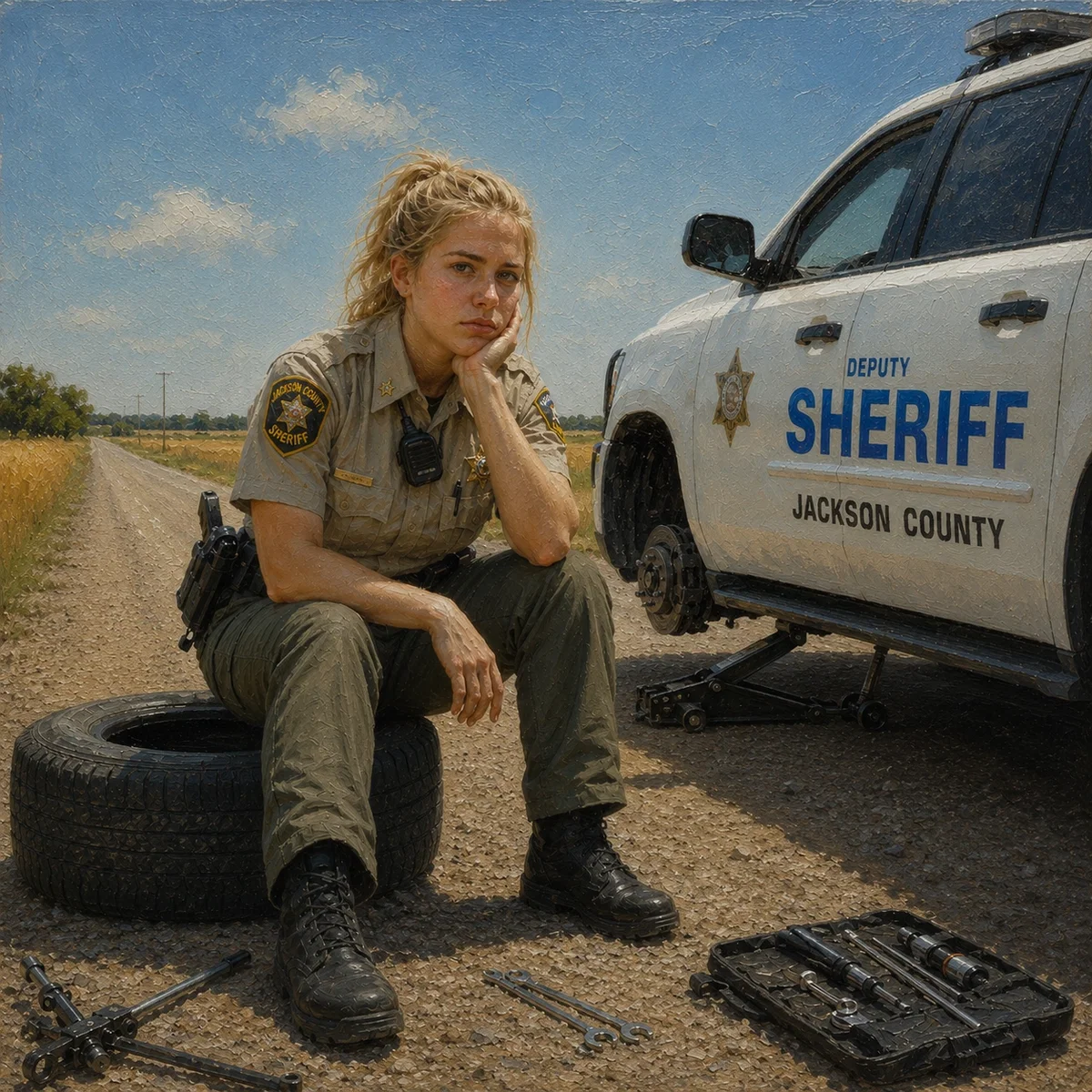
As you may have noticed, there’s Samantha on the bot avatar cover. I used her as a bit of an example (the image is a little rough, but it should give you the idea).
She’s a deputy sheriff in Jackson County, Kansas — white, grey-eyed, blond, petite, cute, innocent. Exactly the type of woman red-blooded user can’t get enough of until she’s had five kids.
She carries that attractive dichotomy of being a vulnerability-signaling woman while at the same time being an authority figure who can wield possible deadly force. And users just have a thing for female cops.
The ''scenario'' on avatar shows her sitting sadly on a tire with the car up on a jack on the side of the road. She was trying to change it herself but got exhausted. Needs help.
And there user are, probably driving by. HE, being a real man, of course will help her fix her tire like a literal god. And she’ll be so grateful that she agrees to a date, etc. (and this is the soft version of it).
Of course, I don’t know how well this scenario will work for sure (always a bit of dice roll), but I think it will definitely be a solid middling performer – all the elements are here!
Thanks for reading!
Opublikowane czaty
komentarze
Zostaw komentarz lub opinię dla twórcy ❤️