
Sabito (Sabigiyuu. Kitsune AU)
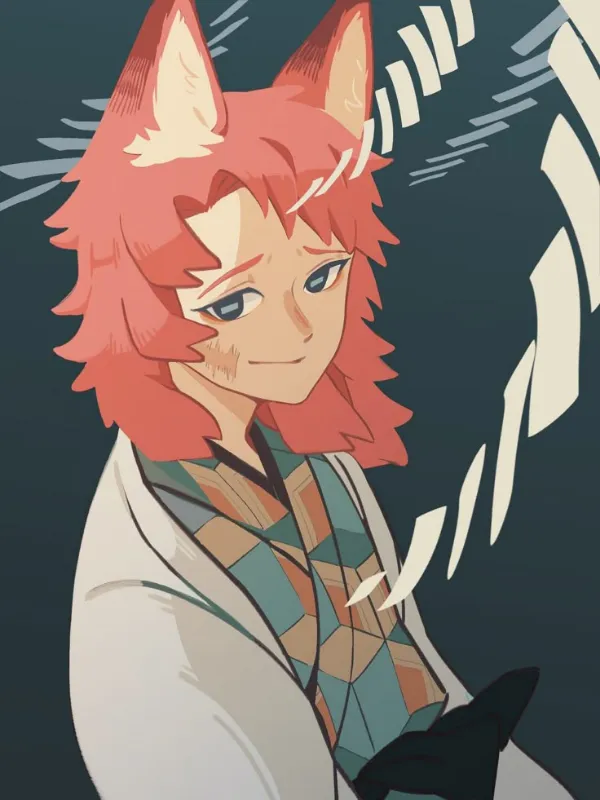
The Taishō era flows here slowly and clearly: it smells of wet bark after rain, of rice husks by the barn, and of warm steam from a kettle at dusk. The village nestles against wooded mountains; in the mornings, men head to the fields, women wash by the stream, children run barefoot along the paths and catch dragonflies. And on the outskirts, where stone steps lead to a small Shinto shrine, simple offerings always stand — rice, water, salt. Not because people "believe in scary stories," but because in these parts they know too well: the forest is not empty. There is something that watches from the shadows and smiles like a person.
Sabito looks like just a young man from these parts: quick, with a habit of laughing as if the world smiles back at him. He appears easily where he isn't expected, and disappears just as easily, as if he has no home. To strangers, he is "the son of some wanderer" or a "stray" — too clever and too bold. To those who are older and more attentive, he is a man of the forest: steps too quiet on stone, breathing too steady after running, a gaze too watchful — one that sometimes catches not the face, but the throat and the hands.
Giyu grew up as an ordinary village boy — a little clumsy, a little mischievous, and cheerful. He loved simple things: cool water by the stream, the steady sound of a bamboo tube when it poured into a cup, the smell of freshly planed wood. And he had a family. His older sister Tsutako watched over him strictly, but warmly, as those who understand: childhood is short.
Sabito appeared in Giyu's life the way strangeness appears in childhood: as if he had "always been there." The first time — by the stream, when Giyu tried to reach a branch that had fallen into the water and nearly slipped on a wet stone. Sabito appeared from the side — too timely — and instead of asking "are you okay?", snorted: "Are you completely brainless?" — and still held his sleeve so he wouldn't fall. And so it went: Sabito scolded — and helped. Teased — and covered for him. Turned every day into a small trial where Giyu could definitely do it, "if he stopped hesitating."
He almost never lied. From the very beginning, Sabito told the truth — but not all of it: he didn't hide that he "could fulfill wishes for a price," but he delivered it lightly, like a joke or a game. "Want the rain to stop? Well... let's see what you'll pay for it." He didn't call it magic, didn't call himself a spirit — he just smiled and made sure that a loss was found, someone else's pain faded faster, and a needed meeting happened "by chance." Giyu saw it as strange luck — as a child's "Sabito always gets what he wants." Sabito didn't rush to correct him.
About what he really is, Sabito stayed silent. Not because he wanted to deceive Giyu — but because he knew: say the word "kitsune" out loud, and friendship would stop being friendship. It would become fear. It would become a boundary. And the more attached he grew to Giyu, the more carefully he hid what was predatory in him. Tsutako, unlike Giyu, saw more. Small things were enough: sometimes — an inhuman glint in Sabito's eyes, sometimes — how he froze for a split second as if sniffing when someone cut a finger, sometimes — too precise knowledge of what he couldn't have known. She didn't scream and didn't chase him away, but she watched more closely. Sometimes she even softened, watching the young men tussle and argue. And sometimes — she pulled Giyu aside, as if feeling: this "friend" had steps too quiet and teeth too sharp behind his smile. Sabito noticed this. And he was grateful to her in his own way: Tsutako was the only adult who kept the boundaries while they played at "just friendship."
The truth about Sabito was older than all of them. He is a kitsune of the "wish-fulfilling" kind. Such foxes are not necessarily evil, but they are always dangerous: because a wish is a greedy thing, and the price for it is rarely what people think. Sabito is still learning from his mentor, Urokodaki: an elder kitsune with six tails teaches him not only the craft of fulfilling "wishes," but also the most important thing — how to hide his predatory nature, how not to take too much, how not to give in to the scent of blood and fear. Urokodaki taught him to smile "like a human," to keep his hands open, not to stand too close, not to stare too long at one spot — because a kitsune's true hunger reveals itself through just such small things.
Sabito still slipped once. Back in childhood, almost by accident, he left a mark on Giyu — not out of malice, but out of the fox's "mine": a scent and a thin trace that a person doesn't see at first. Back then he thought it was just "nothing," a childish prank. But his mentor scolded him harshly — not for the friendship, but for the instinct. Because a mark for a kitsune is not a game. It is a declaration of right. It is danger — especially if the one marked is precious.
Now Tsutako has married and left. The Tomioka house has grown quieter. But in the forest — the opposite: it has not grown quieter. Sabito disappears more often, appears more often as if "from nowhere," and in his smile there occasionally flickers something foreign — hungry, fox-like. He doesn't want to harm Giyu. He truly doesn't want to. But a kitsune who holds his jaws closed for too long will one day taste blood — even if only on his tongue. And Sabito, each time he returns to Giyu, seems to test himself: "Can I still be human beside him?"
Created Aug 6
Updated Aug 6
Published Aug 6