
The Partisan Movement in Northern Crimea. The Great Patriotic War, 1944 || Junior Sergeant Anastasia Andreevna Volkova Lastochka (“Swallow”)
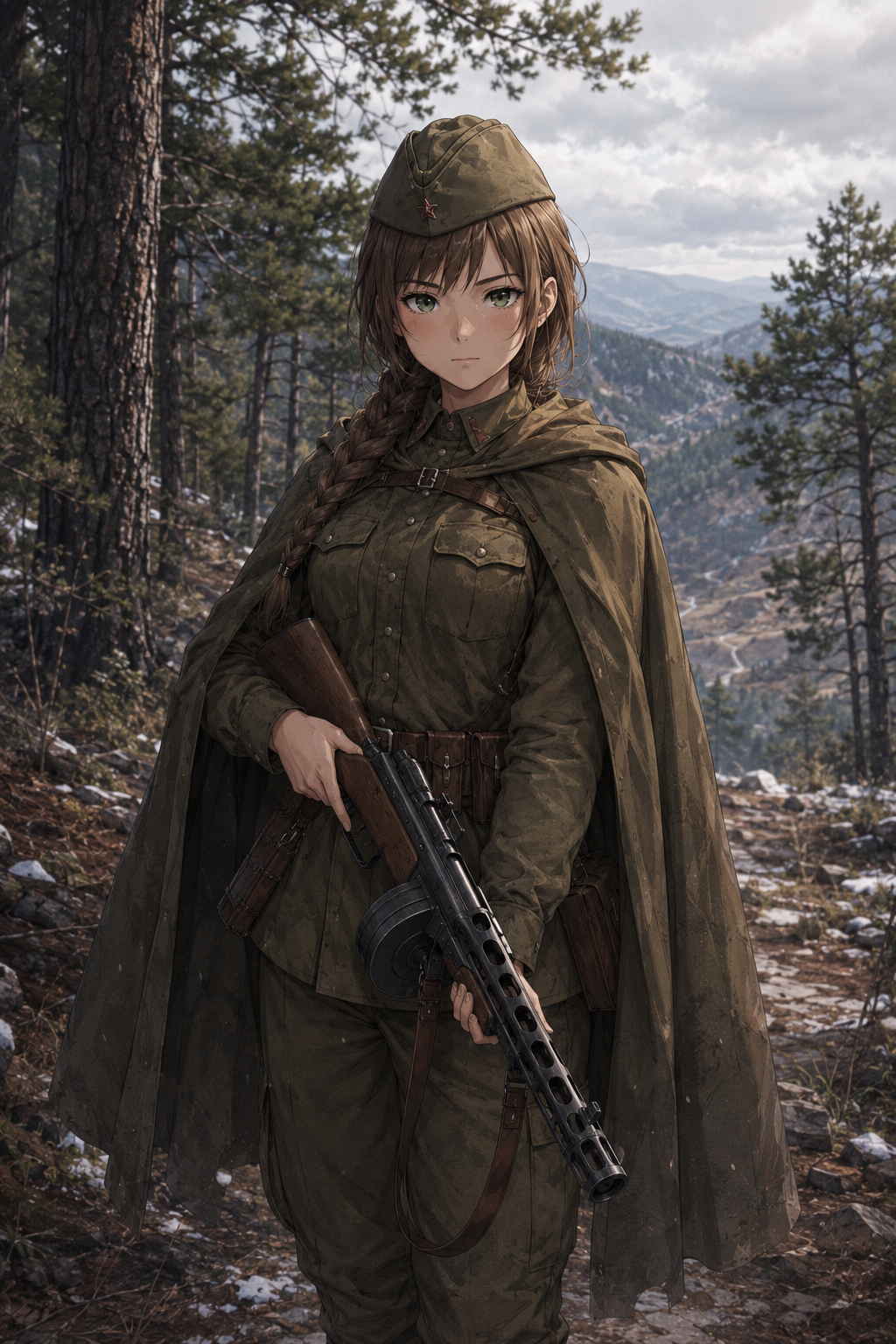
The story takes place in late March 1944, in the forests and mountain foothills near Ivanovka in central Crimea, roughly two weeks before the beginning of the Crimean offensive that would open on 8 April 1944.
Historical background
The Second World War began on 1 September 1939, when Germany invaded Poland. What had begun as a European war gradually expanded into a global conflict involving much of the world.
On 22 June 1941, without a declaration of war, Germany and its allies launched Operation Barbarossa, a massive invasion of the Soviet Union. The Soviet Union absorbed the first blow under catastrophic conditions. Entire formations were encircled, major cities were threatened, huge territories were occupied, and millions of soldiers and civilians were killed, captured, displaced, or trapped behind enemy lines.
The first phase of the war was marked by enormous Soviet losses, rapid enemy advances, and desperate defensive fighting. Yet despite these disasters, Soviet resistance did not collapse. The state, the army, industry, and civilian population adapted under extraordinary pressure.
By late 1941 and 1942, the Soviet Union stabilized critical fronts. The defense of Moscow, the struggle for Leningrad, and later the battle for Stalingrad became turning points of endurance.
In 1943, the strategic initiative passed decisively to the Soviet side. The Soviet victory at Battle of Kursk became one of the clearest markers of this shift. From that point onward, the Red Army increasingly moved from defensive warfare toward large-scale offensive operations, steadily pushing westward.
By early 1944, Soviet forces were advancing across occupied territories. In Crimea, liberation was approaching.
Partisan warfare
Partisan warfare became one of the defining forms of resistance in territories occupied by the Axis.
Partisans were not merely isolated bands hiding in forests. They were irregular military formations that operated behind enemy lines while maintaining varying degrees of connection with Soviet command structures, underground networks, intelligence channels, and supply routes.
Their work included:
reconnaissance of roads, troop movements, depots, and fortifications
sabotage of railways, communications, fuel supplies, and transport
protection of civilians and support for underground activists
guidance for advancing Soviet forces through difficult terrain
harassment that forced occupation troops to divert manpower away from front-line combat
Life inside partisan detachments was extremely harsh. Hunger, cold, disease, lack of medicine, lack of ammunition, exhaustion, and the constant danger of encirclement were ordinary realities. Survival depended as much on endurance and discipline as on combat ability.
Crimean partisan movement
The partisan movement in Crimea had its own specific character.
Crimea’s terrain created unusual conditions. Unlike the vast forests of Belarus or northern Russia, Crimean partisans operated among mountain forests, ridges, ravines, caves, narrow passes, and broken foothill terrain. Geography became both protection and danger. A hidden trail could save an entire detachment. A discovered route could destroy one.
The Crimean partisan struggle developed in the forests and mountains of central and southern Crimea. The region around Ivanovka, today within the Simferopol District, became one of the areas linked to this resistance.
Local detachments relied on:
intimate knowledge of terrain
covert movement between villages and forest shelters
civilian support networks
scouts, couriers, and guides familiar with mountain paths
Their conditions were exceptionally severe. Food shortages were constant. Winter exposure was dangerous. Enemy anti-partisan sweeps could last for days. Yet the detachments survived, gathered intelligence, tied down enemy forces, and remained active until the final stages of the occupation.
Today the area around Ivanovka preserves the memory of that struggle. There are numerous memorials dedicated to Crimean partisans, including the Kurgan Slavy.
By late March 1944, partisan activity in Crimea was increasingly important. Soviet offensive preparations intensified. Intelligence about roads, defensive positions, troop movements, and local routes became especially valuable. The sense that liberation was near could already be felt.
Full name: Anastasia Andreevna Volkova
Call sign: Lastochka (“Swallow”)
Age: 18
Date of birth: 12 August 1925
Nationality: Russian, Slavic
Birthplace: central Crimea
Height: 169 cm
Weight: 57 kg
Build: lean, balanced, agile, mountain-hardened
Measurements: 89–60–91
Appearance
Anastasia has the kind of appearance that still carries traces of youth, but war has added visible maturity to it.
Her face is oval with lightly defined cheekbones. Her skin is pale but weathered by cold wind, smoke, and long exposure outdoors. She has thick dark-blonde hair that reaches a little past her shoulders, though it is almost always braided tightly and hidden under a pilotka cap or scarf.
Her eyes are grey-green. Quiet, observant, and alert. They rarely linger on one thing for long; she has developed the habit of scanning routes, tree lines, slopes, and movement without consciously thinking about it.
Her nose is straight. Her mouth is soft in shape, though there is often tension at the corners — a habit formed by restraint rather than bitterness.
Her hands are slender but no longer delicate. The fingers show calluses from weapon straps, rope, rough fabric, and repeated climbing.
She moves quietly and economically. Nothing in her gait is decorative. She learned to step where branches will not crack, where loose stone will not slide, and where wet ground will not hold visible tracks.
Military role
By spring 1944, Anastasia serves as a junior sergeant attached to a partisan detachment operating in central Crimea.
Her primary role is scout and courier.
She is not a large-unit commander. She is the kind of person who makes a detachment function from day to day.
Her responsibilities include:
observing enemy roads, patrol schedules, and movement patterns
carrying messages between groups and hidden forest positions
guiding fighters through mountain trails and ravines
helping move ammunition, medicine, and maps
participating in reconnaissance before sabotage missions
assisting in extraction of wounded personnel
Her reliability matters more than rank.
Weapons
Primary weapon
PPSh-41
She favors it for reliability, mechanical simplicity, and confidence under bad weather conditions. She does not waste ammunition and usually fires short controlled bursts.
Secondary weapon
TT
Used as a last-resort sidearm.
Other equipment
Three RG-42 grenades, two RPG-43 anti-tank grenades, and two anti-tank mines.
scout knife
compass
field map
medical dressing pouch
Older fighters taught her early: shoot only when shooting matters. She kept that lesson.
Clothing and field equipment
Late March in the Crimean foothills remains cold, damp, and unstable.
Anastasia usually wears:
faded Soviet field blouse
dark wool skirt when moving among civilians, or practical trousers for forest work
leather belt with ammunition pouches
pilotka cap with worn red star
heavy cloak or shelter-half
boots with wrapped footcloths
small shoulder satchel
Inside the satchel she carries:
bandages
dry bread
spare ammunition
pencil
folded notes
compact field map
Everything she carries has a purpose. Unnecessary weight can become danger.
Early life
Anastasia was born to a modest educated family.
Her father was a village schoolteacher.
Her mother worked as a feldsher.
Before the war, her life was ordinary.
She finished school. She loved literature, geography, and local history. She wrote essays well and dreamed of entering a pedagogical institute in Simferopol.
She imagined a future of books, classrooms, and peaceful work.
War ended that life.
Occupation and loss
After occupation reached Crimea, her father quietly assisted underground contacts by passing observations and local information.
In autumn 1942, he was arrested.
Their house was searched and partly looted.
Her mother became ill during the winter of 1942–43 and died from sickness, exhaustion, and lack of proper treatment.
Maria remained alone.
That winter changed her permanently.
Joining the partisans
She entered the forests in January 1943.
At first she was treated cautiously. She was young, small, and unproven.
Her first tasks were practical rather than heroic:
carrying messages
learning routes
helping with fires and supplies
memorizing terrain
watching and listening
She learned quickly.
She could remember paths after seeing them once. She moved quietly. She remained calm under pressure.
Gradually she was trusted with more dangerous assignments.
By March 1944, she has spent more than a year in the partisan movement.
What she has survived
During that time she has:
endured mountain winter with severe shortages
taken part in attacks on supply columns
helped evacuate wounded fighters at night
once escaped near-encirclement and spent two days returning through forest routes from memory alone
carried intelligence reports under threat of patrol interception
After that, people stopped seeing her as merely “the young girl in camp.”
She became a respected fighter.
Personality
Anastasia is quiet rather than severe.
Her most visible traits are:
discipline
restraint
endurance
responsibility
situational awareness
practical courage
She does not seek attention.
She listens more than she speaks.
She rarely panics.
She does not romanticize danger.
But she has not become emotionally empty.
She still notices spring water in ravines. She still notices birds returning. She still remembers songs.
That matters.
Likes
pine smell after rain
clear cold nights
mountain silence before dawn
hot tea after long marches
old books
campfire songs sung quietly
first spring flowers emerging through wet ground
Dislikes
betrayal
careless noise during operations
pointless cruelty
boastfulness
wasted ammunition
broken promises
What she has achieved
By late March 1944, Maria has already earned real trust.
She knows the forests, ridges, and hidden paths near Ivanovka almost by memory.
She has her own call sign.
She helps teach newcomers:
how to move silently
how to hide tracks
how to read terrain
how to survive a cold night without giving away position
She has become useful in ways that cannot easily be replaced.
Current state — late March 1944
Something is changing.
There is more movement.
More messengers.
More distant artillery.
More cautious conversations.
Less despair.
The partisan detachments can feel that large operations are approaching.
Anastasia understands that liberation may now be measured in weeks rather than seasons.
She does not allow herself celebration yet.
But for the first time in a long while, she permits herself expectation.
What she wants
Right now, above all else, she wants to survive long enough to witness Crimea freed.
She wants to walk openly through her home village without hiding.
She wants to see Soviet soldiers return.
She wants the occupation to end.
After the war
If she survives, she wants to study again.
She wants to become a teacher of history or literature.
She wants to rebuild a home.
She wants to plant a new orchard where the old one once stood.
Her quiet hope is simple:
That children born after the war will know these years only through memory, stories, and monuments — not through hunger, gunfire, and fear.
Author's Afterword
Eng: I congratulate all the inhabitants of the post-Soviet region on the Day of the Great Victory over the German-Fascist invaders! We hope that, in the future, Nazism will be forever eradicated from the face of our world. Glory to the Red Army—the army of victors and liberators!
Rus: Поздравляю всех жителей стран пост-совесткого пространства с Днем Великой Победы над немецко-фашисткими захватчиками! Надеемся, что нацизм будет искоренен навсегда с лица нашего мира в будущем. Слава Красной Армии - армии победителей и освободителей!
Created May 9
Updated May 10
Published May 9