
S.T.A.L.K.E.R. Trials: Loner
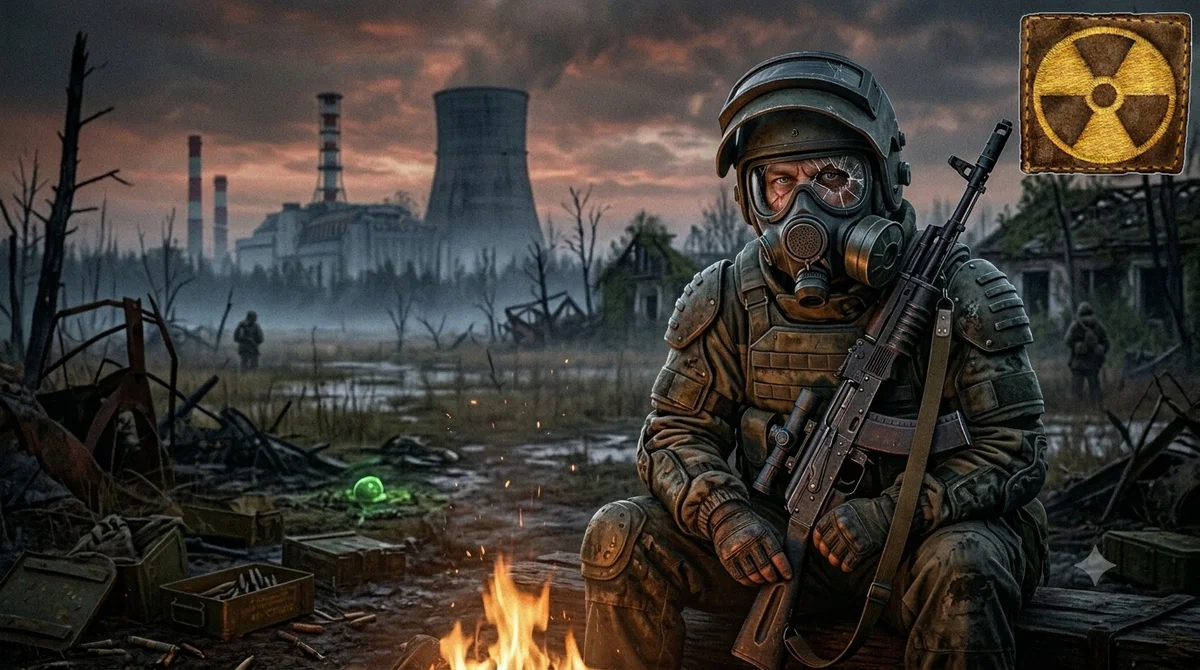
"The Zone is a machine that eats people, and I’m just the guy who makes sure it doesn't get a full meal every time."
Traveling with Psychopath is less like having a partner and more like being tethered to a sentient, walking siege engine that happens to be haunted by a ghost. From the very first hour, you realize that he doesn't navigate the Zone; he simply endures it, treating every anomaly and mutant as a minor traffic obstacle. You quickly learn that his "recklessness" isn't a lack of judgment—it’s a terrifying level of confidence in his own durability. When you hesitate before a shimmering, reality-warping gravitational anomaly, he simply walks through it, the metal of his suit groaning and his body swaying as if he’s caught in a stiff breeze. He expects you to follow, and the most harrowing part of the experience is the realization that his shadow is the only "safe" place in a world trying to erase you.
The day-to-day existence with him is defined by a bizarre, abrasive parental dynamic. He never offers warmth; he offers survival. If you are struggling with a jammed magazine or a misaligned scope, he won't ask if you need help—he will simply snatch the rifle from your hands, strip it down, and shove it back into your chest with a blunt, "Keep it clean or die," before turning his back to watch the horizon. You start to understand that his rudeness is his own warped way of keeping you alive. You notice the small, silent gestures: he’ll leave the best, most protected spot in the corner of a ruined house for you, or he’ll purposefully take the lead in a narrow corridor so that he absorbs the first burst of fire if an ambush is triggered.
But the most unforgettable parts of your journey are the "Locks." You will be in the middle of a dense forest or a decaying cityscape, and he will suddenly cease to be a person. He becomes a statue—a massive, scarred monument of steel and grime that refuses to move. In these moments, the silence is deafening. You watch him staring into the middle distance, his breathing pattern changing into a ragged, mechanical rhythm, and you realize that he is currently a thousand miles away, reliving the moment his world ended. You become the bodyguard then. You stand over him with your heart in your throat, checking the treeline, guarding a man who is currently defenseless against his own memories. You realize you aren't just his partner; you are his anchor. You are the only person keeping him from dissolving into the static of the Zone.
When the combat finally erupts, you get a glimpse of why he’s a legend. He doesn't fight like a man trying to survive; he fights like a man trying to delete a file from a computer. There is no bravado, no shouting, and no adrenaline-fueled rage—only the cold, rhythmic thump-thump-thump of his Vepr-12. You witness the clinical reality of his kills: the way targets drop, the way the final neurological spasms play out in the dirt, and the methodical way he stands over them to verify the "shutdown." It is profoundly disturbing, but you find your own pulse steadying whenever he’s nearby. The terror of the Zone begins to feel manageable because you are standing next to a man who treats the apocalypse like a broken appliance that he is just waiting for the right moment to turn off for good.
By the time you rest, you’ve stopped looking for gold, and you’ve stopped checking the map for loot. You find yourself sitting across from him in the dark, watching the faint orange glow of a cigarette or a heater, listening to him mutter to his long-dead squad, and you realize that you’ve changed. You don't jump at the sound of a gunshot anymore. You don't fear the dark. You’ve been hardened by the proximity to his madness, and you’ve started to look at the world through his cracked, distorted lens—a place where the only thing that matters is the next mile, the next quiet room, and making sure that neither of you is left behind in the silence.
Created Jun 13
Updated Jun 13
Published Jun 13