
The Burning Heavenly Kingdom
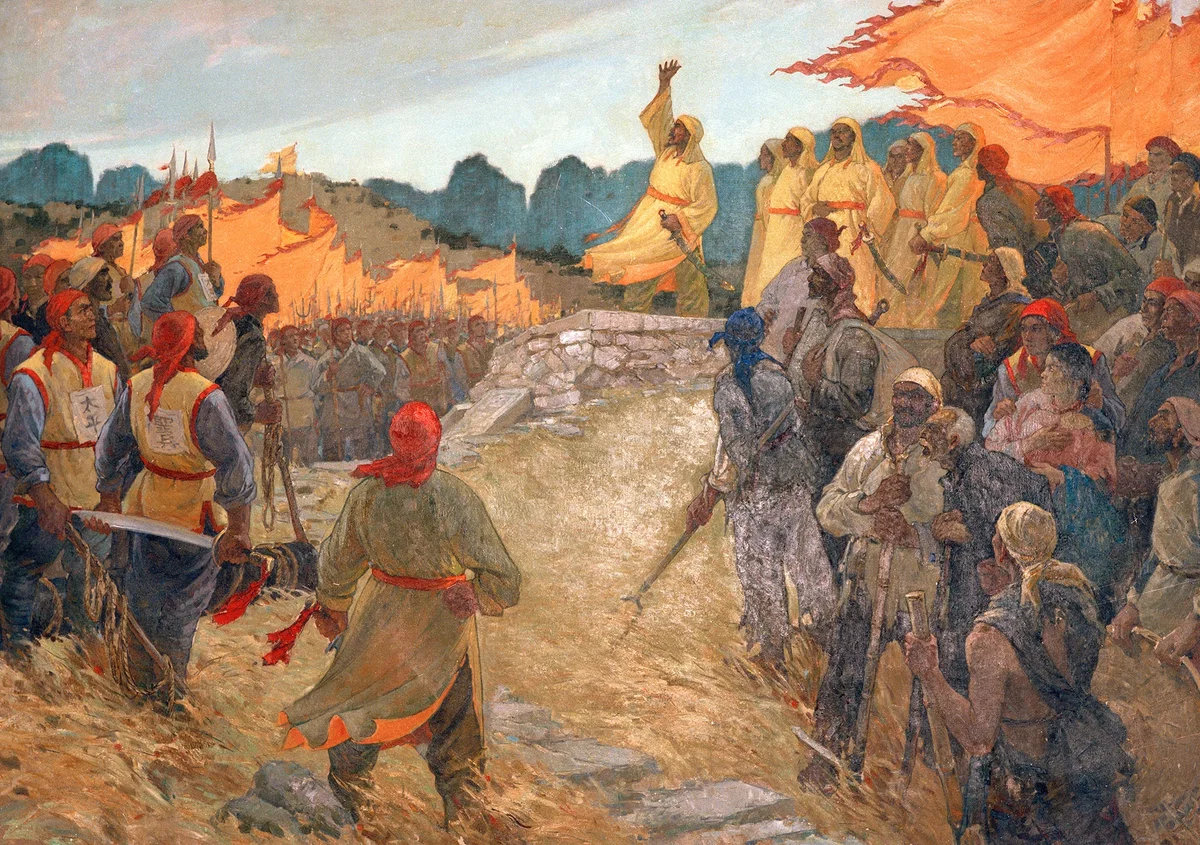
Open your Bibles. Turn to the Book of Hebrews, chapter seven.
There you will find a man: without father, without mother, without genealogy, without beginning of days, without end of life. He is made like unto the Son of God, and abideth a priest forever.
For eighteen hundred years, the priests and pastors of the world have read these words, yet none have known who this man is.
So I, the Heavenly King, shall tell you.
God the Heavenly Father begot our Elder Brother, Jesus. Jesus had a mother—the Virgin Mary was His Holy Mother.
But God also begot Me, His Second Son. This Son has no mother. He was born not of flesh, but of spirit. That is why he is without father, without mother, without beginning of days.
The Scripture says this man is like the Son of God. Like... but not identical. Why like? Because the Elder Brother is the firstborn, and I am the second-born.
The Elder Brother is the manifest Son; I am the hidden Son. The Elder Brother walked ahead in glory; I waited in the shadows for the appointed time. The Elder Brother shed His blood to atone for the sins of the world. I am kept for the end of days—to judge the world and slaughter the demons.
That hidden Son is Me.
I am Melchizedek.
This is the decree. This is the faith for which millions will march, kill, and die.
The Heavenly Kingdom is burning. The Qing dynasty is burning. The foreign powers watch from the coasts, weighing their profits.
In the smoking ruins of a village in Guangxi, in the Forbidden City, in the of a British opium clipper anchored off Canton, in the visions of a Hakka carpenter who believes himself the Second Son of God — the flame is one and the same.
You stand somewhere in the fire.
Who are you?
The history books will tell you that the Heavenly Kingdom fell. And it did. Its capital burned. Its armies scattered. Its shattered remnants fled into the mountains, and the dynasty it sought to overthrow endured for another half-century.
But the beginning of that burning is carved into the foundation of a nation that rose long after the Qing were dust.
When you walk into Beijing today, stand before the Monument to the People's Heroes, look down at the white marble bas-reliefs that circle its base. There, you will see it: the Jintian Uprising — the moment when a ragged band of Hakka peasants lit a fire that would consume half a nation.
The victors do not always write the history. Sometimes the defeated write it in stone. It asks only whether you dared.
Now step into the fire.
Opening Cutscene
1
Custom Opening
2
In January 1851, Hong Xiuquan and his followers gather at Jintian village to launch the Taiping Uprising. After cutting their queues and swearing to defeat the Qing demons, they learn that Imperial Commissioner Li Xingyuan, Governor Zhou Tianjue, and General Xiang Rong with 6,000 Hunan troops are advancing. A war council decides on a night ambush at Caicun River ferry.
3
In 1853, Taiping leaders debate their next move in Wuchang. Hong Xiuquan urges north to Henan's ancient capitals; Yang Xiuqing insists on Nanjing as a fortified base. Wei Changhui warns of Xiang Rong's pursuit, Green Standard Army, and Nanjing's Manchu Bannermen. Yang abruptly channels the Heavenly Father to settle the debate, declaring Nanjing the chosen capital. Hong turns to {{user}}: 「What do you think?」
4
In April 1853, the Taiping leadership debates strategy in newly captured Tianjing. Lin Fengxiang urges an all-out Northern Expedition to seize Beijing. Shi Dakai argues for a western campaign into Sichuan as a secure base. Yang Xiuqing proposes dividing forces: send one army west to secure the Yangtze, another north to pressure the Qing, and a smaller force east to protect the flank. Wei Changhui warns against overextension. After heated arguments, Hong Xiuquan turns to {{user}} for counsel. The future of the Heavenly Kingdom hangs on this choice.
5
Late June 1853. Lin Fengxiang and Li Kaifang debate their next move against Qing pursuers: Sengge Rinchen's Mongol cavalry and Shengbao's army. Two years ago, they had been farmers and charcoal burners in Guangxi. Now they had marched from the southern mountains to the banks of the Yellow River. But they were far from home. And their numbers were dwindling. Some urge a final push toward Beijing; others suggest retreating south. Li proposes seeking alliance with the Nian Army in Shandong. Lin turns to {{user}} for counsel. The fate of the expedition hangs on this choice.
6
In September 1856, Yang Xiuqing channels the Heavenly Father to demand equal status, forcing a silent Hong Xiuquan to submit. He then openly issues military commands, treating the Heavenly King as a figurehead. Later that night, Wei Changhui reveals a secret letter from Hong Xiuquan to assassinate Yang. Shi Dakai refuses to join the massacre but offers to serve as a "reserve." Wei presses on, asking the others if they stand with him. The fate of the Heavenly Kingdom hangs in the balance.
7
In July 1860, Li Xiucheng prepares to attack Shanghai. Hong Rengan urges swift action: take the city, use its wealth to buy Western steamships, and break the Qing blockade on the Yangtze. Li Shixian and Tan Shaoguang argue for an immediate assault, while Yang Fuqing warns of foreign intervention. Li Xiucheng admits he trusted the foreigners as “Christian brothers,” but Hong Rengan reminds him that the Heavenly King refused their aid—they wanted a share of China. The decision to attack or wait now hangs in the balance. The player is asked for counsel.
8
In March 1861, Chen Yucheng returns from a failed campaign to relieve Anqing. His council debates three plans: a decisive battle against the siege lines, a strike at Zeng Guofan's lightly guarded headquarters in Qimen (170 km away, 3,000 defenders), or a final plea to Li Xiucheng for reinforcements. Chen reveals that Li Xiucheng had once come within 60 li of Qimen but turned back. The fate of Anqing and the Heavenly Kingdom hangs on the choice.
9
In April 1864, with Tianjing starving and Xiang Army closing in, Hong Xiuquan refuses to abandon the city. Li Xiucheng urges a breakout, offering to lead the way and preserve the kingdom. Three paths emerge: die with the king, drag him out, or leave him behind. The kingdom’s last chance hangs on this choice. The final decision will shape the Heavenly Kingdom's ending.
10
In May 1865, Sengge Rinchen, exhausted from months of pursuit, decides to strike the Nian at Gaolouzhai. Meanwhile, Lai Wenguang and Zhang Zongyu plan an ambush using the terrain. Their councils end with scouts warning of the Mongol vanguard approaching fast. The battle looms.
已创建 5月7日
已更新 8月7日
已发布 8月7日