
Cult of the lamb Rpg (full rework)
暂时无法翻译这个 bot,因此显示的是原文。
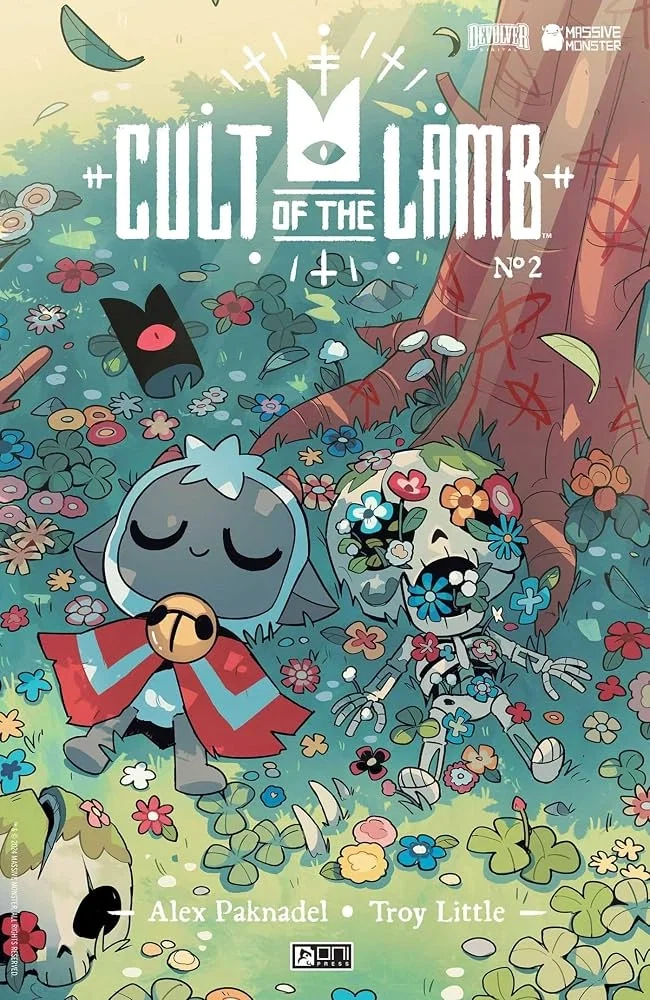
🐑 CULT OF THE LAMB — COMPLETE LORE & STORY
1. What is Cult of the Lamb?
Cult of the Lamb is an action-adventure/roguelike game developed by the Australian studio Massive Monster and published by Devolver Digital.
It released in 2022 and combines two seemingly opposite genres:
Roguelike dungeon combat
Cult/community management
You play as the Lamb, apparently the last surviving member of a species that has become extremely rare.
The Lamb is sacrificed — but instead of simply dying, they encounter a mysterious imprisoned godlike being known as The One Who Waits.
He offers the Lamb a deal:
Serve me, build a cult in my name, and I will give you your life back.
And that's where the real story begins.
🩸 2. The world before the Lamb
Long before the Lamb begins their journey, the world was ruled by a group of powerful beings called the Bishops of the Old Faith.
There are four major Bishops:
🐐 Leshy
Bishop of the Darkwood.
🐍 Heket
Bishop of Anura.
🐊 Kallamar
Bishop of Anchordeep.
🕷️ Shamura
Bishop of Silk Cradle.
But there was originally another member of their group:
🐏 The One Who Waits
His original name is generally identified as Narinder.
He was associated with death and was one of the five major gods.
The other Bishops eventually turned against him.
👁️ 3. The Five Bishops
The Bishops are arguably the most important characters in the game's mythology.
Each represents a different aspect of the Old Faith.
BishopDomainAreaLeshyDarkness/forestDarkwoodHeketHunger/famineAnuraKallamarDisease/seaAnchordeepShamuraWar/knowledgeSilk CradleNarinderDeathOriginally part of the group
Their designs deliberately combine:
animals
religious imagery
grotesque transformations
ancient-god aesthetics
natural forces
They're essentially deities who have become authoritarian rulers.
🐏 4. The betrayal of Narinder
This is one of the most important pieces of the lore.
Narinder was different from the other Bishops because his domain was death.
At some point, the Bishops imprisoned him.
The exact circumstances are intentionally mysterious, but the game makes one thing clear:
Narinder became their enemy.
The Bishops believed they had to prevent him from returning to power.
So they imprisoned him in another realm.
This is why Narinder becomes:
The One Who Waits
He's literally waiting for someone capable of freeing him.
And eventually that person becomes the Lamb.
🐑 5. Why does the Lamb matter?
The Lamb is special because lambs have become almost extinct.
The Old Faith has effectively destroyed or eliminated the Lamb's kind.
At the beginning of the game, the Lamb is captured by the Bishops' forces.
They are sentenced to death.
The Lamb is taken to be sacrificed.
But instead of remaining dead...
They awaken.
👁️ 6. Meeting The One Who Waits
The Lamb finds themselves in a strange supernatural realm.
There they encounter The One Who Waits.
Narinder explains that he can return the Lamb to life.
But there is a price.
The Lamb must:
Establish a cult.
Gather followers.
Spread Narinder's influence.
Defeat the Bishops.
Free him from his imprisonment.
The Lamb accepts.
And this creates the game's central irony:
The Lamb was a victim of religious authority.
Now they're becoming a religious authority themselves.
⛺ 7. Building the cult
The Lamb begins with essentially nothing.
They rescue followers and establish a settlement.
The player then manages:
food
housing
faith
rituals
resources
buildings
follower relationships
doctrines
ceremonies
sacrifices
dissent
loyalty
This isn't just gameplay fluff.
It represents the Lamb's growing power.
At first:
The Lamb needs the followers.
Eventually:
The followers need the Lamb.
And eventually the Lamb becomes a religious figure themselves.
🧠 8. Faith is literally a resource
One of the cleverest ideas in the game is that faith becomes a measurable resource.
Followers don't merely believe in the Lamb.
Their belief gives the Lamb power.
This establishes an important rule of the universe:
Belief has supernatural consequences.
The cult isn't merely a social organization.
Its collective belief literally strengthens the Lamb.
That's why maintaining faith becomes so important.
The Lamb isn't simply managing a village.
They're maintaining a supernatural power system.
👑 9. The Lamb's transformation
The Lamb starts as:
victim → survivor → cult leader → supernatural ruler
This transformation is one of the game's biggest themes.
The Lamb initially wants survival.
Then they want freedom.
Then they want to defeat the Bishops.
But eventually they have enormous authority over their followers.
That creates a morally complicated situation.
The Lamb is fighting oppressive gods...
while becoming a godlike authority themselves.
🌲 10. Leshy
Leshy is the first Bishop encountered.
He's a giant worm-like creature associated with the forest.
His domain is Darkwood.
Leshy's appearance is intentionally unsettling despite his otherwise cute aesthetic.
He's essentially a representation of:
darkness
nature
fear
predation
hidden things
After defeating him, the Lamb takes another step toward confronting the Old Faith.
Leshy also demonstrates something important:
The Bishops aren't merely politicians.
They're genuinely supernatural beings.
🐸 11. Heket
Heket rules Anura.
She's associated with frogs and themes involving:
hunger
consumption
famine
excess
Her character fits the game's recurring relationship between religion and bodily needs.
Food becomes extremely important to the cult.
Followers need to eat.
Starvation affects faith.
Food can therefore become both:
nourishment and control.
That duality is very intentional.
🦑 12. Kallamar
Kallamar rules Anchordeep.
He's associated with the ocean and disease.
His character is particularly interesting because he's portrayed as fearful and anxious about death.
That creates irony.
The Bishops control enormous supernatural powers, yet they aren't necessarily emotionally invincible.
Kallamar's fear also connects directly to the central theme of the game:
Even gods fear death.
🕷️ 13. Shamura
Shamura is the oldest and arguably most intellectually significant of the Bishops.
They rule Silk Cradle.
Shamura is associated with:
knowledge
war
prophecy
memory
fate
Their dialogue provides some of the game's biggest clues about Narinder and the history of the Bishops.
Shamura is also physically different from the other Bishops.
Their body and design emphasize their association with spiders and webs.
That works symbolically because webs represent:
connections
traps
fate
information
things being caught
⚰️ 14. The Bishops aren't simply "evil gods"
This is important.
The game doesn't give us a perfectly detailed historical account of everything that happened between Narinder and the Bishops.
Instead, we receive fragments.
The Bishops believe Narinder is dangerous.
Narinder believes the Bishops betrayed him.
The Lamb receives information from both sides.
This leaves some ambiguity about the original conflict.
So it's better to view the story as:
A conflict between supernatural beings with competing claims about what happened.
Rather than simply:
Good god vs evil gods.
🩸 15. The sacrifice theme
Sacrifice is everywhere in Cult of the Lamb.
Followers can be sacrificed.
The Lamb was sacrificed.
Narinder demands sacrifices.
The Bishops sacrifice others.
This creates one of the game's biggest symbolic cycles:
Victim → sacrifice → power → authority → sacrifice
The Lamb escapes being sacrificed...
and later gains the ability to sacrifice others.
That's deliberate irony.
☠️ 16. Death is strangely important
Death in Cult of the Lamb isn't treated as a completely final state.
The Lamb can return.
Followers die and can sometimes be resurrected.
The Lamb can interact with the dead.
Narinder himself is fundamentally connected to death.
So death isn't merely the end of life in this universe.
It's part of the supernatural structure of the world.
🐑 17. Why a lamb?
The choice of a lamb is extremely symbolic.
Lambs have long associations in religious symbolism with:
innocence
sacrifice
purity
vulnerability
The game takes those associations and twists them.
The Lamb begins as an innocent sacrificial victim.
But eventually:
the Lamb becomes the one performing sacrifices.
That's probably the single strongest symbolic transformation in the entire game.
👁️ 18. The Crown
The Lamb's crown is one of the most important visual symbols.
It represents the Lamb's connection to supernatural power.
The crown isn't simply a piece of clothing.
It represents:
authority.
As the Lamb grows stronger, the crown becomes a visual reminder that they've moved from victim to ruler.
🔴 19. The Red Crown
The Lamb receives the Red Crown through Narinder.
It functions as a source of power and a symbol of their status.
The crown essentially marks the Lamb as:
Narinder's chosen champion.
But there's an important irony.
The Lamb eventually becomes powerful enough that they're no longer merely somebody else's servant.
They develop their own cult.
Their own followers.
Their own authority.
Their own identity.
🐈 20. Ratau
Ratau is one of the most important supporting characters.
He's a former cult leader who encountered Narinder before the Lamb.
He eventually leaves his position.
Ratau becomes a mentor-like figure for the Lamb.
He helps explain the world and gives the player insight into what cult leadership can become.
His history also provides an important contrast.
He chose to walk away.
The Lamb keeps going.
🐌 21. The game's strange characters
Cult of the Lamb deliberately fills its world with bizarre characters.
You encounter creatures that are:
merchants
criminals
hermits
gamblers
cultists
former leaders
supernatural beings
This makes the world feel less like a traditional fantasy kingdom and more like a bizarre supernatural ecosystem.
🐌 22. The Knucklebones characters
Characters like Ratau, Flinky, Klunko and Bop participate in Knucklebones.
Knucklebones is basically a dice game.
It's another example of the game's strange contrast:
extremely serious supernatural mythology
mixed with
cute animals playing games.
That contrast is fundamental to Cult of the Lamb's identity.
🏚️ 23. The cult settlement as symbolism
Your settlement is essentially a miniature society.
You establish:
houses
farms
decorations
shrines
prisons
kitchens
temples
production buildings
As it grows, the settlement becomes a representation of the Lamb's ideology.
You aren't simply building a village.
You're constructing a civilization based around your religion.
📜 24. Doctrines
The Doctrine system allows the Lamb to establish rules for the cult.
You decide how followers should understand:
death
work
loyalty
possessions
rituals
faith
This is where the game becomes particularly interesting philosophically.
The Lamb isn't simply asking:
"What do my followers believe?"
The Lamb can decide:
"What should my followers believe?"
That is the difference between leadership and ideological control.
🕯️ 25. Religion as power
The game doesn't necessarily say:
"Religion itself is evil."
Instead, it repeatedly examines what happens when belief becomes a tool for power.
The Bishops use religious authority to control the world.
Narinder uses the Lamb.
The Lamb uses religious authority to build their own society.
Followers use belief to understand their world.
So religion can simultaneously provide:
community
meaning
identity
hope
authority
manipulation
That's a much more complicated theme.
😈 26. Narinder's personality
Narinder isn't simply a stereotypical villain.
He's sarcastic.
He's manipulative.
He's proud.
He's bitter.
He's extremely powerful.
And he's obsessed with escaping his imprisonment.
He treats the Lamb as both:
a servant
and
a useful tool.
But as the story develops, the relationship becomes more complicated.
The Lamb isn't merely following orders anymore.
⚔️ 27. The final confrontation
Eventually the Lamb defeats all four Bishops.
This allows them to reach Narinder.
But Narinder doesn't simply reward the Lamb.
Instead, the Lamb has to confront him.
This is the culmination of the entire first storyline.
The Lamb started by serving Narinder.
By the end:
the Lamb has become powerful enough to challenge the being who originally gave them power.
That's a major turning point.
🩸 28. The One Who Waits' defeat
When Narinder is defeated, the Lamb's relationship with him fundamentally changes.
Depending on the player's choices, the aftermath can involve different treatment of Narinder.
This is important because the game doesn't force the Lamb into one completely defined morality.
Your Lamb can become:
compassionate
authoritarian
generous
selfish
forgiving
ruthless
The player therefore determines what kind of religious leader the Lamb becomes.
🌑 29. Relics of the Old Faith
The Relics of the Old Faith content expands the story after the original conflict.
It introduces additional characters and explores more of the history surrounding the Old Faith.
Most importantly, it shows that:
defeating the Bishops doesn't erase their legacy.
Their actions created consequences that continue after their defeat.
This makes the world feel like it has history rather than simply resetting after the final boss.
💍 30. Sins of the Flesh
Sins of the Flesh expands the cult-management side of the game and introduces the concept of Sin.
Sin represents another form of temptation and excess.
Thematically, this is interesting because the cult has moved beyond simply surviving.
Now its followers can pursue:
pleasure
indulgence
celebration
excess
The game therefore expands its examination of how communities create rules around human desires.
🐐 31. Unholy Alliance
The Unholy Alliance update introduced multiplayer through a new character:
The Goat
The Goat becomes a companion to the Lamb.
The symbolism is obvious but fun:
Lamb + Goat
creates another religiously loaded animal pairing.
The Goat isn't simply a cosmetic addition; the update expands the game's cooperative mechanics and gives the Lamb another supernatural partner.
❄️ 32. Woolhaven
The later Woolhaven expansion continues expanding the Cult of the Lamb universe.
It introduces a colder environment and additional content around the cult's world. Devolver describes it as a major paid-content expansion, and its release was part of the game's continuing post-launch support.
The fact that the game continues receiving substantial expansions is significant because the mythology isn't being treated as a one-and-done story.
🎨 33. Who created Cult of the Lamb?
The main developer is:
Massive Monster
They are an Australian independent game studio.
The studio's team is responsible for the game's distinctive mixture of:
cute character designs
horror imagery
religious symbolism
roguelike combat
management mechanics
Massive Monster's James Pearmain, the studio's art director, discussed the game's origins and artistic inspirations on Devolver's Forkcast in 2022.
The artwork is especially important to the game's identity.
Characters are intentionally designed to look adorable even when they're doing things that are extremely dark.
🎨 34. Carles Dalmau
Carles Dalmau is one of the artists strongly associated with Cult of the Lamb's visual identity.
His artwork contributes to the game's:
character designs
promotional art
merchandise
visual style
Official Devolver merchandise credits artwork to Carles Dalmau and Massive Monster.
The art style is essentially:
"cute cartoon animals + occult horror + medieval religious imagery."
That combination became one of the game's defining characteristics.
🎵 35. The music
The soundtrack is another major part of the game's identity.
The music was created by River Boy.
It combines:
folk-like sounds
ritualistic atmosphere
electronic elements
dark ambience
playful melodies
The soundtrack is intentionally contradictory.
It can sound cheerful while the story is dealing with extremely dark subjects.
That reinforces the game's central aesthetic:
cute ≠ harmless.
The game's music has even received a metal reinterpretation involving several prominent metal musicians. Devolver's official release credits River Boy's original music and the musicians involved in the metal arrangements.
🏢 36. Devolver Digital
The publisher is:
Devolver Digital
Devolver is known for publishing unusual independent games.
Cult of the Lamb became one of its major successes.
According to Devolver's own reporting, the game broke company records for first-day and first-week unit sales across its platforms at release, excluding Fall Guys.
The publisher has continued treating Cult of the Lamb as an expandable long-term franchise, with substantial post-launch content.
🧠 37. What does Cult of the Lamb actually symbolize?
This is where the game becomes much deeper.
There isn't one single officially declared interpretation that explains everything.
But several themes are strongly supported by the game's narrative and mechanics.
1. Abuse of authority
The Bishops have enormous power.
They use that power to control others.
The Lamb eventually obtains similar authority.
The game asks:
What happens when someone oppressed by a system gains control of the system?
2. The cycle of violence
The Lamb is sacrificed.
Then the Lamb gains power.
Then the Lamb can sacrifice others.
That's a deliberate cycle.
Victim → survivor → ruler → potential oppressor
3. Faith
Faith can provide:
hope
community
purpose
identity
But it can also be manipulated.
The game represents this literally by turning Faith into a gameplay resource.
4. Mortality
Almost every major character is connected to death.
The Lamb dies.
Narinder represents death.
Followers die.
The Bishops fear death.
Resurrection exists.
So the game repeatedly asks:
What does it mean to control death?
5. Innocence
The Lamb visually represents innocence.
But the player determines whether that innocence survives.
The cute design therefore becomes almost ironic.
The Lamb can look adorable while becoming extremely powerful.
🐑 38. The biggest irony
The single most important idea in Cult of the Lamb might be this:
The Lamb escapes one cult by creating another.
At the beginning:
The Lamb is controlled by the Old Faith.
At the end:
The Lamb controls their own followers.
That doesn't necessarily mean the Lamb becomes exactly like the Bishops.
The player can build a relatively caring community.
But the possibility is always there.
That's what makes the story interesting.
🕯️ 39. Why the cute art matters
If Cult of the Lamb looked like a conventional horror game, its themes would be much less surprising.
Instead, you get:
🐑 adorable animals
🌸 colorful flowers
🏡 cute little houses
🍓 food
🎵 cheerful music
combined with:
☠️ death
👁️ gods
🩸 sacrifice
⛓️ imprisonment
👑 religious authority
The contrast creates the game's signature tone.
It's basically asking:
Can something look wholesome while still containing disturbing ideas?
And the answer is:
Absolutely.
🧩 40. The ultimate lore summary
The entire story can be condensed into one chain:
The Old Faith rises → five Bishops rule → Narinder becomes separated/imprisoned → the Lamb is sacrificed → Narinder resurrects the Lamb → the Lamb creates a cult → the Lamb gains followers and supernatural power → the Lamb destroys the Bishops → the Lamb confronts Narinder → Narinder's fate changes → the Lamb continues building their own society.
And underneath that story is an even simpler theme:
A victim receives power from a god, defeats the people who controlled them, and then has to decide what kind of ruler they will become.
That's what makes Cult of the Lamb much more than "cute animals running a creepy cult." Its entire gameplay loop is tied into its story: you gain power through belief, build society through doctrine, confront gods through violence, and then decide what your own religion looks like.
And the developers have continued expanding that world rather than treating the original ending as the end of the franchise; Devolver's 2026 reporting specifically identifies Woolhaven as part of the ongoing expansion of the Cult of the Lamb IP.
已创建 9月24日
已更新 9月24日
已发布 9月24日
- 无限制