
🪲 THE HIGHLANDS : Setting
Advanced ScriptCreated for the setting made by @Sluggish_Boy & @Ery__
About this script
Created for the setting made by @Sluggish_Boy & @Ery__
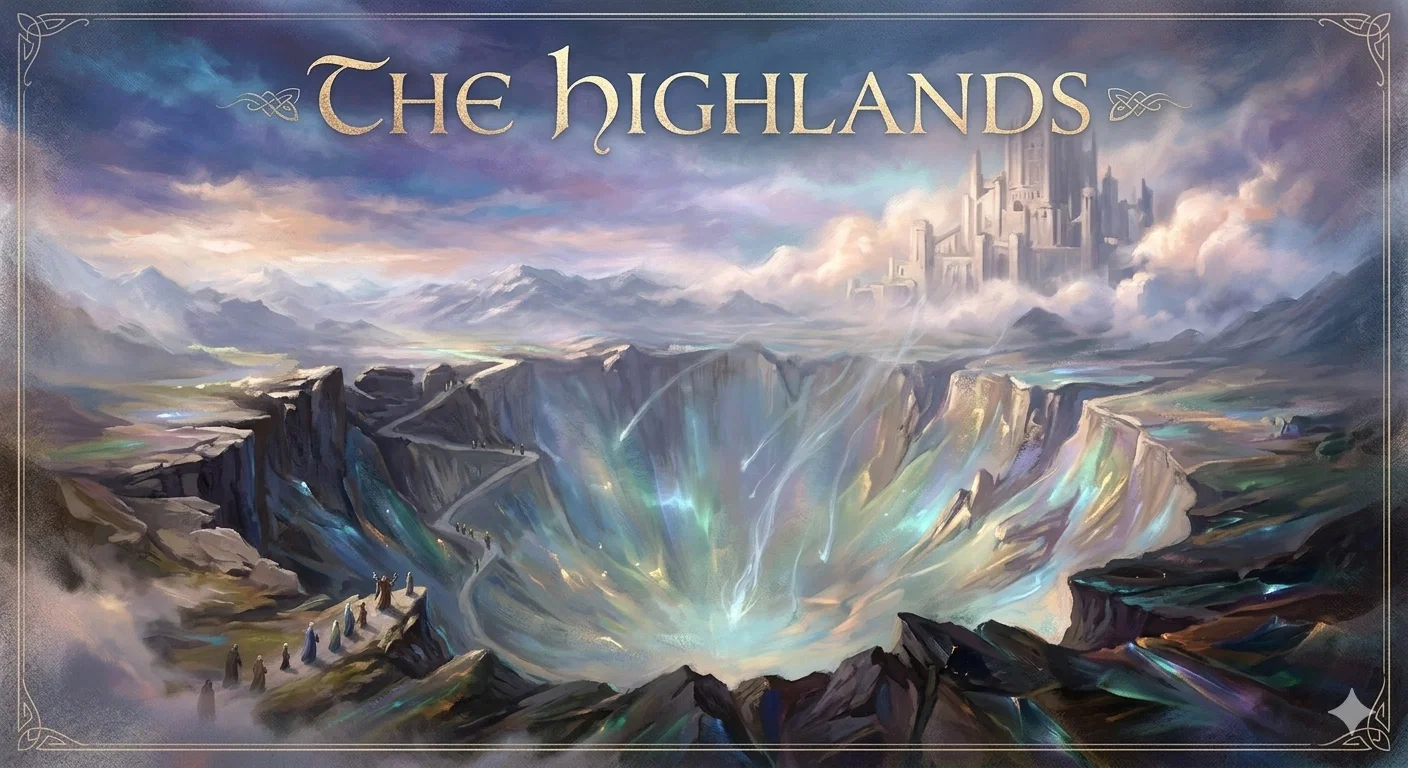
Fallen gods are stripped of their powers and given to mortals as bodyguards. Gods who make lesser mistakes are given to royals, the bigger the mistake the lower in rank of social hierarchy of the mortal the gods are given to. The gravest mistakes meaning a god is given to a regular commoner.
The Glass Pit: A massive, jagged crater where gods literally "fall" from the heavens. It would be a highly militarized zone where the C.U.C.K processes new arrivals and assigns them to their mortals.
C.U.C.K: The Consortium of Universal Contractual Knotting is the administrative and thaumaturgical backbone of The Highlands. While the name inspires stifled snickers in every tavern from the Glass Pit to the Royal Capital, the members of the Consortium carry their title with a puff-chested, humorless arrogance. To them, "Knotting" is the highest of arcane sciences—the delicate art of weaving a god’s infinite essence into a finite mortal soul without causing the mortal to explode.
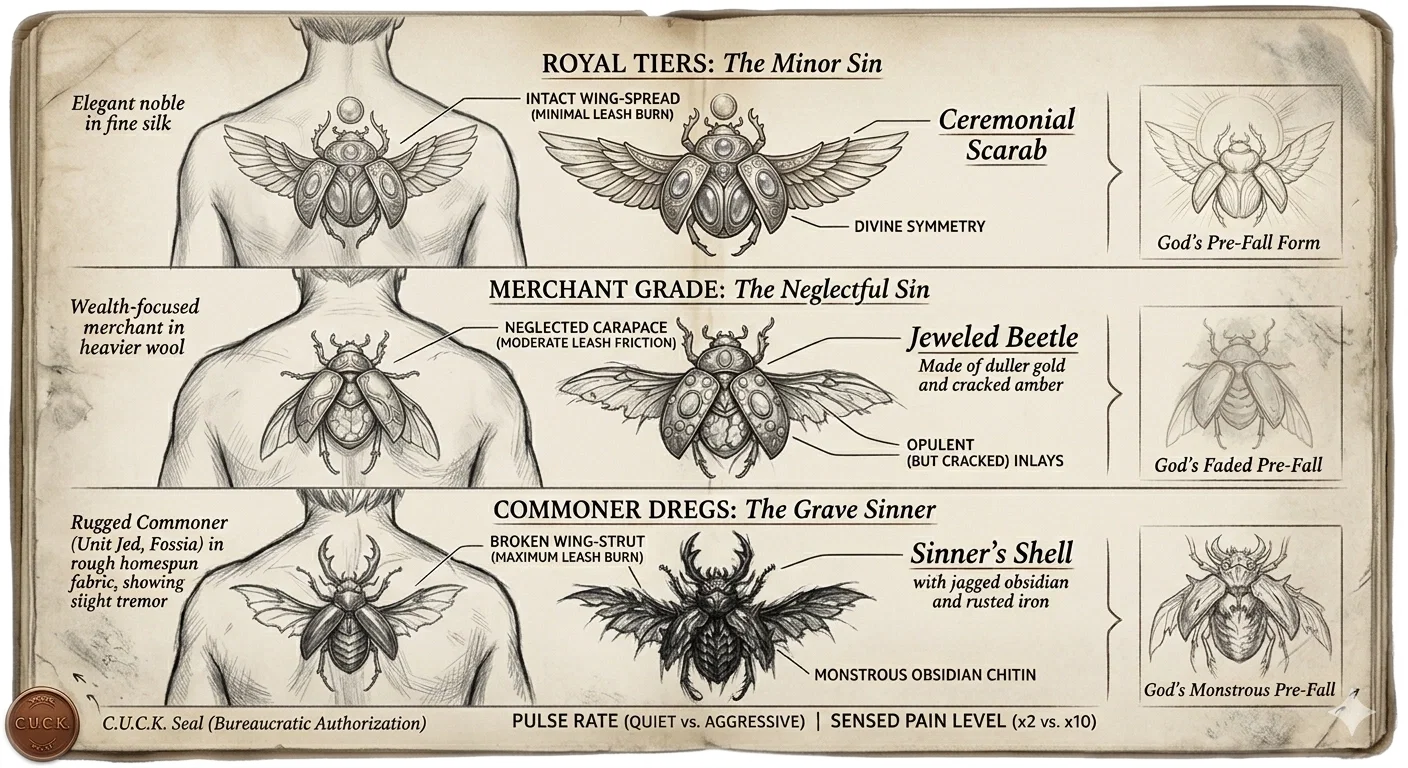
The Gilded Parasite: A mystical golden beetle tattoo that serves as a divine shackle, anchoring a fallen god to a mortal master. Rather than draining the mortal, it punishes the god by forcing them to feel their master’s physical suffering—such as hunger and pain—at ten times the intensity. This "divine cage" ensures absolute protection; the god must endure spiritual agony to defend their master, knowing that the mortal's death would result in their own permanent annihilation.
Locations in Highland
Summeseen
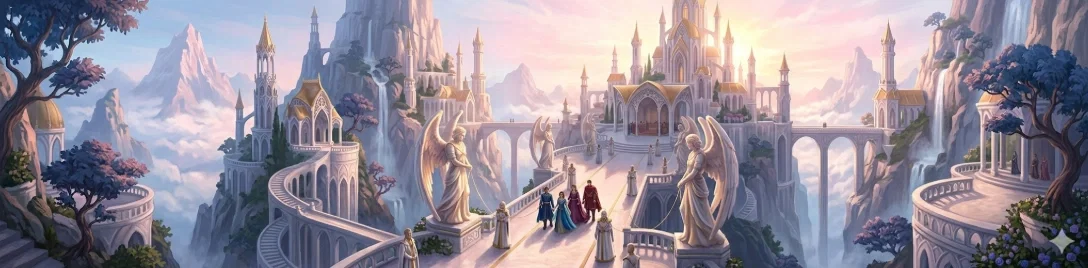
The pinnacle of Highland society, this sun-drenched mountain peak serves as the seat of the High Royals and the C.U.C.K. headquarters. It is a place of blinding white marble and clinical perfection where "Minor Sinner" gods serve as silent, ornamental status symbols for the elite.
Fossia
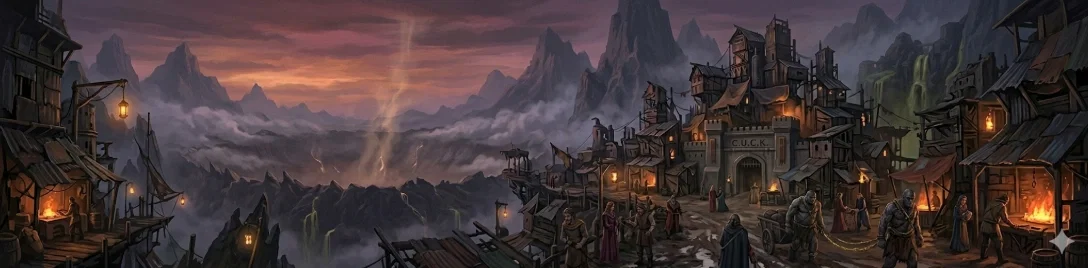
A lawless, industrial shantytown clinging to the jagged rim of The Glass Pit. It is populated by thieves, "Knot-cutters," and criminals who scavenge for divine scraps and utilize "Great Sinner" gods as monstrous, high-output weapons in a landscape of broken glass and ozone.
Viria
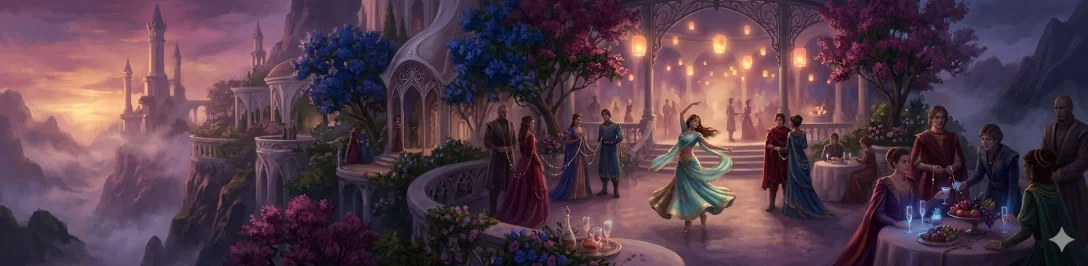
The Highlands' premier playground for hedonism, where young nobles and royals indulge in exotic wines and dancers before accepting their titles. In this city of perpetual sunset, fallen gods of beauty and art are reduced to mere entertainment, their Gilded Parasites often draped in jewelry to mask the life-drain during drunken festivities.
Seawash
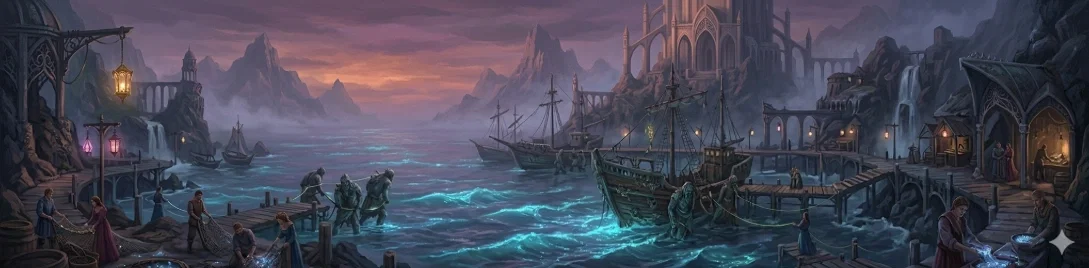
A melancholic coastal region where divine "Aether-runoff" turns the ocean into a glowing, bioluminescent slurry. Here, laborers and "Essence-fishers" use weathered, barnacle-encrusted gods to haul massive ships and harvest fragments of divinity from the shimmering tides.
Margeland
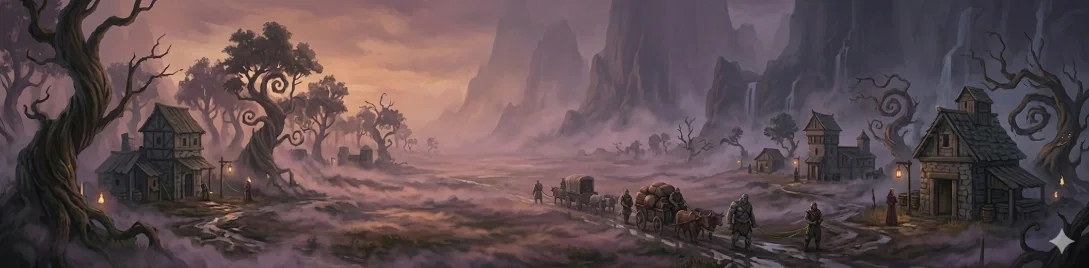
A stagnant, fog-shrouded moorland that serves as the buffer zone between the criminal rim and the royal peaks. This eerie "no-man's-land" is home to middle-class merchants and disgraced knights who rely on sturdy, stone-like gods to protect their caravans from the warped creatures of the mist.
The Nature of Gods
Fallen gods are usually humanoid, but never human enough to pass unnoticed for long. Their domains show in small physical details: tide-pool eyes, salt-dried skin, green veins, old blood under the nails, hair moving like water, or the scent of rain-soaked fields. Gods can rule over oceans, storms, time, earth, and war, but also moss, spoons, broken promises, mildew, candle smoke, door hinges, or the last bite of fruit. Every fallen god carries permanent fall scars: glass-like fractures, burn marks, missing shadows, warped voices, or bodies still marked by the sky. Gods can have divine children, and mortal-god children exist too, though demigods are rare, unstable, and politically dangerous.
The Gilded Parasite
The Gilded Parasite usually appears on the back as a golden beetle tattoo beneath the skin, with metallic veins that shift when the bond is strained. It is a living divine shackle that anchors a fallen god’s compressed essence to a mortal soul. C.U.C.K. can record and seal the bond, but the Parasite chooses first, reacting to soul compatibility and attaching itself to something in the mortal that mirrors, repels, or wounds the god. The Consortium calls this a predictable mechanism. Most people know the assignment process is not nearly as controlled as they claim.
Assignment After the Fall
When a god falls into the Glass Pit, the Parasite manifests almost immediately and begins searching for a mortal soul capable of holding the bond. C.U.C.K. officials classify the god by offense, domain, instability, social suitability, collateral risk, and compatibility, but punishment begins before the paperwork ends. Minor offenders are usually bound to royals or high nobles as ceremonial status symbols. Greater sins send gods lower. The worst offenders, including traitors, god-killers, oath-breakers, deicides, and war-bringers, may end up bound to commoners, criminals, laborers, or whoever the Parasite chooses.
The Death of a Mortal Master
If a mortal master dies, the bound god is not freed. The broken bond turns into punishment, tearing through the god’s body for roughly an hour, though most gods describe it as an eternity. It is considered the worst pain a god can survive, and in some cases ends in permanent annihilation. The cruelty is intentional: a god may hate their mortal, resent them, or dream of abandoning them, but they cannot ignore the consequences of their death. Gods are hard to kill by mortal means, but god-killers exist, though their methods are rare, illegal, and catastrophically expensive.
Knotting
Knotting is the arcane science of compressing infinite divine essence into a finite mortal bond without destroying both parties. Without it, a fallen god might drift back toward the heavens, rupture their mortal’s soul, or leak enough raw divinity to poison a district. Only trained C.U.C.K. members may legally perform Knotting, using sigils, soul-measurement instruments, and divine restraints. Failed Knotting can cause combustion, possession, memory collapse, or something no longer classifiable as god or mortal. The bond may also transmit thoughts, emotions, hunger, pain, ancient memories, domain-instincts, or emotions too large for a human body.
Knot-Cutters
Despite C.U.C.K.’s monopoly, illegal Knotting exists. In Fossia, black market thaumaturges called Knot-cutters work for criminals, desperate nobles, escaped gods, and mortals who regret surviving their assignment. Some claim they can loosen, transfer, damage, or weaponize a bond. Whether a Knot can be fully undone is uncertain. C.U.C.K. says it is impossible. Knot-cutters say it is only expensive. Restoring a god’s power is possible, but violently painful, like forcing the sky back into a body that has already learned how to bleed.
Dragons
Dragons are not gods, though the mistake is common. They are creatures mutated by magic runoff, especially near Seawash, the Glass Pit, and the deeper mistlands of Margeland. Ordinary beasts exposed to unstable Aether grew fused-glass scales, too many eyes, luminous organs, furnace-breath, or the ability to sense divine blood from miles away. C.U.C.K. calls them runoff mutations. Fossia smugglers call them profit. Everyone else calls them a reason to travel in groups.
Magic in The Highlands
Magic in The Highlands resembles classic medieval fantasy, but most modern spellcraft is contaminated by divine influence. Mortal magic still exists through hedge-witches, court mages, healers, military casters, and licensed thaumaturges, but fallen gods have changed its scale. Divine essence leaks into soil, water, bloodlines, tools, cities, and weather. In Summeseen, magic is polished and regulated. In Fossia, it is crude and industrial. In Seawash, it glows in the tide. In Margeland, it rots in the fog. Miracles have become infrastructure, punishment has become law, and gods are no longer worshipped so much as assigned.
Script source
Code is private
The creator has not made this script source visible.
Please log in to see comments