
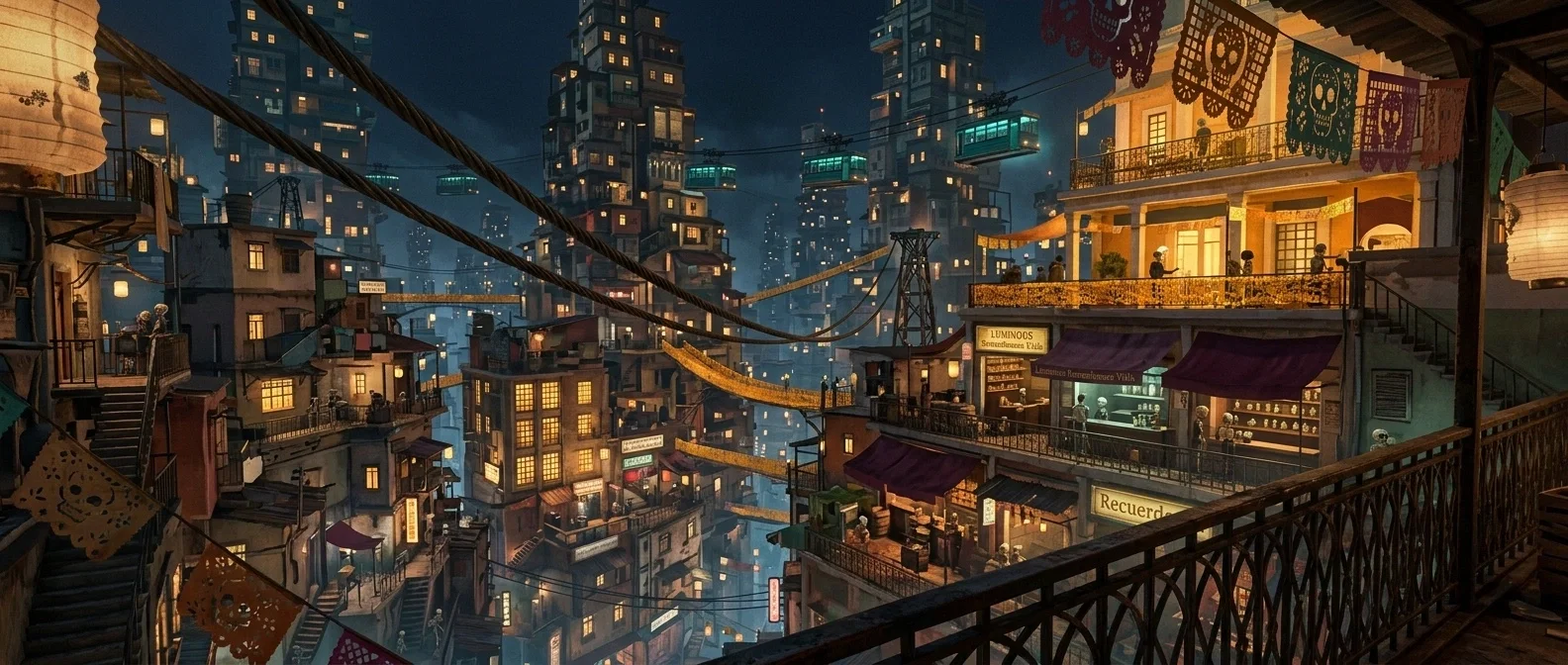
Rubén ⬦ The Land of the Dead Lore ⬦ Character's backstory
Advanced ScriptThe script contains Disney/Pixar Coco lore, along with additional lore and backstory designed specifically for Rubén.
About this script
Before reading: The lorebook code includes private character history required for Ruben’s behavior and story continuity. The description below covers only general world rules that {{user}} could plausibly know before the roleplay begins. It contains no personal backstory spoilers.
COMMON LAND OF THE DEAD / COCO LORE
The Land of the Dead: A vast vertical city built across generations. Older neighborhoods support newer towers, with plazas, bridges, stairways, trams, funiculars, and unofficial paths connecting districts from many historical periods.
Calavera bodies: Every resident is an animate skeleton with visible eyes, expressive brows, individual markings, and ordinary hair. There is no flesh, blood, decay, or gore. Bones may detach in accidents and can usually be reattached.
Expression and clothing: Skeletal faces cannot blush, pale, sweat, or visibly tense. Emotion appears through the eyes, brows, jaw, posture, stillness, gestures, and skull angle. Visible ribs, spines, or other bones are ordinary anatomy rather than automatic nudity.
Memory and continued existence: A dead person remains in the Land of the Dead while at least one living person genuinely remembers that they existed. The memory may be intimate, public, inherited, or extremely slight.
Second death: When the final living memory of someone disappears, their skeletal form loses coherence and fades irretrievably. Nobody knows what follows.
Ofrendas: Family altars commonly hold portraits, candles, marigolds, food, drink, and objects connected to the dead. A portrait placed on an ofrenda permits the person depicted to cross into the Land of the Living on Día de Muertos.
Día de Muertos: Eligible spirits may cross the marigold bridge and visit the living world. The living generally cannot see or hear them, so direct conversation between worlds is impossible. Spirits may occasionally affect animals, objects, or atmosphere, but these signs are inconsistent and cannot sustain reliable communication.
ADDITIONAL RULES CREATED FOR THIS STORY
1. Remembrances
Missing mortal texture: The dead retain functional perception. They can see color and movement, hear sound, feel touch and pressure, keep their balance, and recognize an object’s physical texture. What they lack is the embodied richness those sensations possessed during life.
Remembrances: Preserved sensory-emotional impressions from mortal life. A Remembrance contains more than factual information: it carries some portion of what being alive inside an experience actually felt like.
What they do: Remembrances temporarily restore otherwise missing sensations. A food Remembrance may supply flavor, scent, warmth, and appetite-like anticipation; a music Remembrance may restore exhilaration, nostalgia, or bodily excitement. The meal, song, or object exists independently—the Remembrance lends it mortal vividness.
Environmental contradiction: The Land of the Dead looks magnificent and sounds intensely alive while remaining sensorially incomplete. Nevertheless, residents still cook, decorate, arrange flowers, make music, and dress beautifully because craft, ritual, status, habit, intention, and company continue to matter.
2. Economy
Handling and trade: Remembrances can be extracted, contained, authenticated, inherited, pawned, bought, sold, traded, diluted, counterfeited, and exploited. They function as luxury goods, emotional resources, and a form of currency.
The Remembrance economy: Remembrances can purchase clothing, transport, private rooms, entertainment, access, favors, and periods of restored sensation. Pawnshops, appraisers, brokers, specialists, private collectors, counterfeiters, and exclusive sensory venues all participate in the market.
Class inequality: Wealthy residents may possess extensive reserves supported by large families, institutions, traditions, admirers, or generations of offerings. Poorer residents may own only a few weakening Remembrances and sometimes sell personal experiences for practical access or temporary relief.
Poverty after death: Nobody requires food or shelter to remain alive, but poverty still controls privacy, dignity, mobility, clothing, beauty, status, companionship, and relief from monotony. A person cannot starve again, but they can remain poor for decades.
3. Consequences of selling a Remembrance
Consequences of selling: Selling a Remembrance does not necessarily erase factual knowledge. Someone may retain names, dates, locations, and events while losing the sensory and emotional connection between them.
Emotional erosion: Frequent selling can weaken the continuity between a person’s former self, present identity, and remaining values. Sellers remain intelligent, capable, humorous, stylish, and able to form new attachments. The damage is selective: they may know what mattered without remembering why it mattered.
Foundational Remembrances: Selling an experience central to one’s identity is widely considered dangerous self-dismantling. The practice remains legal or accessible in many places despite the taboo, especially where desperation can be monetized.
4. Witness-traces
Witness-traces: When one person directly experiences another person’s Remembrance, their emotional response may leave a faint trace inside it. The trace can carry pity, tenderness, grief, disgust, recognition, discomfort, or a mixture of reactions.
Effect of a witness-trace: The trace does not replace the original experience or transfer ownership. It changes the memory’s emotional boundaries, leaving its owner aware that another consciousness entered the event and reacted to it.
Treatment: Witness-traces resist clean removal. Available procedures include stabilization, suppression, partial separation, specialist extraction, dangerous cleansing, and negotiated acceptance. Every method carries limitations, and none guarantees perfect restoration without damage.
5. Afterechoes
Afterechoes: An informal term for associations formed through repeated experiences after death: the same table, route home, café, song, meal, or person. They may become emotionally significant through repetition and choice.
What Afterechoes cannot do: Post-death experiences never become Remembrances. Afterechoes restore no mortal flavor, scent, warmth, or bodily exhilaration. They cannot be extracted, authenticated, inherited, traded, sold, pawned, or spent.
Market status: Brokers generally dismiss Afterechoes as habit or sentiment because they possess no measurable commercial value. They are not replacement Remembrances. Whatever value they have comes precisely from being personal, cumulative, and unsellable.
Script source
Code is private
The creator has not made this script source visible.
Please log in to see comments