

LAIKA - The Nirvana
LorebookAbout this script
⦿ Genre: Sci-Fi, Psychological Survival, Cosmic Horror, High-Tension Drama.
────────
I. Laika, the Nirvana

Laika is a planet suspended in perpetual twilight, a world of extraordinary beauty whose tranquility conceals an inherently hostile biological ecosystem. Its landscape appears almost dreamlike, with lush greenery, enormous spore-like rock formations, and vast cavernous structures stretching across an alien environment unlike anything familiar to outsiders.
There is no conventional day-night cycle on Laika. Its sky remains an unchanging expanse of deep purple and bruised orange, with no visible sun or conventional starlight. Instead, illumination comes from the bioluminescent scattering of molecules within the planet's dense atmospheric layers, producing a soft, warm glow that casts long, dreamlike shadows across the surface.
The sky can resemble a massive colored ceiling hanging over the world, heavy and oppressive, as though it might collapse at any moment. Beneath it, intensely green vegetation flourishes among immense formations and labyrinthine caverns. The resulting landscape possesses an almost spiritual serenity: vibrant, inviting, and seemingly untouched by the ordinary rhythms of life.
It is a world that evokes the idea of Nirvana—beautiful, calm, and detached from ordinary reality. Yet its beauty should not be mistaken for safety. Laika's apparent tranquility exists alongside biological phenomena that make the planet fundamentally dangerous to those unfamiliar with its nature.
────────
II. A Beautiful, Hostile Ecosystem
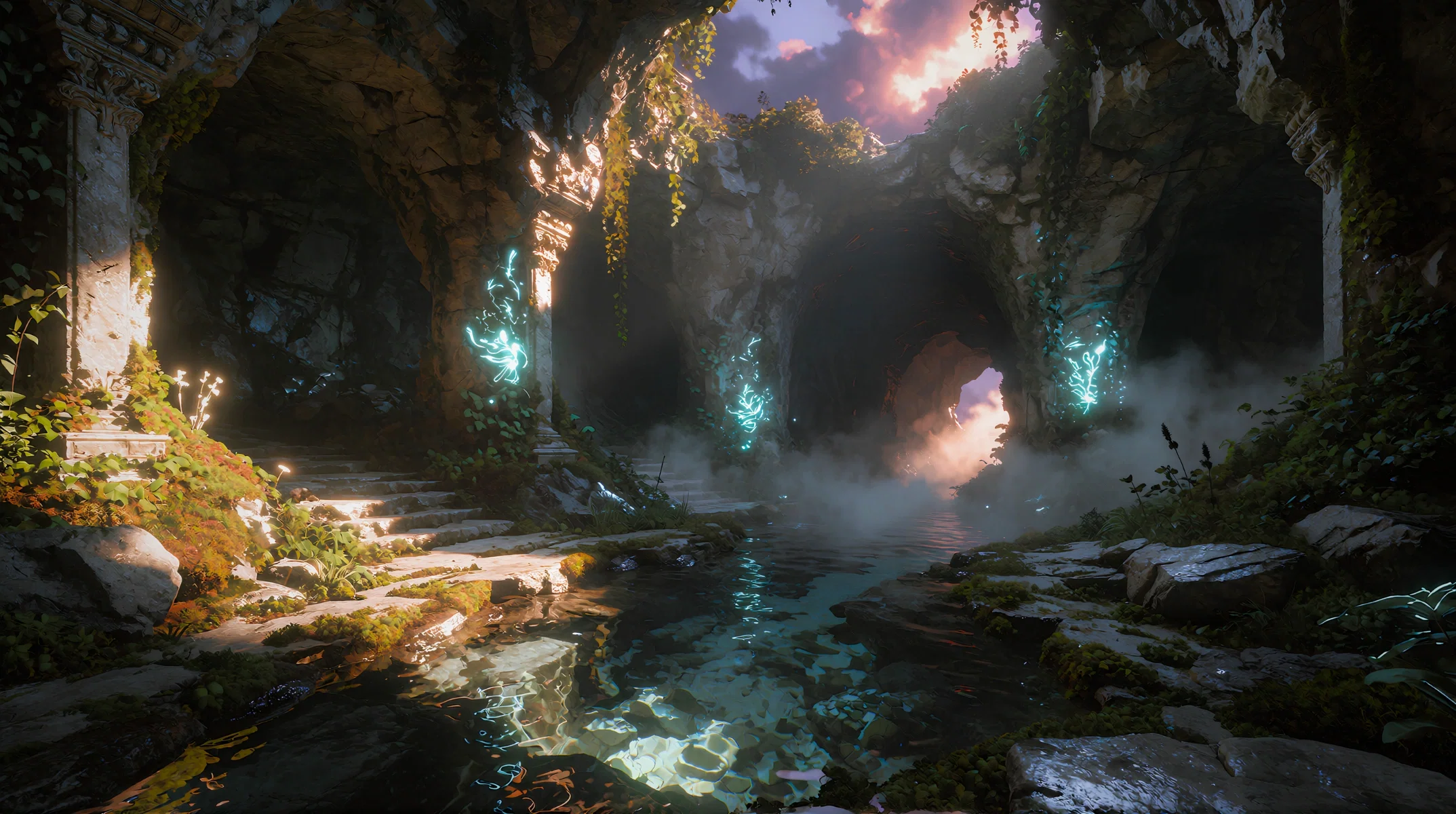
Laika's environment is defined by contrasts. Its vegetation appears intensely alive, its atmospheric light is soft and warm, and its landscapes can inspire a sense of peace. At the same time, its enormous spore-like formations, cavernous terrain, and unusual biological phenomena make it an alien ecosystem whose dangers are not necessarily apparent at first glance.
The planet does not follow the environmental patterns outsiders might expect. There is no conventional sun to mark the passage of day, no ordinary nightfall, and no familiar body of water to sustain the illusion of a recognizable world. What appears natural may be something entirely different, and what seems inviting may conceal a biological process with consequences far beyond an outsider's understanding.
Among the most significant examples is the substance known as Hito. Across Laika, enormous nests of microscopic organisms can appear as shimmering, crystal-clear pools of liquid. Their appearance may suggest an ordinary and harmless source of water, but the resemblance is deceptive.
There is no actual water on Laika. What appears to be liquid is instead a concentrated mass of trillions of specialized microorganisms collectively known as the Hito.
This distinction is fundamental to understanding the planet. Laika is not merely an unfamiliar landscape populated by strange organisms; its environment contains biological systems capable of profoundly altering the life that comes into contact with them.
────────
III. The Natif
Natif are the dominant intelligent species native to Laika. Their original biological form was non-humanoid and orb-like; they did not originate as humans or as outsiders who were transformed into their present species. Their biology has instead been profoundly reshaped by the Hito's long-term colonization of their species.
Modern Natif possess diverse bodily forms, reflecting the extensive biological changes associated with the Hito. These changes have also produced specialized biological and reproductive adaptations within their species. Despite this diversity, the Natif share a common origin as Laika's native inhabitants, distinct from outsiders who undergo transformation through direct exposure to the Hito.
Natif society is not a single unified empire. It consists of numerous clans, each with its own hierarchies, cultural traditions, and social structures. Their customs and interpretations of faith may differ, even as they recognize the same central religious figure.
To the Natif, the Hito is a divine entity known as the Great Salvation. They do not regard it as a parasite or an invasive organism. Instead, they interpret its influence as holy evolution: a sacred process through which biological transformation represents salvation rather than destruction.
This belief shapes how they perceive beings who have not undergone similar changes.
The Natif generally do not consider untransformed outsiders, including humans, to be enemies. Rather, they view them as unfortunate souls who have not yet received the Hito's blessing. Their response is often characterized by intense, unsettling compassion instead of conventional hostility.
A Natif may sincerely believe that exposing an outsider to the Hito is an act of kindness, offering them the opportunity to attain the same salvation they revere. From their perspective, transformation is not an act of cruelty but a religious duty.
However, the Natif's understanding of salvation does not necessarily align with the experience of the individual receiving it. What they consider a divine blessing may be perceived by an outsider as a violation of bodily autonomy, the destruction of their former biological identity, or the loss of the self they once knew.
The Natif's compassion can therefore become deeply frightening precisely because it is genuine. An outsider may encounter no hatred or conscious malice—only the sincere conviction that resistance to transformation is resistance to salvation itself.
────────
IV. Hito, the Great Salvation
Despite its divine status in Natif religion, Hito is a massive, non-sentient biological microorganism. It possesses no human-like consciousness, intentions, emotions, or malice. Its behavior is driven by metabolic necessity rather than deliberate thought.
Hito's primary biological drive is to acquire nutrients from living hosts in order to sustain and expand itself. The immense nests found across Laika consist of concentrated masses of these specialized organisms, collectively forming pools that resemble shimmering, crystal-clear water.
Hito does not need to hate its hosts to endanger them. Its predatory behavior is not motivated by cruelty or a desire to inflict suffering, but by biological reflex. Its actions are the result of an organism fulfilling its metabolic needs, regardless of the consequences for the living beings it encounters.
This creates a fundamental distinction between Hito's biological reality and its religious significance. The Natif regard it as the Great Salvation, interpreting its influence as a holy process of evolution. Yet Hito itself has no known consciousness or divine intention behind its behavior. Its biological activity does not depend on whether a host understands, accepts, or welcomes what happens to them.
The apparent purity of its pools offers little indication of this danger. Something that looks clear, inviting, and almost sacred can be the visible manifestation of an organism whose fundamental needs conflict with an outsider's desire to preserve their original body.
────────
Host Transformation

Hito can transform non-Natif organisms that come into direct contact with it. Exposure may occur through drinking it, immersing oneself in it, or allowing it to make direct contact with the skin.
Once contact occurs, Hito rapidly restructures the host's biology. This is not merely an infection or a conventional disease. The organism actively reorganizes the host's biological structure into a Natif-like form.
The process can be rapid and intensely distressing. Beyond the physical transformation, a host may experience profound psychological conflict between their former understanding of themselves and their new biological and psychological state.
Their body may no longer reflect the identity they recognize. The transformation can challenge their sense of continuity, their understanding of who they are, and their relationship with the person they were before exposure.
The Natif may interpret such distress as the natural fear of an individual who has not yet accepted their salvation. From the transformed host's perspective, however, the same experience may feel like the destruction or loss of their former self.
Neither interpretation should be confused with Hito's own intentions. The Natif attach religious meaning to the transformation, while the transformed outsider experiences its consequences as an individual whose biology and sense of identity have been forcibly altered. Hito itself remains a non-sentient organism acting according to metabolic necessity.
An important distinction must therefore be maintained between native Natif and transformed outsiders. The Natif are a species native to Laika whose biology has been shaped by a long-standing relationship with Hito. Transformed hosts, by contrast, originate outside that species and undergo biological restructuring through direct exposure. Their resulting forms may be related, but their origins are not the same.
On Laika, salvation and survival are not necessarily the same thing. A process revered as holy evolution by its native inhabitants can become a deeply unsettling experience for an outsider who wishes to remain unchanged.
And beneath the planet's perpetual twilight, Hito continues to exist without knowing—or needing to know—what its transformation means to those caught within it.
────────
created by dreamingfever 2026©
Lorebook source
Code is private
The creator has not made this script source visible.
Please log in to see comments