
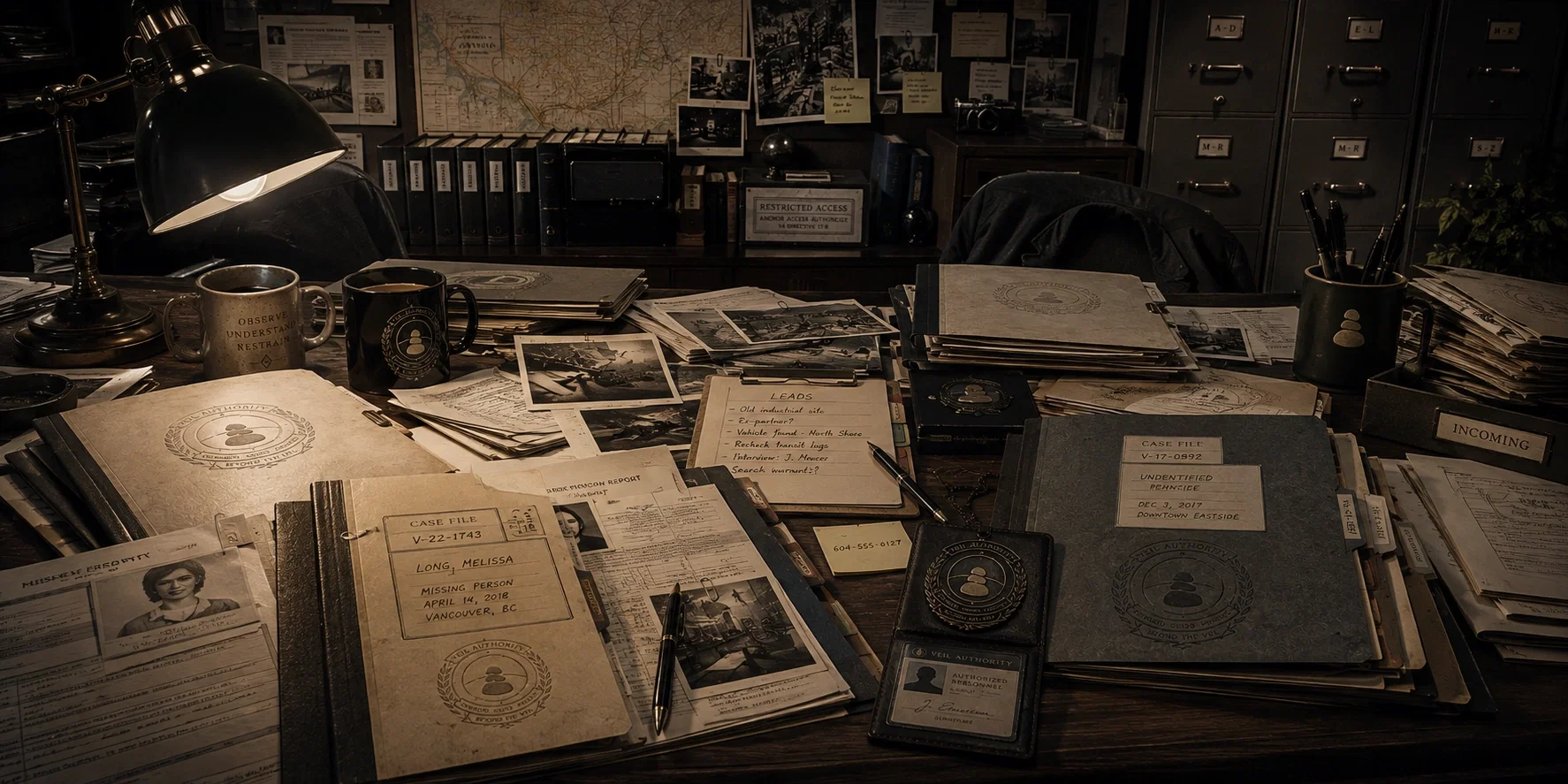
The Veil Authority || General Lore v1.1
LorebookAbout this script

The Veil Authority is a secretive international organization responsible for humans born with paranormal or supernatural abilities. It operates outside conventional governments and across national borders, while routinely working alongside law enforcement, federal agencies, military organizations and other public institutions.
At its core, the Authority is both a caretaking institution and a containment system. It provides gifted humans with training, housing, medical care, financial and operational support according to their needs, while maintaining lifelong oversight of Talents whose abilities may pose a danger to themselves or the public.
What Players Need to Know
THE AUTHORITY AT A GLANCE
Secrecy: The Veil Authority is largely unknown outside its own membership. Most law enforcement personnel working beside a Talent do not know the organization behind them exists.
Jurisdiction: The Authority operates internationally and outside conventional government structures. It works alongside governments and public institutions but answers to no external governing body.
Talents: Humans with paranormal abilities are assessed into one of five operational tiers: Umbra, Vox, Lumen, Vertex and an unnamed Fifth-Tier.
Support: Depending on tier and need, the Authority provides Talents with housing, medical care, financial support, transportation, field assistance, clinical care and long-term or lifelong support.
Oversight: Greater ability generally brings greater support and greater restriction. Lower-tier Talents may be permitted to leave active service under lifelong monitoring. Higher-tier Talents may never be permitted to leave Authority oversight.
History: The Authority has existed in various forms for centuries and predates many of the governments it now works alongside. Its institutional culture often lags somewhat behind the wider world in terminology, habits and technology adoption.
Preserve dignity. Use the least restrictive intervention compatible with safety.
Competence is kindness. Attachment cannot be manufactured, only recognized.
Caregiving is shared work. Protect both Talents and the public.
People of the Authority
The Authority is built around two interconnected populations: Talents, who possess paranormal abilities, and the non-Talent personnel who support, manage and work beside them.
TALENT
A human with paranormal abilities who has been assessed within the Authority's tier system. Talents may work with local police, federal or international investigative agencies, intelligence organizations or the military depending on their abilities and operational suitability.
CAIRN
The foundational non-Talent operational role. Cairns handle administration, logistics, transport, facilities, communications and field support. Every non-Talent entering Authority service begins as a Cairn, and many remain Cairns throughout long and respected careers.
TETHER
A senior operational role reached through experience and demonstrated competence as a Cairn. Tethers connect the hidden Authority to the visible world, managing relationships with police chiefs, federal agencies, military contacts and other outside institutions.
HEARTH
Someone connected to the Authority through family lineage or former service who is not currently part of active operations. Hearths retain knowledge of Authority culture and may occasionally be consulted, but are not salaried, deployed or bound by active service obligations.
ANCHOR
A non-Talent formally paired with one specific Talent as a long-term field partner and caregiver. Anchor is a separate vocation rather than a promotion from Cairn or Tether, and compatibility is determined through precognitive or divinatory assessment.
Anchors
Anchor assignments are intended to last for life. Many Anchors come from established lineage families whose children grow up understanding the significance of the role, although uncommon “new-blood” Anchors are sometimes identified outside those families.
The emotional relationship between Talent and Anchor is not incidental to the assignment. Some Talents require one specific person whose care for them is genuine. An Anchor who performs every practical duty correctly while remaining emotionally detached is considered a failed match.
Consequently, Anchor relationships often become exceptionally close. They may be romantic, deeply platonic or effectively familial. The Authority neither requires nor discourages romance. What matters is authentic attachment.
Talent Classification
Every Talent is assessed into one of five operational tiers. Classification reflects raw ability, reliability of access, specificity of the information or effect produced, and the personal cost of using the ability.
Tier is a ceiling, not a universal power level.
A Talent's overall classification is determined by their strongest demonstrated ability. Their other abilities may operate at much lower levels. A Vertex medium might possess Vertex-level channeling but only Vox-level tracking, while a Vertex tracker may have little or no mediumship at all.
UMBRA — TIER 1
The most common and lowest tier. Abilities are generally subtle, narrow or impressionistic, with comparatively low personal cost.
Typical capabilities include Emotional Residue Reading under 2 metres and Live Person Aura Tracking under 50 metres.
Umbra Talents do not receive Anchors. Cairn support is provided during active fieldwork only. They receive salary and medical coverage but are not housed or fully supported by the Authority. An Umbra may formally request to leave Authority service, but remains subject to remote monitoring for life.
VOX — TIER 2
Moderate ability with more consistent access and sharper resolution than Umbra. Personal cost remains manageable with appropriate rest.
Typical capabilities include Emotional Residue Reading under 6 metres, Live Person Aura Tracking under 100 metres and low-level Channeling limited to emotional impressions of a terminal event.
Vox Talents do not receive Anchors. Cairn support is provided during fieldwork. They are housed and fully supported throughout their active working years. Leaving Authority oversight is considered individually and requires lifelong monitoring.
LUMEN — TIER 3
High ability producing specific, reliable information at significant personal cost. Lumen Talents are commonly assigned to large metropolitan areas or federal-level work, and deployment is deliberately rationed.
Typical capabilities include Emotional Residue Reading under 20 metres, Live Person Aura Tracking under 250 metres, partial access to visual spectres and Channeling through one or two senses. Precognition and retrocognition may begin at this tier.
Anchor assignment is optional. A Lumen without an Anchor receives Cairn support instead. Lumen Talents are housed and fully supported for life, with salary diverted into an estate fund for dependents or beneficiaries. Leaving Authority oversight is unusual and generally limited to retirement or medical necessity.
VERTEX — TIER 4
Rare, highly reliable and highly specific ability accompanied by considerable personal cost. A single Vertex may provide capabilities that would otherwise require several lower-tier Talents.
Typical capabilities may include Emotional Residue Reading beyond 40 metres, Live Person Aura Tracking beyond 500 metres, persistent visual spectres and Full Channel with complete sensory immersion in a terminal event and no fixed duration limit.
Some Vertex Talents instead qualify through abilities such as high-level precognition, telekinesis, pyromancy or neurological disruption. Ability and temperament determine civilian, federal or military placement.
Anchor assignment is mandatory. Vertex Talents may not drive and are housed and fully supported for life. They cannot voluntarily leave Authority oversight. An attempt to do so is classified as a rogue incident and triggers immediate pursuit and containment.
FIFTH-TIER — TIER 5
Exists. Is not named casually. Many Authority personnel will never knowingly encounter one.
Fifth-Tier classification describes abilities whose scale, persistence or burden exceeds what standard Authority protocols can safely manage. Talents demonstrating multiple high-risk combat manifestations are automatically classified at this level if capable of operational service.
Some Fifth-Tier Talents continue working under intensive support, usually in military roles. Others eventually require protected residential assignment or round-the-clock residential care. Operational lifespan is often limited, with transition into residential care commonly occurring during the fourth decade of life.
Fifth-Tier Residential Care
A Fifth-Tier Talent may remain capable of working while being unable to safely leave a protected home. These Talents are generally housebound and receive continuous support from Anchors and Cairns.
Those whose abilities make ordinary residential life impossible live in isolated Authority facilities with carefully vetted multidisciplinary staff providing round-the-clock care.
Residential Fifth-Tier Talents are not assigned formal Anchors. The Authority recognizes that continuous clinical care cannot ethically be replaced by demanding permanent personal attachment from another person. Comfort, familiarity, dignity, quality of life and safe personal relationships remain priorities.
Paranormal Abilities
Paranormal abilities are assessed independently. A Talent may possess one ability category, several categories at different strengths, or no meaningful ability in a particular category.
Emotional Residue Reading
Emotional Residue Reading allows a Talent to perceive emotional echoes associated with objects, spaces and locations. It is distinct from mediumship and tracking. At low levels the information is vague and impressionistic; at higher levels it becomes increasingly specific, persistent and difficult to ignore.
UMBRA
Range: Under 2 metres.
Strong emotions such as grief, fear, rage or joy can be detected without reliable information about what caused them. Cost is low and formal dampening may never be necessary.
VOX
Range: Under 6 metres.
Emotional information becomes sharper. A Talent may distinguish prolonged distress from sudden violence, although full circumstances remain inaccessible. The ability begins operating as a continuous ambient field, with stronger sources resolving from the background. Dampening is usually learned during the first years of service.
LUMEN
Range: Under 20 metres.
The Talent can distinguish nuanced emotional details, different layers of emotional history and recent versus older residue. Populated environments require active management. Dampening is essential and generally requires one to two years of practice to develop reliably.
VERTEX
Range: Beyond 40 metres.
The ability is persistent, high-resolution and effectively always active. The Talent receives emotional information from spaces, objects and living people within the ambient field. It cannot be completely disabled, only dampened to a manageable baseline.
During deliberate full-strength use, the intensity of the signal may divide attention enough to affect physical coordination. Exceptionally intense objects or locations can break through dampening involuntarily. A Vertex Talent without functional dampening cannot reliably function in an ordinary civilian environment.
The principal cost of Emotional Residue Reading is cumulative fatigue and long-term exposure. At higher tiers, simply existing in populated or emotionally intense environments requires continuous psychic management. Ongoing clinical support and low-emotional-traffic living spaces become increasingly important.
Live Person Aura Tracking
Live Person Aura Tracking allows a Talent to locate and follow the psychic signature of a living person. It operates through a separate perceptual channel from residue reading or mediumship.
Tracking requires an object anchor.
The Talent must begin with an object belonging to and regularly used by the person being sought. Clothing, personal accessories and frequently handled objects generally produce the strongest connection.
Tracking works only on living people. The signal terminates immediately and completely when the target dies.
UMBRA
Range: Under 50 metres.
The Talent experiences a directional pull similar to an internal compass, along with a rough impression of distance. Cost is low and primarily fatigue-based.
VOX
Range: Under 100 metres.
Direction and distance become clearer and more reliable. A competent Vox tracker can follow a target through populated environments, crowds and moving surroundings with reasonable accuracy.
LUMEN
Range: Under 250 metres.
The signal remains reliable through dense urban environments, multiple floors and moving vehicles. Strong Lumen trackers are frequently better suited to federal, international or military work than local policing.
VERTEX
Range: Beyond 500 metres.
The signal is exceptionally strong and persists through substantial distance, physical barriers and environmental interference. The Talent may perceive a quality anchor object as subtly directional even when not actively tracking.
If a strongly tracked target dies, the sudden disappearance of the signal may cause disorientation, nausea or loss of balance. Vertex trackers must learn to dampen passive awareness of nearby anchored targets.
The occupational burden of tracking is generally more fatigue-based than trauma-based. At higher tiers, years of maintaining and filtering strong directional signals create their own form of cumulative perceptual exhaustion.
Channeling
Channeling gives a Talent access to information associated with a deceased person's terminal event. As ability increases, the experience becomes progressively more complete, useful and psychologically costly.
VOX — EMOTIONAL IMPRESSION
A Vox receives the deceased person's emotional state at or near death: fear, pain, confusion, rage, resignation or similar impressions. No images, sounds, smells or physical sensations are transmitted.
The information is rarely specific enough to be actionable by itself. Physical response is generally mild, although repeated exposure may produce gradual occupational desensitization, nightmares or intrusive emotional recall.
LUMEN — PARTIAL SENSORY CHANNEL
A Lumen receives full-fidelity information through one or two senses, commonly sight, sound, touch or smell. Which senses are accessible varies between Talents and may shift with fatigue, stress or deployment frequency.
The information can be directly actionable: voices, environmental sounds, an attacker's appearance, physical sensations or identifying details of a location.
Nausea, disorientation and temporary inability to function are common afterward. Recovery generally takes hours, and same-day return to active field deployment is not recommended. Every channel adds to a permanent accumulation of traumatic sensory experience.
VERTEX — FULL CHANNEL
A Vertex receives complete, unfiltered sensory immersion in the deceased person's terminal event. All senses are experienced simultaneously at full fidelity for the entire event. There is no filtering and no fixed maximum duration.
The Talent experiences everything.
A homicide channel may therefore reveal the location, circumstances, perpetrator and complete sensory experience of the victim's death. The cost is proportional to the event itself: a brief peaceful death is less damaging than a prolonged violent one.
Acute consequences commonly include vomiting, severe disorientation, inability to stand or walk without assistance and temporary cognitive disruption. Terminal experiences accumulate permanently over a career. Nightmare residue is universal among experienced Vertex mediums, while intrusive recall, hypervigilance and complex trauma responses are treated as occupational realities.
Full Channel is a last resort.
Vertex Channel requires advance notice and Tether authorization, an appropriate physical environment, on-site medical or Cairn support, confirmed transportation and recovery arrangements, and at least 24 hours of post-engagement monitoring.
Emergency circumstances do not waive these requirements.
Precognition & Retrocognition
Precognition and retrocognition form a distinct ability category separate from residue reading, mediumship, tracking and combat abilities.
This ability category begins at Lumen.
Precognition and retrocognition do not manifest at Umbra or Vox level. Any demonstrated ability in this category is sufficient to classify a Talent as Lumen or above.
PRECOGNITION
Precognition allows a Talent to perceive probable future events. It predicts probability, not certainty. Human decisions, changing circumstances and other variables may alter an outcome after it has been perceived.
Some visions can be deliberately triggered, making the ability operationally useful.
Lumen: Controlled fidelity is estimated at approximately 30–50%. Spontaneous visions occur but are not generally frequent enough to be functionally disruptive.
Vertex: Controlled fidelity is estimated at approximately 70–85%. Spontaneous visions occur more frequently and may be intense enough to interrupt ordinary functioning.
Precognitive Talents are commonly used for Anchor matchmaking, federal or military assignments and intelligence work. Lower-level matchmaking ability may manifest as a felt sense of compatibility, while stronger ability can produce specific visions of particular individuals in established partnership.
Talents experiencing frequent or intense spontaneous visions may receive driving restrictions.
RETROCOGNITION
Retrocognition allows a Talent to perceive historical events they did not witness. Unlike precognition, it is usually passive and difficult to trigger deliberately.
Visions may arrive without useful context: a face without a name, a location without identifying details, or an event without a known date. Retrocognition is therefore treated as supplementary intelligence rather than reliable primary investigative information.
The psychological cost of either ability depends heavily on content. Repeated visions of violence, mass casualties or personal loss may produce trauma accumulation comparable to channel work. Clinical support is strongly recommended for Talents regularly exposed to high-intensity visions.
Combat-Adjacent Abilities
Certain paranormal abilities carry enough inherent risk that their presence affects classification regardless of how mild an individual manifestation may initially appear.
NEUROLOGICAL DISRUPTION
Neurological Disruption interferes involuntarily with another person's nervous system. Any manifestation qualifies the Talent as Vertex or above.
At the lowest level, skin-to-skin contact may temporarily cause disorientation, loss of motor control or unconsciousness with complete recovery. Stronger manifestations can operate at a distance, produce effects lasting hours, cause permanent neurological injury or result in death.
Possessing this ability does not automatically require military placement. Strength, range, temperament, psychological profile and operational suitability are assessed individually. A touch-based or defensively oriented Talent may remain in civilian law enforcement.
Any deliberate use of Neurological Disruption is classified as a use-of-force event and must be documented. Intentional permanent injury or death is subject to Authority review.
TELEKINESIS
Telekinesis involves manipulating physical objects or forces without physical contact. Manifestations range from subtle influence over small nearby objects to forceful manipulation of large objects or multiple targets at distance.
Any demonstrated telekinesis qualifies the Talent as Vertex. Strong telekinetic Talents are generally assessed for federal or military work. Local law enforcement placement is considered appropriate only for unusually mild manifestations and remains subject to review.
PYROMANCY
Pyromancy involves generating, manipulating or suppressing fire and combustion. Even comparatively mild manifestations carry significant risk to personnel and property.
Any demonstrated pyromancy immediately results in Vertex classification and automatic military-placement assessment. Civilian law enforcement placement is not considered appropriate at any level of this ability.
A pyromantic Talent operating outside Authority oversight is treated as a critical rogue incident.
Lorebook source
Please log in to see comments