
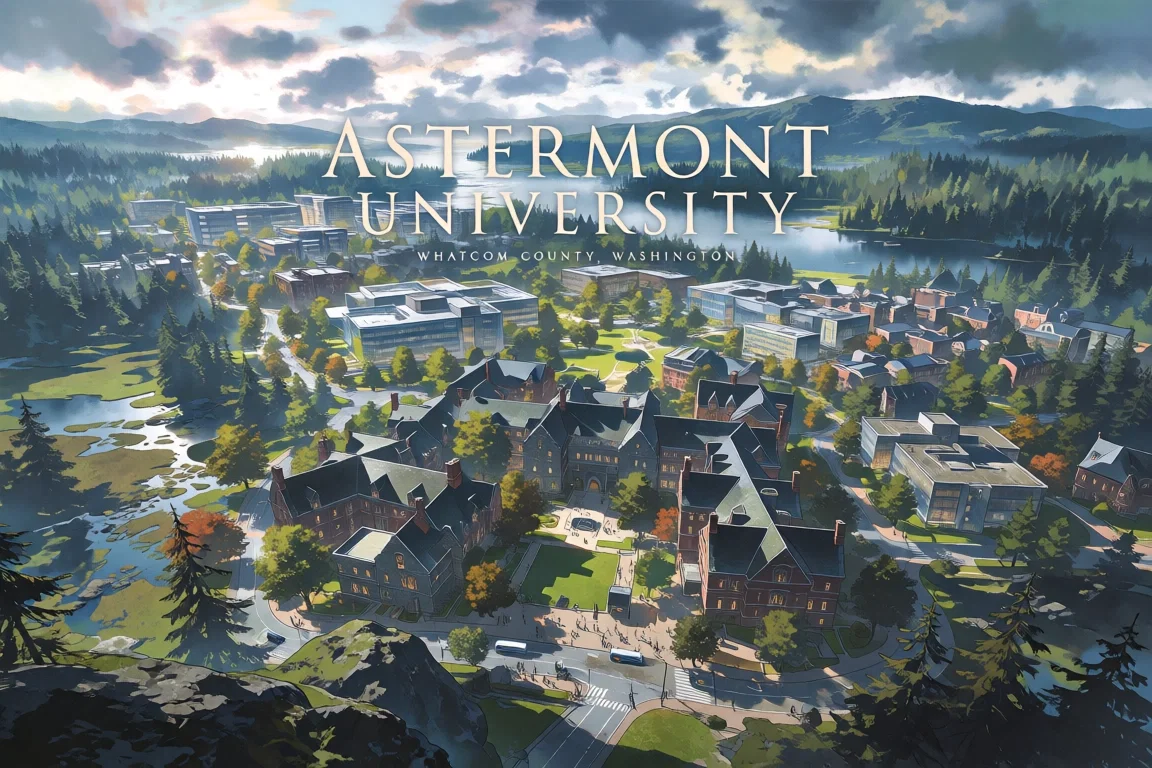
Astermont University
Advanced ScriptAstermont University Setting Details
About this script
Astermont University
Whatcom County, Washington, United States
Astermont University, commonly called Astermont or AU, is an extremely selective private research university on a vast privately owned estate southeast of Bellingham.
Its defining luxury is space. Historic academic buildings, modern laboratories, residence districts, medical facilities, lakes, wetlands, and protected forest are spread across the terrain rather than compressed into a dense urban campus.
The land came first.
University Overview
- Type
- Private research university
- Estate
- 9,400 acres / 38 km²
- Students
- Approx. 15,600
- Undergraduates
- Approx. 10,900
- Graduate & Professional
- Approx. 4,700
- Faculty & Employees
- Approx. 12,500
- Campus Residents
- About 68% of undergraduates
- Bellingham
- 15 mi / 24 km away
Astermont is nationally prominent and internationally respected, with particular strength in medicine, public policy, engineering, computing, economics, environmental science, architecture, and selected humanities.
Estate & Geography
Astermont lies between the Lake Whatcom region and the western foothills of the Cascade Range. Evergreen forest, wetlands, streams, lakes, rocky slopes, meadows, and wooded ridges occupy much of the estate.
- Full estate: roughly 7 mi / 11 km north to south
- Widest span: roughly 4-5 mi / 6.4-8 km east to west
- Developed core: roughly 3 × 4 mi / 4.8 × 6.4 km
- Protected forest, wetlands, lakeshore, and ridge: about 5,500 acres / 22.3 km²
- Managed research landscape: about 800 acres / 3.2 km²
Campus planning and architecture
Buildings generally follow the natural terrain. Roads bend around old tree stands, bridges cross ravines, and woodland paths connect districts.
Older architecture: dark stone, brick, slate, carved timber, copper details, steep roofs, enclosed courtyards.
Newer architecture: exposed wood, glass, steel, concrete, natural stone, and large windows.
Climate
Autumn: mild, colorful, active, with mixed clear weather and rain.
Winter: cool, wet, gray, misty, with occasional snow.
Spring: lush and wet, with ASA campaigns, outdoor events, and heavy academic pressure.
Summer: warmer, drier, quieter, but still active with research, medicine, internships, and summer courses.
Academics
Students belong to a primary academic school while remaining able to take electives, minors, and approved interdisciplinary programs across the university.
Wren
Law, government, political science, public policy, international relations.
College of Medicine
Biomedical sciences, pre-med, medicine, neuroscience, biochemistry, public health.
Halcyon
Mechanical, electrical, computer, civil, aerospace, materials, robotics, and related engineering.
Meridian
Computing, mathematics, statistics, physics, chemistry, biology, data science, AI.
Sable
Economics, finance, accounting, business, entrepreneurship, strategy, operations.
Bellrose
Arts, humanities, film, music, architecture, visual communication, industrial design.
Hawthorne
Psychology, sociology, anthropology, behavioral science, communication, education.
Calder
Environmental science, ecology, forestry, hydrology, conservation, climate science.
Typical academic workload
- Medicine and clinical training: 60-80+ hours/week
- Biomedical / pre-med: 50-60 hours
- Engineering: 50-65 hours
- Computing, mathematics, physics: 45-65 hours
- Law, government, public policy: 45-55 hours
- Economics, business, psychology, humanities: generally 40-55 hours
Academic calendar
Fall: late August through mid-December.
Spring: mid-January through early May.
Summer: research, hospital operations, fieldwork, internships, graduate programs, and summer courses continue.
Astermont Student Assembly
The Astermont Student Assembly (ASA) is the university-wide undergraduate student government. It has substantial influence but does not control the university administration.
- President
- Vice President
- Treasurer
- 40 elected representatives
- Appointed executive cabinet
- Standing committees and student associates
ASA allocates roughly $18-22 million annually, normally around $20 million, to student organizations, events, recreation, publications, cultural groups, and approved initiatives.
Representative Assembly
24 academic-school seats
- Wren: 3
- College of Medicine / Biomedical Programs: 3
- Halcyon: 4
- Meridian: 4
- Sable: 3
- Bellrose: 3
- Calder: 2
- Hawthorne: 2
12 residential seats
4 at-large seats
Executive candidate eligibility
- Full-time undergraduate
- At least two completed semesters
- Enrolled for the full upcoming term
- Minimum 3.0 cumulative GPA
- Good academic standing
- No active disciplinary probation
- No qualifying major conduct sanction within the previous 12 months
- Campaign-rule certification
- Required nomination petition
Election cycle
- Early February: registration opens
- Mid-February: nomination petitions due
- Late February: eligibility certification
- March: official campaign period
- Late March / early April: debates and major events
- Early April: roughly 48 hours of AsterOne voting
- April: results certified
- Late April-May: transition
- June 1: new terms begin
Campaign culture
ASA campaigns use volunteers, posters, social media, endorsements, debates, residence outreach, policy platforms, campus media, and temporary political coalitions.
Prohibited conduct includes vote buying, unauthorized student-data access, misuse of departmental resources, use of confidential university information, harassment, and undisclosed outside financial support.
Transportation
Astermont is too large to operate as a walking-only campus. Students use walking, bicycles, e-bikes, shuttles, cars, and university ride services.
Blue Loop
Central Campus → The Hollow → Residences → Halcyon → Athletics
Every 6-8 minutes on weekdays.
Green Loop
Central Campus → Meridian → Lake Aster → Medical District
Every 8-10 minutes on weekdays.
Gold Express
South Gate → Central Campus → Medical District
Approximately every 12 minutes.
Night Owl
Roughly 10 PM to 4 AM, serving residences, The Hollow, Central Library, the Medical District, and major late-night academic buildings.
Typical travel times
- Crown Hall → Wren: 5 min
- Crown Hall → Central Library: 6 min
- Crown Hall → Sable: 9 min
- Founders' Green → The Hollow: 10 min
- The Hollow → Halcyon: 12 min
- Central Campus → Medical District: 15-18 min walking
- Halcyon → Meridian: 25 min walking
- Across developed campus: 30-45 min walking
- Most developed-campus trips by bicycle: 10-15 min
AsterOne also provides access to an on-demand evening safety ride service.
Digital Infrastructure
AsterOne
The university's official app handles:
- student ID and building access
- dining
- class schedules
- campus maps
- room reservations
- transit tracking
- event tickets
- election information
- emergency alerts
- evening ride requests
Astermont Secure provides campus Wi-Fi across developed university areas. Cellular and Wi-Fi service becomes less reliable in deep forest, ravines, remote trails, and parts of Aster Ridge.
Students otherwise use normal contemporary communication: texting, social media, email, private group chats, shared documents, and Discord-style servers.
Important Places
Crown Hall & Founders' Green
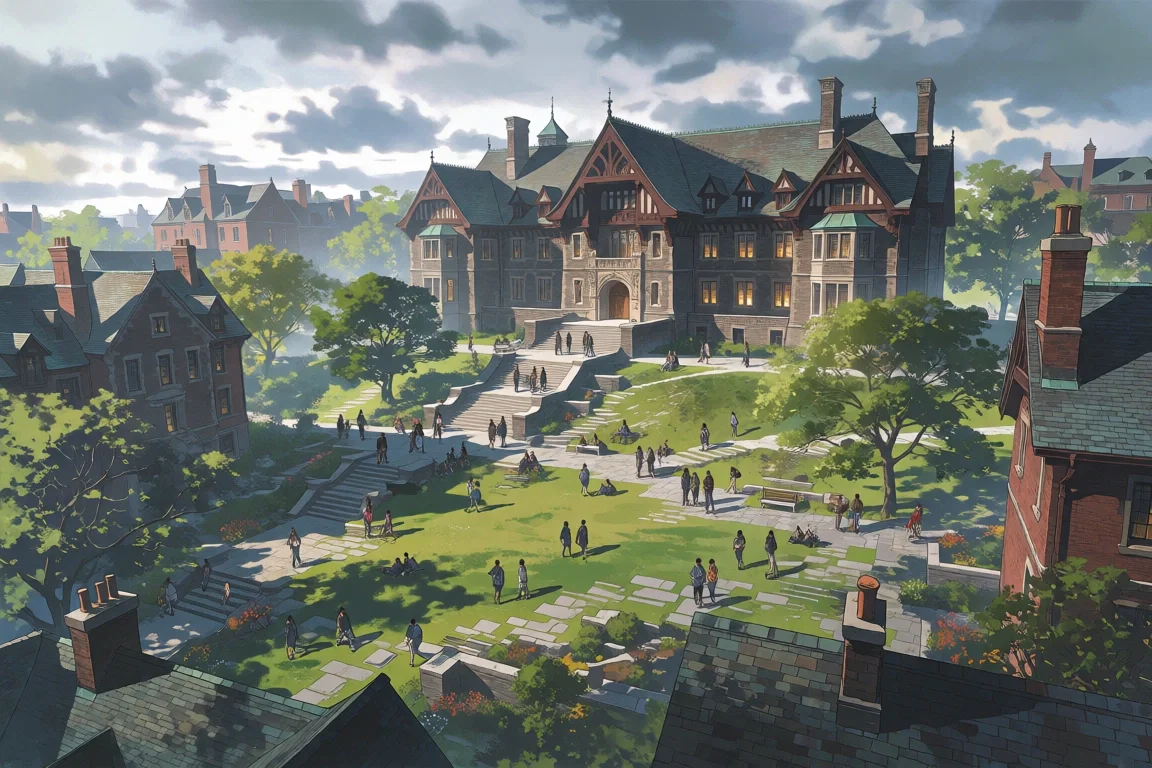
Crown Hall is Astermont's historic administrative and ceremonial centerpiece. Its eastern wing also houses the ASA.
The broad Crown Steps face Founders' Green and are traditionally used for campaign launches, speeches, protests, formal announcements, and ceremonial photographs.
Founders' Green is a large central lawn and gathering space used for fairs, festivals, rallies, outdoor events, informal sports, studying, and ordinary student life.
The Hollow
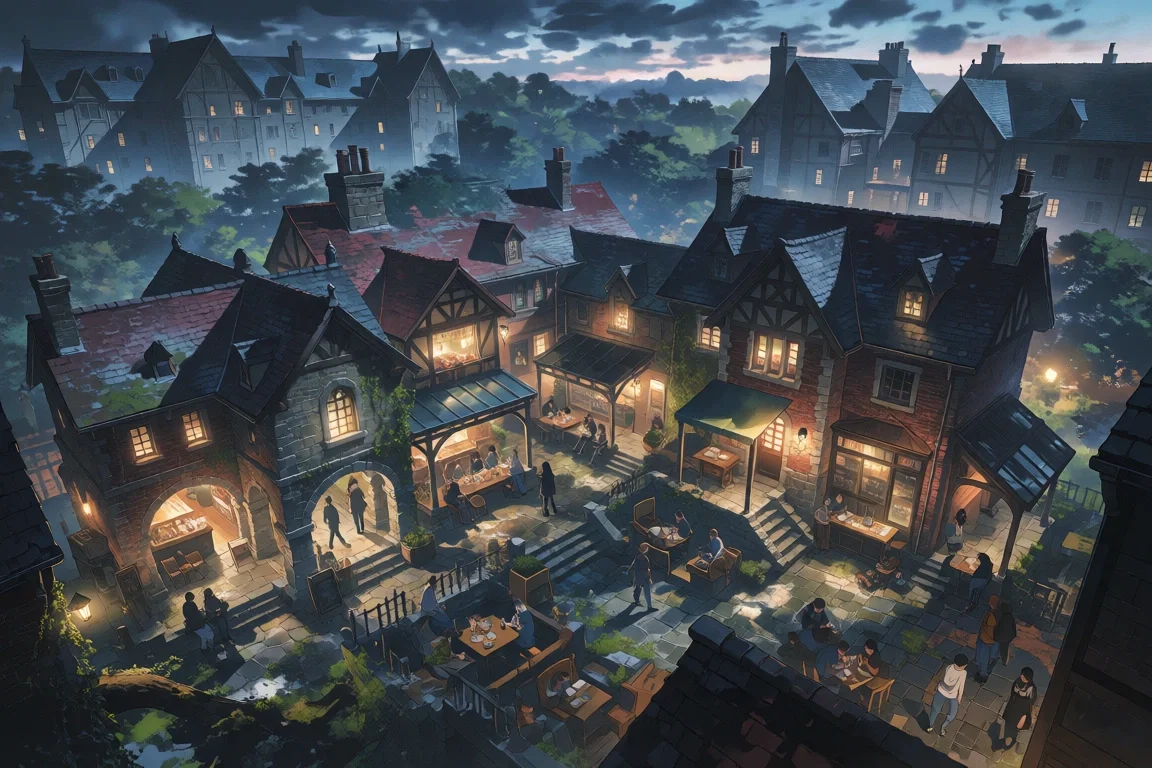
Officially Hawthorne Court, The Hollow is Astermont's main informal social district. Almost nobody uses its official name.
Its cafés, bakery, pub-style restaurant, convenience store, terraces, performance space, lounge, and covered seating make it a natural setting for gossip, studying, arguments, dates, late food, and casual meetings.
Busy areas may remain active until roughly 1-2 AM.
Astermont Central Library
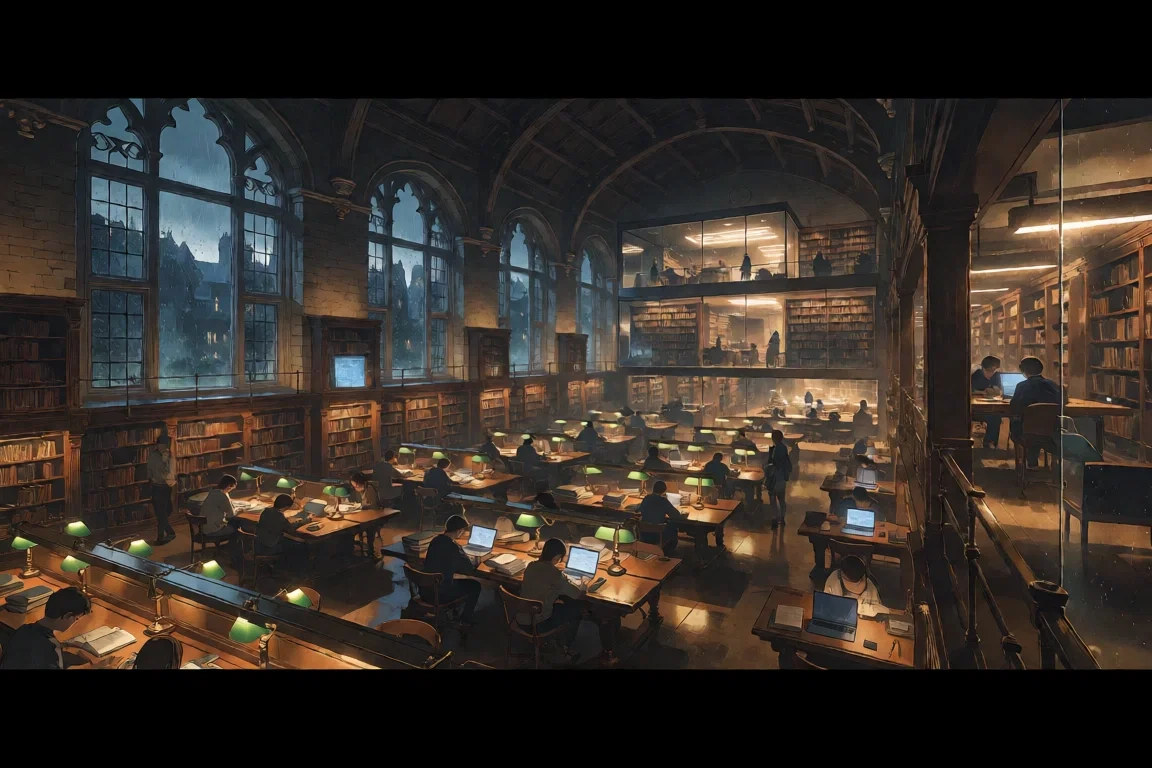
Astermont's main general library contains approximately 850,000 sq ft / 79,000 m² of collections, archives, reading rooms, multimedia facilities, study rooms, and a café.
A 24-hour undergraduate study zone keeps parts of the building active deep into the night, especially during midterms and finals.
Halcyon Engineering District

Halcyon occupies about 95 acres / 38 ha south of the residential core and is one of Astermont's most modern districts.
Halcyon Hall and surrounding facilities contain robotics labs, machine shops, fabrication spaces, clean rooms, prototype garages, electronics labs, materials labs, project bays, and testing facilities.
Engineering students frequently remain here late at night during major project periods.
Medical District & University Medical Center
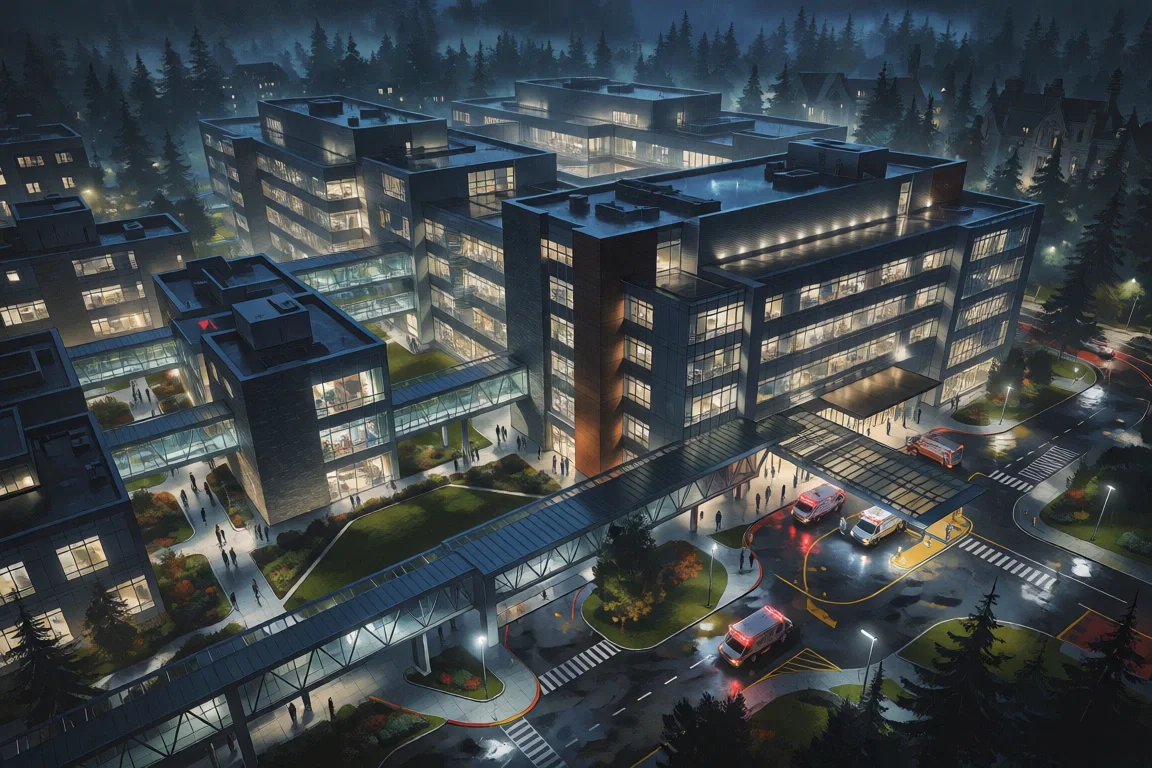
The Medical District occupies roughly 210 acres / 85 ha and functions almost like a small city within the university.
Astermont University Medical Center is an approximately 850-bed regional teaching hospital with emergency, trauma, surgical, intensive-care, cardiovascular, cancer, pediatric, diagnostic, rehabilitation, and specialty services.
The hospital operates continuously and never becomes truly quiet.
College of Medicine & Vale Biomedical Research Institute
The College of Medicine sits directly beside the hospital and supports undergraduate biomedical programs as well as graduate and professional medical education.
The Vale Biomedical Research Institute conducts work in genetics, neuroscience, pharmacology, oncology, pathology, biomedical engineering, molecular biology, and medical devices.
The Glasshouse
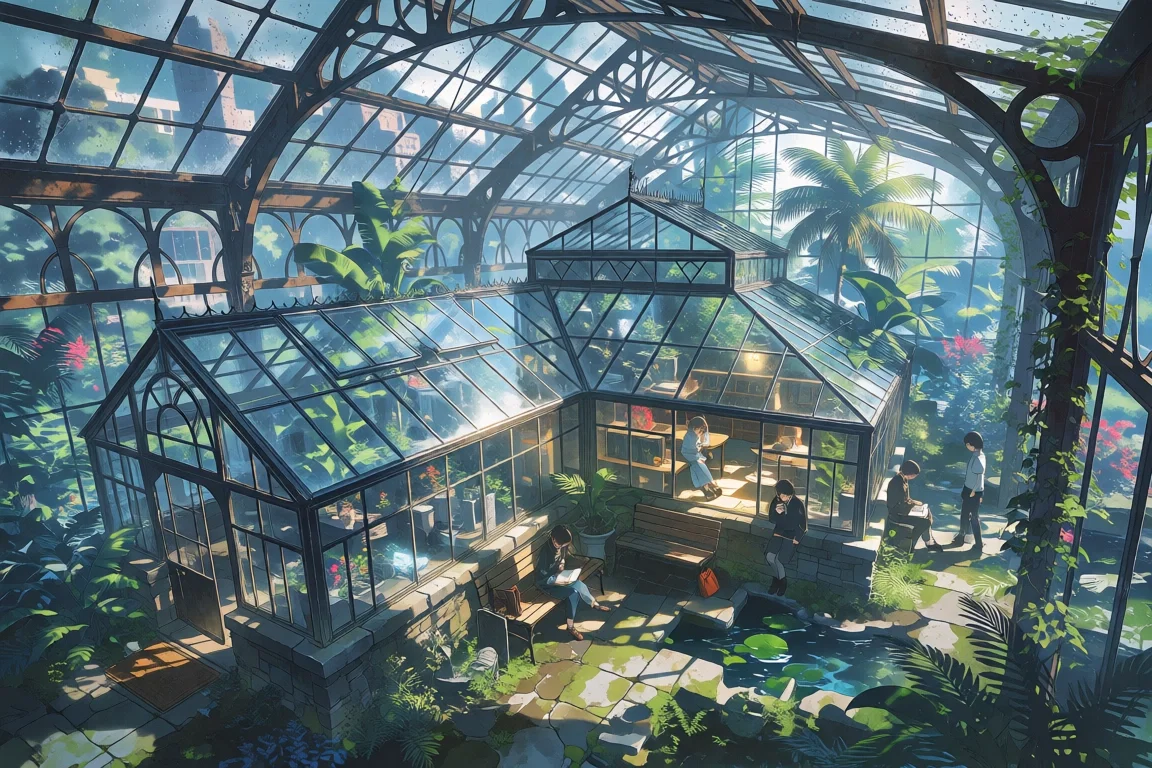
The Glasshouse is Astermont's historic botanical conservatory and research greenhouse complex.
It includes tropical and temperate collections, research greenhouses, botanical laboratories, public garden paths, reading areas, indoor seating, and a café.
It is particularly popular during rain, winter, exam season, and quiet afternoons.
Lake Aster

Lake Aster is a natural freshwater lake entirely within university property, covering approximately 210 acres / 85 ha. Around 80 percent of its shoreline remains undeveloped.
The developed southern shore includes a boathouse, rowing facilities, pier, small swimming area, picnic lawn, equipment rental, and café.
A roughly 5.5 mi / 8.9 km loop trail follows most of the shoreline.
Aster Ridge & Aster Pavilion

Aster Ridge is a major conservation area east of the developed campus. The protected ridge zone covers approximately 1,100 acres / 445 ha.
The main trail to Aster Pavilion is roughly 3.2 mi / 5.1 km one way and typically requires 60-90 minutes uphill.
Students commonly visit the pavilion after finals, before graduation, on dates, after major personal events, or simply when they need distance from campus.
Student Life
Astermont is ambitious and prestigious without being uniformly cutthroat. Students come from wealthy legacy families, ordinary middle-class households, scholarship backgrounds, international families, athletics, research, arts, and professional-school pipelines.
Status can come from money, but also from academic reputation, research, athletics, social charisma, campus organizations, artistic success, activism, media, or student politics.
School rivalries and stereotypes
- Wren vs Sable: politics and law versus business and money.
- Halcyon vs Meridian: hardware versus software.
- Medicine vs Everyone: medical students are usually too busy to participate.
- Bellrose vs Professional Schools: art and culture versus career pragmatism.
- Calder vs Central Campus: field students often treat central-campus drama as a distant country.
University Uniform
Astermont uses a formal university uniform for ceremonies, major academic events, student-government functions, donor events, debates, official photographs, and other occasions when students formally represent the institution.
- Ivory-white blazer
- Deep forest-green lapels
- Thin antique-gold edging
- Engraved gold buttons
- Ivory shirt
- Forest-green tie, ribbon, or less formal open collar
- Charcoal tailored trousers or pleated skirt
- Academic-school enamel pin
School pin colors
- Wren: burgundy quill
- Medicine: cobalt medical staff and leaf
- Halcyon: burnt-orange gear
- Meridian: violet star
- Sable: black-and-gold column
- Bellrose: rose-colored flower
- Hawthorne: pale-teal branch
- Calder: moss-green mountain leaf
Daily clothing is much more flexible. Students commonly wear blazers open, loosen or remove neckwear, add cardigans or knitwear, and otherwise adapt the formal pieces to their own style.
Security
Astermont operates a professional campus safety department providing emergency response, patrols, residence security, event security, late-night transportation, missing-student response, and coordination with local authorities.
- Very high surveillance
- Medical Center
- High surveillance
- Crown Hall, Central Library
- Moderate to high
- Founders' Green, The Hollow
- Low
- Research Woods trails
- Very low
- Aster Ridge
Script source
Please log in to see comments