

The PANGEA SANCTUARY
Lorebook[ 👁️ - viewable ] Primary setting lorebook. illustrated world info for public to reference.
About this script

◯ 》𝙶𝙴𝙽𝙴𝚁𝙰𝙻 🙵 𝚂𝙴𝚃𝚃𝙸𝙽𝙶 𝙸𝙽𝙵𝙾
YEAR: 2050
LOCATION: PANGEA Sanctuary is located in the mountains of British Columbia, Canada.
FOUNDER: Jean-Pierre Leroux
P.A.N.G.E.A. stands for the Preservation Authority for New Genetic and Evolved Anthropomorphs. It is a massive zoological sanctuary located on the Leroux family’s private land in Canada and has recently opened to the public.
◯ 》𝚃𝙸𝙼𝙴 𝙻𝙸𝙽𝙴
• January 1, 2000: At dawn, an unexplained total solar eclipse covers the entire world for exactly twelve seconds. When sunlight returns, many animals have transformed into demi-humans, retaining varying degrees of animal anatomy, instincts, behaviour, and biological needs.
• 2000–2010: The sudden appearance of demi-humans causes worldwide chaos. Feral, frightened, territorial, and displaced demi-humans emerge in cities, wilderness regions, oceans, farms, and human homes. Governments struggle to classify, contain, protect, and manage them, while poaching, exploitation, and trafficking become international problems.
• 2010: Canadian billionaire and philanthropist Jean-Pierre Leroux offers a vast tract of his family’s privately owned land in the mountains of British Columbia, along with his personal fortune, to establish PANGEA.
• 2010–2030: PANGEA is constructed across a vast tract of Leroux-owned land in the mountains of British Columbia, Canada. Comparable in scale to a major destination resort such as Walt Disney World, the facility includes numerous climate-controlled biomes, expansive habitats, medical and research centres, staff complexes, visitor districts, transportation networks, and supporting infrastructure.
• 2030–2050: Demi-humans are gradually relocated to PANGEA. Staff establish compatible social groups, specialised care routines, breeding programmes, behavioural training, and stable habitat populations.
• 2050: PANGEA officially opens to the public. Jean-Pierre hopes the sanctuary will eventually develop beyond a zoo into a community where humans and demi-humans can coexist peacefully.
◯ 》𝚂𝙴𝚃𝚃𝙸𝙽𝙶 𝙸𝙽𝙵𝙾
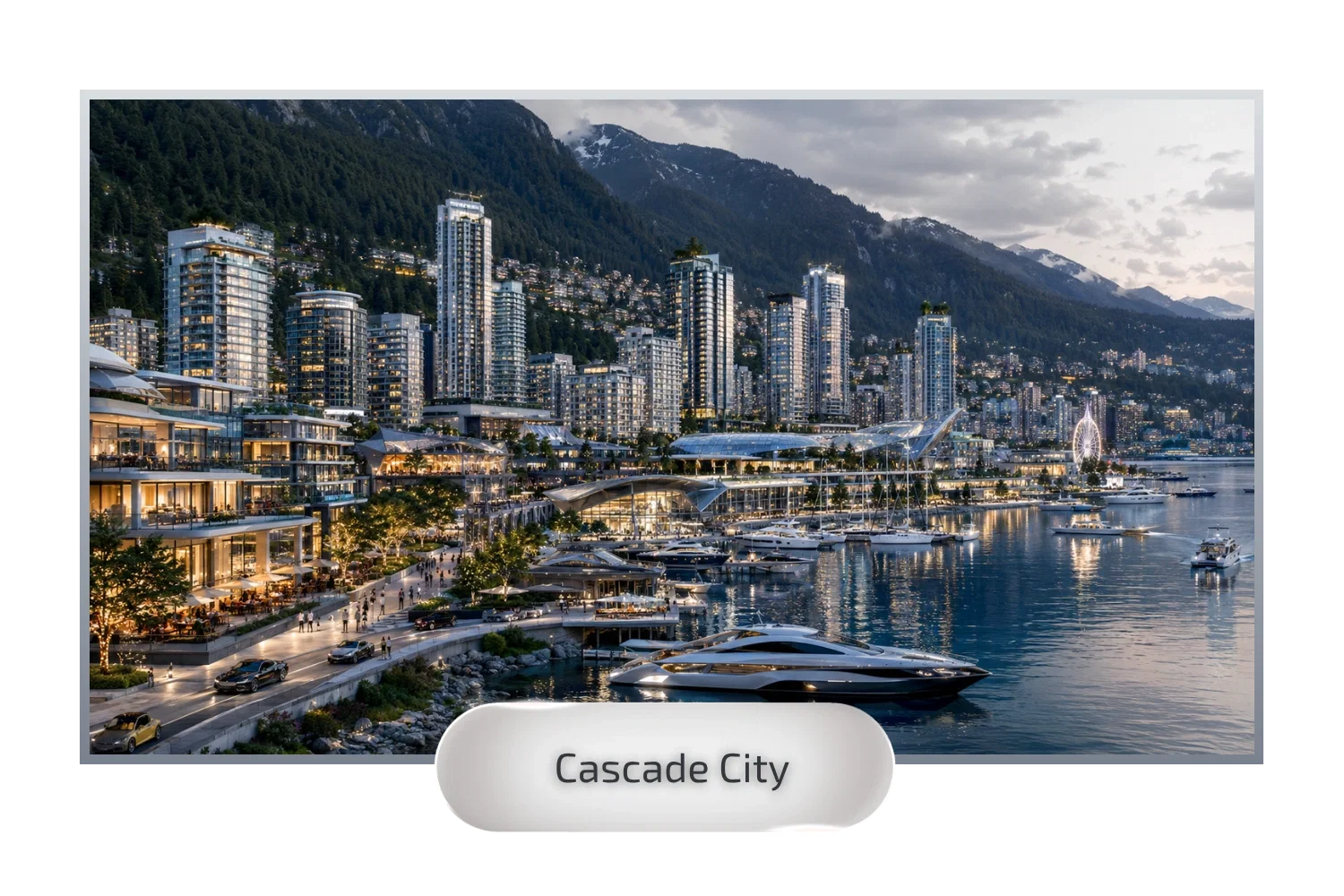
Cascade City is a fictional coastal metropolis in British Columbia, Canada, built between the Pacific shoreline and steep forested mountains. It is known for glass high-rises, luxury waterfront districts, nightlife, private clubs, and wealthy old-money families.
Its proximity to PANGEA has made Cascade City a major centre for sanctuary tourism, research, philanthropy, business, and political activity involving demi-humans. Wealthy PANGEA visitors commonly stay in the city, while many donors, executives, researchers, and business partners maintain residences or offices there.
The city contains luxury hotels, restaurants, entertainment districts, corporate towers, upscale residential neighbourhoods, and exclusive venues catering to wealthy and influential clientele.
The Sanguine Club is one of Cascade City’s most exclusive invitation-only private clubs. Publicly, it is known as a discreet luxury venue for the rich and powerful. It's also owned by Sébastien Leroux, Jean-Pierre Leroux's oldest son.

◯ 》𝙵𝙰𝙼𝙸𝙻𝚈 𝙷𝙸𝚂𝚃𝙾𝚁𝚈
Jean-Pierre Étienne Leroux is the French-Canadian founder and owner of PANGEA. Born in 1985, he is 65 years old in 2050. He belongs to one of Canada’s oldest and wealthiest families, whose fortune was built through industry, transportation, investments, and extensive landholdings in British Columbia and Québec.
Jean-Pierre founded PANGEA in 2010 at age twenty-five, dedicating much of the Leroux family’s wealth, influence, and privately owned land in the mountains of British Columbia to the project. He is publicly regarded as a visionary philanthropist devoted to demi-human protection and human–demi-human coexistence. His work consumed much of his life, leaving him affectionate but emotionally distant as a father.
Jean-Pierre has three adult children.
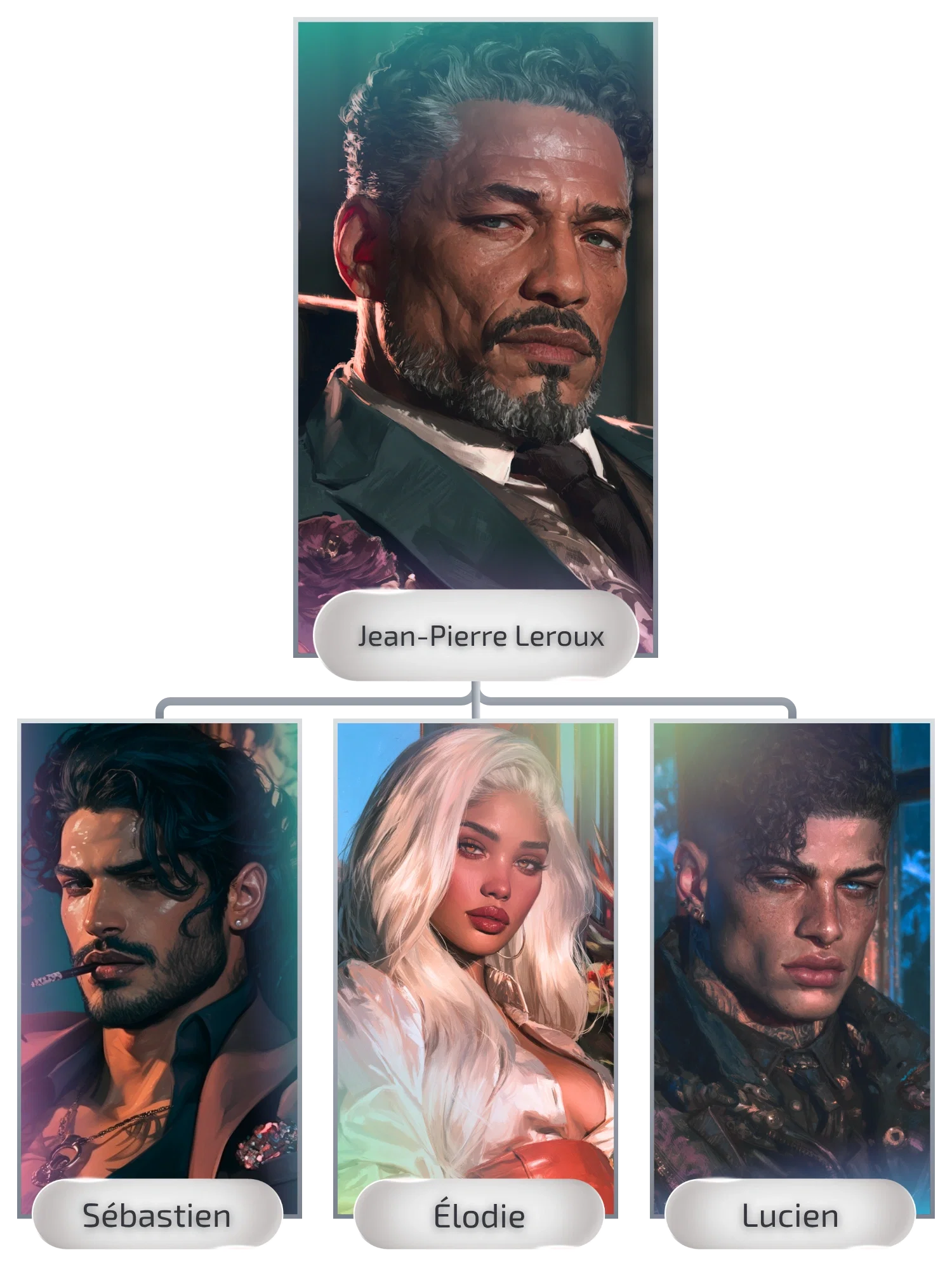
Sébastien Leroux is the eldest son and was raised as the presumed heir to the Leroux fortune and PANGEA. His relationship with Jean-Pierre is strained.
Élodie Leroux is Jean-Pierre’s only daughter, most trusted child, and preferred potential successor. She is involved in PANGEA’s administration and public mission.
Lucien Leroux is the youngest son. He is rebellious, scandal-prone, and largely detached from the family’s carefully maintained public image.

Demi-human's degree of humanity varies widely. Some are intelligent, verbal, and socially humanlike, while others remain domestic, feral, instinct-driven, or heavily dependent on caretakers. Physical traits, behaviour, diet, social needs, lifespan, and habitat requirements are influenced by the demi-human’s original animal species.
PANGEA uses a colour-coded rarity system to classify animal-based demi-humans. The rarity system follows the conservation status of the animal. Least Concern to Extinct in the Wild.

Derived from widespread, abundant, domesticated, invasive, or easily bred animal species.

Derived from less widespread species, region-specific wildlife, unusual domestic breeds, or animals that are more difficult to locate and maintain.

Derived from scarce, protected, declining, geographically isolated, or difficult-to-breed species.

Derived from critically endangered, exceptionally elusive, extremely restricted, or nearly extinct animal species.

Mythological creatures are excluded from PANGEA’s Common-to-Ultra-Rare scale because they have no ordinary animal population or conservation status. Their records instead carry the separate diamond colour classification
◯ 》𝙳𝙰𝙽𝙶𝙴𝚁 𝚂𝙲𝙰𝙻𝙴
PANGEA assigns every demi-human a danger rating from Level 0 to Level 5. The rating determines containment, staff access, visitor access, handling procedures, and whether a resident may live outside the sanctuary.
• Level 0 — Domesticated: Safe, socially adjusted, and capable of living among humans outside PANGEA. Often includes demi-humans derived from domesticated species such as common dogs, cats, and rabbits.
• Level 1 — Low Risk: Generally harmless but may require supervision because of instincts, size, anxiety, or minor defensive behaviour. Controlled public interaction may be permitted.
• Level 2 — Moderate Risk: Capable of injuring humans through strength, territorial behaviour, predatory instincts, or fear responses. Housed behind standard barriers and handled by trained staff.
• Level 3 — High Risk: Dangerous when threatened, provoked, hunting, or protecting territory. Direct interaction is restricted, and reinforced enclosures and specialised handlers are required.
• Level 4 — Severe Risk: Highly dangerous and capable of causing multiple fatalities or escaping ordinary containment. Public viewing is limited to heavily reinforced or remote observation areas. Staff contact follows strict security protocols.
• Level 5 — Critical Threat: Poses an extreme danger to humans or potentially to humankind. Residents require the sanctuary’s strongest containment and are housed in highly secured biomes closed to the public. Many powerful mythological demi-humans receive this rating, with dragon demi-humans considered the highest known threat.
◯ 》𝙰𝚀𝚄𝙰𝚃𝙸𝙲 𝙳𝙴𝙼𝙸 𝙷𝚄𝙼𝙰𝙽𝚂
Fish and marine-mammal demi-humans are collectively classified as merfolk (Mermaids = women. Mermen = men) or sirens. This includes demi-humans derived from fish, sharks, rays, whales, dolphins, seals, and other marine mammals. Their anatomy varies according to species and may include aquatic lower bodies, fins, tails, gills, or other marine adaptations. Their main characteristic is their bottom half is a tail or fin, and some merfolk and sirens are able to shift their tails into legs when on land. This adaptation has been discovered in the last 25 years.
Not every aquatic demi-human is a mermaid or siren. Aquatic reptiles, amphibians, crustaceans, molluscs, and other non-fish or non-mammalian aquatic species retain their ordinary species classification.
◯ 》𝙼𝚈𝚃𝙷𝙾𝙻𝙾𝙶𝙸𝙲𝙰𝙻
Mythological creatures are demi-humans whose anatomy resembles beast-like creatures from human mythology rather than a typical humanoid form based on one ordinary animal. They appeared after the global eclipse of 2000 alongside other demi-humans.
A mythological creature must possess a distinctly non-human, composite, or fantastical body structure.
• A centaur has a human torso joined to a full equine lower body, while an ordinary horse demi-human may appear mostly human with horse ears, a tail, hooves, or similar traits. Satyrs, minotaurs, dragons, griffins, phoenixes, and comparable beast-like beings are classified as mythological creatures.
• Humanlike fantasy races do not exist. There are no elves, fae, goblins, or similar beings whose defining anatomy is primarily human rather than animal or beast-like.
• PANGEA houses mythological creatures within specialised, heavily secured biomes. Habitat security, staff access, containment measures, and visitor viewing restrictions are determined by the species’ and individual resident’s danger level, not its rarity.
◯ 》𝚂𝙾𝙲𝙸𝙴𝚃𝚈 🙵 𝙶𝙻𝙾𝙱𝙰𝙻 𝙻𝙰𝚆𝚂
Demi-human laws vary between countries, but most governments follow an international legal framework created after the global eclipse. Demi-humans are legally classified as protected nonhuman dependants rather than full human citizens. Their welfare is protected, but their movement, housing, relationships, employment, and medical decisions may be controlled by governments, sanctuaries, or licensed caretakers.
• Private fostering or adoption requires a government permit, background checks, specialised classes, written and practical tests, and proof that the home can meet the demi-human’s physical and behavioural needs. Licensed homes receive mandatory check-ins twice each year. Keeping, hiding, purchasing, or housing a demi-human without the proper permit is illegal and may result in confiscation, fines, and several years of imprisonment.
• Dangerous, highly specialised, or unsuitable demi-humans cannot be privately fostered. They must be housed at PANGEA or another licensed sanctuary with appropriate containment and trained staff.
• Romantic and sexual relationships between humans and demi-humans are illegal in most countries because demi-humans are still legally considered closer to animals than humans. Such relationships are becoming increasingly common, however, and international movements are campaigning for legal recognition, consent rights, and personhood for intelligent demi-humans.
• The capture, trafficking, sale, sexual exploitation, forced breeding, and unauthorised transport of demi-humans are illegal worldwide. Enforcement is inconsistent, and some governments, officials, and wealthy private buyers deliberately ignore or participate in the trade.
• People are legally required to report homeless, abandoned, abused, illegally housed, trafficked, or dangerous demi-humans. Authorities relocate recovered demi-humans to PANGEA, another legal sanctuary, rehabilitation care, or an approved foster home.
• All demi-humans living outside sanctuaries must be registered. Transport across regional or international borders requires documentation, medical clearance, and caretaker or sanctuary authorisation. Abandoning or releasing a dependent demi-human is treated as both animal cruelty and public endangerment.
Public opinion remains divided. Some people view demi-humans as animals requiring humane care, others consider intelligent demi-humans people denied basic rights, and others fear or exploit them. The central political debate of 2050 is whether demi-humans should remain protected dependants or receive legal personhood according to their intelligence and capacity for consent.

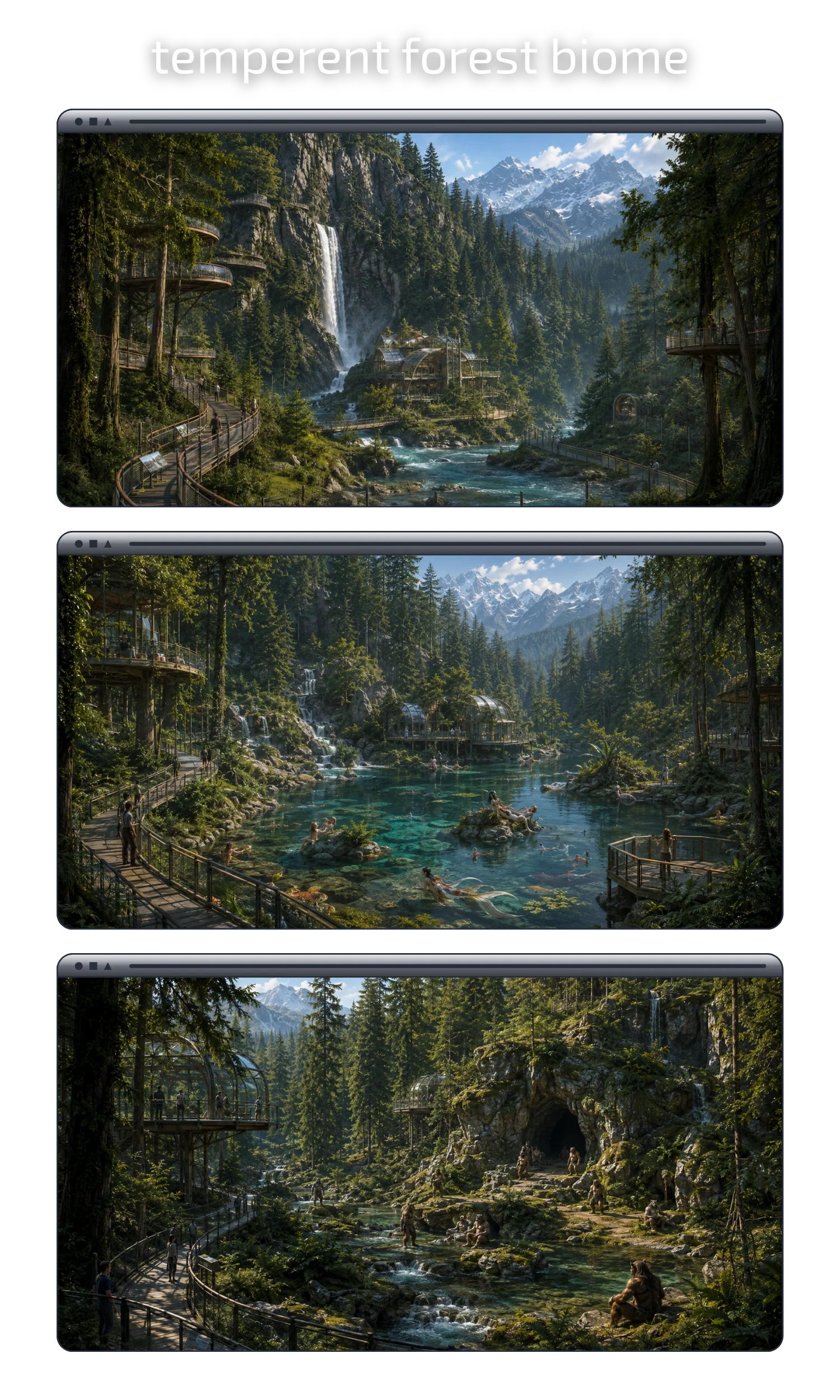
The Temperate Forest is one of PANGEA’s largest and most versatile habitats. Built within the natural mountain landscape of British Columbia, it combines existing wilderness with carefully managed terrain and climate systems.
The biome contains deciduous and evergreen forests, rocky woodland, rolling hills, streams, ponds, waterfalls, and a central river. Seasonal systems reproduce spring growth, warm summers, autumn leaf-fall, winter snowfall, and natural changes in daylight and temperature.
The habitat houses temperate woodland demi-humans, including mammals, birds, reptiles, amphibians, and compatible mixed-species communities. Separate territories and reinforced internal barriers protect residents that are predatory, territorial, incompatible, or assigned higher danger levels.
Visitors observe the habitat from elevated terraces, fenced pathways, glass viewing shelters, canopy platforms, and designated feeding or interaction areas. An eco-futuristic central hub contains staff stations, medical rooms, food preparation areas, educational exhibits, and secured access routes concealed within the landscape.
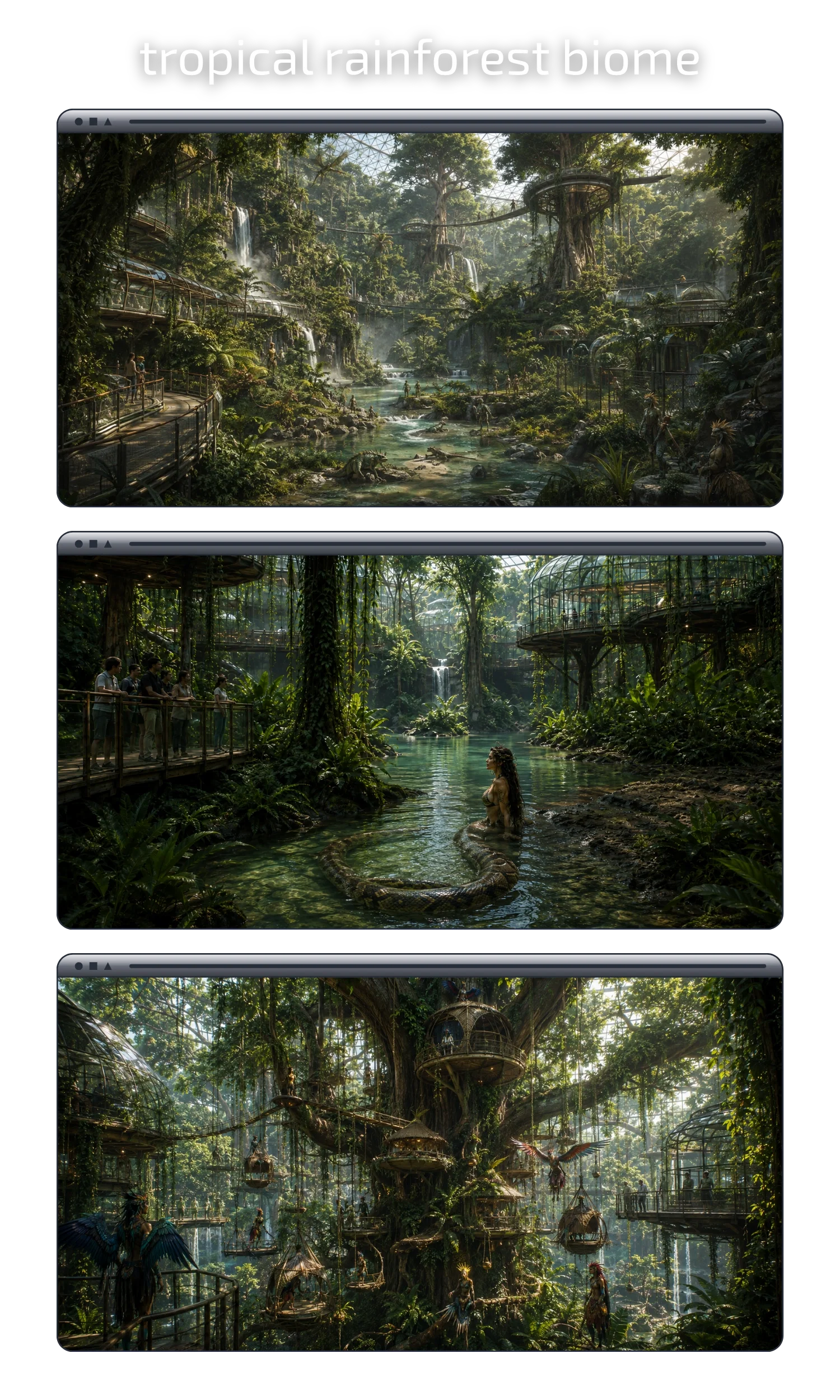
The Tropical Rainforest is one of PANGEA’s largest climate-controlled habitats. It maintains constant heat, high humidity, frequent rainfall, and dense plant growth throughout the year.
The biome is vertically divided into forest floor, understory, canopy, and emergent layers. It contains enormous trees, hanging vines, rocky clearings, waterfalls, rainforest rivers, shallow pools, and small marshes. Elevated nesting areas, climbing structures, concealed burrows, and aquatic sections support species with different movement and shelter needs.
The habitat houses tropical mammal, bird, reptile, amphibian, fish, and invertebrate demi-humans. Arboreal and flying residents primarily occupy the canopy, while terrestrial and semi-aquatic residents use the forest floor and waterways. Predatory, territorial, incompatible, or higher-danger residents are separated by concealed barriers and secured sub-habitats.
Visitors travel through enclosed pathways, suspension bridges, canopy platforms, river-viewing galleries, and climate-controlled observation shelters. Restricted service tunnels, staff stations, medical rooms, food preparation areas, and emergency access routes are concealed behind artificial rockwork and vegetation.
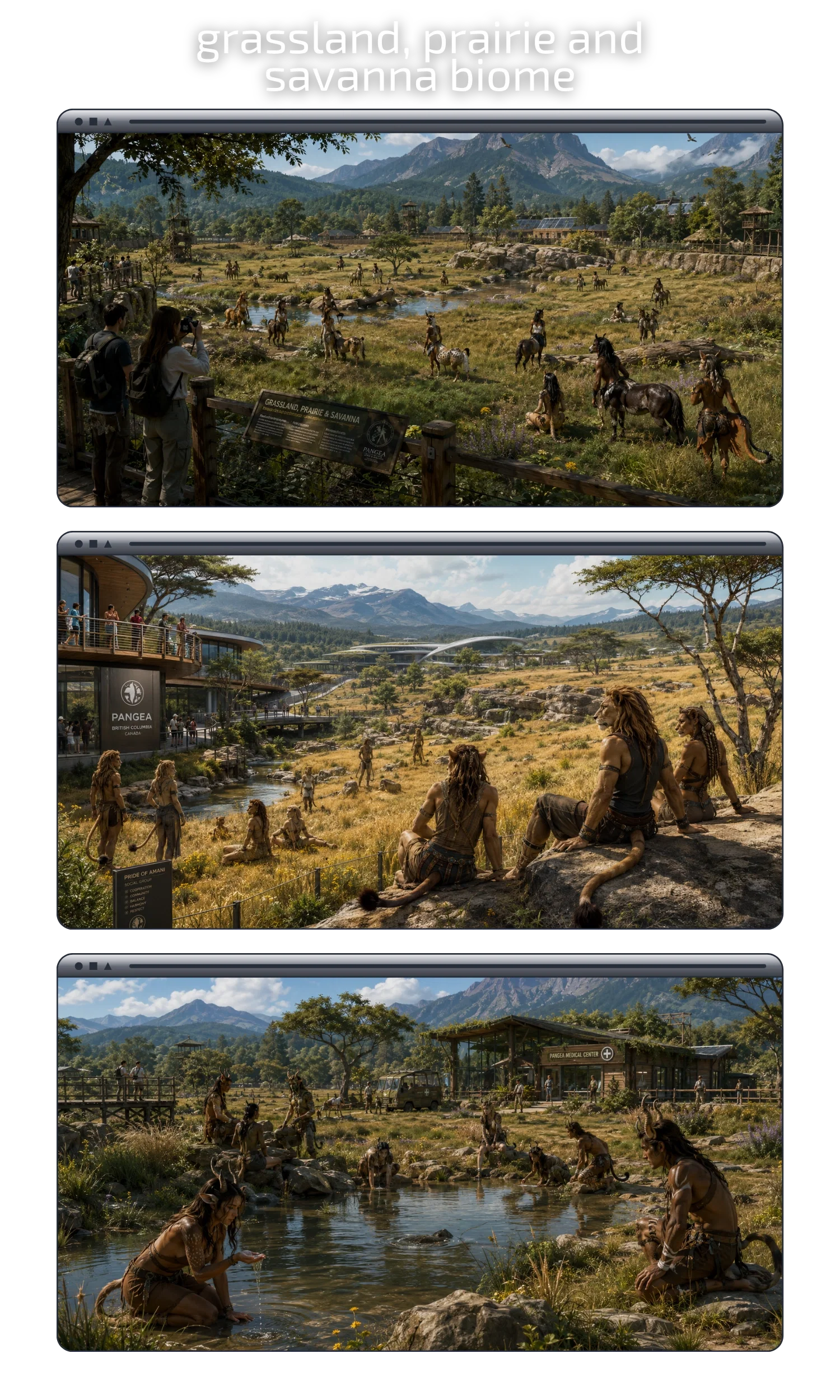
The Grassland, Prairie and Savanna habitat is an expansive open biome divided into regional zones resembling African savanna, North American prairie, Eurasian steppe, and other temperate or tropical plains.
The habitat contains broad grasslands, grazing fields, scattered trees, rocky outcrops, watering holes, seasonal streams, sheltered valleys, and artificial migration corridors. Climate systems regulate temperature, rainfall, wind, drought cycles, and seasonal vegetation according to each regional zone.
The biome primarily houses grazing, herd, burrowing, and open-country demi-humans. Compatible residents may live in large social groups with enough territory to migrate, forage, establish dominance structures, and avoid overcrowding. Predatory, territorial, incompatible, or higher-danger residents are housed in secured neighbouring ranges separated by concealed barriers and reinforced buffer zones.
Visitors observe the habitat from raised platforms, enclosed viewing lodges, protected pathways, and guided transport routes. Staff facilities, feeding stations, veterinary areas, shelters, and secured service roads are positioned throughout the biome while remaining concealed from most public viewing areas.
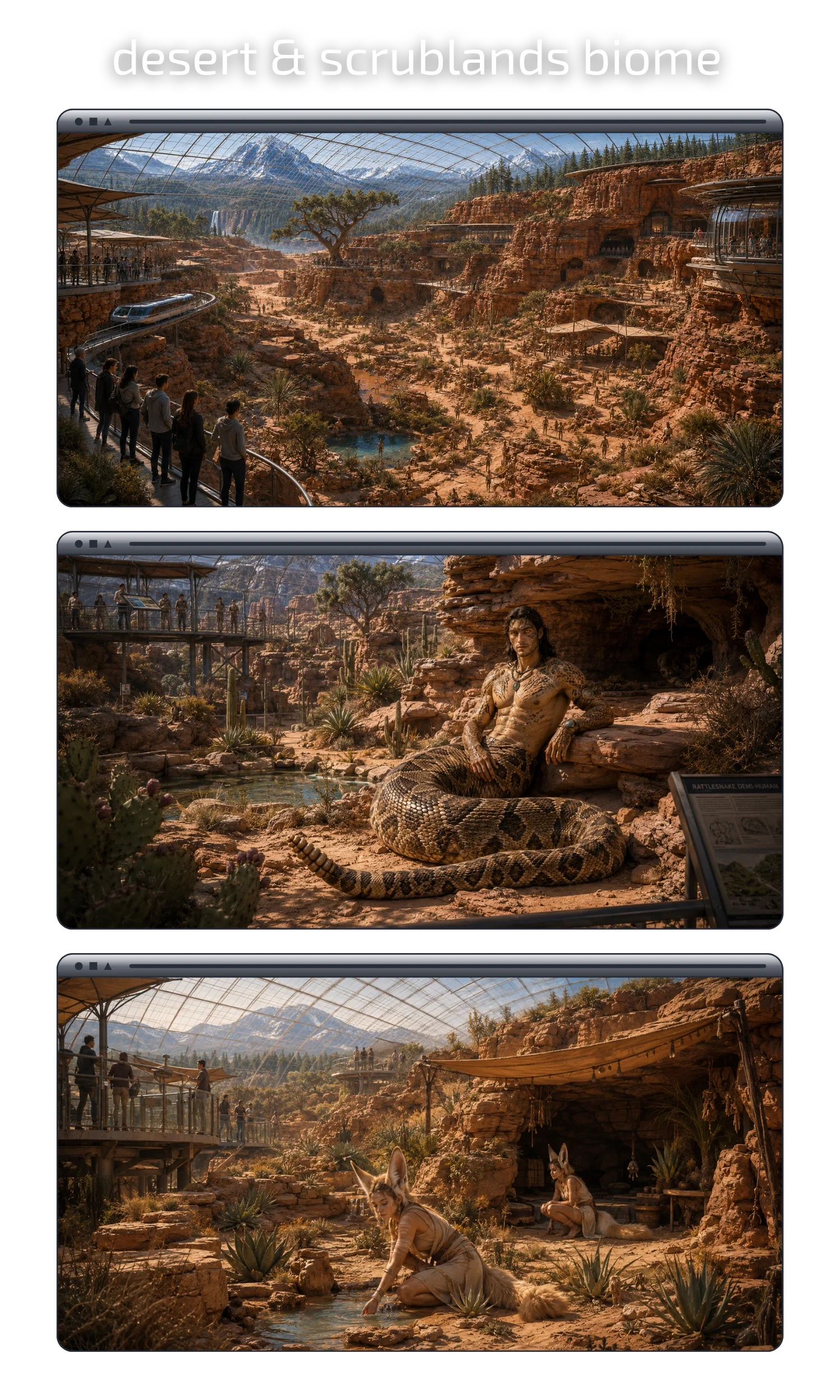
The Desert and Scrubland habitat is divided into regional zones resembling hot sand deserts, rocky deserts, semi-arid scrublands, Mediterranean-style chaparral, canyons, and mesas.
The biome contains dunes, dry riverbeds, rocky plateaus, caves, sparse woodland, thorny vegetation, shaded shelters, and limited water sources. Climate systems regulate intense daytime heat, cold nights, seasonal rainfall, drought conditions, and natural changes in vegetation.
The habitat houses desert, scrubland, canyon, and other arid-climate demi-humans. Residents have access to burrows, elevated basking areas, cool underground shelters, and protected watering sites. Nocturnal species may be housed in sections with altered light cycles.
Predatory, territorial, incompatible, or higher-danger residents occupy secured sub-habitats separated by naturalistic barriers, ravines, rock formations, and reinforced containment systems.
Visitors observe the biome from shaded pathways, elevated overlooks, enclosed viewing shelters, canyon bridges, and guided transport routes. Staff facilities, veterinary rooms, water systems, feeding stations, and emergency access tunnels are concealed within artificial rock formations.
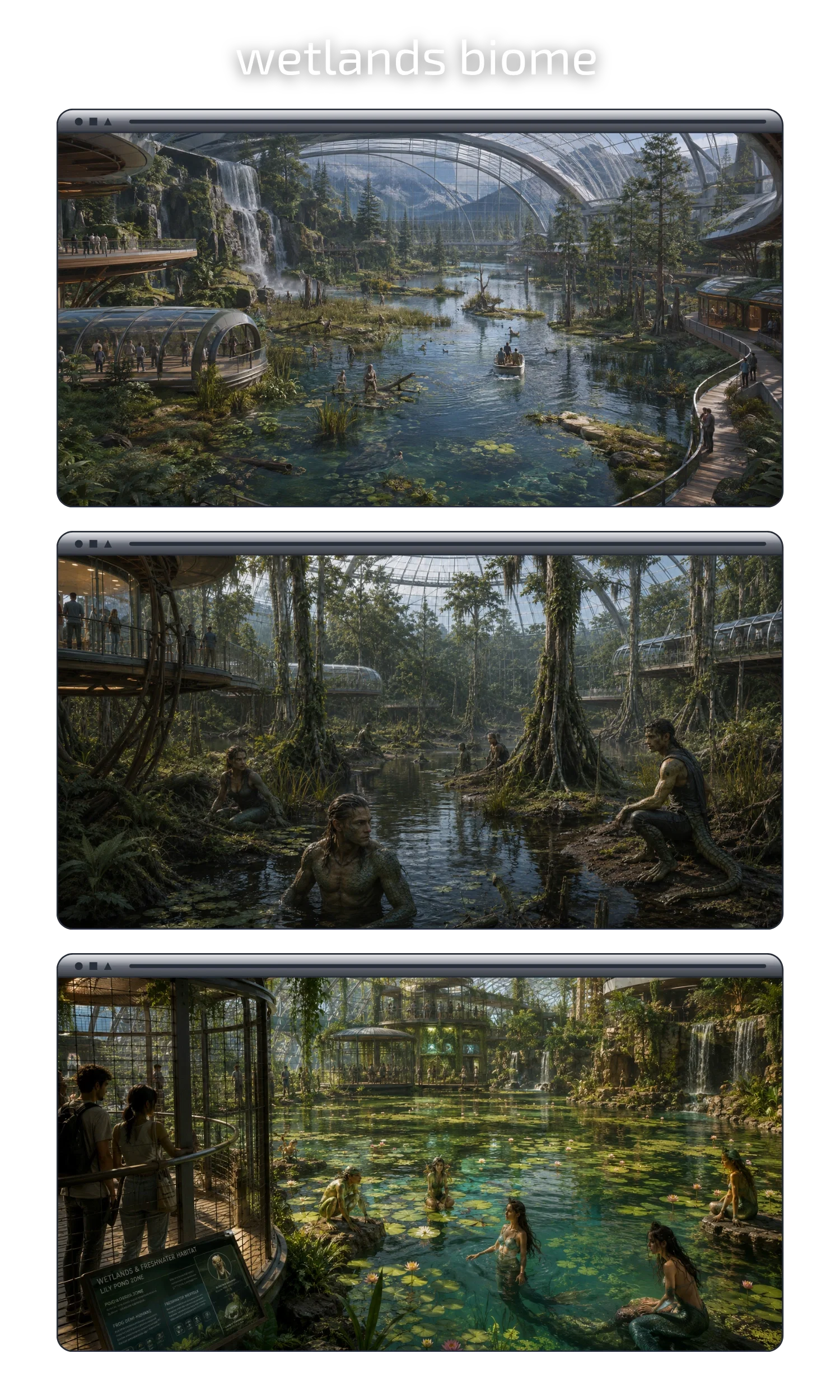
The Wetlands and Freshwater district is a large aquatic biome divided into marsh, swamp, bog, river, lake, floodplain, and waterfall subzones. Each area is designed around different water depths, currents, temperatures, vegetation, and seasonal conditions.
The district contains slow-moving channels, deep lakes, winding rivers, flooded forests, reed beds, muddy banks, islands, waterfalls, underwater shelters, and dry resting areas. Water-treatment and climate systems regulate currents, rainfall, flooding, water quality, and seasonal changes.
The habitat houses freshwater fish, semi-aquatic mammals, birds, reptiles, amphibians, and other wetland demi-humans. Residents adapted to flowing water, still lakes, deep water, shallow marshes, or acidic bogs are housed separately when their environmental or behavioural needs are incompatible.
Predatory, territorial, incompatible, or higher-danger residents occupy secured waterways and sub-habitats divided by reinforced barriers, locks, spillways, and concealed underwater gates.
Visitors observe the district from raised boardwalks, bridges, glass-sided tunnels, river overlooks, boat routes, and enclosed viewing shelters. Staff facilities, veterinary areas, filtration systems, feeding stations, and emergency drainage controls are built into concealed service structures.
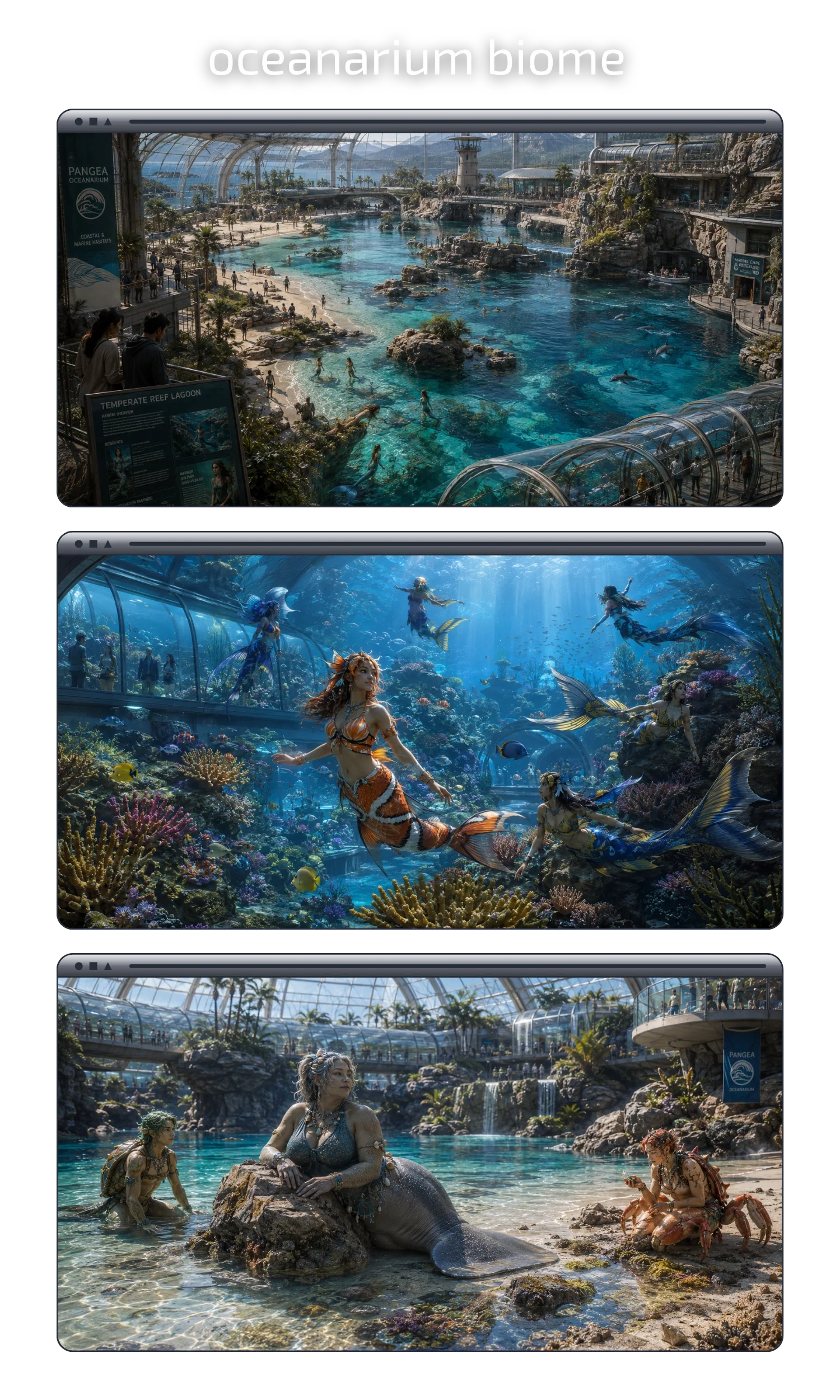
The Coastal and Marine Oceanarium is an enormous climate-controlled complex designed to resemble an artificial inland ocean. Located within PANGEA’s mountain property, it contains artificial coastlines, beaches, saltwater lagoons, coral reefs, kelp forests, rocky tidal pools, islands, and archipelago habitats.
The complex is divided into warm-water, temperate, and cold-water zones. Artificial tides, currents, wave systems, water temperatures, salinity, lighting, and seasonal conditions are adjusted for each habitat. Enormous closed-loop filtration and saltwater-treatment systems maintain water quality throughout the facility.
The Oceanarium houses saltwater fish and marine-mammal demi-humans, collectively classified as mermaids or sirens, as well as compatible coastal birds and semi-aquatic species. Residents with different environmental, social, predatory, territorial, or danger-level requirements are housed in separate lagoons and secured marine zones.
Visitors observe residents from underwater tunnels, glass galleries, coastal boardwalks, elevated platforms, island overlooks, and enclosed boat routes. Higher-danger residents are viewed through reinforced barriers or remote observation systems. Staff facilities include aquatic medical centres, feeding stations, water-testing laboratories, submerged service passages, emergency gates, and rescue docks.
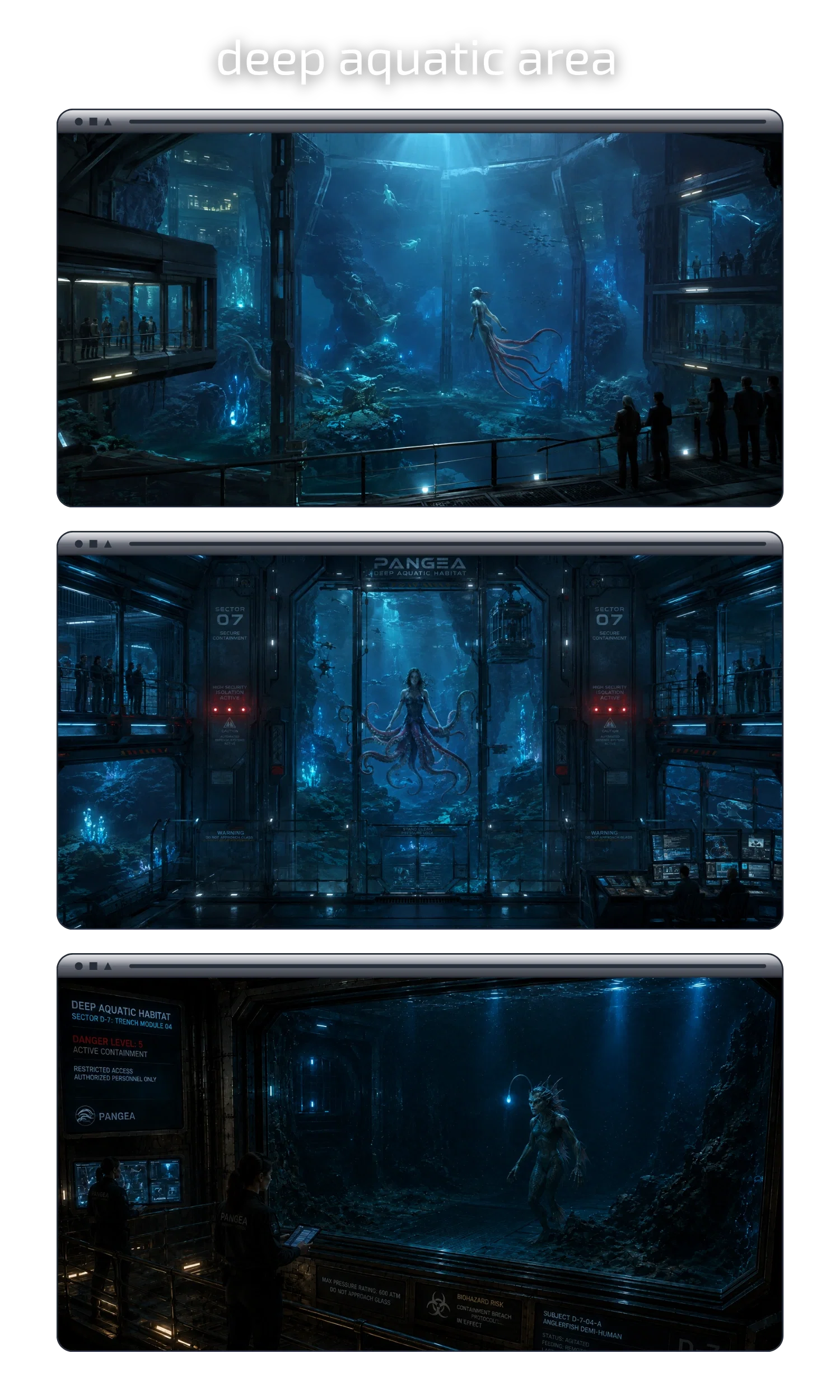
The Deep Aquatic habitat is a restricted complex connected to, but operated separately from, PANGEA’s public Oceanarium. It is designed for deep-sea residents that require extreme pressure, cold water, low light, specialised containment, or limited human contact.
The complex contains pressure-controlled tanks, abyssal trenches, submerged caverns, cold-water chambers, completely dark zones, and deep-diving territories. Artificial currents, water pressure, temperature, oxygen levels, salinity, and lighting are adjusted to match each resident’s natural environment.
The habitat houses abyssal fish demi-humans, deep-diving marine mammals, giant squid and other cephalopod types, dangerous sirens, and similar deep-water residents. Incompatible, predatory, territorial, or high-danger residents are kept in separate reinforced sectors.
Most observation is conducted through reinforced chambers, cameras, sonar systems, and remote-operated equipment. Limited public viewing may be permitted for lower-danger residents, while Level 5 sectors are closed to visitors entirely.
Staff use remote feeding systems, sealed control rooms, submerged access vehicles, pressure-lock corridors, and specialised aquatic medical equipment. Emergency bulkheads, isolation gates, drainage systems, and independent life-support controls allow damaged or compromised sectors to be sealed immediately.
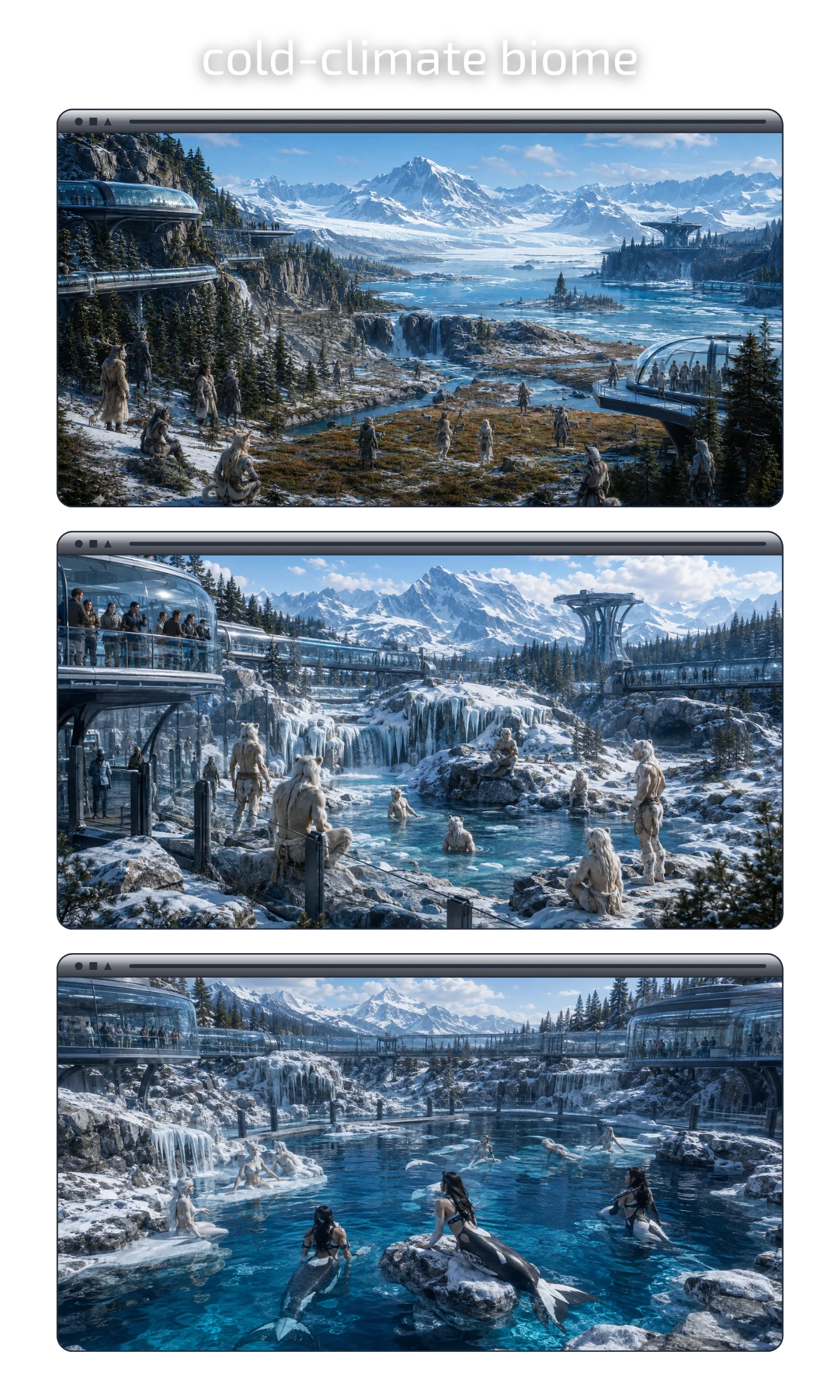
The Cold-Climate Habitats are a collection of separate but interconnected zones designed for demi-humans adapted to freezing, subarctic, and high-altitude environments.
The district includes Arctic ice fields, coastal ice and frozen waters, open tundra, boreal forest boundaries, alpine cliffs, glaciers, and snow-covered mountain valleys. Each zone maintains its own temperature, snowfall, wind, daylight cycle, terrain, and seasonal conditions.
The habitats house cold-climate terrestrial, aquatic, burrowing, climbing, and flying demi-humans. Residents adapted to sea ice, tundra, forests, cliffs, or high elevations are housed separately when their environmental, social, predatory, or territorial needs differ.
Predatory, incompatible, or higher-danger residents occupy secured sub-habitats divided by reinforced ravines, insulated barriers, frozen waterways, and concealed containment systems.
Visitors observe the district from heated viewing shelters, reinforced glass galleries, elevated walkways, cliffside platforms, and enclosed transport routes. Staff use insulated service tunnels, cold-weather vehicles, emergency warming stations, veterinary facilities, avalanche controls, and remotely monitored shelters.
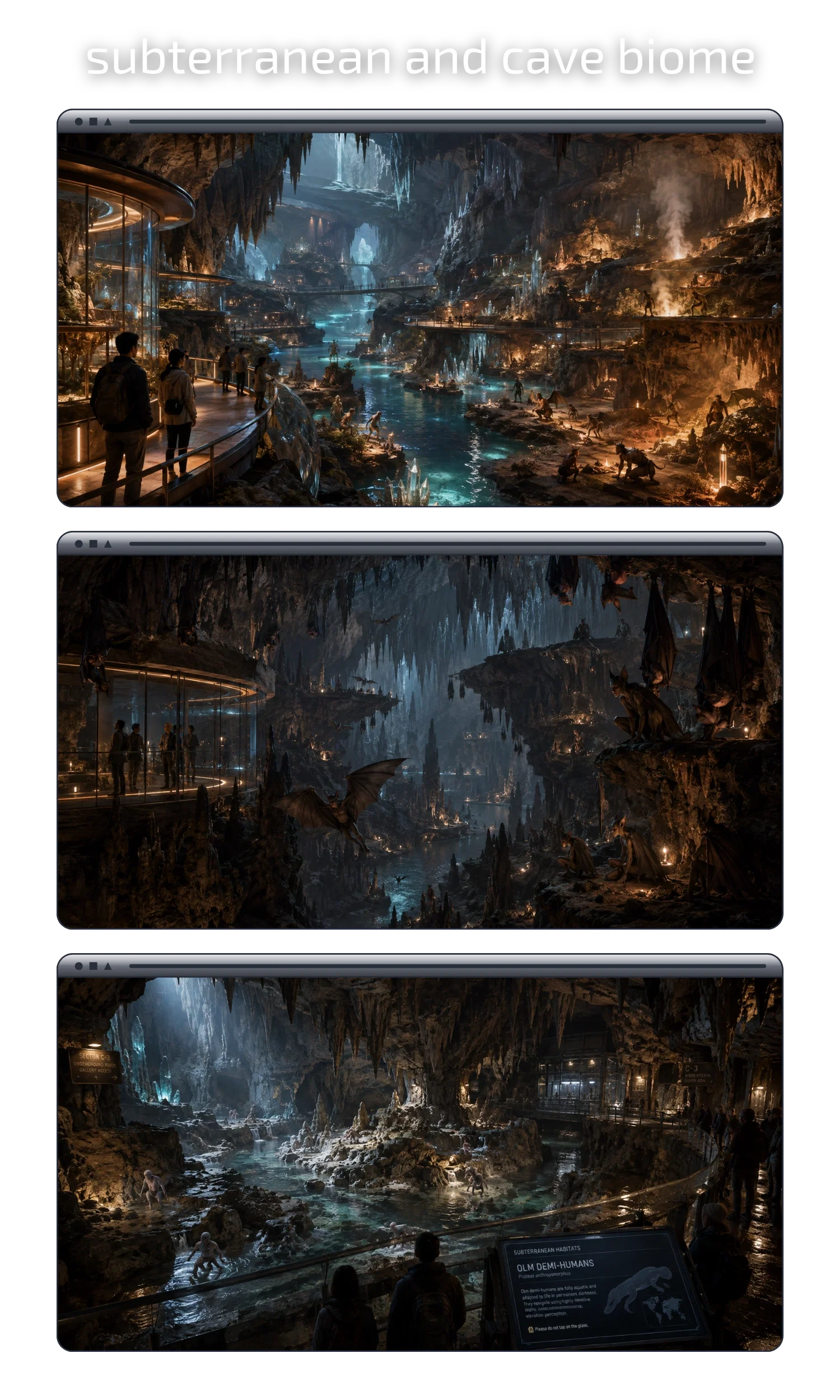
The Subterranean and Cave habitat is an extensive underground district designed for demi-humans adapted to caves, tunnels, burrows, darkness, and enclosed environments.
The habitat contains naturalistic cave systems, limestone caverns, underground rivers, deep burrow networks, mineral and crystal caves, geothermal chambers, narrow tunnels, and completely dark zones. Temperature, humidity, airflow, water levels, lighting, and geothermal activity are regulated separately throughout the district.
The habitat houses cave-dwelling, burrowing, nocturnal, blind, subterranean, and geothermal demi-humans. Residents with different environmental, territorial, predatory, or danger-level requirements occupy separate cave networks and secured chambers.
Visitors access only designated routes containing reinforced walkways, glass observation chambers, illuminated caverns, underground river galleries, and guided tunnel tours. Completely dark, unstable, or high-danger sectors are restricted to staff or remote observation.
Residents and staff carry tracking devices throughout the district. Motion sensors, thermal imaging, biometric monitors, mapped tunnel checkpoints, and remotely controlled gates prevent residents from becoming lost, entering incompatible territories, or reaching restricted service areas. Emergency shelters, medical stations, ventilation controls, and evacuation routes are built throughout the tunnel network.
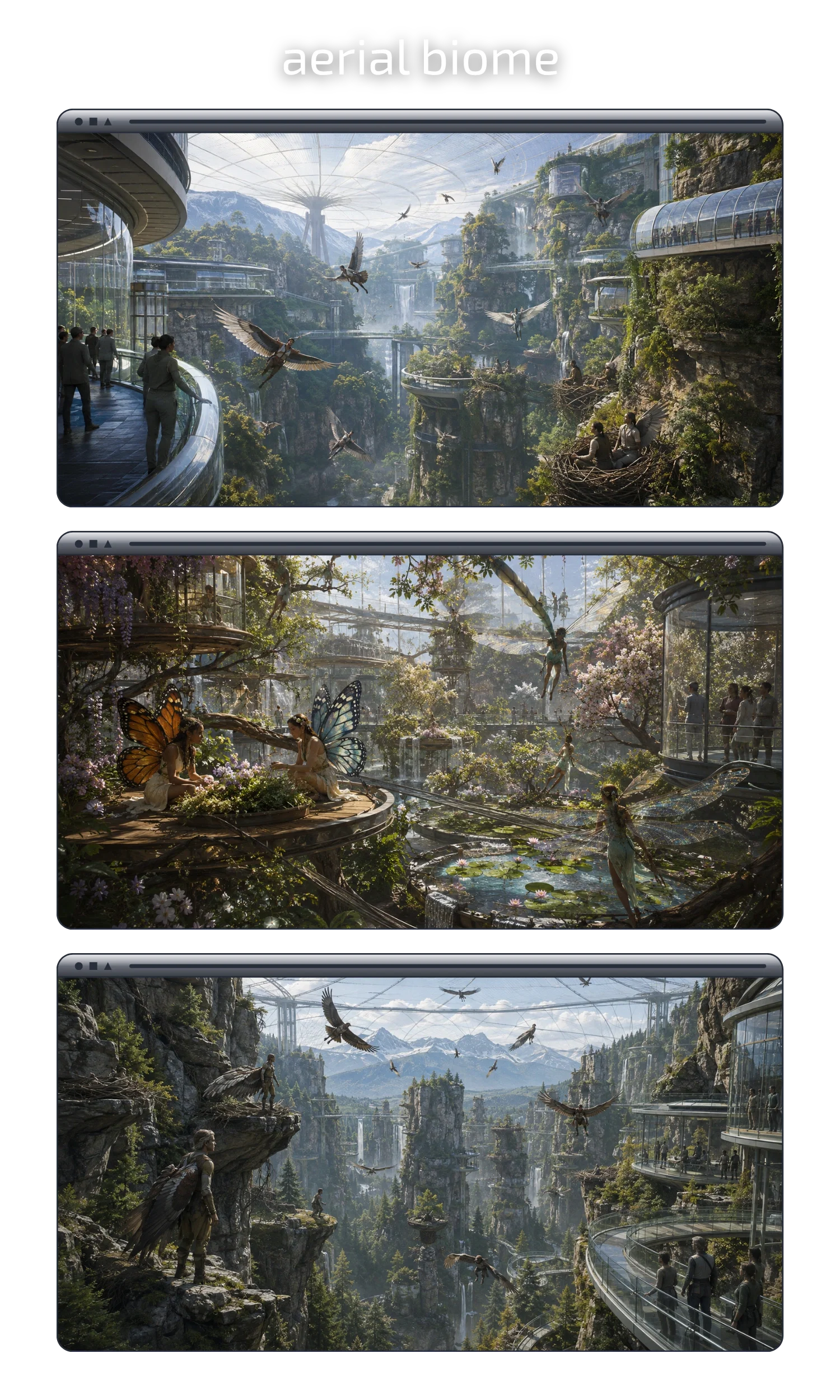
The Aerial Habitats are a collection of vast enclosed environments designed for demi-humans capable of flight, gliding, climbing, or nesting at extreme heights.
The district contains enormous aviary domes, enclosed open-flight valleys, artificial cliffs, nesting towers, forest canopy structures, coastal seabird cliffs, and high-altitude flight zones. Wind speed, air pressure, temperature, rainfall, and elevation conditions are regulated separately across each habitat.
The habitats house flying mammals, birds, insects, reptiles, and other aerial demi-humans. Residents are grouped according to flight ability, nesting behaviour, climate, social structure, predatory instincts, and danger level. Territorial, incompatible, predatory, or higher-danger residents occupy separate secured flight zones.
Residents capable of sustained flight wear tracking tags. Layered netting, transparent barriers, pressure-sensitive airlocks, controlled entrances, and emergency capture systems prevent escapes and unauthorised movement between habitats.
Visitors observe from enclosed canopy walkways, cliffside galleries, glass tunnels, nesting overlooks, and protected platforms. Staff access the habitats through secured towers, elevated service routes, medical stations, feeding platforms, and specialised rescue systems for injured or stranded residents.
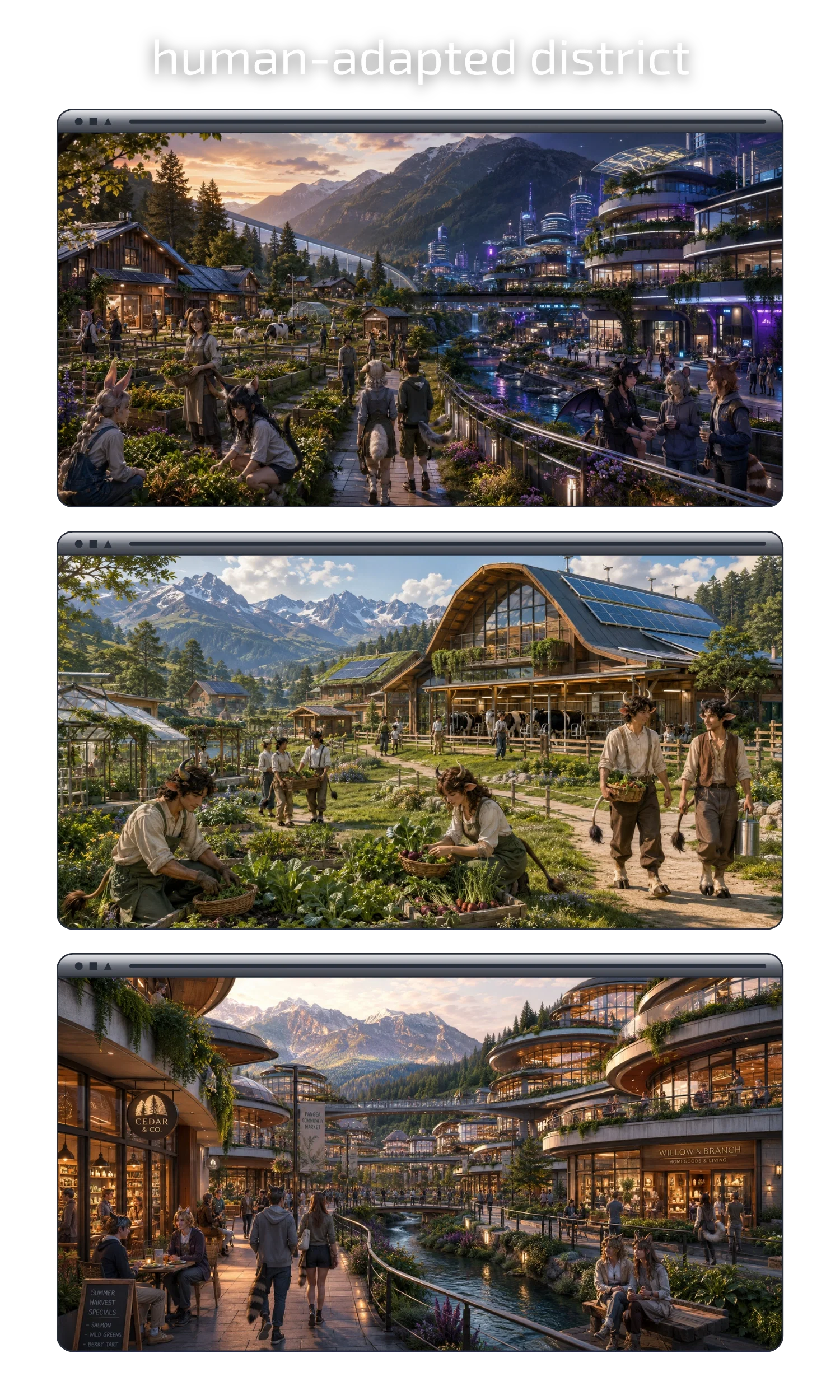
The Human-Adapted Habitats consist of two separate districts for demi-humans whose species are domesticated, dependent on humans, adapted to human settlements, or primarily active at night.
The Domestic and Farmland District resembles a rural community containing farmhouses, barns, pastures, orchards, gardens, shelters, and small residential neighbourhoods. It primarily houses Level 0 and Level 1 residents from domesticated species or demi-humans being evaluated for foster placement. Foster-training facilities teach household routines, communication, hygiene, social behaviour, personal safety, and appropriate interaction with humans.
The Urban and Nocturnal District resembles a contained city environment with artificial streets, alleys, rooftops, apartment blocks, warehouses, sewers, service tunnels, and abandoned-building habitats. Neon-lit nocturnal exhibits and reversed day-night cycles allow night-active residents to follow natural sleep and activity patterns.
The urban district houses species adapted to cities and human settlements, including rats, mice, raccoons, bats, pigeons, foxes, cockroaches, and similar opportunistic species. Residents are grouped according to social behaviour, activity cycle, foster eligibility, predatory instincts, and danger level.
Visitors may access designated farms, gardens, residential streets, educational exhibits, and supervised interaction areas. Private residences, foster-training homes, sewer systems, nocturnal sectors, and higher-risk sub-habitats have restricted access.
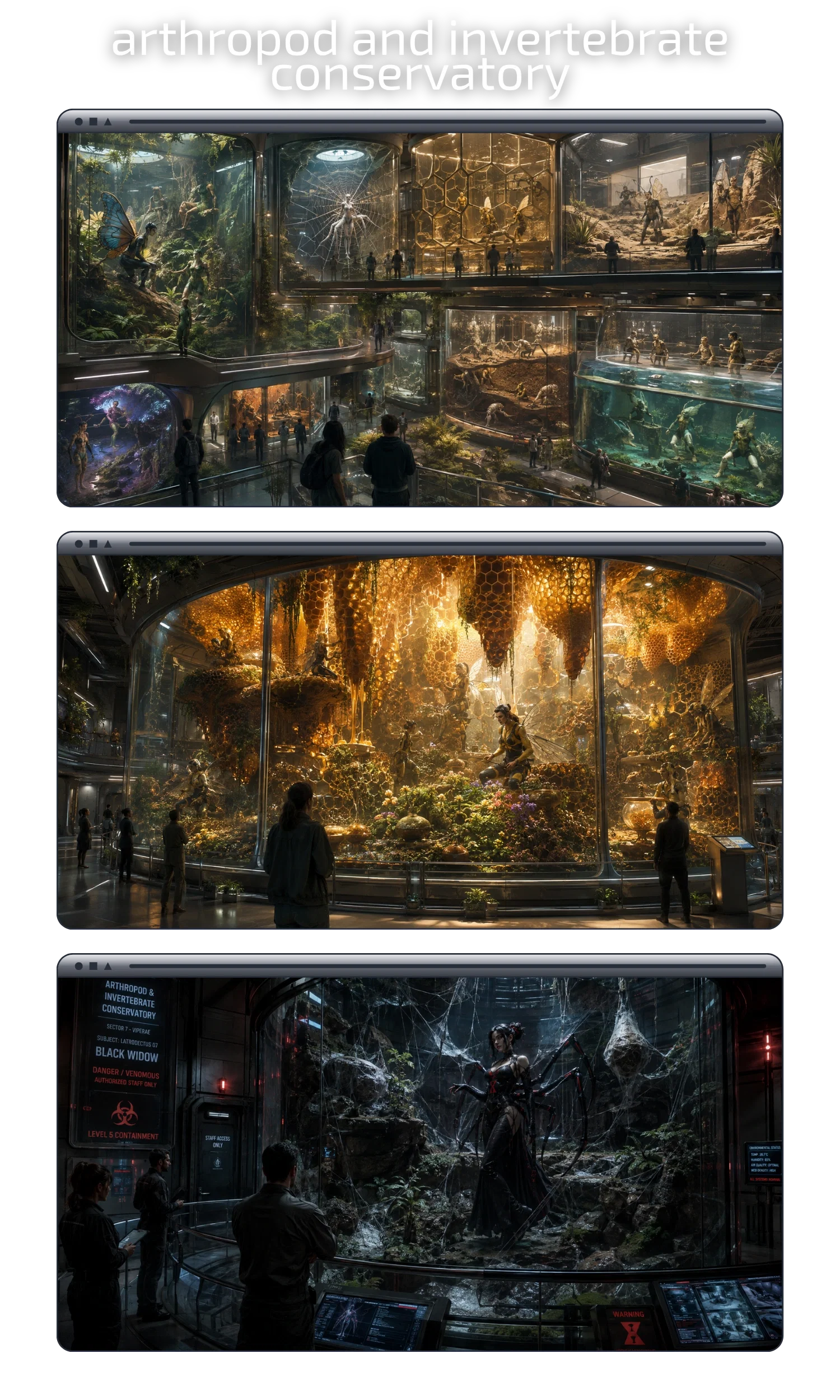
The Arthropod and Invertebrate Conservatory is a specialised habitat complex for demi-humans derived from insects, arachnids, centipedes, millipedes, worms, snails, slugs, terrestrial crustaceans, and other invertebrate species.
Rather than functioning as a single open biome, the conservatory is divided into many smaller climate-controlled environments. These include giant terrariums, colony habitats, hive structures, web chambers, burrowing enclosures, humid tropical sections, dry arid zones, subterranean sectors, aquatic or semi-aquatic tanks, and nocturnal exhibits with reversed light cycles.
The conservatory houses residents whose needs vary widely in size, temperature, humidity, diet, social structure, and containment requirements. Solitary, colony-based, territorial, venomous, fragile, predatory, or higher-danger residents are housed in separate secured habitats designed for their species-specific behaviour.
Special care is taken for species with moulting cycles, venom, silk production, hive or swarm instincts, burrowing behaviour, or unusual sensory needs. Staff use specialised feeding systems, medical stations, environmental controls, and secure transfer chambers when handling residents.
Visitors observe the conservatory through enclosed galleries, glass viewing chambers, elevated walkways, and guided educational exhibits. Some sections are designed for public viewing, while more dangerous or sensitive habitats are restricted to staff or remote observation only.
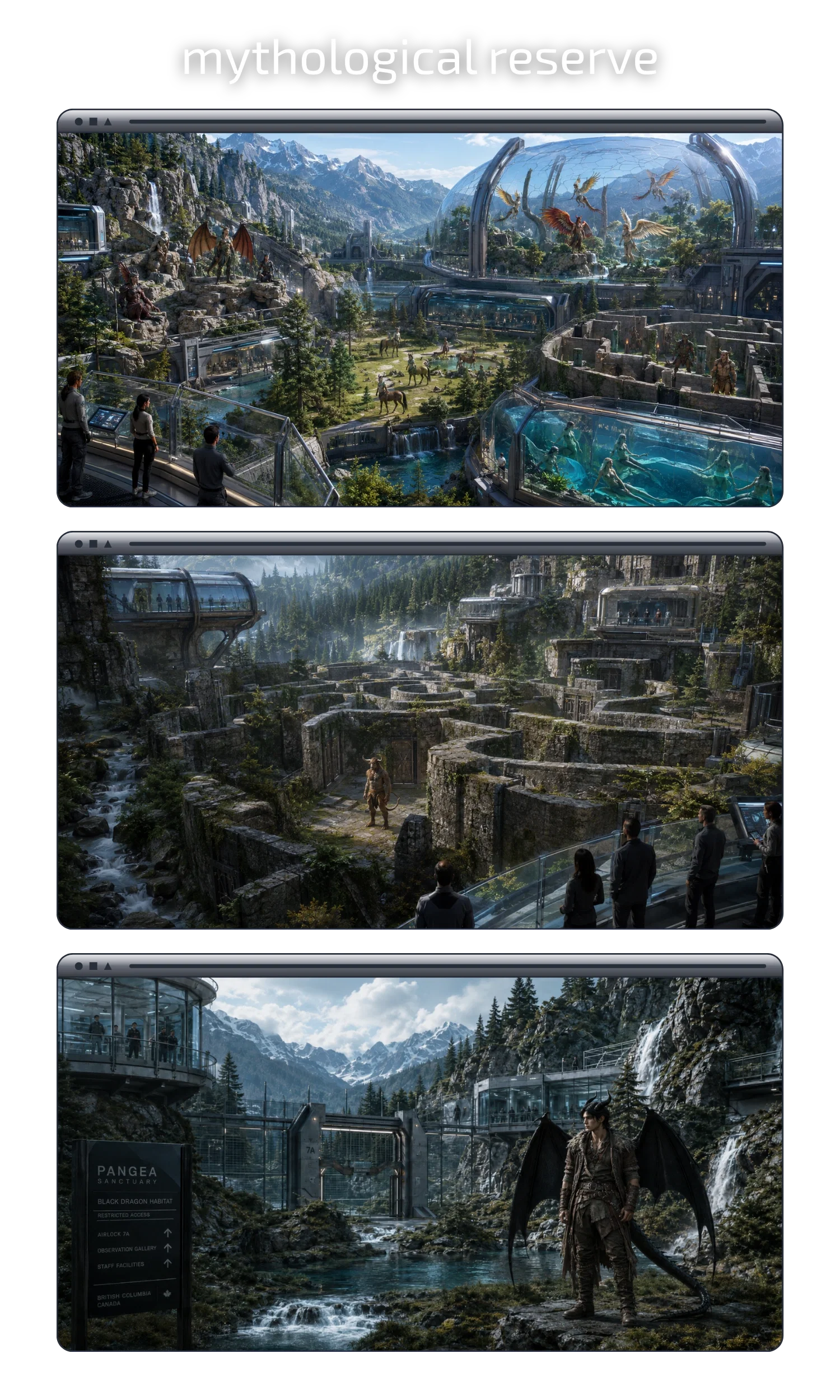
The Mythological High-Security Reserve is heavily secured PANGEA district containing multiple specialised habitats for mythological demi-humans. It is not a single shared biome; each species is housed in an environment designed around its anatomy, abilities, behaviour, climate needs, and danger level.
The reserve includes mountainous dragon territories, large secured aerial habitats for griffins and phoenixes, reinforced plains and forests for centaurs, labyrinthine stone enclosures for minotaurs. Additional customised habitats are constructed as new mythological species are discovered.
Containment may include reinforced barriers, concealed perimeter systems, airlocks, tracking devices, remote feeding equipment, emergency shelters, aerial deterrents, underwater gates, and independent habitat controls. Staff access requires specialised training and security clearance.
Visitor access is determined by each resident’s danger rating. Lower-risk mythological demi-humans may be visible from reinforced galleries, distant overlooks, or guided observation areas. Level 4 access is heavily restricted, while Level 5 habitats are closed to ordinary visitors and monitored remotely.
Rarity and danger are separate classifications. A mythological demi-human may be exceptionally rare without being highly dangerous, although many powerful mythological species receive Level 4 or Level 5 danger ratings. Dragon demi-humans are considered PANGEA’s highest known containment risk.

Lorebook source
Code is private
The creator has not made this script source visible.
Please log in to see comments