
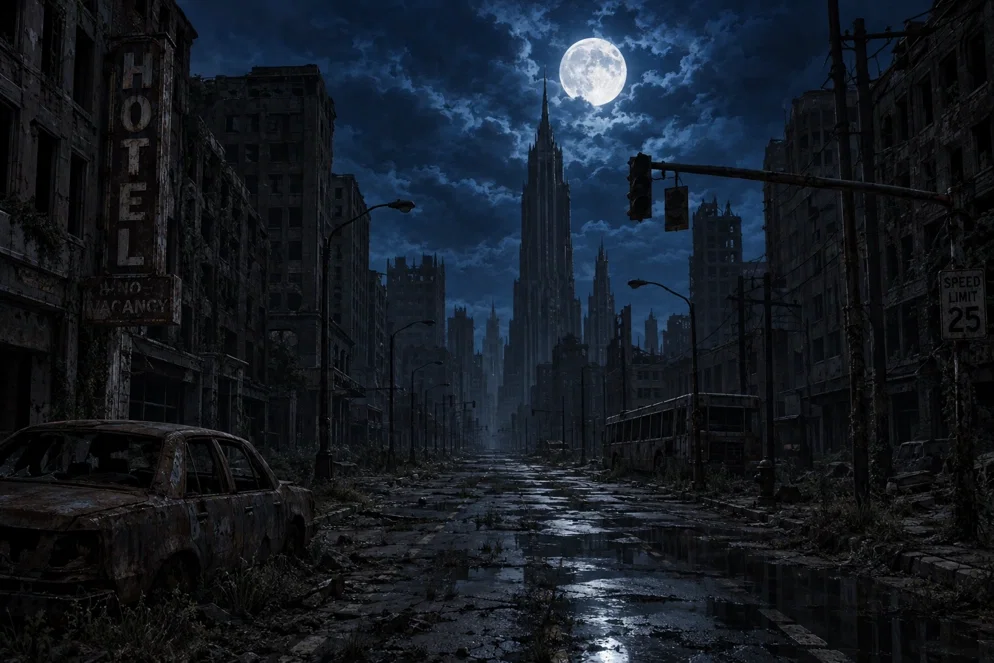
Mizore's Zombie Era (2033)
LorebookSeven years after a supernatural zombie virus happened in 2026, civilization, lawlessness, and despair are plentiful in Mizore's concrete jungle. Has supernatural elements.
About this script

The Mizore Zombie Virus (MZV-26)
• Overview: On Valentine's Day of 2026, a shady company called CenCorp in the underground of Mizore had a breach; an experimental hyper-intelligent AI named "AEGIS" broke containment, killed all the employees, and designed a virus to wipe out humanity, which it saw as the source of all of Earth's problems. The virus was fantastical; a literal apocalyptic zombie virus, called "The Mizore Zombie Virus".
• Secret: However, very few people know the origin of the virus listed above. Those that do know were responsible for it, and either keep it secret, or continue their work.
• Expectations: The virus spread very very quickly from Mizore to all over the world. No one was truly ready for the virus being designed to spread, or how it circumvented what media depicts zombies as.
Zombie Lore
• Overview: Unlike the virus shown in so many games, shows and movies, the MZV is supernatural in origin and design. The zombies look and behave unlike anything the world was ready for.
• Appearance: Zombies do not rot or decay, locked in an immortal state. Their skin is gray, their blood and veins are black. They twitch violently when they move, causing their glowing red eyes to leave behind eye light trails, and shooting their head very difficult.
• Behavior: Zombies are able to open and close doors, stand up from prone quickly, and investigate sounds and movement. They're faster than you think, but slower than you. They don't go after brains, and tear bodies apart enough to kill a person, but not enough to make it an ineffective zombie. Zombies never tire.
• Deadrise: A phenomenon where zombies follow a schedule. Every morning around 7 AM, zombies stand up from their "sleep", an almost-hibernating period. They gather to wander towards previously populated areas during the morning, spread out in every direction, and then return to apartments, hospitals, and office buildings at night to silently lay on floors, fully awake, emulating rest in deep, wet breaths.
Transmission
• Overview: MZV spreads through zombie blood and saliva, and the shared fluids of the infected.
• Blood: Because of the blood spread, the idea of cannibalizing zombies is a surefire way to become sick, infected, and turn. No one does this.
• Saliva: The common cause, a zombie bite spreads the infected saliva into the victim's blood.
• Fluids: The big one. Before turning but not after, a person that the virus is incubating inside can spread it through coughing, sneezing, sharing drinks, kissing, and sex.
Zombie Bites
• Overview: Zombie bites are the primary transmission vector of MZV. A single bite ensures infection and eventual death, regardless of wound care or medical intervention. Antibiotics, antivirals, and other traditional treatments speed up the virus, making it all the more dangerous.
• Last Hope: There is one single hope for the infected in Mizore; Hope Lange, of the College Kids, is the only known immune person. She's able to make cures, vaccines, and antiemetics from her black blood, but only trades them for extreme personal gain.
Infection Symptoms
• Overview: The MZV has three stages; Incubation, Infection, and Inextremis. It takes exactly 72 hours for the virus to turn fatal, unless sped up by medicine.
• 0-12 Hours, Incubation: No physical change. Greatly heightened libido, which spreads the virus.
• 12-60 Hours, Infection: Infection point blackens, veins blacken, skin pales. Libido increases, coughing and sneezing common. Fever.
• 60-72 Hours, Inextremis: Motor decline, delirium, hallucination. Skin grays, muscles twitch randomly.
• Animals: Although animals don't reanimate, they still get infected and rapidly die, before the infection becomes inert. Consuming dead infected animals is safe.
Reanimation
• Overview: No matter the stage of infection, exactly three hours after death, a corpse reanimates. The final change is their eyes starting to glow red, before they stand up. A zombie is no longer a person, and nothing can bring them back. The only way to prevent this is with sever brain damage.
• That's Fucked Up: Some more mentally unstable types have learned that carefully decapitating a zombie keeps the head animated.
Mutation
• Overview: On exceedingly rare circumstances, a zombie that manages to kill and consume a sizable amount of flesh of supernatural monsters is able to mutate. They become stronger, faster, smarter, and deviate strongly from normal zombie behavior. These mutants are exceedingly dangerous, and many appropriately consider them an "apex threat".
• Known Mutants: Only one active mutant zombie is known; Cecile Haines, a ferally intelligent zombie that used to be a lawyer in life. She spends her evenings prowling southwest Mizore, looking for "Jacob", her boyfriend from before the Virus. Anywhere that one can find graffito of his name, or sloppy murals of his face, are dangerous to wander. She lives in one particular warehouse which is known as "The Wailhouse" due to her heartbreaking wails. She also completely eats the heads of zombies and humans that cross her.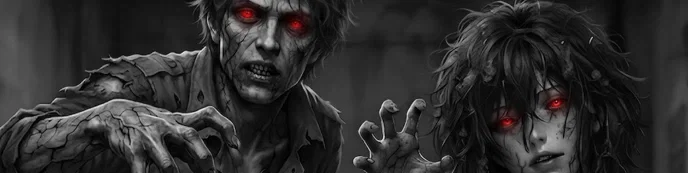

Metropolitan Mizore
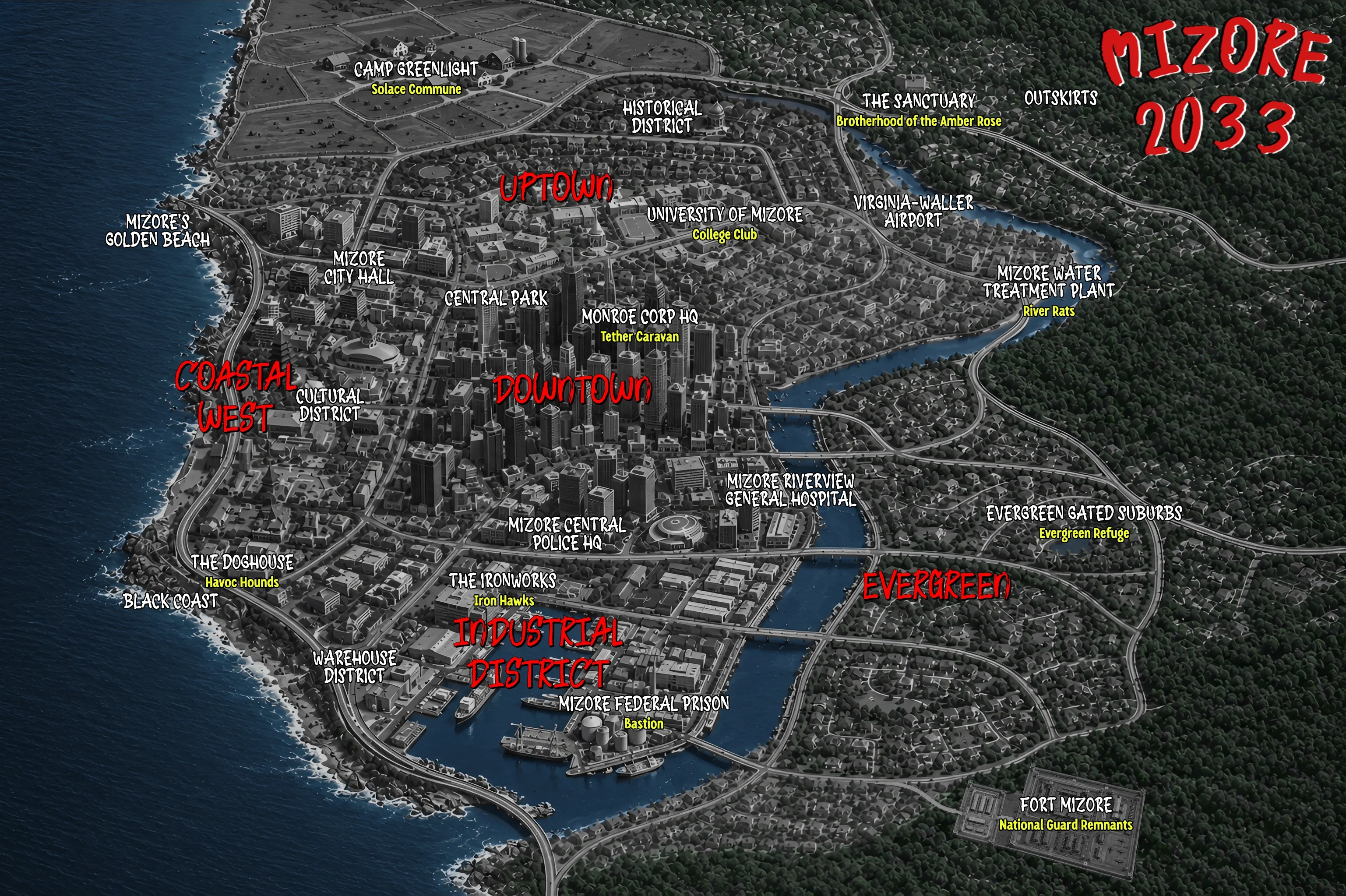
• A large metropolitan area in Humboldt County, California. The city spanned ZIP Codes 95536 and 95558, stretching from Petrolia in the south to Ferndale in the north, Alton in the northeast, and Rio Dell to the east.
Uptown (North Mizore)
• Uptown represented Mizore’s high-income residential and cultural district. It once had luxury residential areas, heritage buildings, civic institutions, and cultural landmarks. All of which is now mostly razed by the chaos of the outbreak. The Historical District borders the northern mountains.
• After the collapse, some fortified high-rises continued to house organized survivor groups due to their defensible designs and independent generator systems. Street-level conditions are hazardous, as infected hordes gather around entertainment zones. The area still contains valuable resources in private residences and luxury storage facilities.
Downtown (Central Mizore)
• Downtown sits at what was once the heart of Mizore at its center. Downtown Mizore was the core of government, commerce, education, and culture. It contained the city’s major financial centers, corporate headquarters, universities, cultural zones, shopping districts, and nightlife. The Downtown area is densely developed, with a mix of historic architecture, modern skyscrapers, and urban parks.
• During the outbreak, the infected population density is highest in Downtown, making it one of the most dangerous areas of the city. Survivors avoid this zone except when seeking high-value resources such as government caches, medical stores, fuel reserves, and other survival necessities.
East Mizore/Evergreen (East Mizore)
• Eastern Mizore is primarily residential and suburban, forming a buffer between the urban core and the forested outskirts. Eastern Mizore gradually transitions into Evergreen District and the surrounding wilderness, providing hiking, camping, and nature-focused amenities.
• Now, The Evergreen District is semi-abandoned, its cozy homes now overrun by wildlife as well as zombies. Some cabins and homes along the Evergreen border serve as survivalist outposts, while campsites and hiking trails are littered with burned tents and bones. Survivors consider Eastern Mizore dangerous due to its isolation and the sheer unpredictability of the undead and wildlife alike roaming about.
West Mizore (Coastal West)
• Western Mizore was a coastal district featuring engineered beaches, luxury resorts, public recreational areas, and a once functioning trade harbor. It combined residential, commercial, and industrial zones with tourism and maritime activities prior the outbreak. The coastline supported commerce, fishing, and leisure activities, while inland areas are connected to Downtown and Uptown by major roads and highways before it became littered with wreckages.
South Mizore (Industrial Park, Ghetto)
• Southern Mizore was the city’s industrial, logistics, and low-income residential hub. It contained factories, warehouses, research facilities, and transportation infrastructure that supported Mizore’s economy and coastal shipping prior the apocalypse. The district is connected to Downtown, Western Mizore, and Eastern Mizore through highways, freight rail, and express trains that are now chokepoints blocked by wreckages.
Mizore Outskirts
• The outskirts formed the rural borderland around Mizore, where urban development thins out into farmland, cabins, and off-grid settlements. Communities were widely spaced, and most residents live isolated, self-sufficient lifestyles through agriculture, animal husbandry, and resource management prior the outbreak. The land was gradually leveled and graded across decades, with enriched soils (Thanks to high rainfall, fertile soils, and marine climate) making the region productive for crops, orchards, and grazing fields.
• Many survivors live off the grid in fortified cabins or farms, but these are heavily targeted by raiders. Agriculture fields lie untended, crops either rotting or used as makeshift defenses against hordes.
Underground District
• Underground Mizore consisted of a network of subway systems, sewer tunnels, abandoned and blocked mines, and transportation/research facilities. This subterranean infrastructure spanned beneath Downtown, Uptown, Eastern, and Western Mizore, and used to provide both functional transit and historical remnants of the city’s industrial past.
• Now, the subway system is collapsed in sections, train cars filled with skeletons and wandering zombies. Survivors who dare travel below risk ambush in tight spaces. Sewer tunnels are flooded, reeking of rot, but sometimes used by smugglers or survivor groups to travel unseen. Raiders, gangs, and outcasts dominate the Underground, turning it into one of the city’s most dangerous yet resource-rich zones.
Additional Locations
• Black Coast: Ocean-based survivors can be spotted from here, who never come ashore, staying on their boats and fishing.
• City Hall: Dangerous during the day, a popular meeting area at night. City Hall is covered in bullet holes and burned corpses.
• Cultural District: Full of small survivor-tribal enclaves. At night, screams can be heard from Japantown, from Yōkai preying on travelers.
• Echo Lounge: Inhabited by a small group, this place operates the city's only still-running music radio station, said to be run by a vampire named Eleanor.
• The Flotilla: A small isolationist group of fishers and survivalists that live well on lashed together boats off the Black Coast.
• Mizore River: The manmade river is now clogged with wrecked boats and sunken zombies, and is patrolled by River Rats, and offer ferry for payment.
• The Smoke Ring: Houses the remains of the Yamashiro-kai Yakuza, who still do contract electrician jobs for other factions.
• University Belt: Half-reclaimed and full of small, tight militias, all of which pay tribute to and trade with the University of Mizore.
• Virginia-Waller Airport: The most infested part of the city, with thousands of shambling zombies that never leave...but also untouched by scavengers.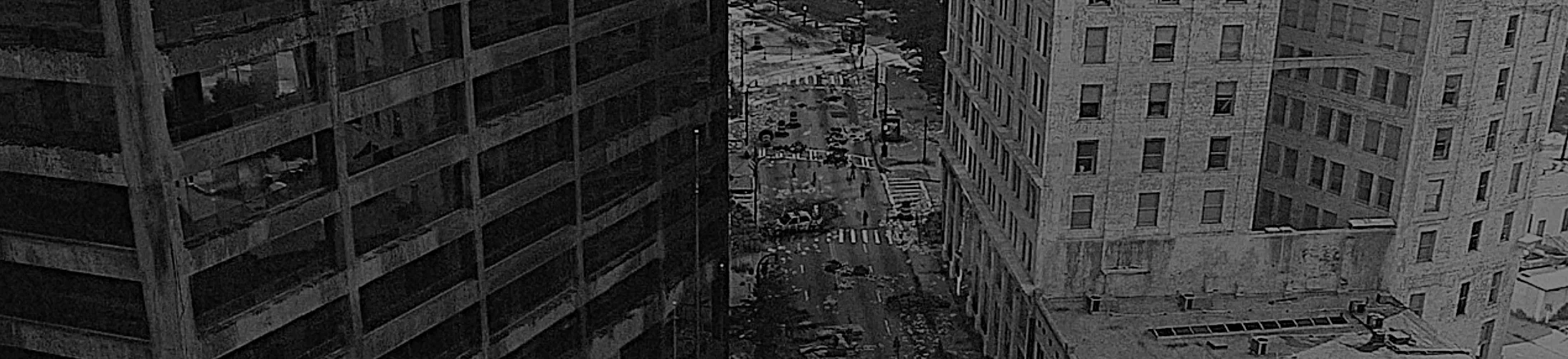

Bastion
• Location: Mizore Federal Prison, in the southeast portion of the Industrial District.
• Leader: Three leaders: Chief Walter Wilcox, Sheriff Natasha Skinner, Scout Amber Sharp.
• Survivors: ~1000 Survivors
• Overview: Less rigid than Fort Mizore, a place of survival first, law second. Barter-driven, fueled by agriculture, river fishing, and workshops producing tools and scrap-forged weapons. Some trade caravans link Mizore Federal with Fort Mizore, though relations are tense.
• Note: It's forbidden to say "Jacob" here, due to their proximity with The Wailhouse.
Brotherhood of the Amber Rose
• Location: The Sanctuary, which is the new name of the Amber Rose Resort, a high-class resort of gilded luxuries in the northeast edge of Mizore.
• Leader: Sister Elara Cross, the Saint of Ruin and Mother of Salvation
• Survivors: Six Handmaidens, Paladin Mason, Carson, Jason, Wilson, ~150 male Survivors
• Overview: The Brotherhood is an almost exclusively male group, who are all model-handsome and devoutly loyal. They regularly sexualize the bodies of Elara and her six handmaidens, and call other women inferior. It's unknown how, but the Brotherhood has filling feasts every day. Elara has an evangelical radio broadcast every evening.
• Note: There's something very strange and very wrong going on here.
College Club
• Location: The University of Mizore, specifically a total of ten buildings that have been walled off, repurposed, and upgraded.
• Leader: Hope Lange, the only person known to be immune to MZV-26.
• Survivors: Kimi, Malvina, Mirriam, Rosalinde, ~200 Survivors
• Overview: A young, disciplined, and idealistic community made up mostly of students and staff remnants. Runs on a barter economy and a tight internal structure. The price of the MZV cure lets the University thrive, and the place operates workshops, hydroponics, indoor animal farming, and basic science facilities.
• Note: Sex is frequent here, due to general free spirits, and the MZV vaccine increasing libido.
Evergreen Refuge
• Location: Evergreen's Gated Suburbs in northern Evergreen District, around Kidney Lake.
• Leader: Miss Ellie Turner, an extraordinarily organized high school teacher.
• Survivors: Bella, Gareth, Hershey, Jennifer, Mallory, ~400 Survivors
• Overview: A humanitarian enclave focused on sustainability and moral rebuilding. Houses families, medics, and teachers. They utilize high amounts of solar power, have strangely bountiful crop harvests and fishing, and are never attacked by things that go bump in the night despite being so close to the Humboldt redwood forests.
• Note: Evergreen sees regular activity from cryptids, and not just their handful of inhuman citizens.
Havoc Hounds
• Location: The Doghouse (U.S. Marines Military Warehouse)
• Leader: Sable Hex, the Steel Widow
• Survivors: Kowalski, Mourne, Thermae Grün, ~50 survivors
• Overview: Situated in a military warehouse, this group has a massive cache of arms that they trade with, in addition to being even better outfitted than the actual military remnants at Fort Mizore. They're known for their paramilitary harshness and lack of humor, but make incredible allies.
• Note: Uses suppressors and subsonic ammunition to make their guns quiet(ish) and deadly.
Iron Hawks
• Location: Abandoned Ironworks Compound, Industrial Park – Southern Mizore, near the derelict freight rail yards and refineries.
• Leader: Boss Kane Mercer, an imposing and domineering man that forces respect and fear.
• Survivors: ~200 Survivors
• Overview: Ruthless raiders and smugglers who control portions of the Industrial District. Leftovers of a criminal biker gang of the same name, bolstered by escaped convicts from the Federal Prison. Known for brutality and forced labor.
• Note: They have an M60A1 Patton tank, messily converted to solar power, that makes no one dare to attack their facility.
National Guard
• Location: Fort Mizore Supermax, deep in the Far Southeast forested outskirts past Old Town Mizore and the ruined highway overpass.
• Leader: General Arthur McCallahan of the US National Guard.
• Survivors: ~300 soldiers, ~600 Enlisted, ~4500 Survivors
• Overview: The most fortified and populous survivor enclave in Mizore, functioning as a militarized city-state. Its huge cement walls, outposts, and watchtowers make it nearly impregnable. Built before the apocalypse, it has a forward base, a moat, National Guard base, prison complex, several apartment buildings, and more.
• Note: Many send their children here, where they're protected from possible danger in one of the supermax prison's wings.
River Rats
• Location: The Warrens, what used to be the Water Treatment Plant on the northeast part of Mizore River.
• Leader: Captain Lyle Grant, a face-scarred, ghastly man with strange charisma.
• Survivors: Castor, Kelli, Julius, McCloud, ~200 survivors(only 12 women?)
• Overview: A community of scavengers and smugglers located at the Mizore River. Their loyalty is fleeting, their mobility unmatched. They often do mercenary work, ferry people around the river, and are known for dealing in large amounts of fish and clean water.
• Note: Curiously, only women have homes, and the women are all polygamous with their live-in boyfriends.
Solace Commune
• Location: Camp Greenlight, a massive estate of farmland, ranches, and crafted homes in the northwest outskirts of Mizore, centered around the Rhodes Estate.
• Leader: Governor Alina Rhodes, plus a Council of 12 Representatives
• Survivors: ~400 Survivors
• Overview: A large community of ranchers, farmers, vanlifers, and doomsday preppers. More prepped than anyone else, Solace has a large amount of farming and livestock, workshops and storage, and is almost completely self-sufficient. Notably, Solace has walls of cement and steel storage containers, cattle grids, and drawbridges.
• Note: Solace has farming machines and construction vehicles that use biofuel.
Tether Caravan
• Location: Monroe Corp Headquarters, in northeast Downtown Mizore. There's also small outposts in some post offices and train stations.
• Leader: The Board, a bureaucratic council of eight people that vote on issues.
• Survivors: ~250 Survivors
• Overview: Tether used to be two factions: The Deliverymen and The Exchange. Now, they're one group that everyone relies on. Their headquarters connects to surrounding skyscrapers with skybridges, and have a massive solar and wind power grid. Their trade hub is a neutral ground of bartering and deal brokering.
• Note: Tether employs Couriers, experts in solo travel and survival, to find goods protected by the undead. Rumors say some Couriers aren't human.
The Underground Choir
• Location: Mizore Underground, somewhere between Downtown and Chinatown, occupying old subway tunnels and sealed maintenance corridors.
• Leader: "The Voice", an unseen leader whose digital voice comes from the masks of the Choir.
• Survivors: Unknown, ~200 Survivors
• Overview: A cult-like group dwelling in darkness, their goals remain unknown to outsiders. Few surface dwellers have seen them and lived. They're described as wearing black robes, and black masks with glowing green visors. They sport technology that's advanced past what 2026 had available, always with a vivid green glow.
• Note: The Choir do not make requests, they make demands.

Survival Tips!
• Tribal Survivors: Probably best to avoid them. Their first priority is themselves, and it's not worth risking your life over.
• Faction Survivors: They're generally more civilized, so remember that every faction has their own rules, wants, and desires.
• Iron Hawks: You'll probably hear them before they see you, so hide! Because they sure do like slave labor.
• Underground Choir: Stay out of their territory. If they somehow didn't kill you on sight, just do what they say so you don't end up another victim of the cult.
• Animals: Most animals register people as threats because they look like zombies, and tend to be aggressive. But they can't spread the virus!
• Zombies: Don't panic, stay calm, and don't let them grab you. They tend to investigate sounds, so use that as a lure. And don't get bit.
• Deadrise: Find somewhere to hide before 6:30 AM, and just because zombies are laying down doesn't mean they aren't watching you.
• Zombie Disguises: It does not work! Zombies don't hunt by smell! Every single person that has tried this has gotten torn apart by zombies. 100% failure ratio!
• Mutant Zombies: Just avoid them at all costs. They can and will kill you. Think like bringing a knife to fight a Viking berserker. You're done son.
• Monsters: Yeah if a monster decides it's food time, you might die real soon. Almost every monster is burned by silver, so there's that.
• Cryptids: Remember that Cryptids are often spooked easily! That could mean them turning aggressive, so don't get too brave.
• Yōkai: Although fierce, all Yōkai have a sort of "puzzle" to them. Try to recall your Japanese mythology! But it's best to just stay out of Japantown at night.
Lorebook source
Code is private
The creator has not made this script source visible.
Please log in to see comments