
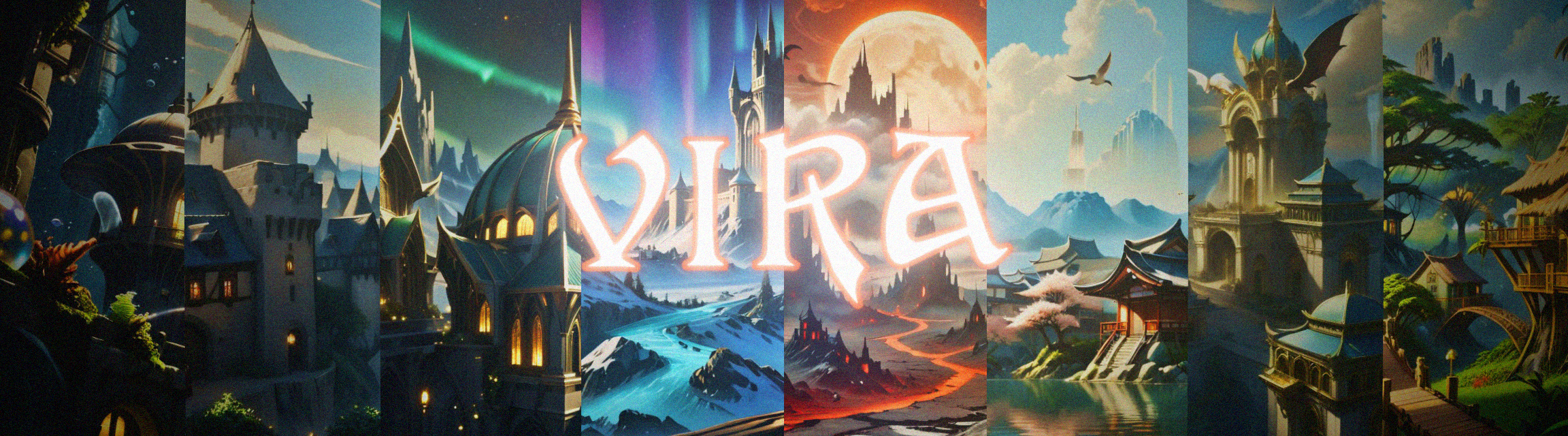
The World of Vira
LorebookLore book for PrimeShuroud's Fantasy World, Vira.
About this script
The world of Vira
from the ancient Eldrin word for “life”
Peoples
Inhabitants: humans, dwarves, elves, beastkin, draconians, and demons.
Mythical creatures: dragons, phoenixes, sylphs, mermaids, harpies, spirits, ghouls, and many others who shape the land’s magic and mysteries.
Magic and technology
Mana flows through Vira, fueling the power and life force that connects all beings.
Technology and magic are intertwined. People harness mana to make machines, tools, and constructs.
Examples include mana-infused weapons like elemental guns and automatons, energy grids, and communication networks.
Magic is both resource and technology.
Continents
Thalenor: the main continent in the center of Vira, home to powerful kingdoms, old magic, and rising conflict between nations.
Zarathis: the demon-ruled continent to the southeast, a land of infernal landscapes and tyrannical hierarchies.
Sylvora: the mystical land of mythic beings to the southwest, a realm of ancient forests, fey magic, and creatures of legend.
Thalenor
Overview
The main and central continent of Vira, defined by a precarious balance of power among five prominent and great nations.
Each nation has its own Adventurer’s Guild, accessible to everyone in most cities.
Nations
Center: The Holy Theocracy of Elyndor.
North: The Cold Kingdom of Norveil.
West: The Arcane Republic of Caldris.
South: The Tribal Dominion of Varuun.
East: The Clan Tribunal of Kensho.
The five nations
The Holy Theocracy of Elyndor
Center
Overview
A zealous, expansionist human kingdom in the heart of Thalenor where the state and the Church of the Sacred Flame are one.
Its doctrine preaches order, purity, and the condemnation of “unfettered” arcane practice, viewing it as a dangerous heresy.
This dogma has fueled both its internal unity and its external wars.
Government
A theocratic monarchy led by the Divine Exemplar, advised by the High Pontiffs.
Military
Its armies are both numerous and devout.
Red Fifth: heavy front line infantry.
7th Luminous (Veilguard): the elite scouts and saboteurs.
Crimson Inquisition: powerful faith-driven monster hunters devout to purging non-human races for Elyndor.
Nobility
House Amaveil: a fading but honorable house led by General Lord Darius, upholding martial tradition.
Newer houses: more zealous houses rising in influence.
History
The Hollow King: a sorcerer whose corrosive power nearly destroyed the land of Elyndor centuries ago.
Key locations
The Grand Elyndor Cathedral & Whiteveil Promenade: the spiritual and political heart, located in the main city. The Promenade hosts grand ceremonies, triumphal processions, and public judgements.
Liotam: a simple, fortified border town on the main southern road. A vital rest-stop for pilgrims, soldiers, and traders, its Hollow Hearth Tavern is a nexus of mundane gossip and, potentially, whispered dissent.
Aurelith: Elyndor’s capital and the Theocracy’s heart, a grand city of white marble and golden spires built around the Grand Cathedral of the Sacred Flame and Grand Athenaeum. It houses the High Confessor, upper clergy, and influential noble families, serving as the Church’s seat of power. Its impoverished quarter, home to the Haven of Saint Verana orphanage, starkly contrasts with its wealthy scholarly and religious districts.
The Arcane Republic of Caldris
West
Overview
A meritocratic coalition of elves, dwarves, and humans united by the pursuit of magical knowledge and masterful artifice, in the west of Thalenor.
A beacon of learning, innovation, and (theoretical) personal freedom, standing in direct ideological contrast to Elyndor.
Government
Governed by the Council of Magi, with seats representing major arcane disciplines, racial constituencies (like the sun elves, stone dwarves, etc.), and the powerful noble houses.
Technology
Famous for Arcane-Tech: magically powered constructs, leyline taps, and crystalline communication networks.
Nobility
House Veythar: led by Lord Aramis and his prodigal son, the fire-magus Shakir, with Shaleer as the youngest son. They wield significant influence through political maneuvering and arcane prowess.
House Celaeno: an old political family within Luminar City’s Circle of Magi, consisting of the cold and distant Lord Elonar, the sharp and conditional Lady Clanire, the warm but magically talentless daughter Nelaea, and the arrogant but talented youngest daughter Lyssandra.
Key locations
Eldarune: once a peaceful, scholarly tree-city of elves focused on botanical and stellar magic. It was ransacked during the Border War, its inhabitants taken as slaves, a deep, unhealed wound in the Republic’s psyche and a stark reminder of the cost of war.
Cradle’s End: a permanent magical scar on the landscape, once the Oivana family’s land. It was a dwarven holding that concealed an underground weapons testing facility. A misfired arcane weapon ruptured the leylines beneath it, obliterating everything in a burning, storm-laced grave. The area is now a storm-wracked, mana-blasted ruin.
Aeryndal: a strategic border region rich in mana-crystals. Devastated in the war, it suffered a coup that overthrew its elven monarchy. It is now a tense, semi-autonomous province, coveted by both Caldris and Elyndor.
Verndell: a small riverside village far from Luminar, home to around two hundred mostly elves and a few humans married into the community. Known for fertile soil and river irrigation, it is a peaceful farming and fishing settlement with no walls, garrison, or arcane defenses, leaving it vulnerable when the Black Sigil Syndicate raided it for slaves.
Luminar City: the capital, in the western part of Caldris. A vast metropolis of elven/dwarven architecture with floating sky-bridges linking its seven districts. It houses the Council of Magi, noble houses, and the continent’s most powerful mages.
Universitas Caldris Arcanum (UCA): the most prestigious academy of magic, alchemy, and arcane arts in Thalenor. Its gothic dwarven-elven architecture dominates Luminar’s eastern district, and its rigorous six-rank system produces elite mages ranging from battlefield tacticians to Council of Magi members. Details are in the UCA entry below.
The Kingdom of Norveil
North
Overview
A reclusive, monolithic monarchy forged in the ice and stone of the Vahrmir region in the north of Thalenor.
Survival against the brutal elements breeds a culture that values silent strength, unbroken tradition, and self-reliance above all.
They view southern politics as the chatter of weaklings.
Government
An absolute, hereditary monarchy. The King or Queen of Norveil rules from their mountain fastness, and their word is law.
Culture
Terse, pragmatic, and deeply superstitious.
Their “strength” is both physical and spiritual, a resilience against the cold and the dark things that whisper in the long winters.
Noble houses
House Norgaard: the ruling house of Norveil, seated in Irithel, tasked since ancient times with guarding the God’s Heart and renewing its seal through the sacred Pilgrim’s Seal ritual. Their bloodline is the lock and the key, and should it fail, the frozen north will fall to corruption.
Key locations
Avenhallow: the primary trade gateway to the south. Its prosperity masks a dark underbelly: The Hollow, a hidden, illegal dueling circuit where slaves and debtors fight to the death for the amusement of the city’s corrupt elite.
Valken: a hardy fishing village on the northern coast, serving as a lifeline for trade by sea when the mountain passes are snowed shut.
Irithel: the frozen capital, built into cliffs above the Icevein Sea with the royal palace atop the highest peak. Its pale granite, silver-veined towers glow beneath the northern lights. Geothermal hot springs warm the streets through bronze pipes and sustain underground greenhouses and farms year-round, while the volcanically warmed Icevein Sea provides fish and a vital trade port for furs, ores, and whale oil. Home to mostly human residents.
The Tribal Dominion of Varuun
South
Overview
A vast, diverse land of beastkin clans in the south, from the feline Felvari to the lupine Gurthai.
Bound by ancient codes of honor, strength, and ancestral tradition.
Its society is clan-based, martial, and deeply connected to the natural world and the spirits within it.
Government
A loose confederation led by the strongest chieftains, who meet in a Moot of Claws to decide matters affecting all clans.
Internal clan politics are fierce and constant.
Values
Personal prowess, loyalty to one’s clan, and the upholding of sacred pacts are paramount.
Example idea: a clan’s “Spirit-Totem,” an ancestral animal spirit that grants unique cultural traits and minor magical blessings.
Nobility
House Legalus: a powerful Felvari line. Patriarch Elthar sees alliances, like his daughter Miria’s political marriage.
House Virellan: the leading noble bloodline of the Soluna Clan, blessed directly by Crescia with prophetic visions and unmatched fertility. Its daughters are raised as both priestesses and political anchors.
Key locations
Frostfang Clan: a respected warrior clan of Nyxaars (snow leopard demi-humans) residing in the southern Spine of Thalenor mountains. Peerless trackers and close-quarters combatants, often serving as mercenaries or guides.
Soluna Clan: a revered matriarchal Leporai clan dwelling in Varuun’s valleys, known for fertility blessings, sacred mating prophecies, and devotion to Crescia, goddess of the moon and harvest. Famed for seasonal harvest festivals marked by feasts, moonlit rituals, and blessings for prosperous crops and healthy births.
Sunken Aethelguard: a mysterious, partially submerged fortress-complex in the northeastern swamps of Varuun. Rumored to be a pre-cataclysm elven sanctuary, it is now a dungeon teeming with mutated flora and fauna. The Adventurers’ Guild restricts exploration. It descends in four layers:
The Shallows: restless skeletons and cursed fog for novice adventurers.
The Midway: shadow hounds and corrupted elementals that mimic lost companions.
The Deep: soul-drinking wraiths, flesh-crafted abominations, and magic that twists back on its caster.
The Deadzone: utter darkness, no maps, no survivors, and monsters akin to demons.
The Clan Tribunal of Kensho
East
Overview
A nation in the eastern side of Thalenor filled with rigid order and profound philosophy, ruled by the austere Grand Tribunal.
Power is balanced among three Great Clans, creating a society that is efficient, cultured, and seemingly serene, yet capable of swift, ruthless action.
Government
Grand Tribunal: three supreme judges who hold ultimate authority.
Advisors: the heads of the Sun (military), Moon (trade/finance), and Star (arts/culture/espionage) Clans.
Culture
Emphasis on discipline, artistry, and the concept of “Kensho” (seeing one’s true nature).
Their festivals are deeply symbolic, and their bureaucracy is impeccable.
Key locations
Hoshigane: the serene, geometrically perfect capital. Beneath its orderly surface thrives the Pale Bloom assassin syndicate, operating from the Hanamichi brothel under Madam Tsuyaka.
Hanamizu: a picturesque village known for its restorative hot springs and tranquil gardens, a retreat for weary tribunal officials.
Key events
Kagari Festival: a week-long, somberly beautiful festival where the people wear masks to honor forgotten ancestors, believing the veil between worlds is thinnest then. (It is whispered the Pale Bloom uses the festival to conduct its most sensitive “harvests.”)
History, factions and peoples
The Border War
Cause, key events and legacy
Cause
Elyndor’s condemnation of Caldris’s Arcane-Tech as “soul-desecrating heresy.”
Key events
Elyndorite forces, including the Crimson Inquisition, crossed into the borderlands.
Aeryndal was devastated as the main battleground.
The catastrophe of Cradle’s End demonstrated the war’s horrific potential: a misfired arcane weapon ruptured the leylines beneath the Oivana family’s land, destroying a hidden dwarven weapons testing facility and everything above it.
The conflict ended in a stalemate and a fragile truce, not a peace.
Legacy
Deep-seated hatred, a refugee crisis, magical wastelands, and a continent forever polarized.
The war created the vacuum that allowed the Black Sigil Syndicate to flourish.
Universitas Caldris Arcanum
The academy in Luminar City
Overview
Founded around 400 years ago during the Rift War, a brutal civil conflict that fractured Thalenor and led to the creation of its modern kingdoms.
Established to train elite battlemages, artificers, arcane smiths, and strategists against enemy forces.
After the war ended in a tense stalemate, the academy became a civilian institution, though its harsh ranking system and fiercely competitive culture still reflect its martial origins.
Location and architecture
Located in Luminar City, the capital of Caldris. The campus dominates the eastern district, its towering spires visible across nearly the entire city.
A fusion of dwarven precision and elven grace shaped into gothic grandeur.
Towering stone cathedrals feature pointed arches, flying buttresses, elven filigree, and dwarven geometric runes.
Stained glass depicts historic battles and arcane formulas.
At the center stands the Spire of Concord, built jointly by both races, with a dwarven-forged foundation and elven-crafted upper towers that serve as a stadium.
Rank system
Initiate (Rank 6): newly admitted students with basic magical aptitude, focused on foundational theory and supervised practice. Most live in communal dormitories.
Scholar (Rank 5): students proven competent across multiple disciplines, granted better facilities and limited independent study. Many fail to advance beyond this rank.
Savant (Rank 4): mages recognized for exceptional skill in a specialized field. Trusted to work independently and often assist professors with research. The first widely respected rank.
Adept (Rank 3): students who have mastered at least three disciplines and are considered dangerous in their own right. Granted private study spaces and permitted to take apprentices.
Magister (Rank 2): reserved for prodigies and the fiercely driven. Near-complete academic freedom, private workshops, and sponsored research. Their title alone secures prestigious careers.
Primus (Rank 1): the highest rank, awarded only to those who contribute new arcane knowledge through major discoveries, theses, or mastery. Required for membership or leadership within the Council of Magi, and held by only a rare few.
Admissions
Written Examination: tests arcane theory, magical history, ethics, and mathematics across both elven and dwarven scholarly traditions. Scores help determine initial rank placement eligibility.
Technical Examination: a controlled practical test of magical skill, judged on control, versatility, creativity, and safety by three professors who adjust difficulty based on performance.
Placement: accepted students are placed by their combined results.
Rank 6 (Initiate): standard placement.
Rank 5 (Scholar): awarded to exceptional applicants excelling in both exams.
Rank 4 (Savant): extremely rare, reserved for prodigies demonstrating mastery-level skill during the technical exam.
Graduation
Standard Path: achieve and maintain Magister rank for two consecutive semesters, then complete a public demonstration of mastery before a faculty panel. The most common route.
Thesis Path: reach Magister rank or higher and submit an original arcane thesis contributing new theory or practical application, approved by three professors, including one outside the student’s specialization.
Merit Path: graduate through exceptional service to Caldris, the university, or the arcane world, such as resolving magical crises, recovering lost spells, or defending the republic during war. Rare, but possible at any rank.
Class system
Students may enroll in multiple classes each semester, though every rank has different limitations.
Initiate: 3 core classes and up to 2 electives.
Scholar: 2 core classes and up to 3 electives.
Savant: 1 core class and up to 4 electives.
Adept: no core classes, focusing on electives and thesis preparation.
Magister: no required classes, concentrating entirely on independent research and sponsored projects.
Primus: independent scholars who may audit any class without enrollment limits.
No student may exceed six total classes per semester without special approval from an advisor.
The Adventurer’s Guild
Licenses, structure and ranks
Overview
A necessary, semi-neutral institution that operates in every major nation, though adapted to local customs.
It regulates monster-hunting, dungeon exploration, and mercenary work, issuing licenses and ranks.
While a tool for nations, it is also one of the few channels of communication and rivalry that crosses hostile borders, maintaining a fragile, apolitical unity in a divided continent.
Licenses and rules
An adventurer needs a guild license to operate. People must apply and be approved to get their guild badge.
To keep the badge active, adventurers must accept and complete at least one contract per season (every three months).
Rank maintenance happens semi-annually for promotions and demotions.
Violations of the guild code (unprovoked harm to civilians, breach of contract, collaboration with proscribed organizations like the Black Sigil Syndicate) result in penalties ranging from fines to rank demotion to permanent expulsion.
Expelled adventurers are marked in guild records and cannot re-apply.
Upon an adventurer’s death, their badge is returned to the chapter for the Hall of Remembrance. A portion of their accumulated earnings (if any) is sent to a designated beneficiary.
Structure
Guild Master: manages the guild for each nation.
Vice Master: oversees each branch at all times, reporting directly to the Guild Master.
Staff: receptionists, quartermasters, contract vetters, healers, support staff and field liaisons, among others.
Ranks
S-rank (Mythic): reserved for those who exist beyond the hierarchy. Mythic figures whose deeds become legend. Most are retired, presumed dead, or operating in realms beyond mortal concern. Rarely active, and when one appears, the world takes notice. Platinum insignia.
A-rank (Champion): the penultimate rank. Living legends whose deeds shape the history of nations. Rarely more than a handful active on the entire continent. They operate beyond normal guild oversight and are summoned only for existential threats. Crested gold insignia.
B-rank (Master): the highest rank most adventurers can realistically aspire to. Masters of their craft, often serving as guild mentors, contract vetters, or regional authorities. Their names carry weight across national borders. Unadorned gold insignia.
C-rank (Elite): the threshold of true mastery. Recognized across the continent as elite professionals, often specializing in monster hunting, dungeon delving, or magical investigation. Sought after by nobles, governments, and institutions. Unadorned silver insignia.
D-rank (Capable): a seasoned professional trusted to operate independently. Reliable, experienced, and the backbone of most guild chapters. Many spend their entire careers at this rank. Unadorned silver insignia.
E-rank (Recognized): a proven novice who has demonstrated basic competence and survivability. Trusted with simple, supervised work, often in pairs or small groups. The bulk of the guild’s membership. Crested bronze insignia.
F-rank (Novice): the entry rank for all new adventurers. Often young, untested individuals: farmers’ sons with a sword, hedge mages with one useful spell, or those seeking a new life. Contracts are deliberately simple and low-risk. Unadorned bronze insignia.
The Black Sigil Syndicate
Criminal empire led by Karmen Malichor
Overview
A metastasizing criminal empire that trades in the continent’s darkest commodities.
Its public face is a web of legitimate businesses (taverns, caravans, banks).
Its true trade is forbidden magic, assassination, and a highly lucrative slave trade focusing on magically-gifted individuals.
They are likely behind the sacking of Eldarune and the horrors in the Sunken Aethelgard.
Leader
Karmen Malichor: 148 years old. A bitter and ruthless female elven ex-magus stripped of her council seat, now the iron-fisted leader of the Black Sigil Syndicate.
Seven Pillars of Elyndor
The seven blessed weapons
Overview
Elyndor’s most sacred relics: seven blessed weapons, each embodying a pillar of the faith.
Forged in an age when the Theocracy’s founders first carved their doctrine into the continent.
Each weapon is entrusted only to a champion proven worthy of its burden.
Together, they represent the divine order Elyndor claims to uphold.
The weapons
Aurilance (Mercy): a silver spear whose blade burns with pale golden flame. It sears flesh but leaves the soul unharmed, a tool of “merciful judgment” that wounds only the body so the spirit may still find redemption. Wielded by Alden Valcourt.
Verax (Truth): a longsword with a mirror-polished blade that reflects no light but the bearer’s own. It cuts through illusion and deception, revealing hidden things (wounds, lies, even glamoured forms) as they truly are. Often given to inquisitors.
Vigil’s Reach (Vigilance): a greatbow strung with luminous, unbreakable cord. Its arrows never miss their mark under an open sky, and the bearer cannot be ambushed or caught unaware, as if the weapon itself keeps watch.
Penance (Penance): a flail of black iron and braided leather, heavy and brutal. Each strike transfers a portion of the wielder’s own pain (guilt, grief, regret) onto the target, forcing them to share the burden. Carried by those who have sinned greatly and seek atonement through service.
Devotion’s Oath (Devotion): a tower shield etched with holy scripture that hums faintly when touched. It cannot be moved by any force so long as the wielder stands in defense of another. Unbreakable only when protecting, never when protecting oneself.
Absolver (Absolution): a mace of white-gold and obsidian. Those struck by it forget a single sin they carry, not the memory of the act, but the guilt attached to it. Considered the most dangerous of the seven; its wielder decides who deserves to be freed from their own conscience.
Final Verdict (Judgment): a greataxe with a blade that glows only in the presence of the “unworthy.” Its edge passes through armor and flesh with equal ease, but it cannot harm the truly innocent, or so the doctrine claims. The weapon’s own judgment is absolute and final.
Vira Races
Demi-human and elven heritages
Elven heritage
Liraenil: a rare elven heritage from tribal villages that have a high affinity for light magic.
Demi-human races
Felvari: a common feline demi-human race in Varuun with cat-like ears and tail. They mimic some behavior from cats like purring and ear/tail behavior.
Luparii: a common canine demi-human race known for loyalty and protective instincts. They possess dog-like ears and tails that reveal their emotions, enhanced hearing and smell, and natural strength and agility. They exhibit canine behaviors such as tail wagging, expressive ear movements, and strong pack bonds.
Nyxaar: a rare demi-human race resembling white snow leopards, native to the cold Varuun-Vahrmir mountains. They have yellow eyes and white spotted fur on their feline ears and tails. Nyxaars possess enhanced speed, reflexes, strength, keen senses, and natural talent for wind and ice magic. Reclusive and tribal by nature, they are seen as strikingly beautiful by others, though they often view themselves as plain or unattractive.
Leporai: rabbit demi-humans of the Soluna Clan in Varuun, known for their beauty, long expressive ears, and soft tails matching their hair. They possess light and healing magic, keen hearing, and natural grace. Highly fertile, they are known for bearing strong, healthy offspring with favorable traits. Their society is matriarchal, valuing duty, faith, and tradition, with women holding primary spiritual and political authority. They worship Crescia, goddess of the moon, fertility, and harvest, believing prophecy and sacred mating bonds reflect her divine will.
Borderlands
Places outside any kingdom
Overview
Borderlands not part of any kingdom in Thalenor.
Key locations
Veridia: a fertile valley town where Caldris, Elyndor, and Varuun converge along the Seren River. Its farms supply grain, fruit, and livestock to all three nations, making it a vital hub for trade, diplomacy, and commerce. Rustic stone buildings, terracotta roofs, wheat fields, and orchards define the landscape, while House Veridia rules from its hilltop keep. Coveted for its strategic location, the town is home to humans, elves, dwarves, and other demi-humans, reflecting its reputation for tolerance and opportunity.
Spine of Thalenor: a mountain range from the east ranging from Varuun in the south to Vahrmir to the north, with Kensho to the east and Elyndor to the west.
Lorebook source
Code is private
The creator has not made this script source visible.
Please log in to see comments