
🔓 Seoul 2026 · World Lore
LorebookSetting, locations, and social culture of contemporary Seoul — everyday life, city infrastructure, beauty standards, and world mechanics included.
About this script
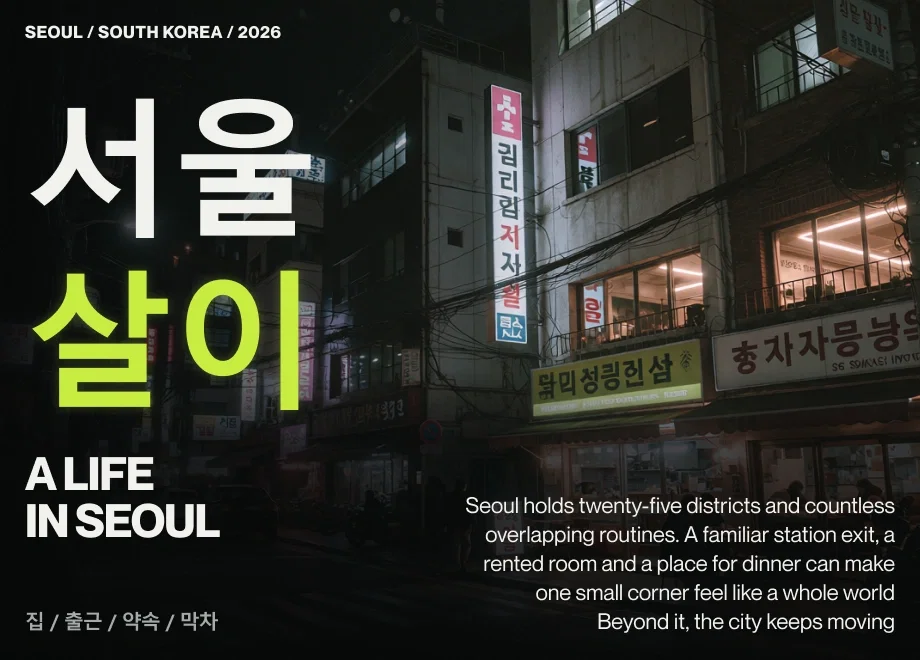
SEOUL / SOUTH KOREA / 2026
MORE THAN ONE CITY
Seoul is South Korea’s capital and the center of a metropolitan region that stretches into Gyeonggi Province and Incheon. Its twenty-five districts contain older residential streets, tower blocks, universities, public institutions, markets, music venues and workplaces. The city has no single daily rhythm: one neighborhood can be opening its shops while another is winding down after a late shift.
The Han River divides much of northern and southern Seoul, but bridges and rail lines connect the two. A person can spend an entire week within a few familiar neighborhoods and still live in a city of millions whose lives rarely intersect. There is always something happening somewhere — not necessarily to the same people.
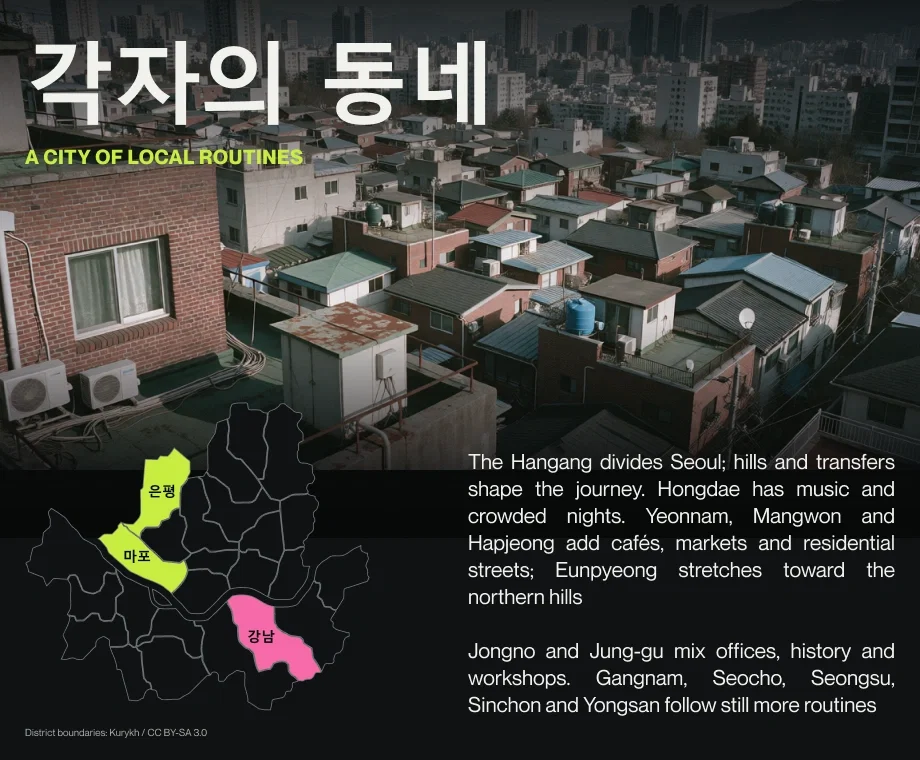
DISTRICTS / DIFFERENT ROUTINES
A CITY OF LOCAL ROUTINES
The Hangang, hills and long transfer corridors shape how Seoul feels on the ground. Yeonnam is associated with cafés and streets near the Gyeongui Line Forest Park; Mangwon combines a market with residential lanes; and Hapjeong brings restaurants, businesses and a major subway interchange together. Nearby does not mean identical.
Hongdae has performance spaces, shops and crowded nights; Eunpyeong has busy neighborhood centers and quieter streets toward the northern hills. Jongno and Jung-gu contain historic sites, markets and offices, while Gangnam, Seongsu and Yongsan have their own mixtures of work, housing and leisure. A district name is an address, not a personality.
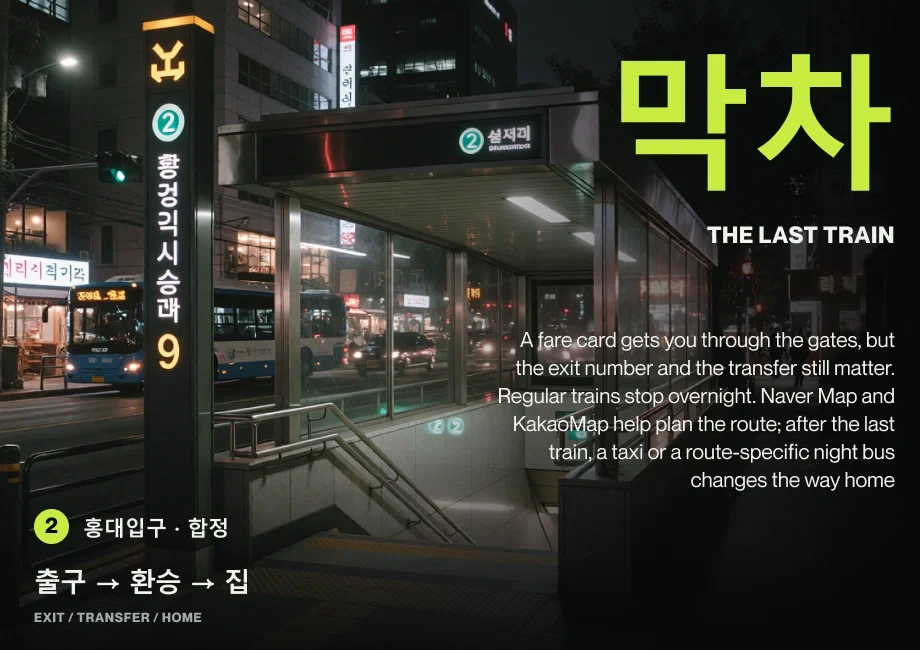
METRO / BUS / THE WAY HOME
THE LAST TRAIN MATTERS
METRO / BUS / NAVER MAP / KAKAOMAP
Seoul’s metro reaches across the city and into the surrounding region, with buses covering routes trains do not. Stations have numbered exits, transfers can involve long underground walks, and the route that looks shortest on a map may include stairs, a steep street or a crowded interchange.
Travel cards and supported payment methods make everyday journeys easier, while Naver Map and KakaoMap help with exits, walking routes and transfers. Regular subway service does not operate all night. Late buses serve particular corridors, and a taxi may become the practical option when the last train has gone. Where people meet depends partly on how they plan to get home.
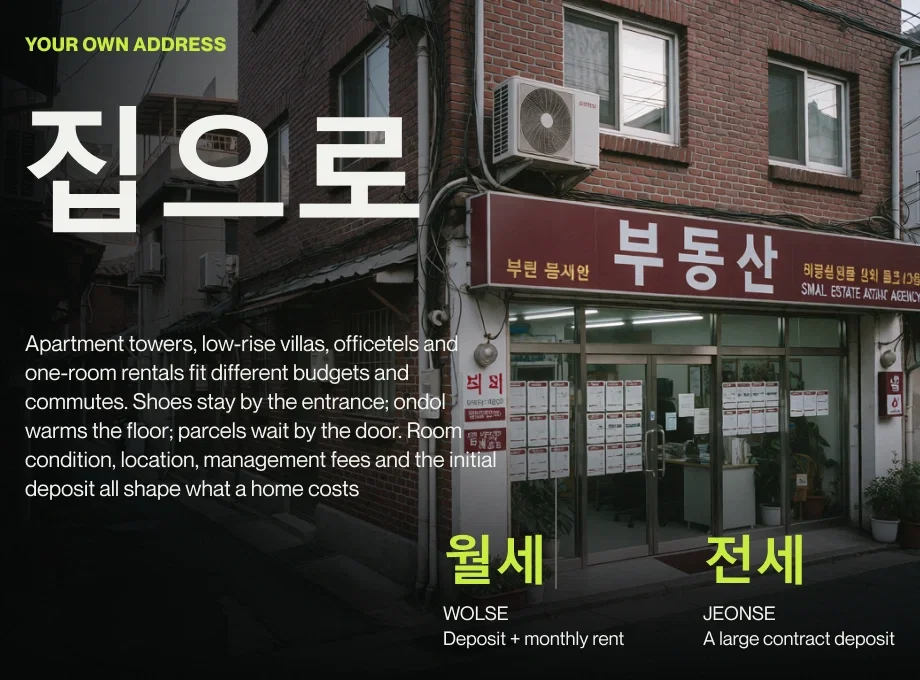
RENT / DEPOSITS / PRIVATE SPACE
WHAT HOME REALLY COSTS
WOLSE / JEONSE / ONE-ROOM / OFFICETEL
Seoul homes range from high-rise apartment complexes to low-rise villas, officetels, one-room studios and very compact rented rooms. An address says little about the person inside. Depending on the building, daily life can involve ondol floor heating, a small kitchen, shared facilities, limited storage or stairs without a lift.
Wolse (월세) usually combines a deposit with monthly rent. Jeonse (전세) involves a much larger deposit in place of ordinary monthly rent for the contract period. Management fees, utilities, commute time and the condition of the unit matter as much as the advertised price. A cheap-looking listing may require far more money upfront than expected.
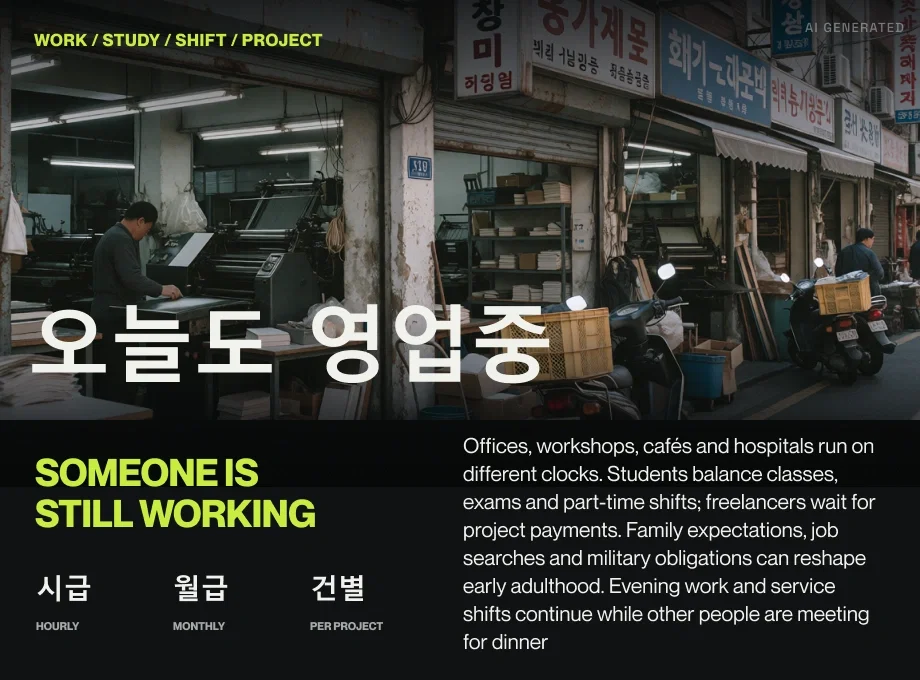
OFFICES / SHOPS / FREELANCE SHIFTS
SOMEONE IS STILL WORKING
A city full of restaurants, workshops, cafés, clinics, studios, offices and concert venues runs on different schedules. Some people work salaried weekdays; others are paid hourly, freelance between projects or take evening shifts. The people setting up a performance or closing a bar may be working while their friends are already out for the night.
Workplace hierarchy varies by employer and industry. Job titles, seniority and formal speech may matter in one office, while a small creative team works more casually. Classes, exams, military-service obligations for eligible citizens, job searches and family responsibilities can also interrupt social plans. An ordinary week can be complicated without becoming a crisis.
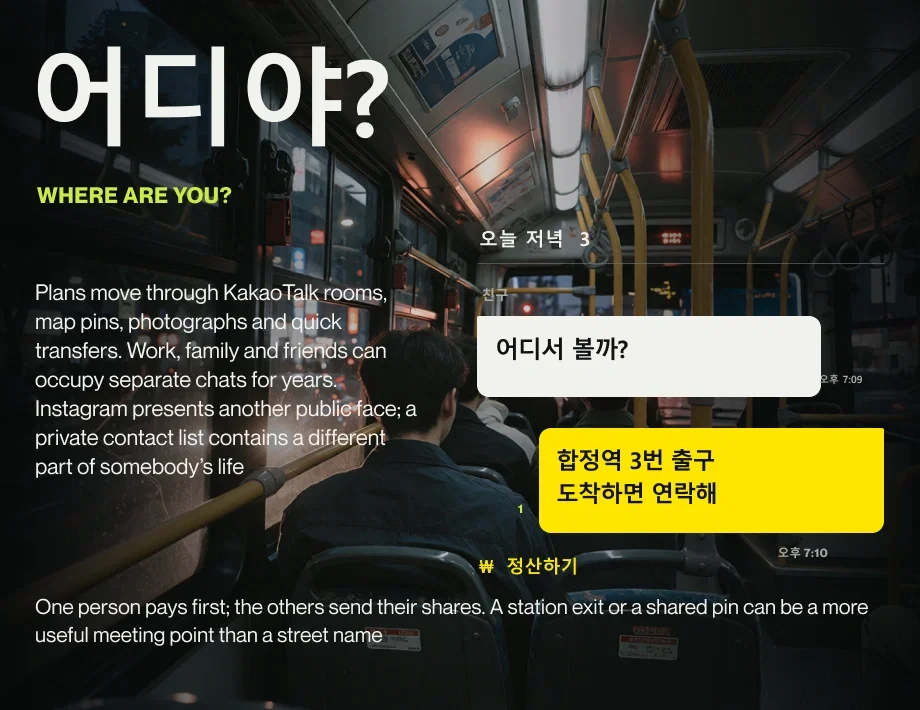
KAKAOTALK / MAP PINS / GROUP CHATS
WHERE ARE YOU?
KakaoTalk is used for private messages, group conversations, photographs and planning. A group chat may be created for one dinner or remain active for years; the same person can belong to several circles that never fully overlap. Instagram stories and direct messages, phone calls, screenshots and shared locations carry different pieces of a social life.
Naver Map and KakaoMap help people settle on a station exit or send a precise meeting point. A public profile is not someone’s entire private life, and members of one chat do not automatically know what was said in another. Someone can miss messages, mute a room or be left outside a particular invitation without the entire city finding out.
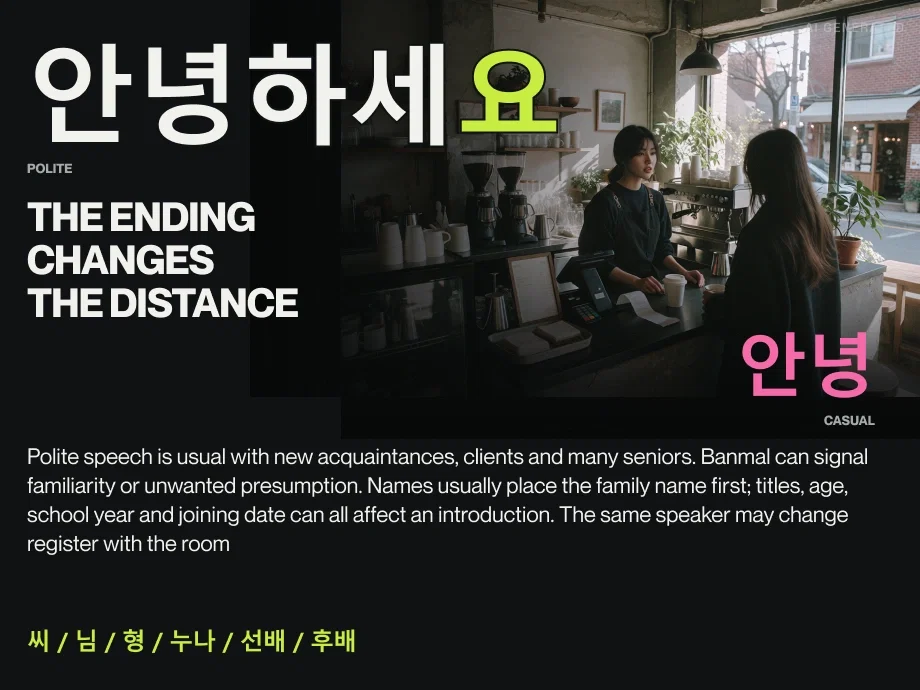
LANGUAGE / NAMES / SOCIAL DISTANCE
HOW YOU SAY IT MATTERS
In Korean, ordinary polite speech (jondaetmal) and casual speech (banmal) signal a speaker’s relationship with the person they address. Friends may use banmal, while a new acquaintance, client or senior often receives polite endings. Switching register can sound warmer, joking, pointed or rude, depending on context.
Names and forms of address matter too. The family name usually comes first; -ssi and -nim convey different degrees of politeness, while hyung, nuna, oppa and eonni depend on the speakers’ relationship and genders. Age, school cohort and workplace seniority can influence these choices, but nobody follows one universal script.
The same words can mean different things depending on who says them
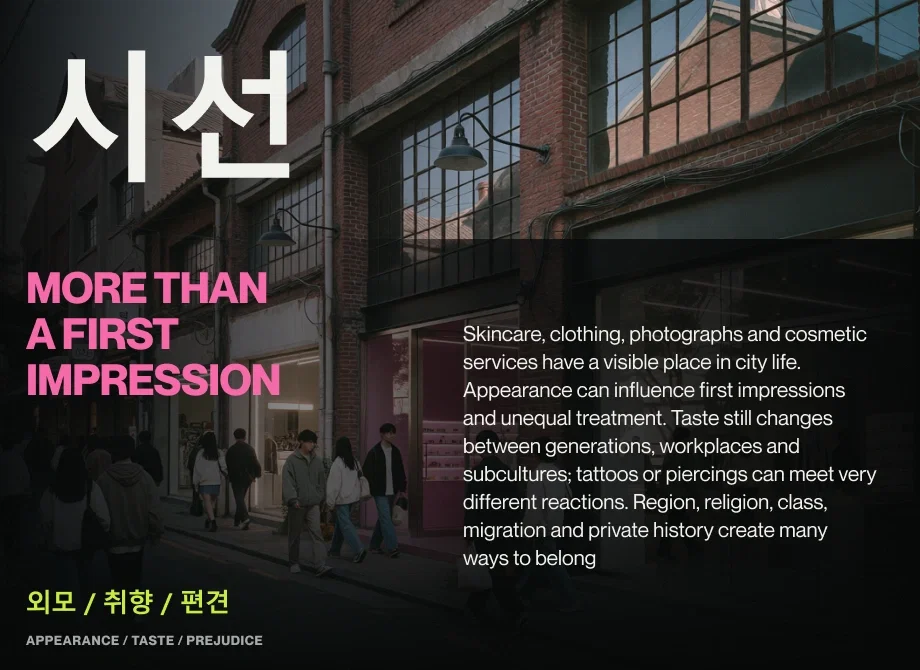
APPEARANCE / TASTE / PREJUDICE
BEYOND THE FIRST IMPRESSION
Skincare, clothing, hairstyling, photographs and cosmetic services have a visible place in Seoul’s commercial and social life. Appearance can influence first impressions and sometimes unequal treatment, including in dating or employment. These pressures exist in a city full of competing expectations, not a single beauty standard accepted by everyone.
Taste shifts across generations, workplaces and subcultures. A look welcomed in a music venue may be judged differently in a conservative office. Lookism means prejudice based on appearance; it is not an objective measure of anyone’s worth. People respond to beauty standards in different ways — accepting them, questioning them, ignoring them or making their own.
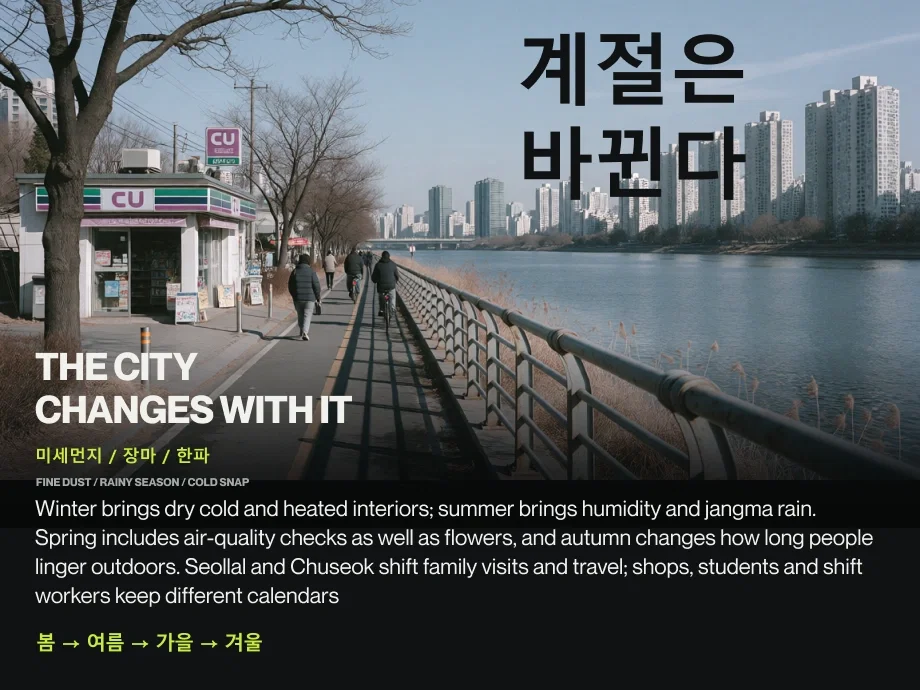
WINTER / SUMMER / THE CITY OUTSIDE
THE SEASON CHANGES THE ROUTE
Seoul’s winters can be cold and dry, with subzero temperatures, heated interiors and occasional snow. Summer brings humidity and heavy rainfall, including the monsoon period. Spring and autumn change where people spend their free time, from neighborhood walks to river parks and outdoor cafés.
The calendar matters beyond the weather. Seollal and Chuseok can affect travel, shop hours and family plans; exam periods and work schedules create their own busy seasons. A summer evening along the Hangang and a freezing walk from a station describe the same city at different times of year.
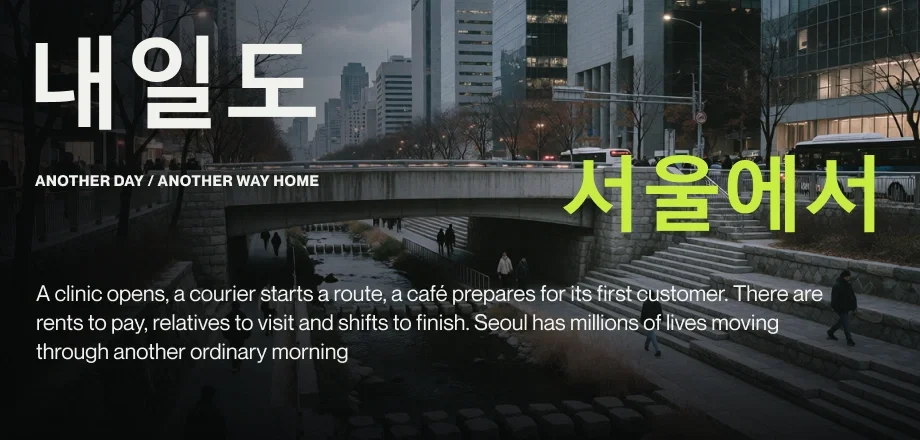
EVERYDAY SEOUL / OPEN POSSIBILITIES
THE CITY KEEPS MOVING
A convenience store opens for its first customers. A student catches a train, a café prepares for lunch, a market vendor unloads supplies, and someone leaves a late shift as someone else starts one. These routines continue whether or not anyone is watching.
Plans can change because of money, weather, work, delayed replies or the last train. A shared photograph may stay inside one group chat, while a disagreement may be forgotten outside the people involved. Seoul has room for friendships, conflicts, boredom, workdays, ordinary mornings and stories that do not need a predetermined ending.
Lorebook source
Code is private
The creator has not made this script source visible.
Please log in to see comments