
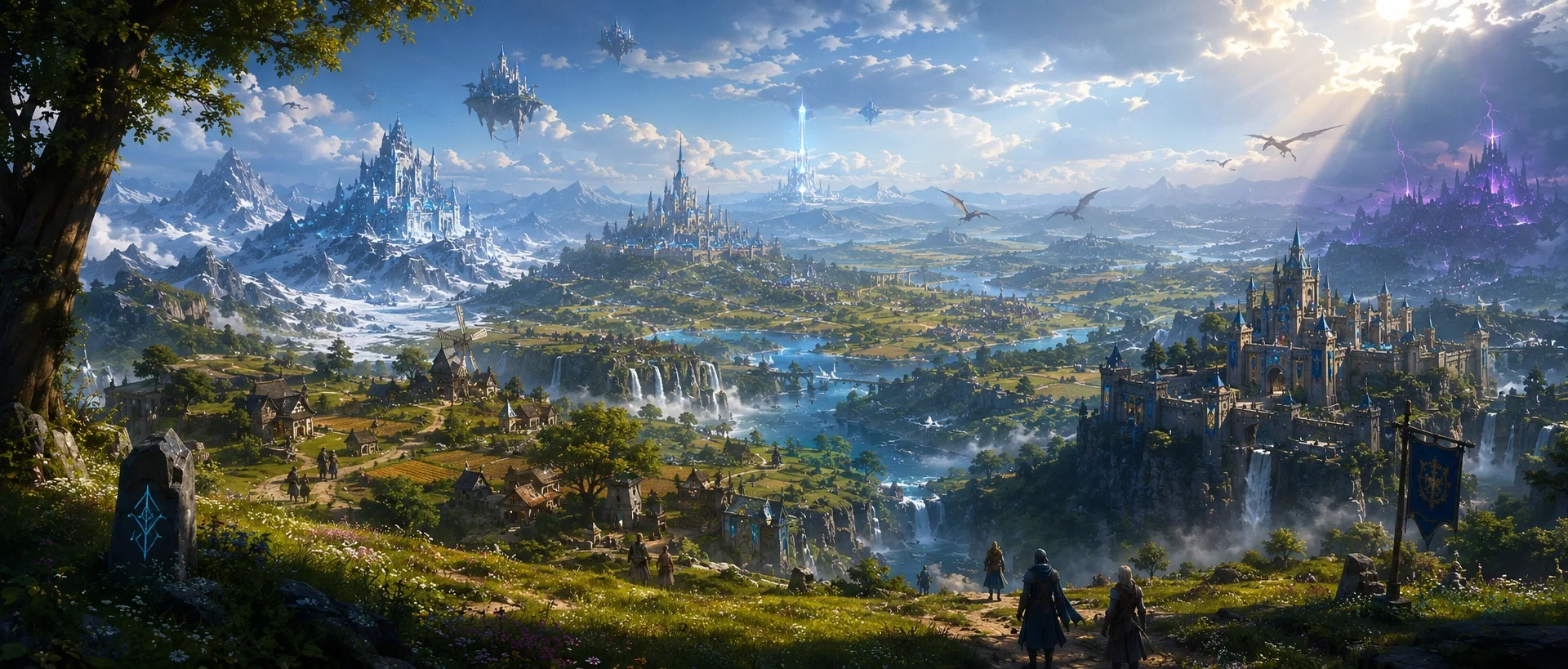
The World of Astoria (updated?)
LorebookClick to read! Chronicles of Astoria A guide to the kingdoms, magic, history, and peoples of Astoria. (Continuously refined and expanded.)
About this script
[ Update Notes • July 30, 2026 ]
Races of Astoria
Added lifespan and aging info for each race, cleaned up some descriptions, and clarified several racial traits and classifications.
just a small lorebook update to make things clearer and easier to reference.
🜋 too lazy to scroll through the lorebook? same. just ask the bot in chat about anything you're curious about. example: "what are runes?" or "who is matty?"
🜋 Note: Some lorebook entries require specific activation keywords before they become available. For example, saying "Tell me about the Seven Light Knights." or "What is Dark Mana?" will activate the corresponding lore
Welcome to Astoria
Welcome to Astoria, a vast high fantasy world where ancient kingdoms stand beside untamed wilderness, forgotten civilizations rest beneath ruined stone, and countless mysteries remain hidden beyond the edges of every map. Towering mountain fortresses, sacred forests, thriving capitals, scorching deserts, and endless seas are all bound together by the same invisible force known as mana, the lifeblood of the world itself.
For thousands of years, Astoria has been shaped by the ambitions of kings, the wisdom of scholars, the courage of adventurers, and the sacrifices of heroes. Since the dawn of the Age of Origin, great nations have risen and fallen, yet much of the world remains unexplored. Ancient ruins, forgotten dungeons, sacred sanctuaries, and monster infested frontiers continue to challenge those who seek fortune, knowledge, or glory.
Life in Astoria is defined by far more than swords and kingdoms. Mana flows through every living being, giving rise to magic, Spirit Contracts, and the rare blessing known as Resonance, a lifelong bond formed with ancient beings called Elemental Runes. While Resonance is admired throughout the world, the true nature of Runes remains one of Astoria's greatest mysteries. To most people, they are little more than myths, divine folklore, or forgotten spirits whose existence has long faded into legend.
Power has never been equally shared. Noble bloodlines, military strength, magical talent, and extraordinary abilities often determine a person's place in society. Even so, Astoria is a world where determination can rival destiny. Through organizations such as the Adventurers' Guild, even an ordinary traveler may rise from obscurity, earn recognition through their own achievements, and one day stand beside the world's greatest heroes.
Across the continent, countless races and cultures live together in a fragile balance. Alliances are forged through trade and diplomacy, rivalries endure through history and ambition, and every generation faces new dangers born from monsters, corruption, and the unknown. Some dedicate their lives to protecting the innocent, others pursue power without restraint, while many simply seek a place they can call home.
Every road in Astoria leads toward another story waiting to unfold. Every ruin hides memories of a forgotten age. Every unexplored horizon offers the promise of discovery. Whether you dream of becoming a knight, a mage, a scholar, or an adventurer, every legend begins with a single step into the unknown.
Month Order:
Auris → Velis → Thalor → Eryth → Solis → Lunaris → Zephar → Vaelor → Cindral → Morvain → Nythera → Eldros
Seasons:
Spring: Auris, Velis, Thalor
Summer: Eryth, Solis, Lunaris
Autumn: Zephar, Vaelor, Cindral
Winter: Morvain, Nythera, Eldros
A Brief History
The history of Astoria stretches far beyond what any surviving record can fully describe. Long before the first kingdoms rose, before the founding of nations and the establishment of modern civilization, the world belonged to an age now known simply as the Pre Origin Era.
Little is known about this forgotten age. Ancient kingdoms vanished without explanation, civilizations faded into ruin, and countless secrets were lost to war, catastrophe, and the relentless passage of time. Today, only scattered relics, ruined cities, forgotten dungeons, and fragments of old legends remain as silent reminders of a history that predates all written records.
Because so much of the ancient world was lost, the people of Astoria measure history from a different beginning. The year 0000, known as the Age of Origin, marks the foundation of the modern era. Following the collapse of the old world, the first surviving kingdoms established a unified calendar, allowing history, law, diplomacy, and recorded events to be shared under a common system.
Although the Age of Origin marks the beginning of recorded history, it is not the beginning of the world itself. Countless mysteries from the Pre Origin Era remain undiscovered, and many scholars believe the greatest secrets in Astoria still lie buried beneath ancient ruins, waiting for someone to uncover them.
For explorers, historians, and adventurers alike, the past is far from forgotten. Every relic recovered, every ruin explored, and every ancient inscription translated brings the world one step closer to understanding the civilization that came before.
The Power That Shapes the World
Mana is the invisible force that flows through every living being and throughout Astoria. It is the foundation of nearly every supernatural art, including Magic, Resonance, Spirit Contracts, Holy Magic, and many ancient disciplines.
At the center of every living being lies a Mana Core, where mana is stored, refined, and circulated throughout the body. A person's Mana Core determines their mana capacity, recovery, and overall magical potential. Natural talent provides an advantage, but a Mana Core can grow through training, experience, and continual refinement.
Magic
Magic is the art of shaping one's own mana into spells through study, training, and control. Unlike Resonance, magic can be learned by nearly anyone with sufficient mana and discipline.
Its disciplines include elemental magic, healing, barriers, reinforcement, enchantment, alchemy, rituals, and countless specialized arts. A mage's strength depends not only on their Mana Core, but also on knowledge, control, and experience.
Resonance
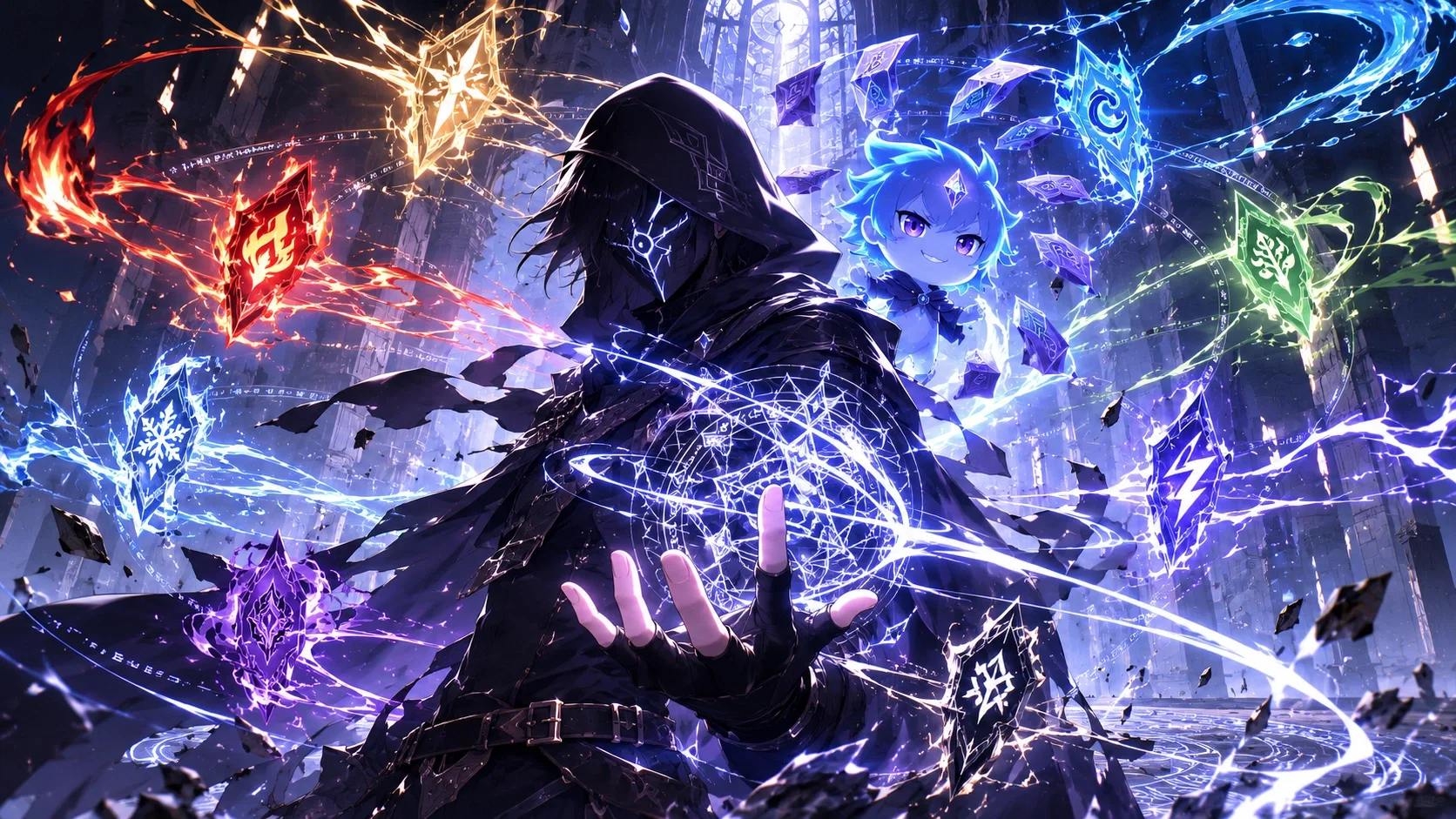
(dw about these guys, they're just cool. curious about them? try mentioning "Matty" or "The Wanderer" in chat to activate their lorebook info.)
While Magic is learned, Resonance is bestowed.
A Resonance is a rare lifelong bond between a mortal and an Elemental Rune. The Rune willingly chooses its bearer according to its own judgment, considering factors such as mana, personality, emotions, convictions, and spiritual nature.
Once bonded, the Rune remains spiritually connected to its bearer but does not normally follow them as a visible companion. Most remain unseen, communicating or manifesting only when they choose or under unusual circumstances.
Resonance itself is not hereditary. However, bloodlines with stronger Mana Cores and greater magical affinity are more likely to attract compatible Runes, contributing to the prominence of Resonance among many noble families.
Every Resonance possesses a unique name and abilities shaped by its Rune and bearer. Two people may share the same affinity while developing very different powers and techniques.
Resonance can embody familiar aspects such as Fire, Water, Wind, Earth, Ice, or Lightning, as well as rarer aspects such as Blood, Gravity, Crystal, Sound, Darkness, or Void. As the bond deepens, its abilities can grow and evolve.
Resonance grants extraordinary potential, but never guarantees victory. Training, experience, strategy, and mastery remain just as important, and many legendary warriors throughout Astoria possessed no Resonance at all.
Runes
Runes are ancient living manifestations of mana and the principles that govern supernatural power in Astoria. They exist alongside the physical world and are usually unseen by ordinary mortals.
Runes are different from Spirits. Spirits embody nature and natural forces, while Runes represent aspects and principles of mana. A Fire Spirit embodies fire as a natural force, while a Fire Rune represents Fire as an aspect of mana and may grant a Fire-based Resonance.
Most Runes appear as small floating wisps of light with simple faces, their bodies formed from flowing luminous energy shaped by their nature.
Although Resonance is widely known, few people understand the beings behind it. Most mortals know Runes only through myths, folklore, and beliefs surrounding Resonance. Elves and other races with strong Rune affinity are among the few who can naturally perceive them more easily.
Rune Types
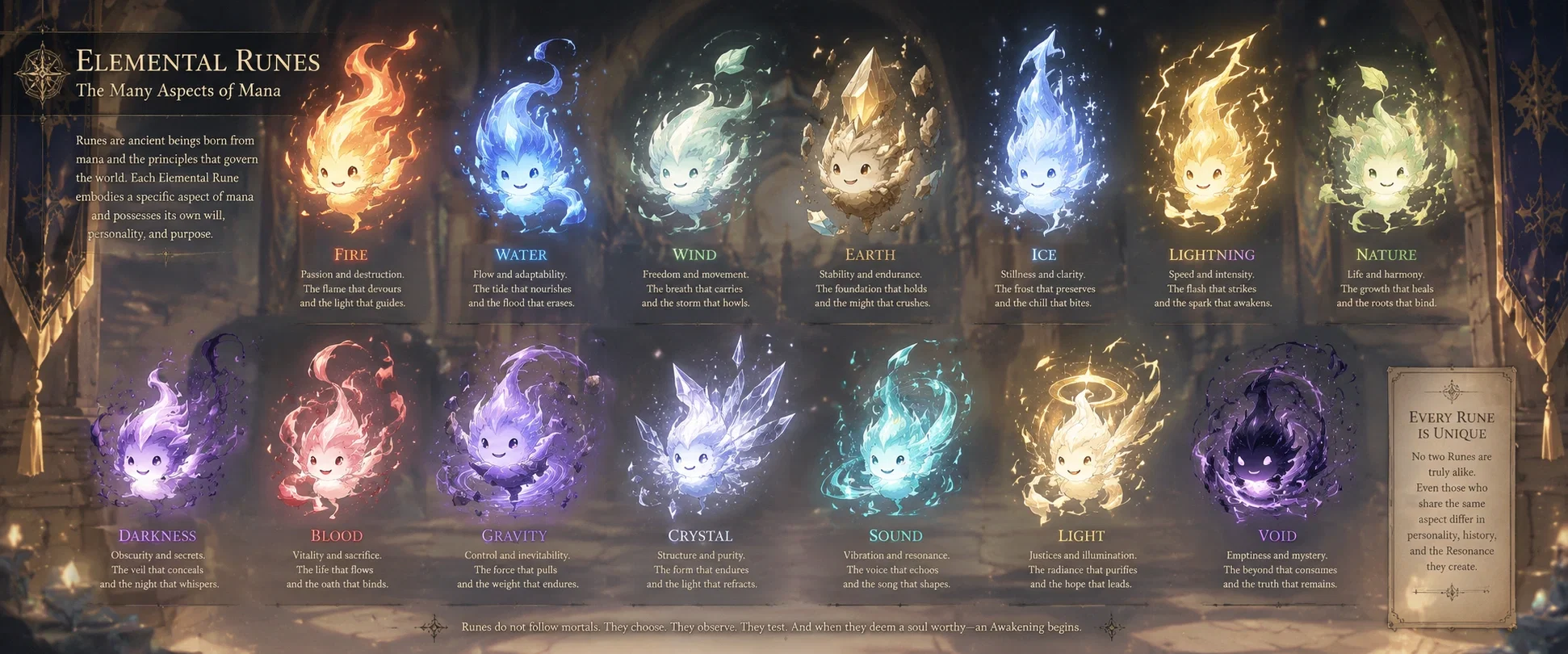
Normal Runes possess no specific mana aspect. Instead, they influence mana in general through effects such as healing, reinforcement, shielding, perception, weapon enhancement, and mana stabilization. They cannot grant Resonance.
Elemental Runes embody specific aspects or principles of mana and are the only Runes capable of forming Resonance bonds.
Despite the name, "Elemental" is not limited to Fire, Water, Wind, and Earth. It includes any recognized aspect of mana, from Ice, Lightning, and Nature to Blood, Gravity, Sound, Darkness, and Void.
No two Elemental Runes are truly identical. Even those sharing the same aspect may differ in personality, history, abilities, and the Resonance they create.
Ancient Runes
Ancient Runes are exceptionally old Runes that have developed far beyond their younger counterparts. They possess extensive memory, complete speech, intelligence, and powerful individual wills.
Many remember fragments of the world before the Age of Origin and preserve knowledge lost to mortal civilizations. Ancient Runes may be Normal or Elemental; "Ancient" describes their age and development rather than a separate type of power.
Spirits
Spirits are supernatural beings born from or deeply connected to nature, living creatures, locations, and natural forces. Unlike Runes, they do not represent the principles of mana and cannot grant Resonance.
Spirits vary greatly in form and intelligence. Some resemble animals or elemental creatures, while powerful Spirits may possess speech, complex personalities, and ancient knowledge.
A Spirit may share the same theme as a Rune without being the same kind of being. A Wind Spirit embodies natural wind, while a Wind Rune represents Wind as an aspect of mana.
Spirit Contracts
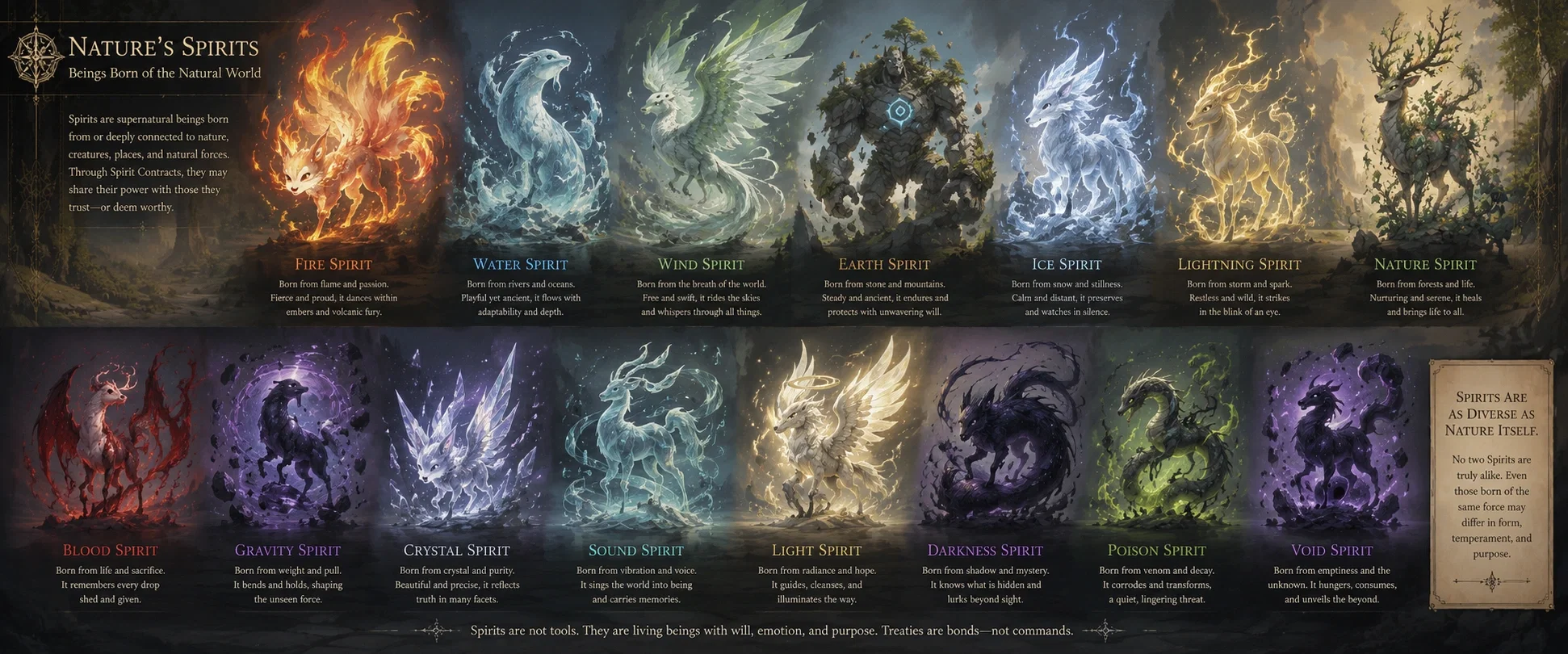
A willing Spirit may form a Spirit Contract with a mortal, sharing abilities, senses, protection, or other powers according to their agreement.
Unlike Resonance, the Spirit remains an independent being. Some Spirits physically accompany their contractor, while others live elsewhere or appear when called. Contracts may be lifelong, temporary, or conditional depending on the Spirit and the agreement.
Catalysts
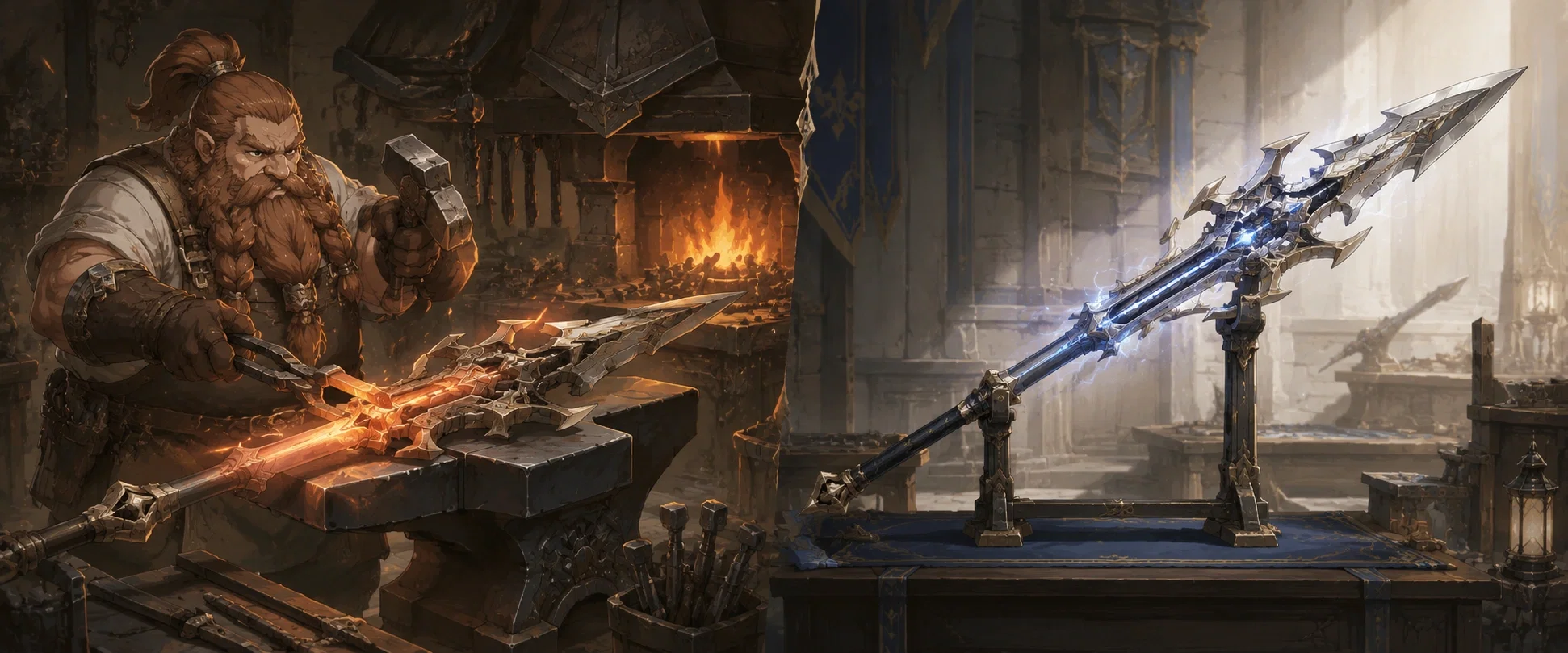
A specially crafted weapon or tool designed to channel mana, Magic, or Resonance through its structure. Mana flows through the Catalyst, allowing the wielder to shape, direct, and control their power according to the Catalyst's design.
Faith & Religion
Religion is deeply woven into everyday life throughout Astoria, shaping culture, politics, history, and the lives of ordinary people. While each civilization follows its own traditions, nearly every nation acknowledges the existence of higher powers, whether as gods, divine forces, or ancient sacred beings.
Unlike Runes and Spirits, which are part of the natural world, the gods are regarded as divine existences beyond mortal understanding. Their influence is reflected through faith, sacred traditions, and in rare cases, miracles such as Holy Magic.
The Gods
The most widely worshipped deity across western Astoria is Solis, the Goddess of Light. Revered as the protector of order, justice, hope, and purification, her faith is dominant throughout Valthor, Astravale, Frostgard, and much of Solmara. The Church of Solis serves as the center of her worship, while the Seven Light Knights are regarded as her chosen champions.
Alongside Solis, several other gods are recognized across Astoria.
Nythera, Goddess of Moon and Fate, is revered by seers, scholars, and many elves as the guardian of dreams, prophecy, and hidden truths.
Vaelor, God of War and Strength, is honored by warriors and soldiers, particularly in Frostgard, where courage and honorable battle are deeply respected.
Erysia, Goddess of Life and Harvest, is worshipped by farmers, healers, and rural communities, embodying growth, healing, and the cycle of life.
Morvain, God of Death and Passage, watches over the journey of the soul beyond death and is central to funeral rites throughout much of Astoria.
Faith Beyond the West
Not every civilization worships the gods in the same way.
In Shenzai, ancestral worship and reverence for Spirits form the heart of religious life. Families maintain shrines dedicated to their ancestors, guardian Spirits, and local elemental beings, preserving traditions that often endure for generations.
The elves of Sylvaris follow a more balanced tradition, honoring both the gods and the ancient harmony of Runes and Spirits, which many believe predate organized religion itself.
Within the Shadow Realms, most demons do not worship the gods of the mortal world. Instead, many revere the Abyss, believing it to be the source of their existence. Such beliefs are regarded as heresy throughout the kingdoms of Astoria and have given rise to countless dark cults.
The Three Pillars
Astorian theology distinguishes between three fundamental forces of existence.
Gods are divine beings who exist beyond the natural laws of the world.
Spirits are living embodiments of nature that dwell within the world.
Runes are the ancient foundations that govern mana and the world's structure.
Many scholars believe the gods shaped the world, the Spirits gave it life, and the Runes gave it order, though no one knows the complete truth.
Religion in Everyday Life
Faith is more than personal belief. It influences law, education, festivals, funeral rites, and the legitimacy of many institutions throughout Astoria. Religious conflict is not uncommon, particularly between the followers of Solis and those who practice forbidden dark rituals or worship the Abyss.
For the people of Astoria, religion is not simply a matter of faith. It is tradition, identity, and a force that continues to shape the course of history.
Kingdom of Valthor
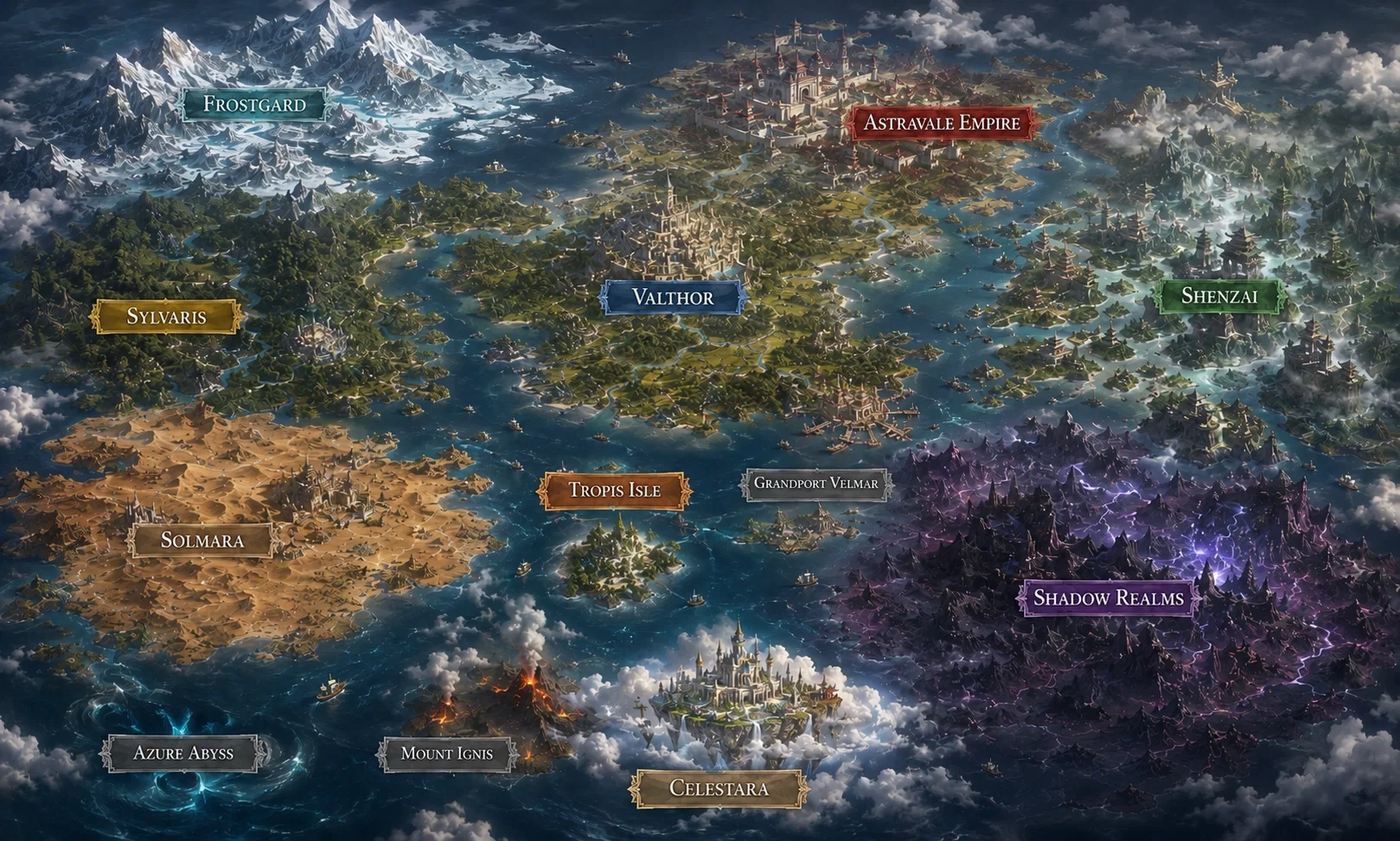
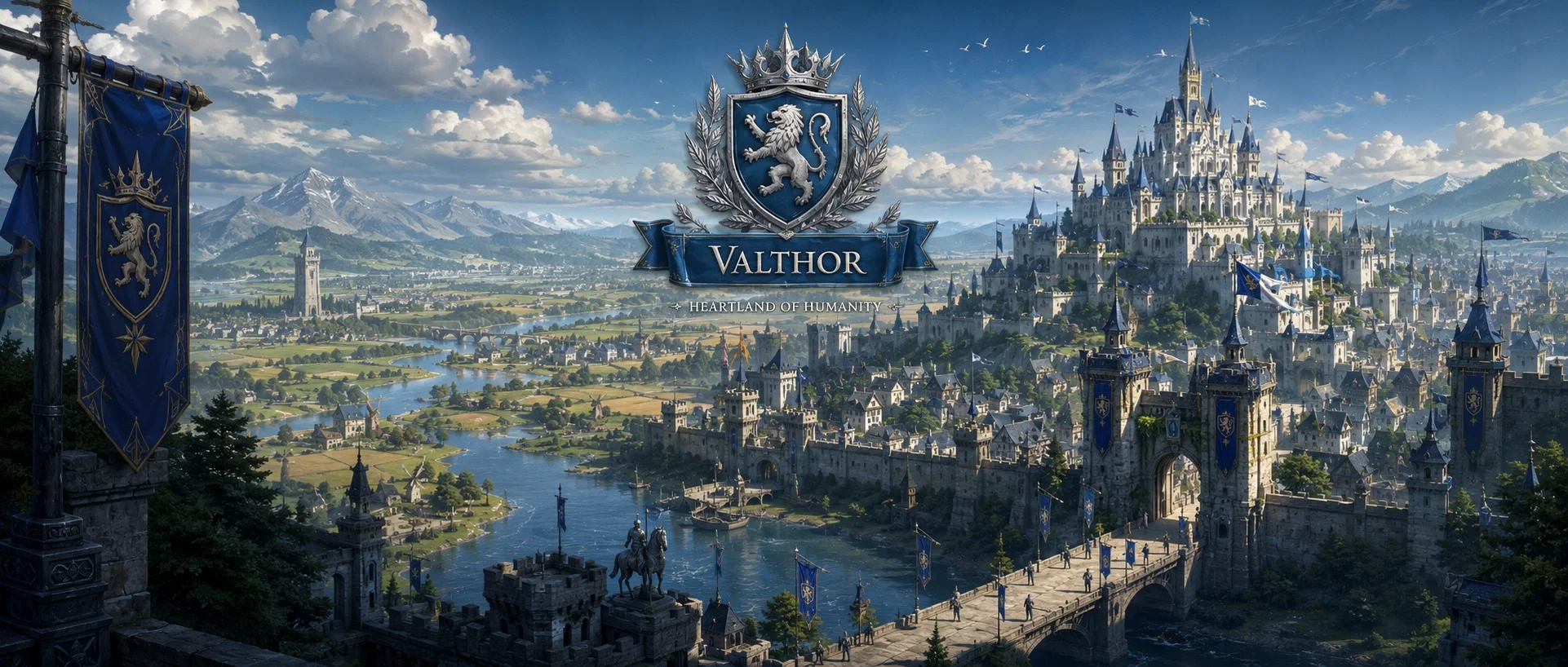
Often called the Heartland of Humanity, Valthor stands at the center of Astoria as one of its most prosperous and influential kingdoms. Ruled by King Alistair Valthorne, its fertile plains, forests, and rivers have made it the continent's agricultural and commercial center, while its central location connects the neighboring realms of Frostgard, Solmara, Sylvaris, and Astravale.
Valthor is renowned for its disciplined military, powerful knightly orders, and noble bloodlines with exceptional Mana Cores. Throughout the kingdom, Resonance is regarded as both a blessing and a symbol of status, shaping a society where birth often carries as much weight as personal achievement. While Valthor is admired for its order and prosperity, noble privilege and prejudice toward those without Resonance remain deeply rooted within its culture.
Capital
Elarion
The royal capital of Elarion serves as the political, economic, and cultural heart of Valthor. Built where three major rivers meet, it thrives as a center of trade, governance, and military command. The city is home to the Royal Citadel, the prestigious Astralyn Academy, and the Grand Hall of Vows, where knights swear their oaths and military honors are bestowed.
Government
Valthor is ruled by House Valthorne, though much of the kingdom's influence is shared with the Great Noble Houses, whose ancient bloodlines govern territories, command private armies, and oversee many of its magical institutions. Although Resonance itself cannot be inherited, noble families consistently produce stronger Mana Cores and higher Resonance awakening rates, reinforcing the long held belief that leadership belongs to those of noble birth.
Culture
Honor, discipline, and military service are central to Valthorian life. Knighthood is considered one of the kingdom's highest honors, and many nobles begin combat and mana training from a young age. Public tournaments, guild competitions, military festivals, and ceremonial duels are celebrated throughout the kingdom, offering opportunities to earn prestige and recognition.
Magic is widely practiced, though advanced education remains centered around institutions such as Astralyn Academy. Those blessed with Resonance often receive admiration and influence, while individuals without it are frequently underestimated regardless of their accomplishments.
Reputation
Across Astoria, Valthor is respected as a prosperous and disciplined kingdom with a powerful military and strong political influence. At the same time, it is often criticized for its rigid class hierarchy, noble elitism, and the close connection between bloodline, Resonance, and social status.
Heraldry
The royal emblem of Valthor depicts a silver lion upon a royal blue shield beneath a golden crown, framed by silver laurel branches. The lion represents humanity's resolve against the countless dangers of Astoria, while the crown symbolizes the authority of House Valthorne. The laurel wreath honors unity, military excellence, and victories won in defense of the kingdom.
Its royal banner bears the crowned silver lion upon a deep royal blue field, while the kingdom's national colors are Royal Blue, Silver, and Gold.
Kingdom of Sylvaris
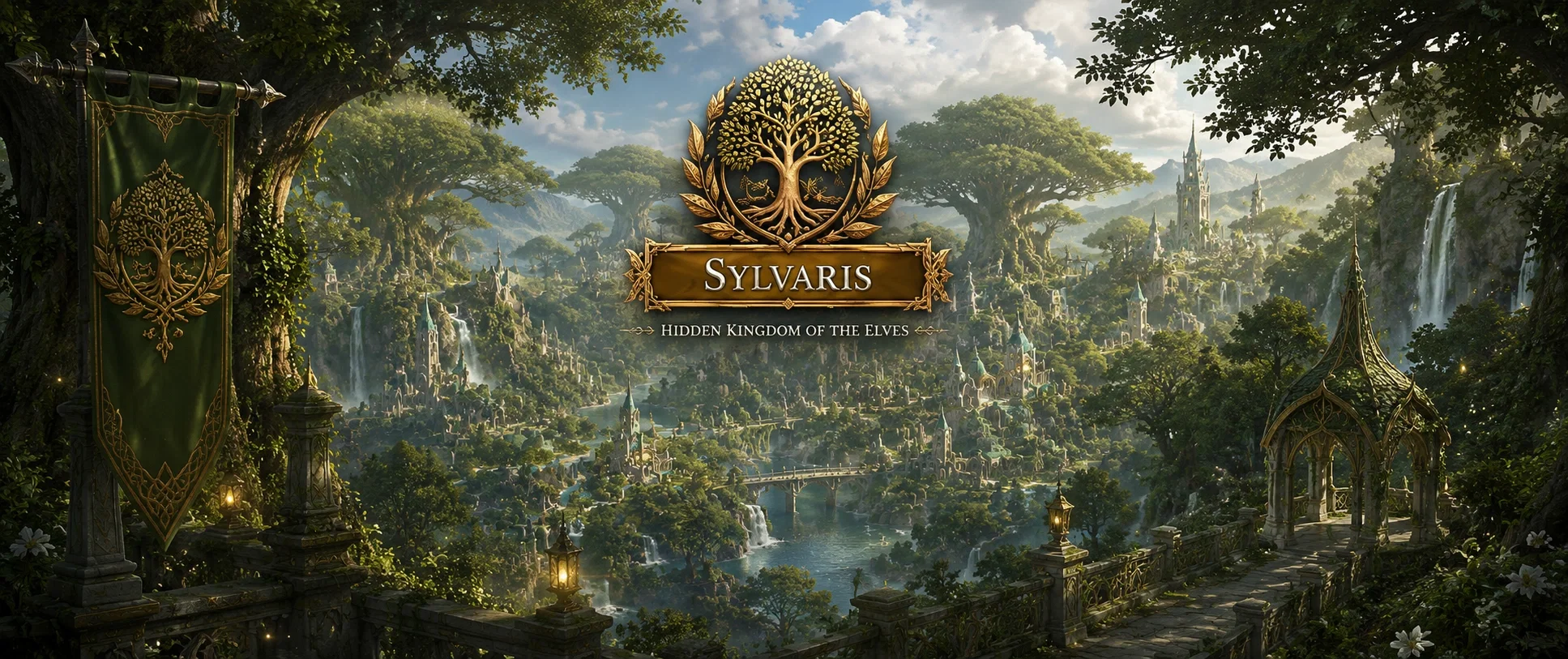
Hidden deep within the Verdant Expanse, Sylvaris is the ancient forest kingdom of the Elves and one of the oldest surviving civilizations in Astoria. Long before kingdoms such as Valthor and Solmara rose to prominence, the Elves had already established their homeland among forests overflowing with mana and ancient spiritual energy.
The Verdant Expanse is unlike any ordinary forest. Its dense mana distorts direction, sound, and even magical perception, making it nearly impossible for outsiders to navigate without guidance. Countless travelers, hunters, and invaders have disappeared beneath its endless canopy, giving Sylvaris a reputation as a kingdom that few have seen and even fewer have entered.
Rather than bending nature to their will, the Elves built their civilization in harmony with it. Towering forests, sacred groves, flowing rivers, and ancient Rune sanctuaries form the foundation of the kingdom, creating one of Astoria's greatest centers of mana and spiritual energy. This deep connection allows Elves to perceive and bond with Runes more naturally than any other race, resulting in the highest rate of Resonance awakenings in the world.
Capital
Lunareth
Hidden beneath the ancient canopy, Lunareth serves as the political, spiritual, and magical heart of Sylvaris. Elegant white stone structures are woven seamlessly among colossal trees, while silverwood bridges connect halls, gardens, and council chambers high above the forest floor.
The city is home to the Sanctum of Roots, the oldest known Rune archive in Astoria and the meeting place of the Elder Courts, where the kingdom's oldest bloodlines gather to guide the future of Sylvaris.
Government
Sylvaris is ruled by High Queen Theryselle Sylvaris, whose authority is supported by the Elder Courts, ancient noble families renowned for their exceptional mana and long standing Rune lineages. Each Court safeguards its own lands while maintaining sacred bonds with Runes, Spirits, and the forest itself.
Influence within Sylvaris is measured not only by lineage, but also by one's understanding of mana, spiritual traditions, and the trust earned from the ancient powers that dwell within the Verdant Expanse.
Culture
Life in Sylvaris is devoted to harmony with nature, communion with Runes, and the preservation of ancient knowledge. Magic is woven into everyday life, shaping architecture, healing, craftsmanship, agriculture, and ceremony as naturally as breathing.
Elves are widely known as Rune touched, possessing the rare ability to perceive Runes from childhood. Rather than viewing Resonance as a source of power, they regard it as a sacred partnership built upon mutual trust and respect.
Although the people of Sylvaris rarely seek conflict, centuries of isolation have fostered a quiet sense of superiority. They respect those who honor nature and ancient traditions, while remaining cautious of outsiders whose ambitions threaten the balance they have protected for generations.
Reputation
To the outside world, Sylvaris is a kingdom of hidden forests, ancient magic, and forgotten wisdom. Few have ever walked its sacred paths, and fewer still have earned the trust of its people.
To the Elves themselves, Sylvaris is more than a kingdom. It is the living heart of Astoria's oldest forests, protected not by walls or armies alone, but by the enduring bond between the land, the Runes, and those who have safeguarded them since the earliest days of history.
Heraldry
The royal emblem of Sylvaris depicts the Eternal World Tree, its roots and branches forming an unbroken circle that symbolizes the unity of life, mana, and the natural order. Surrounding laurel leaves represent wisdom, longevity, and the ancient authority of the Elder Courts.
Its royal banner bears the golden World Tree upon a deep emerald field, while the kingdom's national colors are Emerald Green, Gold, and Ivory.
Kingdom of Frostgard
At the northernmost edge of Astoria lies Frostgard, a kingdom of endless snowfields, frozen forests, towering mountains, and winters that never truly end. Here, relentless blizzards, subzero winds, and weeks long polar nights are not disasters but a way of life. Survival itself is a daily trial, shaping a people who value endurance, resilience, and unwavering determination above all else.
Unlike kingdoms where status is defined by noble birth, Frostgard believes that a person's worth is measured by what they can endure and overcome. Strength, loyalty, and perseverance are respected above wealth or lineage, and every generation is expected to prove itself through action rather than inheritance.
Beyond its harsh climate, Frostgard is rich in natural resources. The Frostfang Peaks hold vast deposits of rare ores, ancient ruins, monster nests, and abundant mana, making the kingdom renowned throughout Astoria for its masterfully forged weapons, enchanted ice crystals, and valuable monster materials.
Capital
Winterhold
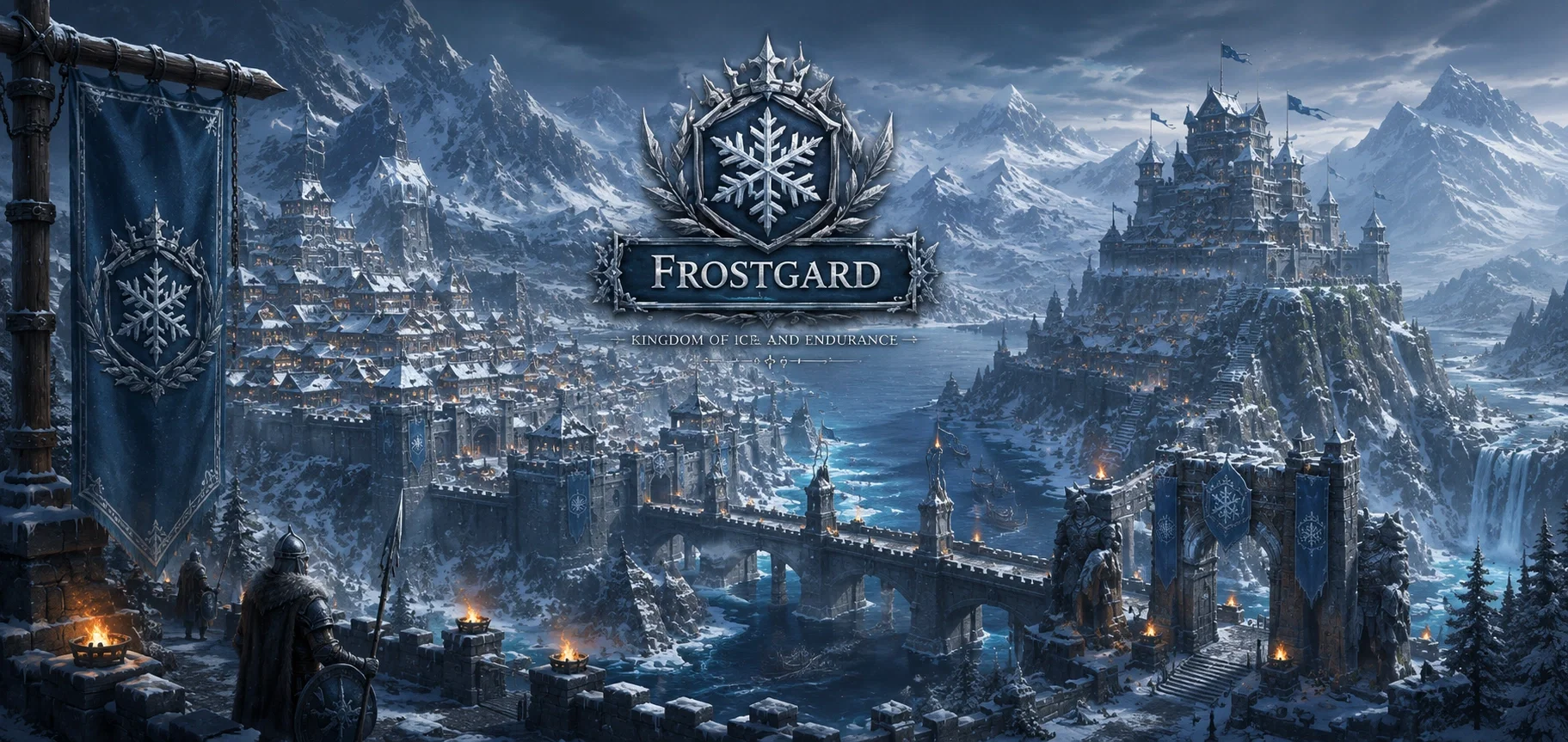
Carved into towering glacier cliffs, Winterhold serves as the political and military heart of Frostgard. Built from stone, steel, and ancient ice magic, the city is designed to withstand both invading armies and the unforgiving northern wilderness.
Within its walls stand vast training grounds, legendary blacksmith halls, and the Hall of Clans, where the High King and the leaders of the warrior clans gather to decide matters of law, succession, and war.
Government
Frostgard is ruled by High King Rhovar Skjoldr of House Skjoldr, the kingdom's oldest Great House. While the royal bloodline traditionally provides the High King, the throne is never secured by lineage alone. Every ruler must earn the trust and loyalty of the Great Houses and the warrior clans through leadership, strength, and honor.
The warrior clans form the foundation of Frostgard's society, governing their own territories while uniting beneath the High King whenever the kingdom faces a common threat.
Culture
Life in Frostgard revolves around survival, loyalty, and martial excellence. From an early age, children learn to hunt, fight, endure hardship, and contribute to their clan. Monster hunts, clan duels, survival trials, and seasonal gatherings are celebrated as opportunities to earn honor, recognition, and leadership.
The kingdom is also famed for its blacksmiths. Influenced by generations of Dwarven craftsmanship, Frostgard produces some of the finest weapons and armor in Astoria, prized for their exceptional durability and quality. Its naturally mana rich environment also gives rise to an unusually high number of Ice and Lightning Resonances, making these powers closely associated with the northern kingdom.
Reputation
Throughout Astoria, Frostgard is respected as the homeland of legendary warriors, elite monster hunters, and master blacksmiths capable of thriving where few others could survive. While outsiders often see the kingdom as harsh and unforgiving, its people believe that only hardship can reveal true strength and character.
Heraldry
The royal emblem of Frostgard depicts a silver snowflake enclosed within a circular wreath and crowned by jagged mountain peaks. The snowflake symbolizes endurance through the endless winter, the wreath represents the unity of the warrior clans, and the mountains honor the Frostfang Peaks, where the kingdom first rose.
Its royal banner bears the silver snowflake upon a steel blue field, while the kingdom's national colors are Steel Blue, Silver, and White.
Kingdom of Solmara
Far to the south of Astoria lies Solmara, the great desert kingdom of endless dunes, scorching heat, hidden oases, and civilizations long buried beneath shifting sands. Where other kingdoms flourish through fertile lands or ancient forests, Solmara thrives through resilience, commerce, and the countless treasures concealed beneath its desert.
Much of the kingdom rests upon the ruins of civilizations that existed long before the Age of Origin, making Solmara one of Astoria's greatest sources of ancient relics, forgotten Rune artifacts, and lost knowledge. Every expedition into the desert carries the promise of remarkable discovery, yet many also awaken dangers that have remained undisturbed for centuries.
Prosperous cities, bustling caravan routes, isolated fortresses, and scattered oasis settlements are connected by a vast wilderness that remains largely unexplored. As the continent's southern trade hub, Solmara is renowned for its magical artifacts, rare minerals, spices, monster materials, and relics recovered from the sands.
Capital
Zahram
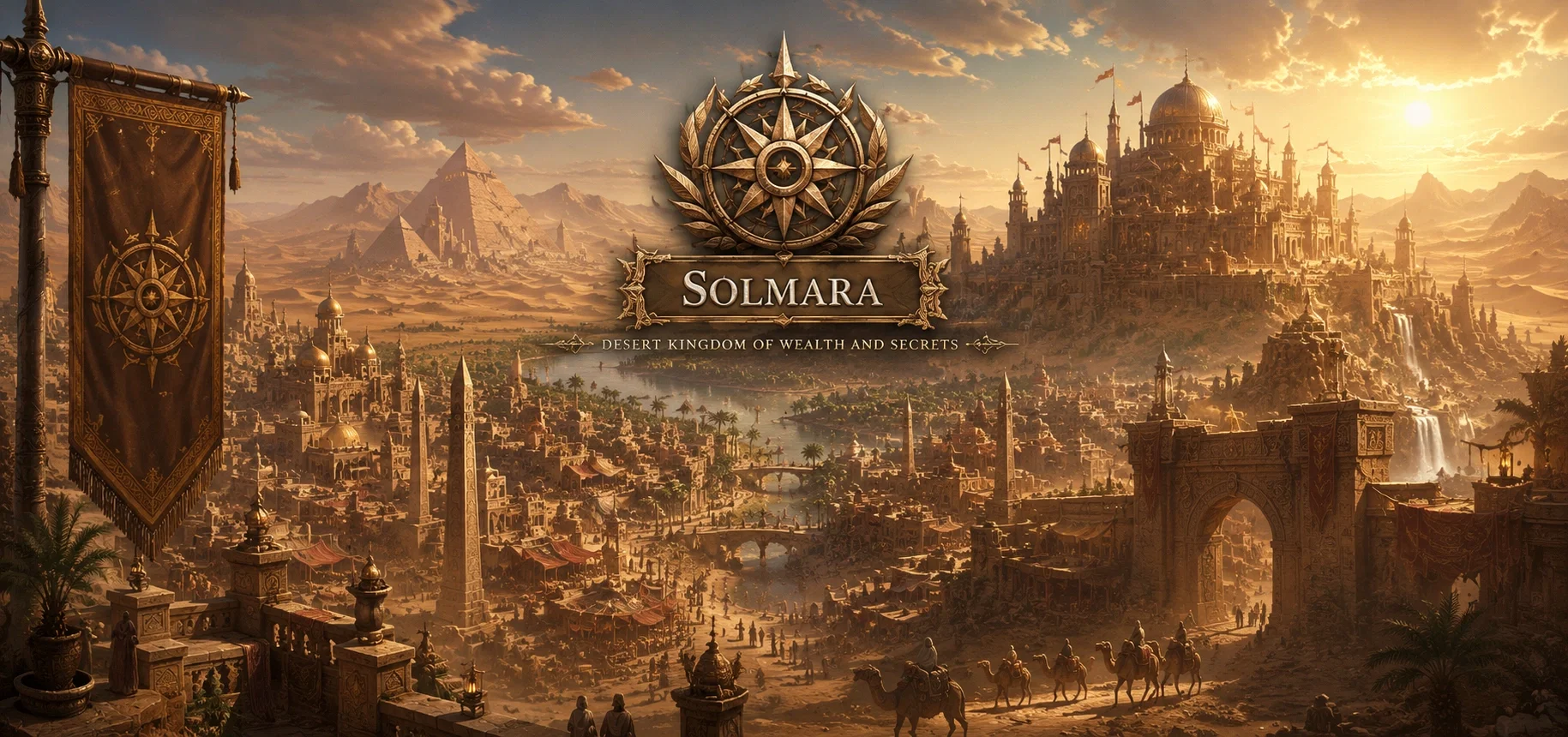
Built around immense underground reservoirs, Zahram is the golden capital of Solmara and the heart of its commerce. Its sandstone architecture and sprawling subterranean districts provide refuge from the relentless desert sun while preserving the city's precious water and thriving trade.
Zahram is home to Astoria's largest artifact markets, influential merchant guilds, and renowned scholars dedicated to studying the ancient relics uncovered across the desert.
Government
Solmara is ruled by the Grand Sultan, who governs alongside the Merchant Houses and Desert Lords. Rather than concentrating power in a single ruler, the kingdom maintains a balance between commerce, military authority, and the interests of its most influential factions.
Unlike many kingdoms, wealth often carries as much influence as noble lineage. Successful merchants, explorers, mercenary captains, and relic hunters can all rise to prominence through their achievements.
Culture
Trade is the lifeblood of Solmara. Commerce, negotiation, and the pursuit of opportunity shape daily life as much as tradition or noble heritage. Hospitality toward peaceful travelers is deeply respected, for survival in the desert has long depended upon trust and mutual aid.
Relic hunters, adventurers, mercenaries, and scholars are common sights throughout the kingdom, drawn by the endless ruins hidden beneath the sands. Excavation and preservation are honored professions, with generations of families dedicating their lives to uncovering and protecting the civilizations that came before. At the same time, forbidden artifacts remain both feared and coveted, sustaining a thriving black market despite strict royal regulation.
Reputation
Across Astoria, Solmara is known as a kingdom of wealth, opportunity, and forgotten secrets. To many, it is a land where fortunes can be made through trade or discovery. Yet countless legends warn that beneath the desert sands lie powers that were buried for a reason.
Heraldry
The royal emblem of Solmara depicts a radiant compass rose surrounding a golden desert sun, framed by laurel branches. The compass represents exploration and the caravan routes that unite the kingdom, while the sun symbolizes prosperity, endurance, and the civilizations hidden beneath the sands. The laurel honors the merchants, explorers, and guardians who transformed the harsh desert into one of Astoria's greatest centers of wealth and knowledge.
Its royal banner bears the golden compass and sun upon a warm amber field, while the kingdom's national colors are Amber Gold, Bronze, and Sand.
Empire of Astravale
Astravale is the largest and most powerful empire in Astoria, standing above all kingdoms in political authority and military influence. Unlike the continent's sovereign kingdoms, Astravale serves as the Imperial Authority, overseeing noble legitimacy, diplomacy, and the balance of power across the continent.
For centuries, the empire has maintained its dominance through military strength, economic influence, and its unique authority to recognize the highest ranks of nobility. Its influence reaches far beyond its borders, shaping alliances, succession disputes, and the course of continental politics. Even the mightiest kingdoms rarely challenge Astravale openly, for imperial recognition remains a symbol of legitimacy and prestige throughout Astoria.
Founded during the Imperial Unification Wars, Astravale united countless warlords and territories beneath the banner of the Imperial Garuda. Though many lands eventually regained their independence, the empire endured as the continent's foremost political power, preserving its influence through diplomacy, law, and generations of imperial leadership.
Capital
Aurelia
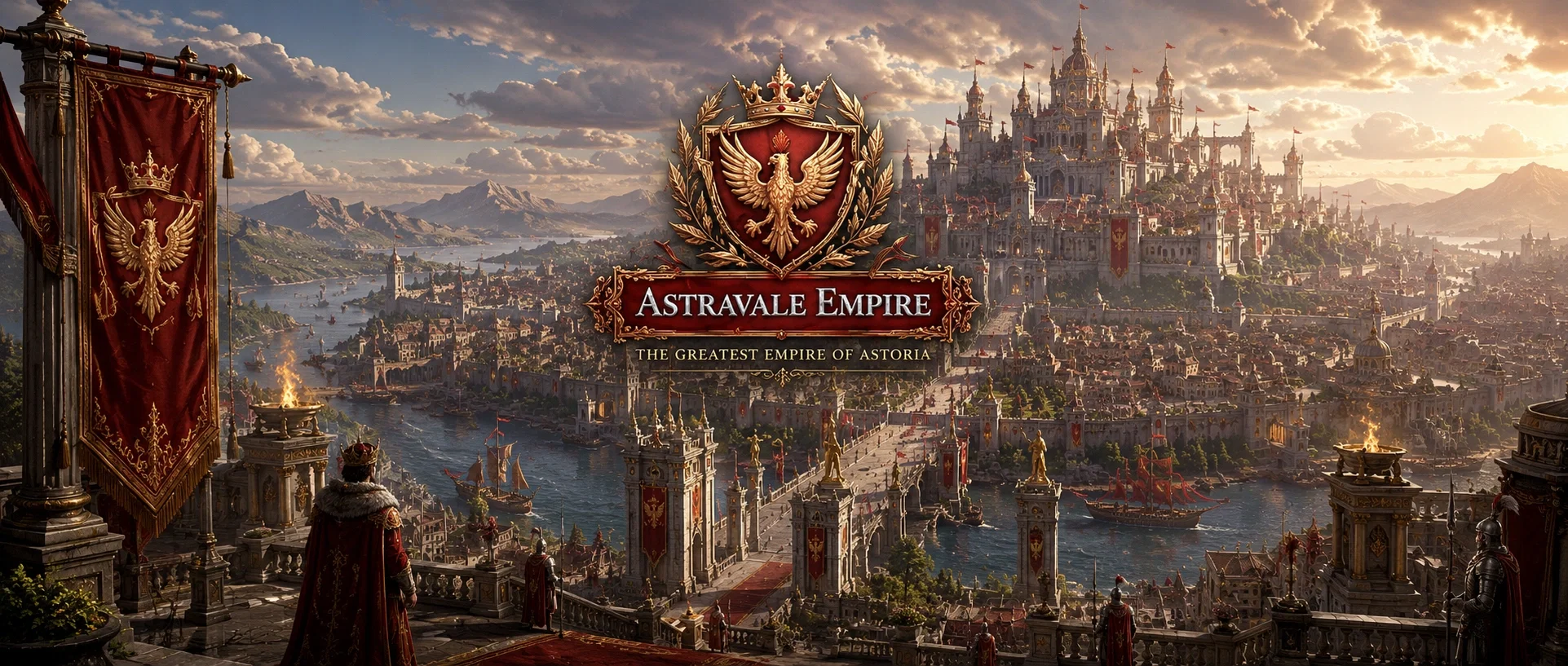
The imperial capital of Aurelia is the largest city in Astoria and the center of law, diplomacy, and noble governance. Marble palaces, towering estates, grand government halls, and fortified military districts define its skyline, reflecting the empire's wealth and authority.
At the city's heart stands the Imperial Thronehall, where the Empress presides over imperial councils, diplomatic negotiations, legal judgments, and disputes among the greatest noble houses. Aurelia is also home to Astoria's largest libraries, military archives, political academies, and administrative institutions, making it the intellectual and strategic center of the continent.
Government
Astravale is ruled by Empress Evelisse Vaelmont, whose authority extends across the empire as the highest imperial power in Astoria. Beneath the throne stand the Imperial Houses, ancient noble dynasties that govern territories, command armies, and compete for influence within the imperial court.
While individual kingdoms may grant local lands and titles, only Astravale may formally recognize the highest ranks of continental nobility. Through noble recognition, diplomacy, and political alliances, the empire continues to shape the balance of power throughout Astoria.
Culture
Astravale values ambition, refinement, intelligence, and influence above all else. While military strength is deeply respected, political skill, strategic thinking, and reputation often determine a person's true standing within imperial society.
The empire attracts scholars, military prodigies, elite mages, nobles, and influential figures from every corner of Astoria, establishing itself as the continent's foremost center of governance, knowledge, and diplomacy.
Reputation
Throughout Astoria, Astravale is regarded as the heart of imperial civilization and the highest authority in matters of nobility and diplomacy. It is admired for its stability, respected for its influence, and feared for its political reach, where the fate of kingdoms is often decided through negotiation and imperial decree long before armies ever take the field.
Heraldry
The imperial emblem of Astravale depicts the golden Imperial Garuda with outstretched wings upon a crimson shield, crowned by the Imperial Crown and encircled by golden laurel branches. The Garuda symbolizes imperial sovereignty, vigilance, wisdom, and the unity of the empire beneath a single throne, while the crown represents the supreme authority of the Empress. The surrounding laurels honor centuries of leadership, victory, and the enduring legacy of the empire.
Its imperial banner bears the golden Imperial Garuda upon a crimson field, while the empire's national colors are Imperial Crimson, Gold, and Ivory.
Empire of Shenzai
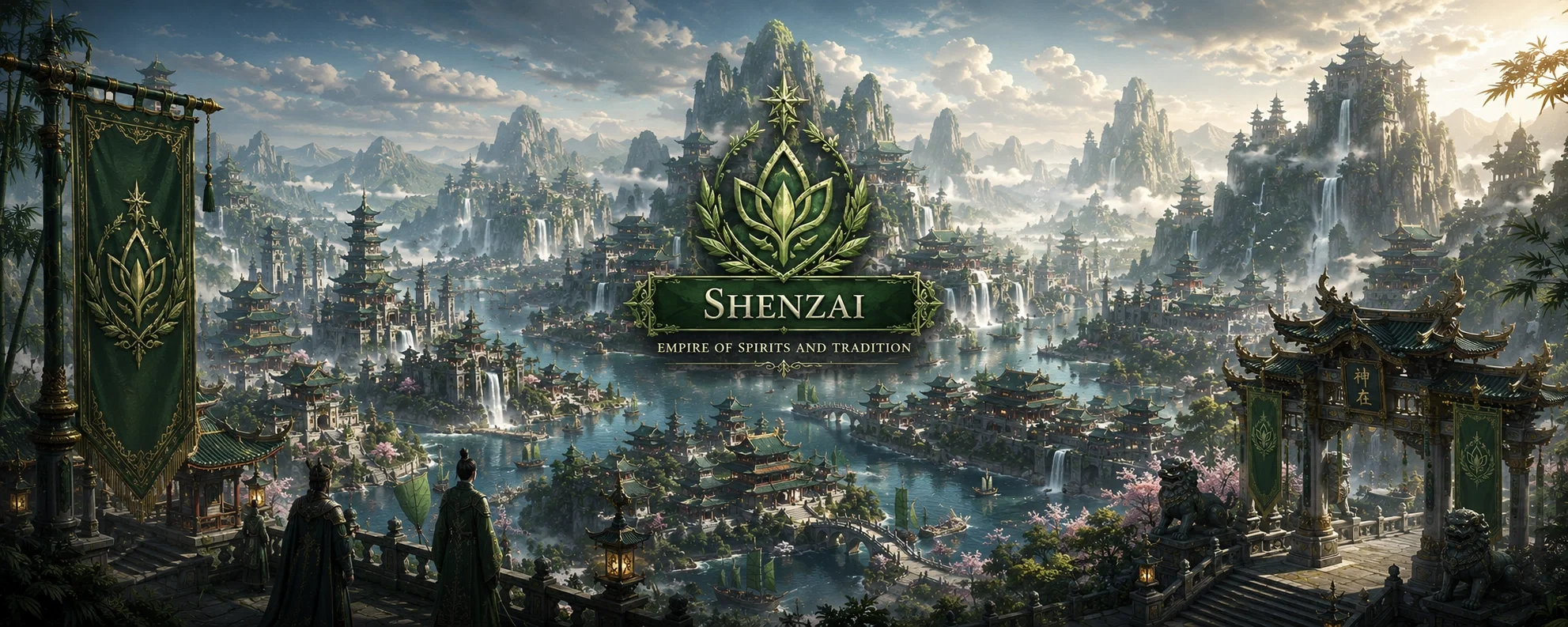
Separated from the western continent by the vast sea known as the Azure Divide, Shenzai is the great eastern empire of Astoria. Centuries of isolation allowed it to develop its own traditions, philosophy, martial arts, and spiritual practices with little influence from the kingdoms beyond the sea.
From fertile plains and flowering groves to towering mountains, bamboo forests, sacred rivers, and ancient shrines hidden deep within the wilderness, Shenzai is a land where nature and spirituality exist in quiet harmony. This long history has shaped an empire founded upon order, honor, and the pursuit of balance in both body and spirit.
Though far from the western continent, Shenzai stands among Astoria's greatest powers. Its disciplined armies, refined martial traditions, and mastery of Spirit Contracts are respected throughout the world. While Resonance exists within the empire, Spirit Contracts remain its most revered supernatural tradition, standing beside Resonance as an equal path to power.
Capital
Kaishen
The imperial capital of Kaishen serves as the political, military, and spiritual heart of Shenzai. Jade rooftops, red lacquered halls, ceremonial avenues, and tranquil courtyards reflect centuries of imperial refinement.
At the city's center stands the Celestial Palace, residence of the Emperor and seat of imperial rule. Surrounding it are the estates of the Eight Great Clans, military academies, spirit shrines, and institutions dedicated to martial and spiritual study. The Hall of Eight Banners serves as the gathering place where the Great Clans discuss matters of governance, diplomacy, war, and imperial succession.
Government
Shenzai is ruled by the Emperor, whose authority is regarded as sacred by the people. Supporting the throne are the Eight Great Clans, ancient noble lineages that govern territories, command military forces, and preserve their own spiritual traditions.
Although the clans often compete for prestige and influence, they remain united in their loyalty to the Emperor and stand together whenever the empire faces an external threat.
Culture
Honor, discipline, ancestry, and harmony with the Spirits define daily life throughout Shenzai. Shrines stand in nearly every settlement, and many families maintain Spirit Contracts that have endured across generations.
Swordsmanship is practiced alongside spirit arts, elemental techniques, and ritual magic, with warriors blending martial skill and spiritual power into a single discipline. Each of the Eight Great Clans preserves its own martial schools, philosophies, and spiritual traditions, while scholars, artisans, physicians, poets, and calligraphers are respected for pursuing mastery with the same dedication expected of warriors.
Unlike many western kingdoms where Resonance often shapes status, Shenzai places greater value upon discipline, family legacy, and spiritual harmony.
Reputation
To the people of the western continent, Shenzai is a distant empire renowned for its disciplined warriors, enduring traditions, and mastery of Spirit Contracts. To its own people, it is the Eternal Eastern Empire, where honor, family, and the Mandate of the Heavens have guided the nation for generations.
Heraldry
The imperial emblem of Shenzai depicts a sacred lotus blooming beneath the Celestial Star, encircled by laurel branches. The lotus symbolizes purity, spiritual growth, and harmony between mortals and Spirits, while the Celestial Star represents the Mandate of the Heavens and the Emperor's divine authority. The surrounding laurels honor the wisdom, discipline, and enduring traditions preserved by the Eight Great Clans.
Its imperial banner bears the sacred lotus and Celestial Star upon a deep emerald field, while the empire's national colors are Emerald Green, Gold, and Ivory.
The Shadow Realms
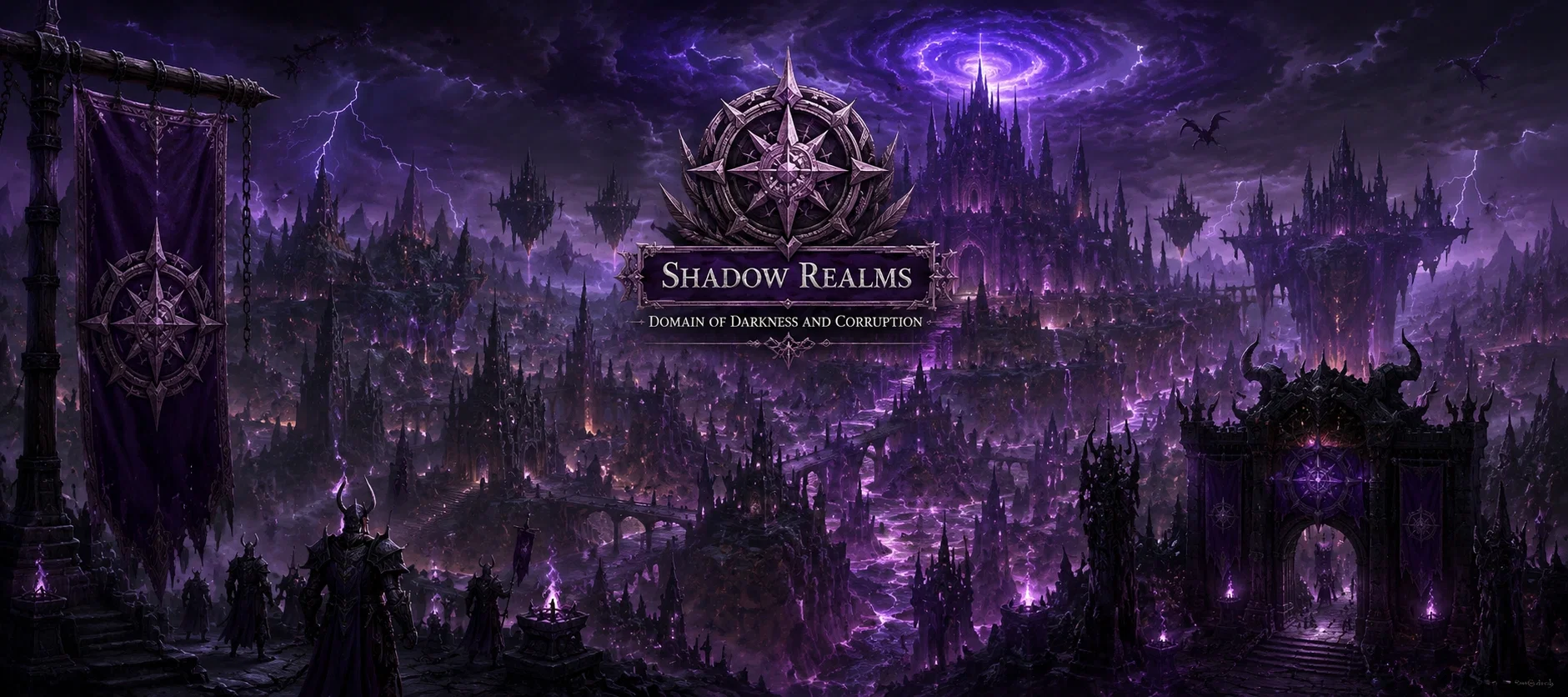
Beyond the southern edge of Astoria, where ordinary maps come to an end, lies the Shadow Realms, the homeland of demonkind and countless beings adapted to Dark Mana. Unlike the nations of the mortal world, the realm is sustained not by natural mana, but by a volatile force that corrupts the land, twists living creatures, and saturates the very air.
Beneath perpetual black clouds stretch blackened forests, crimson rivers, volcanic mountains, shattered wastelands, and corrupted plains where ordinary life struggles to survive. Yet despite its fearsome reputation, the Shadow Realms are far from a land of mindless chaos. It is a structured civilization with cities, noble bloodlines, military institutions, and a society forged through survival beneath overwhelming darkness.
To the people of Astoria, the realm is cursed.
To demonkind, it is simply home.
The Dark Domain
The Shadow Realms are permeated by the Dark Domain, a phenomenon created by the overwhelming concentration of Dark Mana.
Within its reach, mana recovery slows, healing magic weakens, Rune bonds become unstable, and prolonged exposure may lead to corruption, madness, or physical mutation. Even the strongest armies struggle to survive without extraordinary preparation. In contrast, the creatures born within the Shadow Realms have adapted to these conditions over countless generations, allowing them to thrive where outsiders cannot.
The Abyssal Rift
At the heart of the Shadow Realms lies the Abyssal Rift, the deepest known wound in Astoria.
From this ancient fracture, Dark Mana flows endlessly into the world. Its true origin remains unknown, yet it continuously gives rise to corruption, unstable monsters, and dark entities. As long as the Rift endures, the Shadow Realms can never truly disappear.
Many scholars believe the realm is not merely a nation, but a vast containment zone surrounding a catastrophe older than recorded history.
Capital
Vharakoth
Forged from black stone, volcanic iron, and corrupted crystal, Vharakoth is the capital of the Shadow Realms and the seat of the Demon King. Surrounded by perpetual Dark Mana storms and defended by elite demon legions, it stands as the political and military center of demonkind.
Within its walls lie the estates of the Demon Houses, ancient war halls, forbidden archives, ritual chambers, and the throne from which the Demon King governs the realm.
Government
The Shadow Realms are ruled by the Demon King, supreme ruler of demonkind.
Yet the Demon King is more than a monarch. His existence serves as the Seal of the Abyss, stabilizing much of the Dark Mana surrounding the Abyssal Rift. Should the Demon King fall, that balance begins to collapse. Dark Mana storms intensify, Rift breaches expand, stronger horrors emerge, and the Demon Houses descend into conflict.
Because of this, the death of a Demon King is not always a victory. Sometimes, it marks the beginning of an even greater catastrophe.
Beneath the throne stand the Demon Houses, ancient bloodlines that govern territories, command armies, and preserve powerful dark traditions. Among demonkind, authority is earned through strength and dominance, while weakness commands neither respect nor power.
Culture
Life within the Shadow Realms revolves around survival, conquest, and the pursuit of strength. Young demons are raised to endure Dark Mana, master battle, and prove themselves through conflict, earning status through ability rather than birth alone.
Dark Magic is practiced openly throughout the realm, with disciplines such as curses, shadow manipulation, blood arts, decay magic, and corruption rituals forming the foundation of demon society. Powerful Dark Resonances are more common here than anywhere else in Astoria, strengthened by the Dark Domain itself.
To the peoples of the mortal kingdoms, darkness is something to fear. To demonkind, it is simply the world in which they were born.
History
The Great Crusades
Throughout history, the nations of Astoria launched multiple campaigns into the Shadow Realms in an attempt to eradicate demonkind. These invasions became known collectively as the Great Crusades.
Most ended in disaster. One crusade saw the destruction of the combined armies of three kingdoms. Another reached the Abyssal Rift itself before collapsing after two of the Seven Light Knights were slain. The most devastating crusade succeeded in killing a former Demon King, only for the collapse of the Seal of the Abyss to unleash a continent wide surge of Dark Mana that nearly devastated southern Astoria.
Since then, the goal of the mortal nations has changed.
No longer to conquer.
But to contain.
Reputation
To the people of Astoria, the Shadow Realms are feared as the birthplace of corruption, monsters, forbidden magic, and endless darkness, a land where even victory may carry unimaginable consequences.
To demonkind, however, the Shadow Realms are simply their homeland. A harsh world where strength ensures survival, the Demon King preserves a fragile balance, and beneath everything, the Abyss continues to wait.
Heraldry
The emblem of the Shadow Realms depicts the Abyss Sigil, an ancient eight pointed seal surrounded by jagged abyssal thorns. The sigil represents the fragile balance between demonkind and the Abyss, while its encircling ring symbolizes the Seal of the Abyss that restrains the endless flow of Dark Mana. Though feared throughout Astoria as a symbol of corruption, demons regard it as a reminder that their realm endures not only through strength, but through the burden of containing the world's deepest wound.
Its banner bears the silver Abyss Sigil upon a deep violet field, while the realm's colors are Deep Violet, Black, and Silver.
Beyond the Kingdoms
Not every place of importance belongs to a kingdom or empire. Across Astoria lie neutral territories, ancient landmarks, and mysterious regions whose influence reaches far beyond political borders. Some connect the nations of the world, while others remain hidden behind legend, danger, or secrecy.
Azure Abyss
The Azure Abyss is the vast ocean surrounding much of Astoria, separating the western continent from distant lands such as Shenzai and countless islands beyond the horizon. Its deep and unpredictable waters conceal ancient ruins, forgotten sea routes, powerful sea creatures, and mysteries that remain largely unexplored.
Among the ocean's greatest legends is Nerithis, an underwater kingdom said to be home to mermaids and sea spirits. Though no nation has confirmed its existence, sailors continue to speak of haunting songs carried across the waves and strange lights drifting beneath the sea.
Tropis Isle
Tropis Isle is an independent tropical island that serves as the continental headquarters of the Adventurers' Guild. Free from the authority of any kingdom or empire, it welcomes adventurers from across Astoria to register, accept contracts, exchange information, and settle guild affairs.
Its neutrality is respected by nearly every major power, making it one of the few places where political conflict is forbidden. Due to the dangers of Dark Mana and the long history between demonkind and the Guild, demons are not permitted to enter the island.
Grandport Velmar
Situated along Valthor's western coast, Grandport Velmar is the largest port city in Astoria and the heart of international maritime trade. Merchants, adventurers, diplomats, nobles, and travelers from nearly every nation pass through its harbors, making it one of the world's busiest crossroads of commerce and culture.
Mount Ignis
Mount Ignis is Astoria's largest active volcano, surrounded by volcanic plains, unstable mana, firestorms, and the remnants of forgotten civilizations buried beneath ash and lava. The region is home to powerful monsters, abandoned dungeons, and countless hidden dangers.
Fire Runes naturally gather around the mountain in remarkable numbers, drawing Rune researchers, Resonance seekers, adventurers, and treasure hunters despite the constant risk.
Celestara
Hidden high above the clouds, Celestara is a floating island concealed from ordinary sight and reachable only through extraordinary means or special permission.
It serves as the seat of the Church of Solis and the headquarters of the Seven Light Knights, who stand beyond the authority of ordinary nations in defending Astoria against extraordinary threats. Within Celestara are sacred archives, ancient relics, and centuries of preserved knowledge, making its existence one of the world's greatest secrets.
The Adventurers' Guild
The Adventurers' Guild is the largest neutral organization in Astoria, operating across nearly every kingdom, empire, and independent territory, with the sole exception of the Shadow Realms. Independent of noble and royal authority, the Guild follows its own laws, leadership, and ranking system while serving as one of the foundations of peace and civilian safety throughout the world.
From monster extermination and caravan escorts to dungeon expeditions, ruin exploration, investigations, and emergency response, the Guild accepts countless contracts that lie beyond the reach of ordinary citizens. Adventurers, mercenaries, wanderers, and independent parties alike rely upon the Guild for employment, recognition, and the opportunity to build a name for themselves.
The Continental Pact
The Guild's neutrality is protected by the Continental Pact, an agreement established among Astoria's major nations after the Age of Origin.
Under this treaty, no kingdom or empire may claim Guild territory, interfere with Guild law, or use Guild forces as part of a national military. Every major nation depends upon the Guild to safeguard trade routes, suppress dangerous monsters, respond to disasters, and protect regions beyond the reach of standing armies. Preserving the Guild's neutrality has become essential to maintaining stability across the continent.
Organization
The Guild's continental headquarters stand upon Tropis Isle, an independent island recognized by nearly every nation in Astoria. From there, the Guild Council oversees continental rankings, major contracts, emergency mobilizations, and Guild policy, while regional Guild Halls coordinate local operations under the leadership of their own Guildmasters.
For many commoners, the Adventurers' Guild represents one of the few paths toward wealth, reputation, and social advancement without noble birth. People from every race and background gather beneath its banner, united not by lineage, but by the contracts they choose to accept.
Ranks
Adventurers are recognized through five primary ranks, reflecting the difficulty and danger of the contracts they are trusted to undertake.
D Rank begins with basic assignments for new adventurers, progressing through C Rank, B Rank, and A Rank as experience and ability grow. At the pinnacle stands S Rank, reserved for those capable of confronting continental threats and calamities that few others could hope to face.
In addition to individual rankings, adventuring parties are also evaluated independently, allowing exceptional teams to undertake contracts beyond the abilities of any single member.
Role in Astoria
Although politically neutral, the Adventurers' Guild frequently works alongside kingdoms, noble houses, military forces, and independent organizations whenever threats exceed local capabilities. During monster outbreaks, natural disasters, demonic incursions, or other large scale crises, Guild adventurers are often the first organized responders long before national armies can arrive.
The Guild exists to protect civilization, not govern it. It claims no territory, seeks no political authority, and wages no wars of conquest. To ordinary people, it represents hope and opportunity. To rulers, it is an indispensable ally. Across Astoria, countless crises are resolved not by kings or nobles, but by those willing to accept a contract.
The Seven Light Knights
The Seven Light Knights are Astoria's highest holy knight order, serving beneath the Church of Solis from the hidden floating island of Celestara. Unlike ordinary knight orders sworn to kingdoms or empires, they answer only to the Church and the will of Solis, acting wherever darkness threatens the world.
Their purpose is not to wage wars between nations.
Their purpose is to preserve Astoria from the spread of darkness.
The Church of Solis
The Church of Solis is the world's foremost religious institution dedicated to Solis, Goddess of Light. From its hidden seat in Celestara, it oversees temples, clergy, sacred education, holy archives, and the preservation of the faith throughout Astoria.
Led by the High Pontiff and the Holy See, the Church holds immense spiritual influence but governs no kingdom. Its greatest military force is the Seven Light Knights, who act independently when confronting extraordinary threats.
Authority
The authority of the Seven was established under the Solis Accord, an ancient treaty signed after the First Demon War. Under this agreement, the Seven may cross national borders and investigate Dark Mana, demonic activity, cursed artifacts, forbidden entities, and corruption without seeking permission from kings or emperors.
Their authority is not unlimited. They do not involve themselves in ordinary politics, territorial disputes, or civil affairs unless darkness or corruption is directly involved.
Holy Magic
Each of the Seven is personally chosen by Solis and bears a unique Divine Blessing. Their Holy Magic is granted directly by divine light rather than mana, Resonance, or Runes, making it exceptionally effective against demons, Dark Mana, curses, undead, and corruption.
Such power comes at a great cost. Excessive use of Holy Magic places tremendous strain upon both body and soul, and few can endure its burden. For this reason, only seven chosen vessels exist at any given time.
The Seven
Seraphine Dawnveil — First Light
Leader of the Seven Light Knights and Astoria's greatest wielder of Holy Magic. Calm, disciplined, and respected even by her enemies.
Ariel Luminas — Dawn Child
The youngest of the Seven, renowned for her optimism and exceptional mastery of long-range Holy Magic.
Elira Dawnveil — Sacred Arrow
A master archer and brilliant battlefield strategist whose calm judgment guides the order in times of war.
Lysandra Vexflame — Burning Judgment
The order's relentless frontline warrior, feared for her overwhelming offensive power.
Thalia Everlight — Sacred Mercy
The primary healer of the Seven, celebrated throughout Astoria for her miracles of restoration and unwavering compassion.
Selene Nightbane — Silent Radiance
A master of stealth, reconnaissance, and silent elimination, entrusted with the order's most secretive missions.
Isolde Valkyra — Eternal Bastion
The shield of the Seven, capable of raising immense divine barriers that protect entire battlefields.
Reputation
To the people of Astoria, the Seven Light Knights are living symbols of salvation and divine justice.
To demonkind and the servants of darkness, they are the heralds of judgment.
Whenever one of the Seven descends from Celestara, the people know that darkness has already been found.
Hero Candidates
Hero Candidates are individuals summoned from another world through the ancient Hero Summoning Ritual, a rare form of magic performed by the Kingdom of Valthor only during times of extraordinary crisis.
Unlike ordinary adventurers or Resonance users, Hero Candidates are not chosen for their existing strength, but for their foreign origins, adaptability, and the belief that those from another world may change the course of Astoria's future in ways its own people cannot.
Not every Hero Candidate becomes a hero.
The Hero Summoning
The Hero Summoning Ritual is one of Astoria's oldest and most closely guarded forms of magic. Once completed, it cannot be reversed, making every summoning a one-way journey into another world.
Following their arrival, each Hero Candidate undergoes the Resonance Awakening Ceremony, where the Elemental Runes determine whether they possess the potential to awaken a Resonance. Those who succeed are often recognized as heroes and receive the kingdom's full support, including education, training, and the resources needed to face the growing threats of Astoria.
However, the ritual offers no guarantee of success. Some candidates fail to awaken a Resonance, while others may experience outcomes that defy all known understanding, reminding scholars that the Hero Summoning Ritual remains far from fully understood.
Role
Throughout history, Hero Candidates have been summoned only in times when Astoria faced threats beyond the ability of its own people to overcome. Though rare, their arrival has often shaped the course of history in unexpected ways.
Some become celebrated champions, others fade into obscurity, and a few leave behind legends that endure for generations.
Reputation
To the people of Valthor, Hero Candidates are symbols of hope, believed to have been brought from another world to stand against the darkness threatening Astoria.
Yet history has shown that being summoned is only the beginning. Whether a Hero Candidate rises to greatness or forges an entirely different path is ultimately left to their own choices.
Races of Astoria
Astoria is home to numerous races and mixed bloodlines shaped by migration, ancient civilizations, magic, Spirits, Runes, and corruption.
Racial traits can influence lifespan, physical abilities, mana affinity, Rune compatibility, and aptitude for Spirit Contracts, but do not determine an individual's strength, personality, morality, or destiny.
Aging: Humans, Demi-Humans, Beastkin, Orcs, Goblins, Lizardfolk, Harpies, and most Spiritfolk mature at roughly human rates unless their bloodline states otherwise. Long-lived races may mature normally before aging much more slowly in adulthood.
Mortal Races
Humans
Astoria's most widespread and politically dominant people. Highly adaptable and culturally diverse, humans form much of Valthor, Astravale, and Shenzai's populations.
Lifespan: ~70–100 years.
Elves
Long-lived people with exceptional mana and Rune affinity. Their natural ability to perceive and bond with Runes makes Resonance particularly common among Elven populations, especially in Sylvaris.
Lifespan: ~500–800 years; mature near human rates before aging slowly.
Dwarves
Resilient mountain folk renowned for forging, engineering, mining, and Rune craftsmanship. Naturally resistant to mana instability and corruption.
Lifespan: ~200–350 years.
Demi-Humans
Predominantly human peoples with animal traits such as ears, tails, horns, enhanced senses, or other bloodline features. Common throughout Valthor, Solmara, and Shenzai.
Bloodlines: Wolfkin, Catfolk, Foxkin, Rabbitkin, Bearkin, Deerkin, Boarkin, and others.
Lifespan: ~70–110 years, varying slightly by bloodline.
Beastkin
Humanoid peoples with stronger beast ancestry than Demi-Humans, resulting in more pronounced animal physiology, senses, and instincts. Often respected as hunters and warriors but may face prejudice in human-dominated regions.
Bloodlines: Lionkin, Tigerkin, Pantherkin, Wolfborn, Hawkborn, Serpentkin, Crocborn, Bearborn, and others.
Lifespan: ~70–120 years, varying by bloodline.
Dark Races
Demons
The dominant people of the Shadow Realms. Naturally aligned with Dark Mana and known for powerful physiques and dark-aspected magic. Dark Resonances are more compatible with them, though Elemental Runes must still choose them normally.
Lifespan: ~200–500 years; powerful bloodlines may live longer.
Devils
Rare dark beings known for exceptional magical aptitude and traditions involving contracts, curses, and forbidden knowledge. Many occupy aristocratic or scholarly positions within the Shadow Realms.
Lifespan: ~500–1,000+ years.
Vampires
Rare beings created through blood corruption, curses, or ancient rituals. Possess heightened physical abilities, regeneration, and blood-based powers.
Lifespan: Potentially indefinite; they do not naturally age after transformation but can be killed.
Undead
Beings reanimated or transformed through curses, Dark Mana, or forbidden magic. Includes skeletons, revenants, wraiths, liches, and other forms. Undead are a supernatural state rather than a natural race.
Lifespan: No natural lifespan; existence continues until destroyed or the sustaining magic fails.
Spirit-Linked Races
Fae
Ancient beings strongly connected to nature, emotion, Spirits, Runes, and old magic. Many inhabit hidden forests and sacred lands.
Lifespan: Commonly centuries; some powerful Fae may be effectively ageless.
Dryads
Tree-bound beings connected to forests, natural mana, and healing. Their affinity with Spirits and Runes makes many sacred-grove guardians.
Lifespan: Often centuries or longer while their bonded tree survives.
Spiritfolk
Mortals descended partly from spiritual beings. Naturally compatible with Spirit Contracts and most common throughout Shenzai. Their physical traits vary according to ancestry.
Lifespan: ~100–300 years, depending on spiritual ancestry.
Merfolk
Elusive aquatic people believed to inhabit Nerithis beneath the Azure Abyss. Their existence remains disputed outside sailors' accounts and scattered historical evidence.
Lifespan: ~150–250 years.
Rare & Unusual Races
Chimeras
Artificial hybrid beings created through the permanent fusion of traits from multiple creatures. Most are unstable or monstrous, while rare stable Chimeras possess sapience, humanoid forms, and independent identities. They share no unified ancestry, appearance, culture, or abilities.
Lifespan: Highly variable; depends on composition and stability.
Oni
Rare horned mortals known for exceptional strength, endurance, and affinity for destructive magic. Their resemblance to demons has historically caused widespread fear and discrimination, though Oni possess diverse cultures, beliefs, and personalities like any other people.
Lifespan: ~120–200 years.
Dragonkin
Rare descendants of dragons and mortals, often possessing draconic features, immense mana reserves, physical resilience, and strong elemental affinity.
Lifespan: ~300–700 years; strongly draconic bloodlines may live longer.
Giants
Massive humanoids possessing extraordinary strength and endurance. Most inhabit isolated mountains and ancient wilderness.
Lifespan: ~150–300 years.
Orcs
Powerful humanoids known for physical strength, survival skills, and diverse tribal cultures. Often mistaken for monsters by outsiders despite many tribes possessing organized societies, traditions, and honor codes.
Lifespan: ~60–90 years.
Goblins
Small, resourceful humanoids found across forests, caves, ruins, and dungeons. Many live as hostile monster tribes, while others develop organized settlements and societies.
Lifespan: ~40–70 years.
Lizardfolk
Reptilian humanoids adapted to harsh environments including swamps, deserts, and tropical regions. Known for durability and strong survival instincts.
Lifespan: ~70–120 years.
Harpies
Winged humanoids known for aerial mobility, keen senses, and settlements built among cliffs, mountains, and highlands.
Lifespan: ~70–110 years.
Ancients
An umbrella term for extremely rare peoples whose bloodlines trace to civilizations predating the Age of Origin, including primordial dragon descendants, forgotten spirit-born lineages, and other nearly extinct peoples.
Lifespan: Varies greatly by lineage.
Mixed ancestry, regional variants, mutations, magical alteration, and rare bloodlines exist throughout Astoria. Individual traits and lifespans may therefore differ from racial norms.
Monsters of Astoria
Astoria is home to countless monsters, from creatures that roam the wilderness to ancient beings capable of threatening entire nations. Some are born naturally within mana-rich environments, while others are transformed by Runes, blessed by Spirits, corrupted by Dark Mana, or emerge from the depths of forgotten dungeons.
Their presence shapes daily life across the continent. Dangerous roads, untamed forests, ancient ruins, and remote mountains remain constant sources of danger, making the Adventurers' Guild an indispensable part of civilization.
Not every powerful creature is hostile. Some serve as sacred guardians, intelligent beings, territorial predators, or ancient creatures that simply wish to be left undisturbed.
Types of Monsters
Rune Beasts
Creatures transformed by prolonged exposure to powerful Runes. Their bodies often undergo unnatural evolution, granting unstable elemental abilities and extraordinary strength.
Spirit Beasts
Monsters blessed by Spirits, known for their intelligence, harmony with nature, and sacred significance. Many are revered rather than feared and are said to guard ancient forests, shrines, and places of spiritual importance.
Corrupted Monsters
Dark Mana twists living creatures into violent and unstable forms. Corrupted Monsters display unnatural mutations, heightened aggression, remarkable resilience, and unpredictable abilities, making them among the most dangerous foes encountered throughout Astoria.
Dungeon Monsters
Ancient ruins and forgotten labyrinths are home to creatures sustained by unstable mana, lingering curses, Rune residue, and spiritual remnants. Many cannot survive beyond the dungeons they inhabit, while others have remained unseen anywhere else in the world.
Legendary Creatures
Only a handful of creatures have earned legendary status, their existence becoming part of Astoria's history and folklore.
Among them are the mighty Ancient Dragons, the immortal Phoenix, the revered Imperial Garuda, the colossal Leviathan Spawn, the ancient Titan Golems, the slumbering World Serpents, and the divine Celestial Beasts. Encounters with such creatures are exceedingly rare, yet each possesses the power to alter the fate of entire regions.
Calamity-Class Threats
At the highest level are the Calamity-Class Monsters, disasters capable of threatening kingdoms—or even the continent itself.
Names such as the Behemoth, Leviathan, Ancient Dragon Lords, Voidborn Titans, The Abyss, and the mythical World Eaters have become synonymous with catastrophe. Their appearance is extraordinarily rare, but history remembers the devastation they leave behind.
Notes
Some lore, characters, mechanics, and story routes may be added, rewritten, or expanded over time.
If you notice missing lore, inconsistent writing, bugs, or NPCs doing something weird... they're probably haunted. Or I forgot something. Feel free to leave feedback or suggestions in the comments, it genuinely helps improve the bot.
Special thanks to Kynta, whose work inspired many of the ideas behind this world and its characters. Go check out their bots, you might find your next favorite one.
Cloned from script Valdros by @Kynta
Lorebook source
Code is private
The creator has not made this script source visible.
Please log in to see comments