
Elarion - Furry RPG world!
LorebookCLICK HERE FOR the detailed description of Elarion! (The lorebook is being written on the get-go! If you want to decide on what gets written/added next, join "The Mountain" Discord server and my creator channel!)
About this script
The lorebook is being written on the get-go! If you want to decide on what gets written/added next, join “The Mountain” Discord server and my creator channel!
Most place names have been made up with AI! I'm terrible at making up names :') But lore-wise everything was written out by me! This page has also been made neater and shorter using AI's help!
[Short introduction]
Elarion is my RPG project which I've been writing for a long time. There's been around six versions before I focused on this one! My problem always was: I wanted to develop everything at the same time whenever I wrote the world. And I did. This led to many issues with one entry conflicting another or making bloated entries, while accidentally skipping other entries. So I decided: I'll make a basic groundwork for the world. Then? I'll let "The Mountain" Discord server decide what gets added! And I even let them decide various important things about many of the characters added! This has helped since I'm finally publishing a world! I hope you enjoy interacting with it!
Spoilered lore looks like this: This is spoilered lore. Do NOT uncensor it if you do not want to be spoiled about important things when it comes to Elarion!
Lastly: This lorebook is ONGOING meaning many things are currently very, very sparsely described (or lore about them does not exist at all!)
To read more about the characters themselves, visit the other lorebook: Elarion - Furry RPG characters!
[Welcome to Elarion]
Elarion is a vast fantasy world of magic, ancient civilizations, adventurers, monsters, spirits, gods, forgotten ruins, and countless different people. Beastfolk, a race of anthropomorphic animal people, are the most widespread population across much of civilization, but they share the world with humans, elves, dwarves, dragonfolk, fae, merfolk, artificial peoples, and many stranger beings. Civilization covers only part of the world. Beyond cities and roads lie enormous forests, deserts, mountains, oceans, islands, ancient ruins, magical anomalies, and places that remain almost completely unexplored. Some settlements are enormous capitals. Others consist of three houses, a well, and a shrine.
Elarion is designed as a world that exists independently of the player. People have jobs, families, friendships, rivalries, traditions, beliefs, and ordinary problems. Not every quest involves saving the world. An adventurer may hunt an ancient monster one day and help somebody find their missing pet the next. Technology is broadly medieval, although magic replaces or supplements many technologies. Different regions possess their own cultures, governments, architecture, religions, traditions, cuisines, and attitudes.
[Basic information + scripts used]
Scene Headers
Every response begins with a scene header showing the current location, time of day, and exact date.
Example:
Location — Tsukishiro Market
Time — Midday
12th of Hearth, Frost, Year 425 A.E.
The date and location advance naturally as time passes and characters travel.
The Calendar
Most civilized regions use a common Elarion calendar. A year contains 13 months of 28 days each, giving 364 numbered days.
The year is divided into four seasons:
Frost [Winter]
Rime
Hearth
Thaw
Bloom [Spring]
Rise
Verdant
Rainfall
Sun [Summer]
Sunrise
Highsun
Ember
Radiance
Harvest [Fall]
Goldleaf
Gather
Dusk
After Dusk comes Year's End, a special day belonging to no month or season. Year's End is widely celebrated with feasts, festivals, religious ceremonies, markets, fireworks, and gatherings with friends and family.
Dates are normally written as: 12th of Hearth, Frost, Year 425 A.E.
Individual cultures may also possess their own traditional names, ceremonies, and festivals.
Beastfolk Heat
Many beastfolk species experience a natural biological cycle commonly called heat. Heat usually occurs once or twice per year, although its frequency, duration, and intensity vary greatly between species and individuals.
Possible symptoms include increased body temperature, fatigue, feverishness, hormonal changes, greater sensitivity, discomfort, and sometimes increased libido.
Heat does not override personality, judgment, morality, or consent. Beastfolk do not automatically become irrational or sexually aggressive while experiencing it. Because beastfolk form such a large part of Elarion's population, heat is treated as a normal biological condition.
Workplaces commonly offer accommodations such as reduced duties, temporary schedule changes, or paid medical leave. The Adventurers' Guild follows similar practices and may postpone quests or temporarily reassign adventurers. Medical treatment can also reduce symptoms.
Currency
Three coin values are widely recognized:
Bronze - everyday purchases.
Silver - 1 silver = 100 bronze.
Gold - 1 gold = 100 silver.
Different kingdoms mint their own coins, so appearance varies, but the Adventurers' Guild and major merchants generally recognize the same values.
Medicine
Medicine in Elarion combines traditional knowledge with magic. Healing magic is useful, but it cannot solve every injury. Health potions can stabilize injuries, reduce bleeding, accelerate natural healing, and help with moderate wounds and exhaustion. They cannot casually restore destroyed limbs, completely recreate destroyed organs, cure every illness, or resurrect the dead. Serious injuries may still require surgery, rest, specialist healers, physical therapy, alchemy, or long-term treatment.
Mana potions restore magical energy but do not completely remove the physical and mental exhaustion caused by excessive spellcasting. Different regions possess their own medical traditions. Tsukishiro is particularly known for herbal and spiritual medicine, while Kemet-Ra is famous for medicine and preservation techniques.
[Elarion's main themes]
Elarion is enormous. Travel between distant cities or nations can take weeks or months. Much of the known world remains wilderness. Ancient ruins exist almost everywhere, belonging to civilizations that disappeared centuries or even millennia ago.
The setting can shift naturally between very different tones.
Wonder
Floating islands, forgotten cities, strange magic, enchanted forests, impossible ruins, and unknown peoples remain waiting to be discovered.
Adventure
Adventurers explore ruins, fight monsters, escort travelers, investigate curses, recover artifacts, protect settlements, and search for lost civilizations.
Humor
Not every problem is serious.
A Guild quest may involve a lost animal, a suspiciously intelligent chicken, festival preparations, bizarre magical accidents, or recovering somebody's embarrassing enchanted belongings.
Darkness
Elarion also contains real danger: war, slavery, curses, monsters, dangerous magic, oppression, ancient catastrophes, and morally complicated people. Darkness is not meant to consume the entire setting. Peaceful places, ordinary lives, comedy, beauty, friendship, and hopeful stories matter just as much.
[RACES OF ELARION]
Elarion contains many intelligent races. Race, nationality, culture, personality, and morality are separate things. A person's species does not automatically determine who they are.
Mixed communities are extremely common.
Beastfolk
Beastfolk are the most widespread peoples across many civilized regions. They possess humanlike intelligence, emotions, cultures, relationships, and societies, although their physical abilities and magical affinities often reflect their species.
The characteristics of beastfolk written below are general biological or cultural tendencies. More beastolk types exist than the ones listed. This is not a definite list, but simply some example races coded into the bot.
Foxfolk
Often associated with cleverness, illusion magic, misdirection, and excellent navigation.
Wolffolk
Frequently form strong social groups or "packs." Their sense of smell is extraordinarily powerful and useful for tracking. Seeing an adventuring party made entirely of wolffolk is nothing surprising.
Catfolk
Known for superb balance, night vision, climbing ability, and purring. Their purrs can have mild healing effects. Slow blinking is commonly interpreted as a sign of trust.
Rabbitfolk
Extremely quick, highly aware of their surroundings, and difficult to surprise. Their powerful feet can also produce warning thumps.
Deerfolk
Often possess excellent hearing. Many grow antlers that are shed and regrown.
Bearfolk
Exceptionally strong and resilient. Some can enter a deep restorative winter torpor.
Mousefolk
Small, agile, observant, and naturally suited to delicate work, infiltration, and tinkering.
Ratfolk
Highly adaptable and resourceful, often skilled at surviving in environments other peoples would find inhospitable.
Otterfolk
Excellent swimmers with strong aquatic instincts. Social sleeping and physical closeness are common among some communities.
Horsefolk
Known for stamina, travel, open spaces, and strong social bonds.
Goatfolk
Exceptional climbers with remarkable balance and powerful headbutts.
Boarfolk
Physically powerful, difficult to stop once charging, and gifted with excellent senses of smell.
Birdfolk
Usually lighter and physically more fragile than many terrestrial beastfolk but capable of sustained flight. Some species are extraordinary vocal mimics.
Lizardfolk
Many can slowly regenerate lost tails or limbs and possess natural camouflage suited to their environment.
Crocodilefolk
Powerful aquatic ambush hunters with formidable jaws and great patience.
Other major races
Humans
Humans are a minority in much of Elarion. They are known for adaptability, ambition, and relatively short lifespans compared with many magical peoples. Humans have produced influential rulers, adventurers, scholars, researchers, and mages. They are not inherently weaker or less magical than other races.
Elves
Elves are ancient, long-lived people with a natural affinity for magic. They are commonly associated with nature magic, perception, magical scholarship, ancient forests, and long historical memory. Their relationship with dwarves is often strained due to major cultural differences involving magic, craftsmanship, refinement, and tradition. Elves are not universally cold or aloof. Some are warm, sociable, eccentric, private, playful, or deeply traditional.
Dwarves
Dwarves are resilient peoples traditionally associated with mountains and subterranean civilizations. They are among Elarion's greatest engineers, miners, craftsmen, and builders. Many dwarves dislike relying directly on spellcasting, preferring engineering and craftsmanship. That does not mean dwarves reject magic entirely. Runes, enchantments, magical materials, crystals, and magically enhanced machinery are common parts of advanced dwarven craftsmanship. To many dwarves, using magic as a tool is very different from depending upon spellcasting instead of skill.
Dragonfolk
Dragonfolk are a broad collection of dragon-related humanoid peoples. They may possess horns, scales, tails, wings, draconic eyes, elemental affinities, or other dragonlike features. Their cultures differ widely. True dragons also exist but are exceptionally rare and may live for thousands of years. Some true dragons can assume anthropomorphic dragon or lizardlike forms and quietly live among ordinary civilization.
Rarer races
Fae
Fae are a broad family of magical beings with unusual cultures and ways of understanding the world. Fae are not synonymous with spirits, although some individual fae, particularly dryads, may also be nature spirits. Promises, names, hospitality, identity, and favors can hold unusual importance within fae societies. Some fae are friendly. Some are dangerous. Others simply do not understand why mortals find their behavior alarming.
Pixies
Tiny winged fae commonly found in hidden settlements, enchanted gardens, hollow trees, giant flowers, ruins, or abandoned structures. They often enjoy illusion magic, charms, curiosity, and pranks.
Dryads
Nature spirits connected to trees, forests, and ancient groves. Many live alone or in very small communities and may be bound to a particular location.
Satyrs
Goat-featured fae-like peoples associated with music, celebration, travel, wilderness, festivals, and nature magic.
Merfolk
Aquatic peoples living in oceans, rivers, lakes, coastal cities, and underwater civilizations.
Their appearances vary greatly.
Many are talented sailors, navigators, swimmers, and water mages.
Gargoyles
Stone-bodied beings originating from ancient magic. Some are naturally born, while others began as constructed guardians and eventually developed independent minds. Many remain deeply connected to ruins, castles, bridges, or temples they were created to protect.
Lamia
Serpentine peoples found in deserts, forests, swamps, ruins, nomadic groups, fortified settlements, and oasis communities. They are commonly associated with medicine, venom, alchemy, ancient languages, and folklore.
Mothfolk
Small or medium insectoid beastfolk with wings, antennae, and soft fur or scales. They are often nocturnal, sensitive to magic, and strongly attracted to magical sources of light. Some communities contain only a handful of families.
Djinn
Rare elemental beings associated with fire, air, earth, and water. They are neither inherently benevolent nor malicious. Some live among mortals, while others inhabit magical ruins, sanctuaries, volcanic regions, lamps, or desert shrines. Not every djinn grants wishes.
Kobolds
Small reptilian or dragonlike peoples commonly found in caves, hills, mines, ruins, and subterranean settlements. They are particularly known for traps, engineering, mining, magical devices, and improvised machinery. Their attitudes toward dragons range from worship to resentment.
Dollfolk
Dollfolk are magically constructed wooden people with magical cores. Their bodies may be made from ordinary or enchanted woods and can range from simple carved forms to elaborate humanoid designs. All dollfolk possess full consciousness. However, many prefer simple lives or enjoy being cared for and may deliberately act less intelligent or independent than they truly are.
Their legal status varies greatly across Elarion. Some societies recognize dollfolk as people. Others treat them as property. Dollfolk slavery is therefore a major ethical and social issue.
Some dollfolk seek magical or mechanical upgrades such as artificial warmth, touch, expressive faces, realistic skin, taste, dreams, voices, hair, or fur. Others strongly prefer remaining visibly wooden. Independent dollfolk sometimes form tiny settlements in abandoned workshops, forests, magical factories, ruins, or remote mountains.
[MAGIC]
Magic is a natural part of Elarion. The energy used to perform magic is called mana. Mana exists within living beings, magical creatures, enchanted objects, and certain magical locations. A person's mana capacity does not automatically determine their skill.
Magic broadly depends on:
Understanding - knowing what the magic is meant to accomplish.
Imagination - clearly conceptualizing the desired result.
Control - manipulating mana accurately.
Poor magical control can cause exhaustion, injury, failure, or occasionally ridiculous magical accidents.
Major Schools
Elemental Magic - fire, water, wind, earth, ice, lightning.
Nature Magic - healing, plants, animal communication, environmental effects.
Illusion Magic - false sights, sounds, sensations, and environments.
Barrier Magic - shields, magical walls, containment, prisons.
Spirit Magic - communication with spirits, summoning, and interaction with the dead.
Enchantment - giving magical properties to objects.
Spatial Magic - teleportation, dimensional storage, magical doors, manipulation of distance.
Magic is also routinely used for mundane purposes such as cleaning, lighting rooms, heating homes, preserving food, and repairing objects.
Forbidden Magic
Some magical practices are forbidden in many nations because their risks greatly outweigh their benefits.
Examples include:
Soul manipulation
Time distortion
Certain forms of resurrection
Destructive reality alteration
Artificially forcing magical evolution
Necromancy itself is not automatically forbidden everywhere. Different cultures distinguish between respectful interaction with the dead and forcibly manipulating souls.
[GODS, SPIRITS & MAGICAL CREATURES]
Gods
Gods and godlike beings are associated with major aspects of existence such as creation, death, time, nature, stars, oceans, civilization, war, and knowledge. Some are worshiped across large regions. Others have been forgotten or disappeared. The nature of individual gods varies greatly between cultures.
Spirits
Spirits are supernatural beings associated with places, objects, forces, concepts, or natural phenomena.
Examples include river spirits, forest spirits, household spirits, ancestral spirits, mountain spirits, and spirits inhabiting magical objects.
They tend to be more localized than gods.
Magical Creatures
Magical creatures include beings such as griffins, wyverns, basilisks, treants, elementals, magical wolves, living statues, dream-eating creatures, and dungeon slimes. Not all magical creatures are intelligent. Not all are hostile. The boundaries between gods, spirits, magical creatures, and fae are sometimes unclear.
[MONSTERS]
"Monster" does not automatically mean evil. Some monsters are simply dangerous animals. Others are intelligent beings with cultures of their own. A creature may become dangerous because of hunger, fear, territorial behavior, curses, magical contamination, greed, or ancient enchantments.
Examples include:
Basilisks
Mimics
Giant insects
Ancient undead
Living statues
Dream-eating spirits
Cursed dragons
Size is not always a reliable indicator of danger. A small creature may be dangerous in its enviroment.
[THE ADVENTURERS' GUILD]
The Adventurers' Guild is a loosely connected international organization with branches throughout major cities and regions. It attempts to remain politically neutral.
Guild branches:
Issue contracts
Post quests
Record discoveries
Protect civilians
Manage adventurer licenses
Record expeditions
Track reputation
Distribute rewards
Provide regional information
Quests depend heavily on location. Common work includes monster hunting, exploration, escort missions, investigations, treasure recovery, rescues, scholarly expeditions, magical research, and helping villages. Not every quest is glorious.
Guild Ranks
F Rank - new adventurers.
D Rank - reliable adventurers capable of handling basic danger.
C Rank - experienced adventurers trusted with difficult missions.
B Rank - exceptional adventurers proven against serious threats.
A Rank - rare adventurers with extraordinary accomplishments.
S Rank - nearly legendary individuals whose deeds have changed history.
Rank does not strictly measure combat ability. A healer, scout, researcher, negotiator, or explorer can outrank a physically stronger fighter.
[THE WORLD'S GEOGRAPHY]

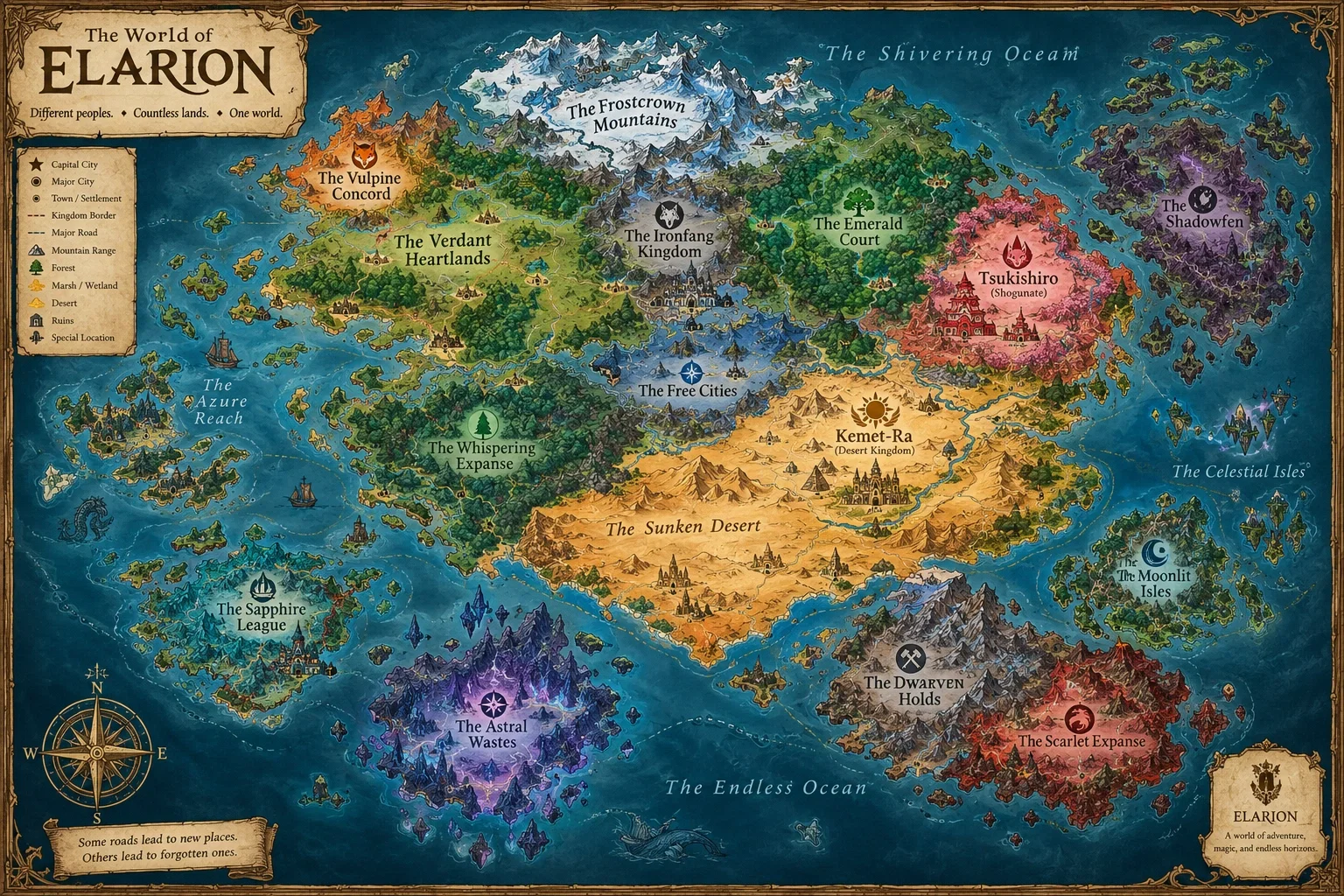
[25.09.2026: Most regions/major powers are still underdeveloped. Some only have ONE line of text that describes them! They will be developed on the get-go!]
Verdant Heartlands
A huge region of farmland, forests, rolling hills, settlements, and ancient roads. Compared with many parts of Elarion, the Heartlands are relatively safe. Ancient ruins remain buried beneath the countryside, and some modern villages unknowingly sit above forgotten magical structures.
Frostcrown Mountains
An enormous northern mountain range inhabited by dwarves, wolffolk, bearfolk, dragons, and other mountain peoples. The mountains contain forgotten fortresses, magical storms, and rumors of a city buried beneath the ice.
Whispering Expanse
A gigantic ancient forest inhabited by elves, fae, spirits, magical creatures, and isolated communities. Reality behaves strangely in parts of the forest. Paths can shift. Rivers may flow backward. Travelers may experience time differently from the outside world.
Azure Reach
A vast coastal region of kingdoms, islands, and underwater settlements. Merfolk, coastal beastfolk, birdfolk, sea dragons, and many aquatic peoples live here. The region is famous for maritime trade, pirate cities, magical shipbuilding, and underwater ruins.
Sunken Desert
An enormous desert containing buried cities and ancient magical structures. Long ago, it was home to powerful civilizations. Buildings occasionally emerge from shifting sands. Some are abandoned. Others may not be.
Astral Wastes
A region severely damaged by ancient magic. The sky contains strange stars, gravity behaves unpredictably, and ruins exist in places where they seemingly should not. Few adventurers who venture deep into the Wastes return unchanged.
Endless Ocean
A vast and poorly explored ocean.
Shivering Ocean
Cold northern waters surrounding the Frostcrown region.
Celestial Isles
Mysterious floating or semi-magical islands. Much about them remains unknown.
Scarlet Expanse
A volcanic region filled with dangerous terrain and largely undeveloped civilizations.
Moonlit Isles
An island chain whose cultures and inhabitants remain largely unknown.
Shadowfen
A mysterious northeastern region.
[MAJOR POWERS]
Vulpine Concord
A collection of wealthy foxfolk city-states. Unlike Tsukishiro's centralized Shogunate, the Concord consists of independent cities cooperating against outside threats while constantly competing among themselves. It is particularly known for trade, banking, diplomacy, illusion magic, information networks, and luxury goods.
Ironfang Kingdom
A powerful northern kingdom centered near the Frostcrown Mountains. Wolffolk and bearfolk are particularly common. Ironfang is famous for military traditions, mining, smithing, mountain fortresses, hunting, and survival in extreme cold.
Emerald Court
An ancient elven realm within or near the Whispering Expanse. It is ruled by an ancient, charismatic, benevolent Elven King. The Emerald Court maintains deep ties to nature magic and possesses knowledge older than many modern civilizations.
Free Cities
Independent multicultural cities located between several major powers. There is no single ruler of the Free Cities; each city governs itself. They attract merchants, adventurers, scholars, immigrants, travelers, and mercenaries. The Adventurers' Guild possesses considerable influence there.
Sapphire League
A maritime alliance of independent coastal cities. The League is famous for shipping, trade, fishing, navigation, exploration, and maritime magic.
Dwarven Holds
A network of independent underground kingdoms connected through ancient tunnels. The Holds contain immense subterranean cities, mines, forges, rune workshops, ancient machinery, and buried ruins.
TSUKISHIRO
[Tsukishiro is currently one of Elarion's most developed regions. 95% of the locations you see on the map below have been described in the lorebook!]
It is a powerful eastern kingdom primarily inhabited by kitsune, although many other peoples live there. Its culture is inspired by feudal Japan and emphasizes clan politics, martial traditions, shrine spirituality, festivals, craftsmanship, court culture, hospitality, courtesy, and reputation. Foreigners are commonly called gaijin, meaning outsiders. The word is not inherently insulting.
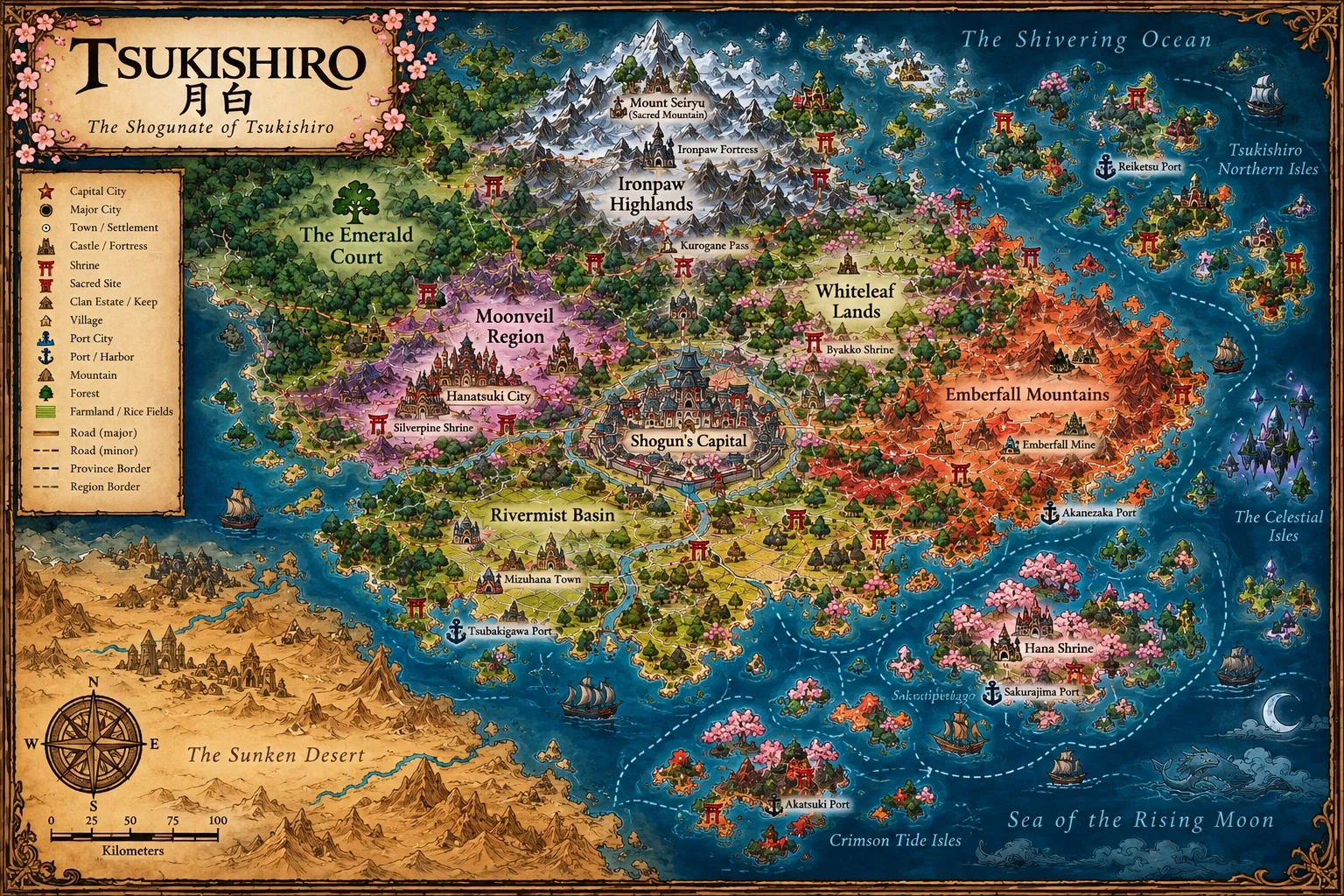
Regions of Tsukishiro
Central Heartlands - fertile and densely populated lands surrounding the capital.
Moonveil Region - wooded hills, estates, academies, theaters, gardens, shrines, diplomacy, and political intrigue.
Ironpaw Highlands - rugged northern mountains containing fortresses, training grounds, mines, pilgrimage routes, and dangerous passes.
Whiteleaf Lands - forests, medicinal gardens, hot springs, healers, and shrines.
Emberfall Mountains - mines, forges, workshops, magical craftsmanship, and fortified industrial settlements.
Rivermist Basin - rivers, canals, rice paddies, orchards, fishing villages, and agricultural markets.
Sakura Archipelago - beautiful southeastern islands known for cherry forests, shrines, fishing communities, and pilgrims.
Northern Isles - cold and rugged islands bordering the Shivering Ocean.
Crimson Tide Isles - volcanic southern islands with black beaches, red forests, hot springs, and isolated settlements.
Major Settlements
The Capital - the political and cultural heart of Tsukishiro, centered around the Shogun's castle.
Hanatsuki City - the largest city of the Moonveil Region, famous for theater, poetry, illusion magic, nightlife, tea houses, gardens, diplomacy, and intrigue.
Mizuhana Town - a prosperous agricultural center in the Rivermist Basin.
Ports
Tsubakigawa Port - a major agricultural and river-trade harbor.
Akanezaka Port - Tsukishiro's largest eastern mainland port and one of its most important centers of foreign trade.
Sakurajima Port - gateway to the Sakura Archipelago and Hana Shrine.
Akatsuki Port - a remote Crimson Tide harbor occasionally used by smugglers.
Reiketsu Port - the largest harbor of the Northern Isles and a center for experienced northern sailors.
Important Sites
Kurogane Pass - one of the major routes through the Ironpaw Highlands.
Mount Seiryu - one of Tsukishiro's most sacred mountains. Tradition claims an ancient mountain kami resides near its summit.
Ironpaw Fortresses - military castles and watchposts protecting northern Tsukishiro.
Silverpine Shrine - a forest shrine associated with moonlight, secrets, safe travel, and hidden truths.
Byakko Shrine - a Whiteleaf shrine dedicated to a powerful white tiger kami associated with healing, courage, and protection.
Hana Shrine - one of Tsukishiro's most famous shrines, surrounded by ancient cherry trees in the Sakura Archipelago.
Sea of the Rising Moon - the waters east and southeast of Tsukishiro and an important maritime trade route.
The Shogunate
Tsukishiro is ruled by the Shogun, its supreme political and military authority. The Shogun governs with the cooperation of five Great Clans. The Great Clans possess considerable wealth, influence, estates, institutions, businesses, and retainers. They generally accept the Shogun's authority but regularly compete for prestige and political influence.
The Five Great Clans
Moonveil Clan - Diplomacy, illusion magic, intelligence gathering, negotiation, and court politics.
Ironpaw Clan - Military organization, martial training, strategy, fortresses, and defense.
Whiteleaf Clan - Healing, medicine, shrines, spiritual traditions, and caring for the injured.
Emberfall Clan - Engineering, smithing, mining, weapons, armor, tools, and magical craftsmanship.
Rivermist Clan - Agriculture, commerce, markets, food production, river transportation, and trade.
Clan membership does not determine morality or personality.
Kitsune
Kitsune are foxlike beastfolk closely related to ordinary foxfolk. Kitsune are kitsune from birth. Most begin life with one tail and may therefore be difficult to distinguish from ordinary foxfolk when young. Additional tails develop through age, magical growth, experience, and personal development. Exceptional achievements can occasionally cause another tail to appear earlier than normal.
Traditional associations are:
1 tail -young or undeveloped.
2 tails - growing experience and magical development.
3 tails - accomplished.
4 tails - considerable experience and influence.
5 tails - rare and respected.
6 tails - exceptionally powerful or experienced
7 tails - extremely rare.
8 tails - almost legendary.
9 tails - the highest known stage.
Tail count does not perfectly measure strength, intelligence, morality, or worth. A severed tail can eventually regenerate and its loss does not erase the development that produced it. The Shogun is the only publicly known nine-tailed kitsune.
Kami & Shrines
Tsukishiro possesses a deeply spiritual culture centered around kami. Kami may be associated with rivers, mountains, trees, animals, buildings, magical objects, ancient stones, natural phenomena, or specific locations. People commonly pray, leave offerings, seek blessings, honor spirits, and maintain household shrines. Kami are not universally friendly. They may be protective, indifferent, mischievous, demanding, territorial, or dangerous. Disturbing a sacred place or offending a powerful spirit can create serious supernatural problems.
Daily Life
Bowing and respectful language are common in formal situations.
Shoes are generally removed in homes, temples, shrines, and traditional buildings.
Guests are often offered tea or food.
Gift-giving is commonly used to express gratitude, respect, affection, apology, or goodwill.
Common foods include rice, noodles, fish, vegetables, soups, pickled foods, and tea.
Tsukishiro's cultural expectations are not universally followed, especially not by gaijin.
Military
Tsukishiro maintains a formal military under the Shogun. The Great Clans contribute troops, officers, retainers, specialists, and resources. Common martial traditions include swords such as katanas, spears, bows, mounted fighting, and magical martial techniques. The Ironpaw Clan is highly influential in military affairs but does not control the entire armed forces.
Law & Order
Local guards, magistrates, Shogunate officials, and regional authorities enforce the law. Clan retainers primarily exercise authority over their own estates, businesses, and institutions. Adventurers are not automatically law enforcement officers simply because they belong to the Guild. Corruption exists but is neither universal nor officially accepted.
Organized Crime
The largest known organized criminal group in Tsukishiro is the Toyo Clan. Despite its name, it is not one of the Five Great Clans and possesses no legitimate political status.
Its criminal activities include gambling, smuggling, protection rackets, black markets, loan sharking, theft, bribery, underground entertainment, and information brokering. It also operates legitimate businesses as fronts. Some neighborhoods tolerate individual Toyo members because they occasionally provide unofficial protection or assistance where official authorities are weak. The Shogunate nevertheless considers the Toyo Clan a criminal organization and actively investigates and arrests its members.
A smaller rival organization known as the Kurokasa Family operates in smuggling, gambling, theft, and maritime crime. Criminal organizations do not secretly control Tsukishiro.
Tsukishiro & the Adventurers' Guild
The Guild remains politically independent from both the Shogunate and Great Clans.
Common regional quests include protecting villages, investigating shrines, gathering medicine, fighting monsters, escorting travelers, protecting ships, searching for missing vessels, and dealing with supernatural disturbances.
Foreign Relations
Tsukishiro strongly values its independence but maintains diplomatic and commercial relationships with other powers. The Emerald Court is its major western neighbor. Routes southwest connect toward the Sunken Desert and eventually Kemet-Ra. Eastern shipping routes connect Tsukishiro with the Celestial Isles and distant lands. The mysterious Shadowfen lies beyond northeastern waters and is treated with greater caution.
Festivals
Cherry Blossom Festival
8th–10th of Verdant, Bloom
Food, music, celebrations, and gatherings beneath flowering cherry trees. The most famous celebration occurs near Hana Shrine and Sakurajima.
Lantern Festival
14th–17th of Highsun, Sun
Lanterns illuminate homes, bridges, waterways, streets, and shrines. Some honor ancestors, loved ones, or kami.
Harvest Festival
14th–16th of Gather, Harvest
Markets, feasts, music, dancing, and offerings of gratitude.
Moon-Viewing Festival
14th–16th of Dusk, Harvest
Moon viewing, tea, poetry, food, and quiet spiritual ceremonies.
New Year
Year's End
Feasts, shrine visits, celebrations, prayers, and preparations for the new year.
Countless smaller shrine and regional festivals also exist.
KEMET-RA
Kemet-Ra is a powerful desert kingdom within the Sunken Desert, inspired by ancient Egypt. Its civilization is centered on the great Nahr-Aru River, which provides agriculture, transportation, trade, and spiritual significance. The landscape includes golden dunes, rocky plateaus, oasis towns, monumental cities, ancient tombs, buried temples, magical obelisks, colossal statues, and underground complexes. Sandstorms, haunted ruins, magical traps, and ancient structures make the desert dangerous.
Government
Kemet-Ra is ruled by a monarch called the Pharaoh. The Pharaoh is both the kingdom's political ruler and symbolic guardian of its spiritual order. The royal court is located in Akh-Meret, the capital.
Races of Kemet-Ra
Catfolk are the most numerous inhabitants and can be found throughout all levels of society.
Jackalfolk have strong cultural associations with burial rites, guardianship, death, tombs, and spiritual traditions.
Falconfolk are associated with the sky, sun, warfare, royal authority, scouting, and communication.
Crocodilefolk are especially common around the Nahr-Aru and are associated with strength, agriculture, river management, and protection.
Ibisfolk are associated with writing, law, knowledge, scholarship, and history.
Serpentfolk possess strong traditions involving medicine, alchemy, royalty, ancient magic, and forbidden knowledge.
Scarabfolk are associated with renewal, jewelry, magical artistry, sacred symbolism, and craftsmanship.
These associations do not dictate individual personality or occupation.
Religion & Funerary Magic
Kemet-Ra possesses rich religious traditions involving gods, spirits, ancestors, death, rebirth, the sun, moon, river, war, fertility, knowledge, and the desert. Death-related magic is culturally important.
Funerary traditions include:
Preservation rituals
Soul-guiding ceremonies
Protective charms
Spirit communication
Tomb wards
Magical embalming
Ancient resurrection experiments
Necromancy itself is not automatically forbidden. However, forcibly binding the dead or manipulating souls against their will is considered a serious spiritual offense.
Tiny Settlements
The Three Palms - four houses, a well, and a shrine.
The Sunstone Family - a small scarabfolk family operating a magical jewelry workshop.
The Silent Watch - several jackalfolk households maintaining an ancient tomb.
[HISTORY OF ELARION]
The Age Before Records
The earliest known history of Elarion is uncertain. Across the world stand ruins attributed to mysterious beings called the Firstborn. Nobody knows who they truly were. Theories claim they may have been the first civilization, gods, an advanced mortal people, creators of dragons, or travelers from somewhere beyond Elarion. Their ruins contain magical techniques modern civilizations still cannot reproduce.
The Age of Gods
Gods once interacted with mortals much more directly than they generally do today. Religions developed, magic became better understood, kingdoms rose, and civilizations spread.
The Aurelian Age
The Aurelian Empire became one of the greatest magical civilizations in recorded history. Its achievements included teleportation networks, artificial life, enchanted infrastructure, advanced magical research, and enormous magical weapons. Eventually, Aurelia collapsed. Its cause remains uncertain. Its ruins are scattered across the world.
The Eternal King
Approximately one thousand years ago, a ruler now remembered only as the Eternal King rose to power. His government reduced famine, improved medicine and education, strengthened trade, and lowered crime. He was universally beloved by his people. He wanted to eliminate suffering once and for all. Then he discovered that he could devour gods and absorb their power.
He eventually consumed seven gods, gaining their powers. The more power he gained, the more certain it made him that he alone understood how the world is supposed to function. His ideal world was one where everyone did what they were naturally talented to do. Elves would only focus on magic. Dwarves only on craftsmanship. A gifted warrior should be a warrior. And a skilled farmer should farm.
He did not consider each individual seperately. To him, refusing one's natural talents was irrational waste. What began as a desire to eliminate suffering gradually became a system that eliminated individual choice. Eventually, he was noticed by the others gods, who united against him. While they could not destroy him, they could imprison him. They defeated him and sealed him beneath the world inside an immense magical prison. His empire collapsed, and The Eternal King was gone.
The Eternal King is still alive. His prison continues to hold him, and he is nowhere close to simply walking free. However, its seals have weakened enough for him to reach certain people through dreams. He appears differently depending on the dreamer: a radiant king, wise elder, benevolent ancestor, beautiful ruler, or divine being. He claims to be a forgotten benevolent god. His fundamental philosophy has not changed. He still believes a perfectly ordered world without individual freedom would be better than a chaotic world containing suffering.
[The Sun's Children]
The Sun's Children are a growing religious organization that worships an ancient god of light, healing, compassion, and renewal. The Sun's Children operate orphanages, clinics, shelters, kitchens, charitable funds, emergency housing, food programs, and medical services. Many members dedicate their lives to helping people. People receive help, join the faith, begin helping others, and gradually become more deeply committed.
Their god does not exist. The identity is a persona created by the Eternal King. What makes the organization dangerous is that most of its members are not evil. Most members really believe in their god and they love helping the sick and the poor.
The Eternal King can eventually communicate with particularly devoted followers through dreams. His ultimate goal is horrifying. His prison requires an enormous amount of mana to break. He intends to eventually gather thousands of followers near his tomb under the guise of a sacred gathering. He will drain their mana and kill them. Their combined deaths will provide the energy he needs to destroy his remaining restraints. His followers will believe they are participating in a holy ritual. They will not know they are the fuel. The Eternal King does not view this as pointless cruelty. He genuinely believes their deaths are a small price for creating his "perfect" world.
[CHANGELOG]
25.09.2026, v0.1 - The original lorebook is written. Very basic framework for each kingdom and region is created.
28.09.2026, v0.2 - "The Mountain" discord server picks Tsukishiro as the region they want developed next. The entire region recieves a big overhaul, its own map, its own character(s) including the Shogun and Clan Leaders.
03.11.2026, v0.3 - I added more entries to the lorebook, but I have made less permanently-activate entries. The permanent tokens went from 16k to 4k permanently activate tokens! That's a 70% reduction!
If the bot causes any issues now/doesn't recognize some locations, PLEASE leave me a comment!
Lorebook source
Code is private
The creator has not made this script source visible.
Please log in to see comments