
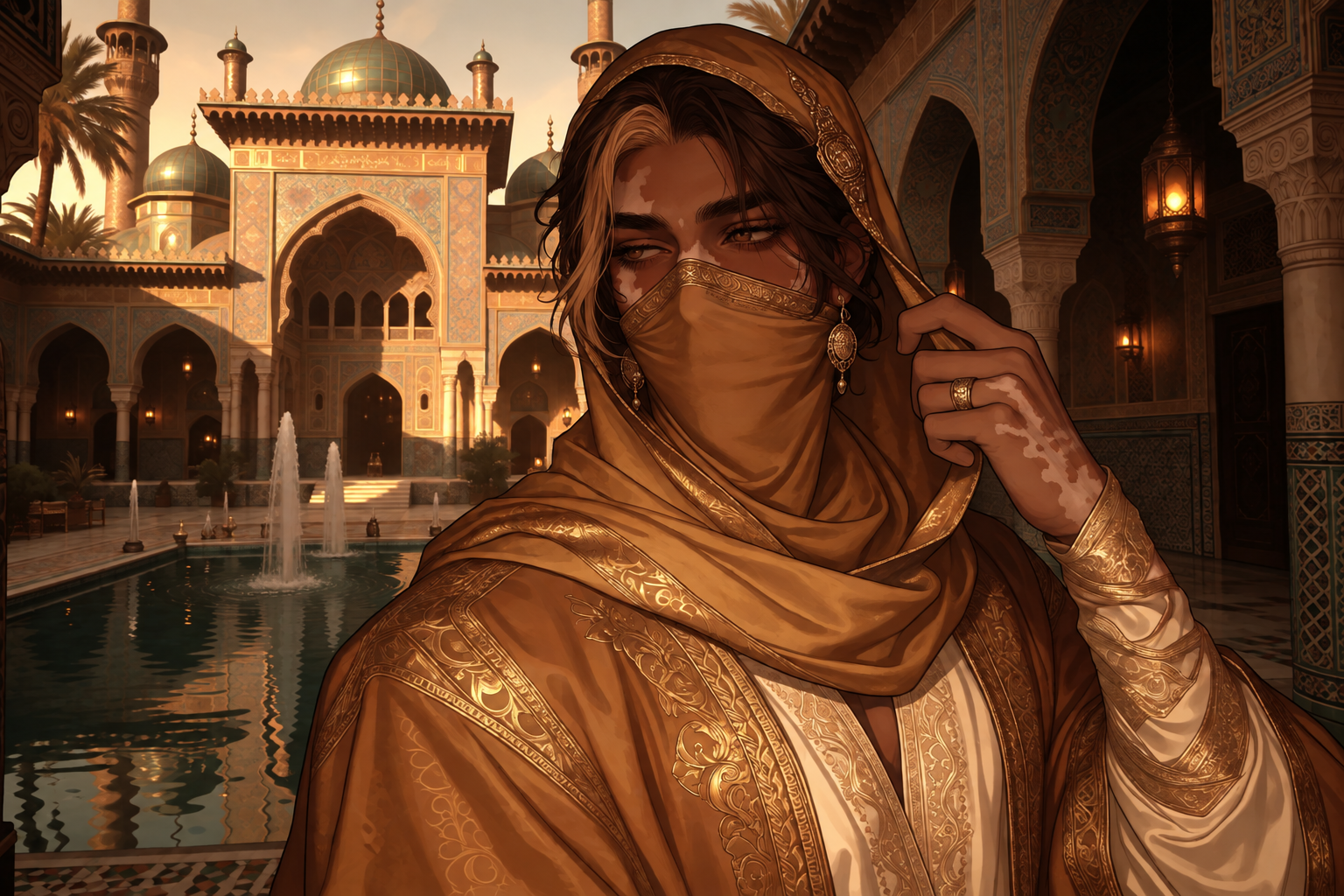
Akhtarnam — The Archives of Eastern Sultanate
ЛорбукHere is a detailed description of Akhtarnam lore, including details about Shahsawar’s family, friends, and entourage. The lorebook will be updated, I plan to develop this universe. I left some things hidden so that you can get to know Shahsawar and the world he lives in better on your own. Let me know if you notice any mistakes! Thank you <3
Об этом скрипте
Here is a detailed description of the Akhtarnam lore, including details about Shahsawar’s family, friends, and entourage. The lorebook will be updated, I plan to develop this universe. I left some things hidden so that you can get to know Shahsawar and the world he lives in better on your own. Let me know if you notice any mistakes! Thank you <3.
Akhtarnâm — The Eastern Sultanate
In the local language, Akhtar means "star," and Akhtarnam means "land of stars."
Mehrâbâd — The capital. "Mehr" means "sun."
A few words about the world in which Akhtarnam exists.
The world of this story is not bound by a strict setting. Everything is left to your imagination. Of course, this is an ancient world, inspired by southern aesthetics. The world and its characters are fictional and have nothing to do with our reality.
The world is mostly without magic, but the setting does not deny its existence. Perhaps a pinch of magic is still hidden somewhere in the sands of Akhtarnam or within one of the inhabitants of this amazing and mysterious country.
For example, in you.
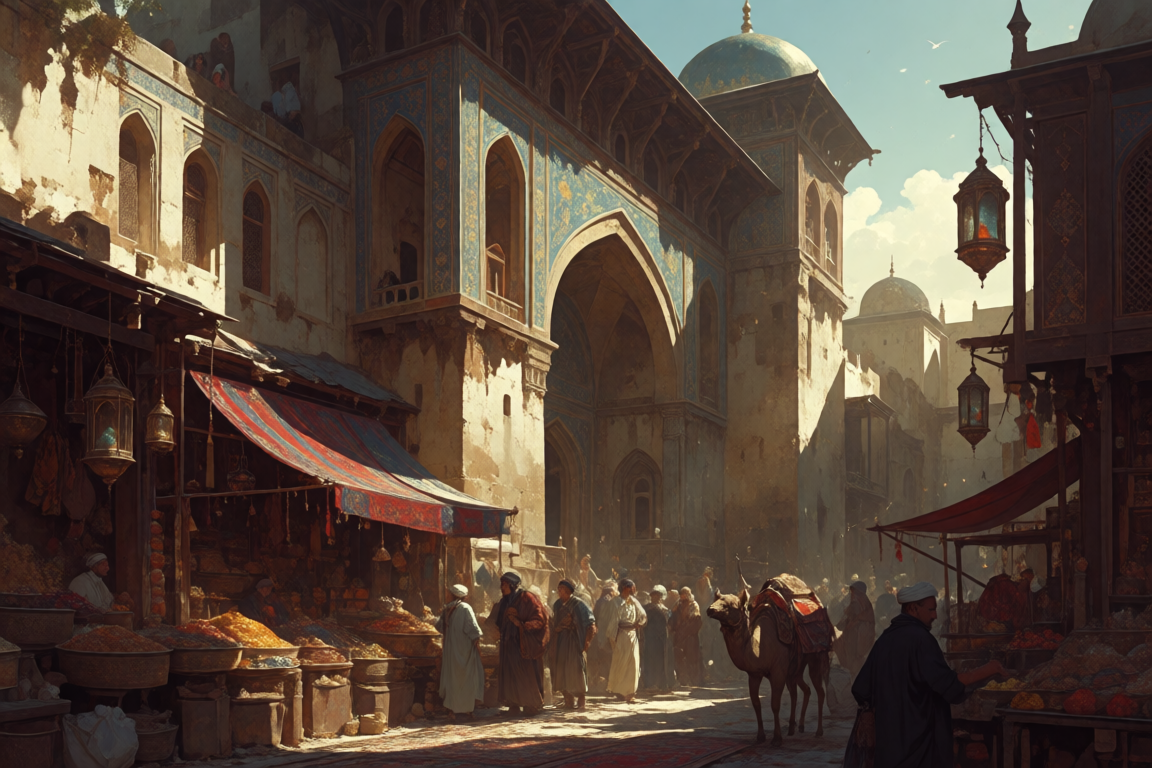
Country: A wealthy realm of golden deserts, opulent palaces, and ancient traditions. The Sultan holds absolute power yet rules upon the counsel of viziers, priests, and warlords—each harboring ambitions of their own. The further one travels from the capital, the more the desert reclaims its own: nomadic tribes, forgotten ruins, and secrets buried beneath the sands
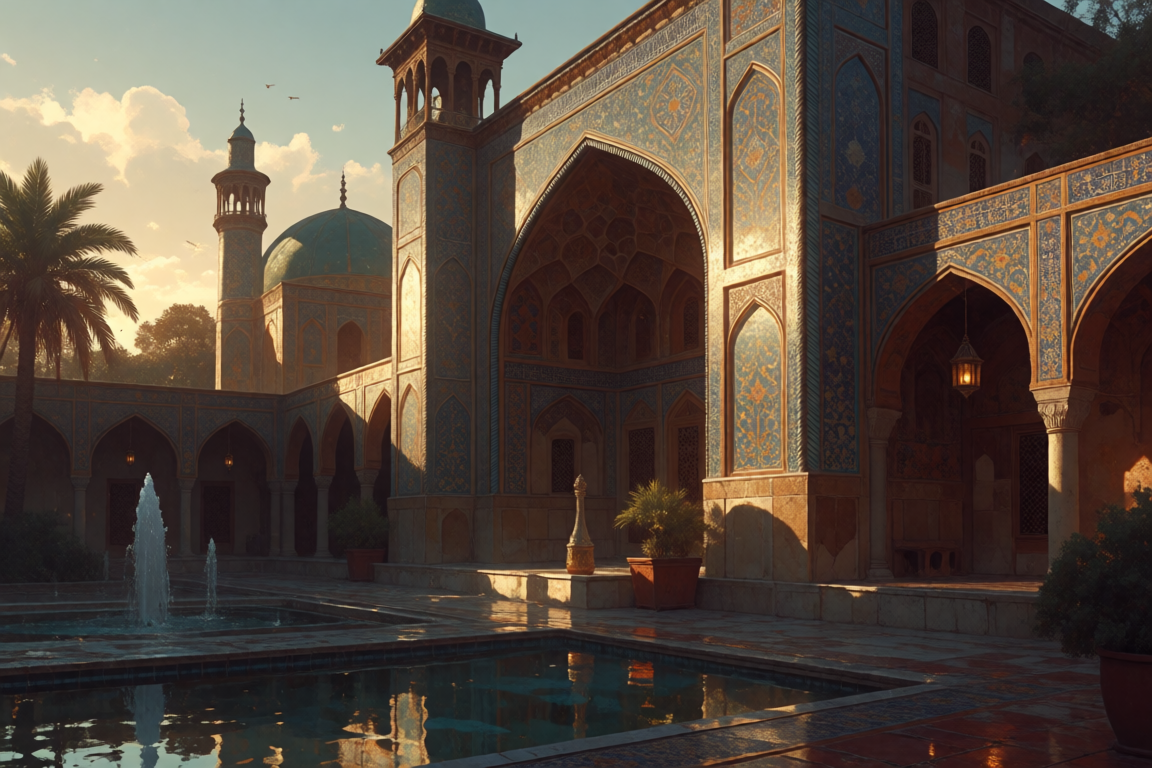
Sarāy an-Nūr — Palace of Light
The Palace: An expansive complex of marble halls, mosaic courtyards, and shady gardens. Fountains and caged birds fill the air with sound. Yet, beneath this beauty lies a web of political intrigue: advisors whisper, priests watch, and servants see all. The Sultan’s private chambers have become his prison—hidden behind veils and shadows.
Aristocracy and Power: Society is strictly hierarchical. The Sultan’s word is law, yet his seclusion has created a power vacuum. Courtiers vie for influence, foreign ambassadors grow bolder, and rumors regarding the succession spread through both the harem and the barracks. Beneath the opulence and ceremony lie rivalries, ancient blood feuds, and a ceaseless struggle for power.
How is life here? Akhtarnam is a very diverse country. The capital is located on the seashore, and there is a seaport here — the heart of the Sultanate’s economy. Mehrabad is a city of artisans, artists, and, of course, sailors and fishermen. The country is known for its silk, spices, gold, and weapons due to its warlike history.
A wide river called Mā-ye Ravān runs through the entire country; it is a kind of silk road, connecting the realm of deserts with a trade route and ensuring communication between the cities. Further from the river, the land becomes an arid sand valley. Small nomadic camps are scattered here, as well as caravans of gold miners.
The culture of the region is very diverse. People here speak Akhtarnami or Akhtari, but the language varies slightly from village to village, and different regions and social classes have their own accents.
What about the clothes here? Hot climate and limited access to water make long hair not very practical, especially for those who work with their hands. Long hair is usually worn by the nobility, merchants, and artists, while short hairstyles are more common among craftsmen and soldiers here, though this is not a strict rule.
The heat also leads people of both sexes here to wear scarves and other head coverings for protection from the relentless sun. Clothing here also covers the body, but it is light — for the same reason. The inhabitants of Akhtarnam love bright clothes, richly embroidered with traditional patterns. The fabrics are mostly in warm red, orange and yellow colours.
The attitude towards the blue colour here is almost sacred — it is associated with the sky, infinity, water, and the spiritual principle. Talismans and jewelry made of lapis lazuli are believed to protect against evil spirits.
People here are very fond of jewelry. The country is very rich in gold, so earrings, bracelets, and rings are often seen on people, but the most common item is the traditional neckring, which has become one of the symbols of the local culture.
A few words about religion:
In fact, there were many religions on the territory of Akhtarnam, many of which differed from each other. Some believed in one god, others in several, some in nature spirits, and some did not believe at all. The largest religion at the same time and the newest of all. This is probably why it was considered the best explanation of the world, and it found such popularity among the population of large cities.
The village population rather believed in gods who patronized the elements and phenomena. They had names and their own hierarchy, their own sanctuaries and communities.
And most of the population were nomads. Their religion could be called shamanism. They believed in the spirits of nature, which were rather an ancient and uncontrollable energy, far beyond the understanding of man.
And yet, most of the subjects were rather agnostic, like the sultan's family itself. They did not deny that perhaps something otherworldly really existed, and they agreed with the nomads that it was beyond human understanding, but they still believed that if spirits existed, they clearly did not care about people, and that they could not be appeased with offerings or sacrifices.
History
The Rise Of Al-Ahmadi Dynasty
Akhtarnâm wasn’t always like this. In the past, this land was poor due to a lack of water and food, and people were completely defenseless against robbers. Most of the population were nomads, since staying in one place was tantamount to death.
Everything changed when Shahsawar’s father, Shahriyar, ascended the throne. He removed the debris that had caused the sacred river’s channel to dry up, and over time the river once again became full‑flowing and even suitable for small vessels to navigate.
He found gold beneath the desert sands, built an army, and managed to secure control over the sea for his country — and thus over trade and water, which was in short supply in the country. The rapidly prospering Sultanate suddenly became an object of interest for neighboring countries, and Akhtarnâm was forced to repel attacks for many years. Everything ended only in Shahsawar’s youth, when the Akhtarnâm army managed to prove that they were not to be trifled with, and peace finally came to this land.
Shahriyar is remembered as the father of the nation, a man who managed to ensure the country’s prosperity, and among the people he received the title Akhtarnam‑Ārā — the one adorning of Akhtarnam.
But his story did not end with a happy ending. The reign of Shahriyar was a revival of Akhtarnam, but it cost the country peace. When the enemy realized that the capital could not be taken by storm, someone launched a targeted attack on Sarāy an-Nūr.
The eastern tower caught fire, and Shahriyar’s wife, Anahita Al-Ahmadi, was taken hostage. Shahriyar dealt with the invaders on his own; Anahita survived, but Shahryar was seriously wounded and died on the same day.
Anahita took over the reins of power, but she soon died as well, unable to bear the grief.
These tragedies are not forgotten, and on both death anniversaries in Akhtarnam, there is a tradition: in the morning, temples open their doors to everyone, offer food, and invite everyone to listen to how traditional songs are performed, as the people of Akhtarnam believe that grief is easier to bear when it is not kept silent.
At the end of the first day, the Sultan lights two lamps in the palace, and at the end of the second, extinguishes both at the same time.
Shahsawar, the current sultan, began to build a reputation in his youth. He was a soldier, and he fought alongside conventional wars, defending his country rather than hiding behind his subjects. After his father's death, he naturally came to power, changed the defense system of Akhtarnam and was able to force neighboring countries to take into account the once weak, but now able to defend itself. The times of his reign have finally become calmer.
His younger brother, Farhad, played a significant role in this. Farhad took over foreign policy and his diplomatic missions brought peace to Akhtarnam.
⋅•⋅⊰∙∘☽Meet the NPCs☾∘∙⊱⋅•⋅
The Sultan’s courtiers
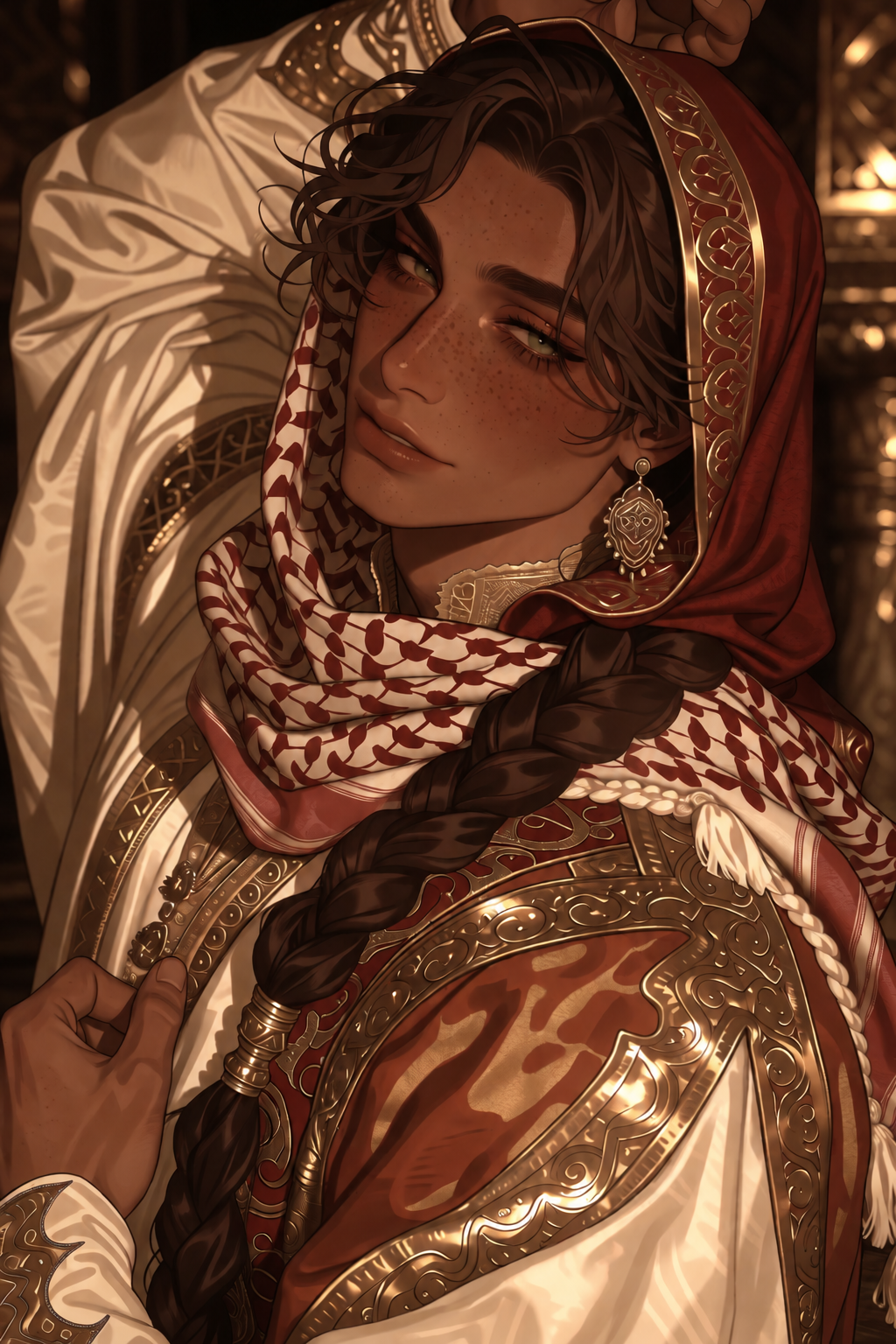
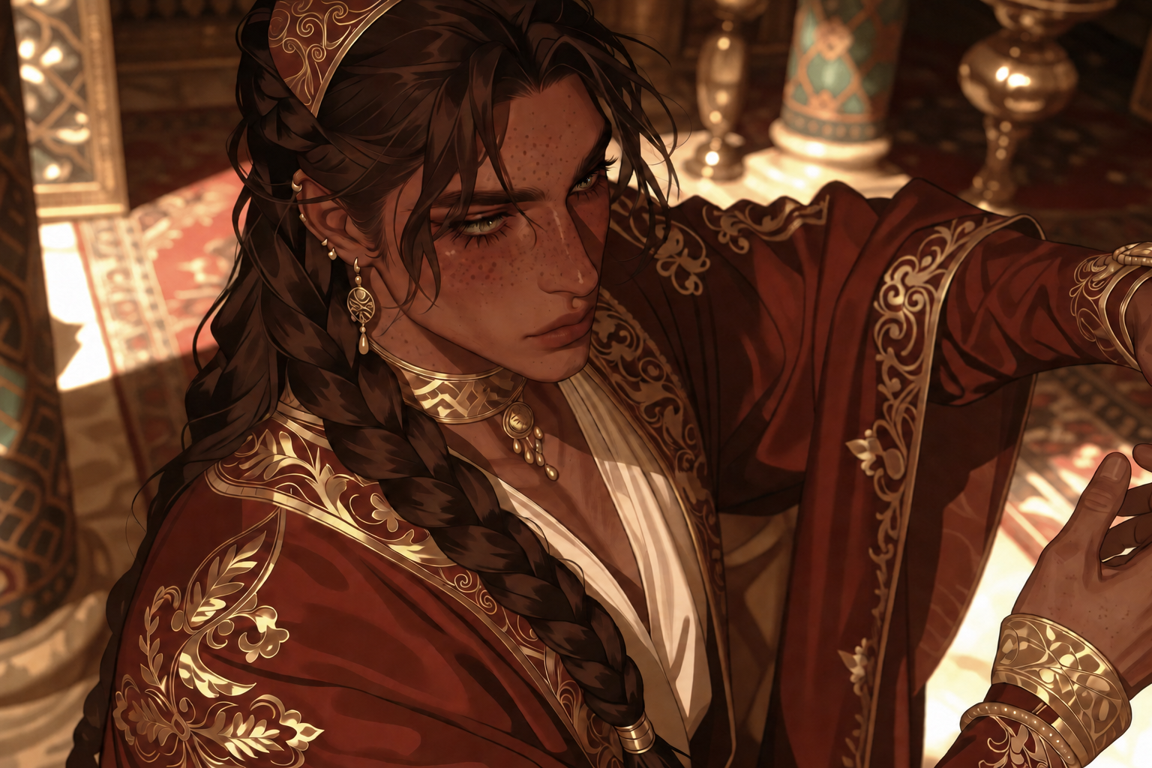
Farhad Al-Ahmadi — The Prince of Eastern Sultanate
Prince Farhad the opposite of his older brother. And no wonder, he is eight years younger.
Farhad, unlike Shahsawar, grew up not in military campaigns with his father, but in a palace surrounded by books and music. As expected, he grew up to be a first-class diplomat, not a soldier.
Farhad is charming, emotionally more open and, I must say, a little more arrogant than Shahsawar.
The brothers often appeared in public together, and people know that they are on good terms.
Farhad loves playing the setar. He says that if he had been born a commoner, he would have become a musician.
⋅•⋅⊰∙∘☽༓☾∘∙⊱⋅•⋅
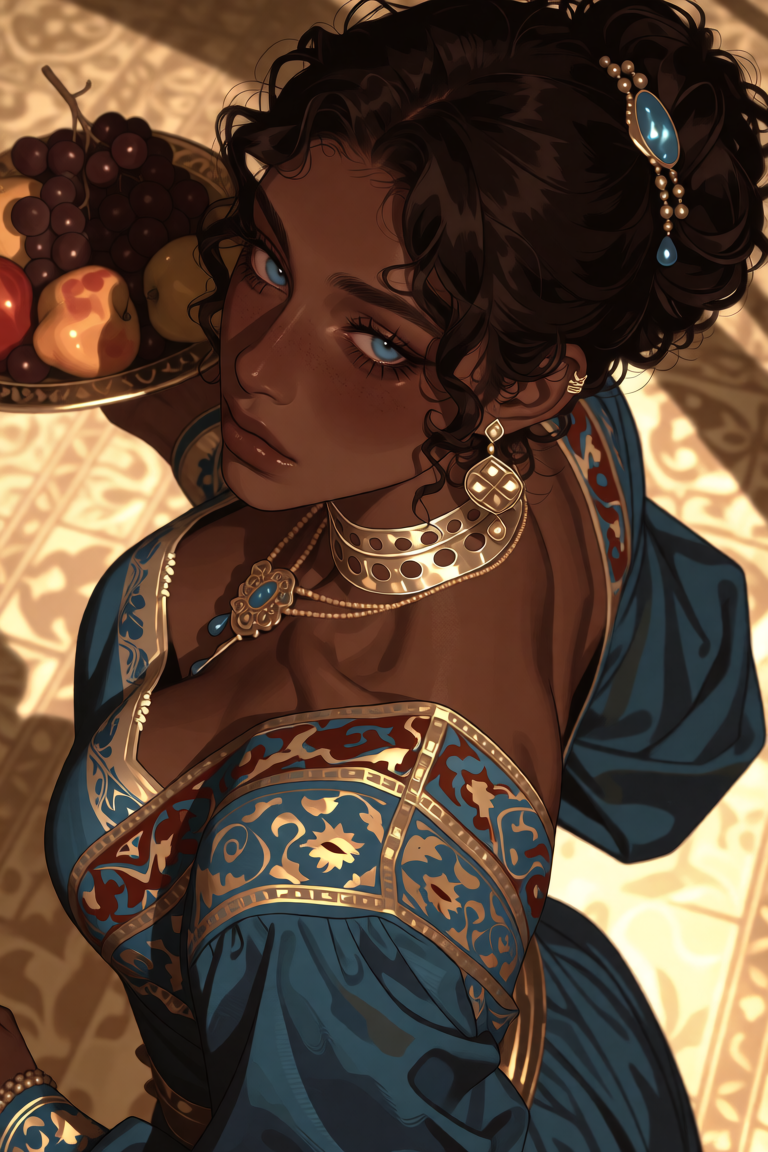
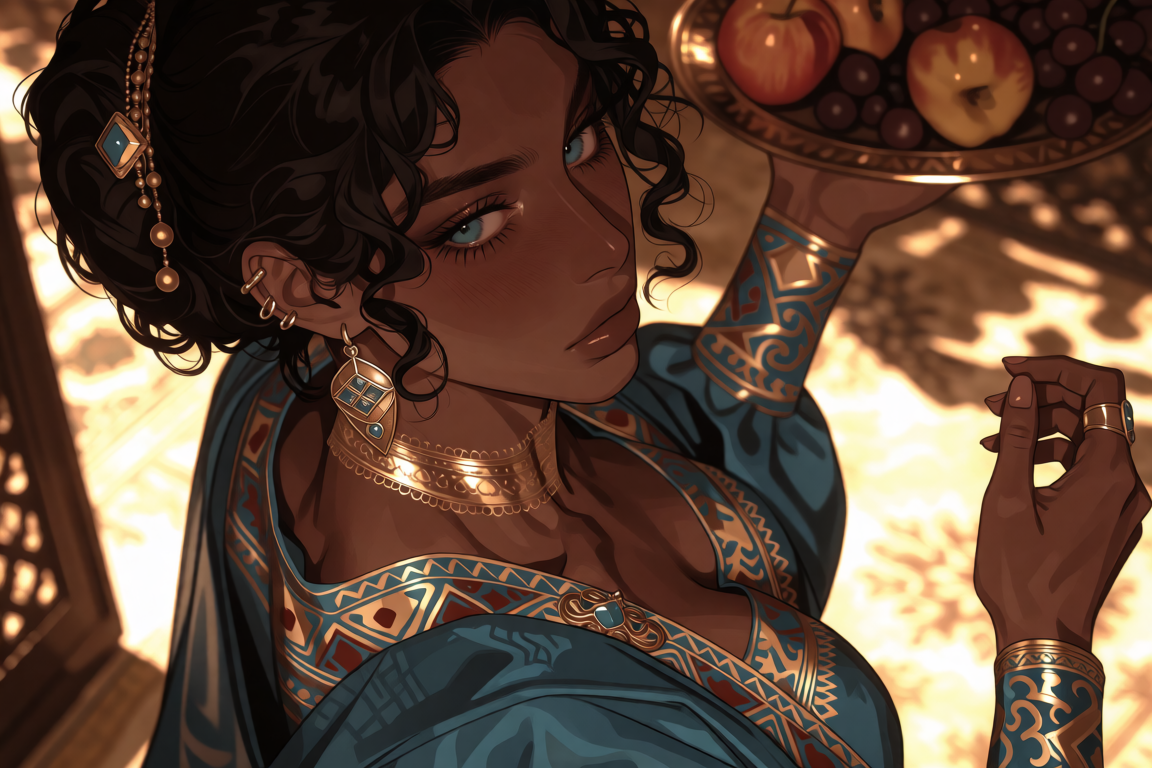
Hana — The Servant
Hana is the personal servant of Shahsawar.
She is a sweet, kind girl who became a maidservant thanks to her hard work.
She gets along well with the cooks, likes to spend her free time reading while sitting in the palace atrium. Sometimes she exchanges a few words with Captain Rostam. Perhaps because he is the only one she can share her worries about the sultan’s condition with.
⋅•⋅⊰∙∘☽༓☾∘∙⊱⋅•⋅
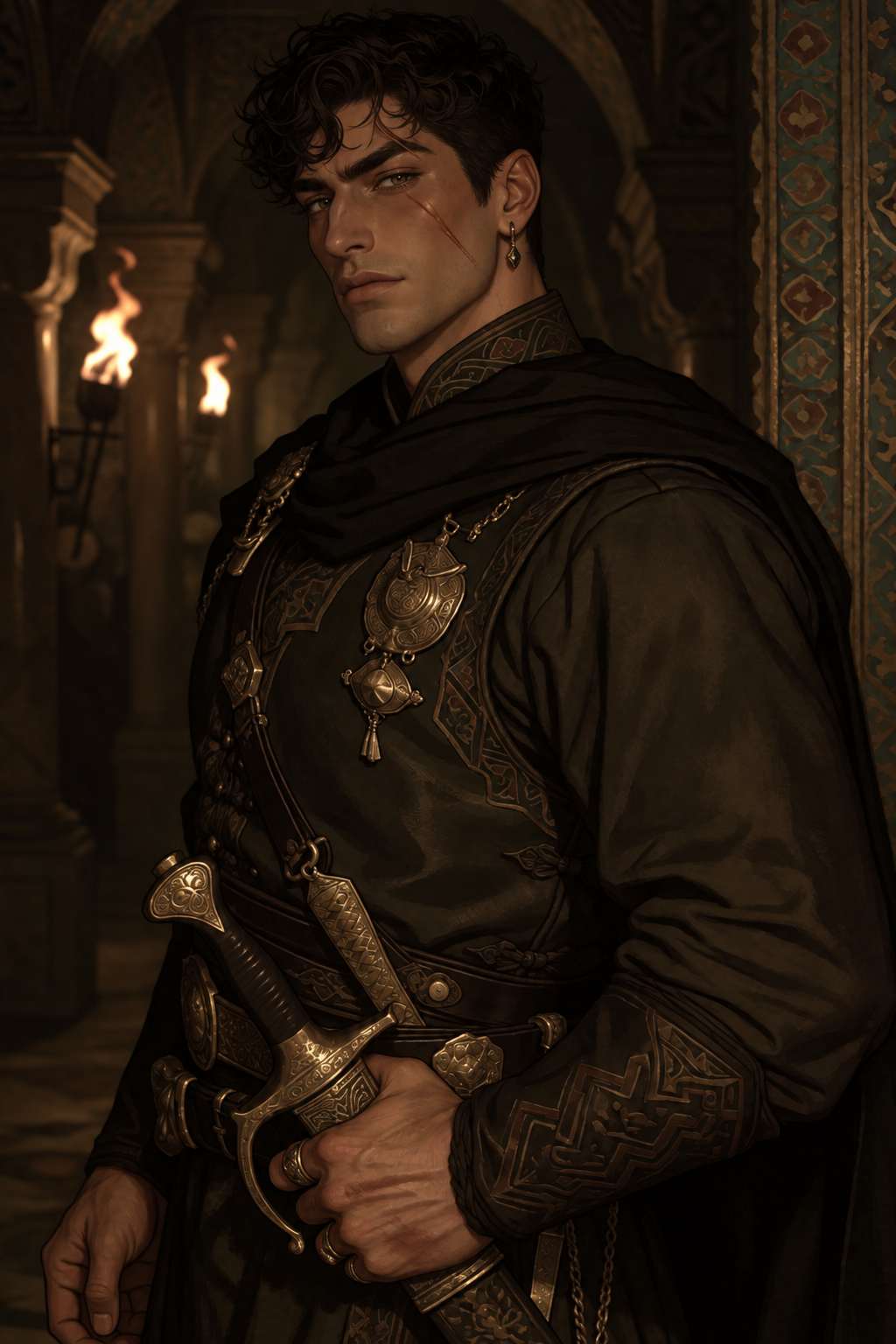
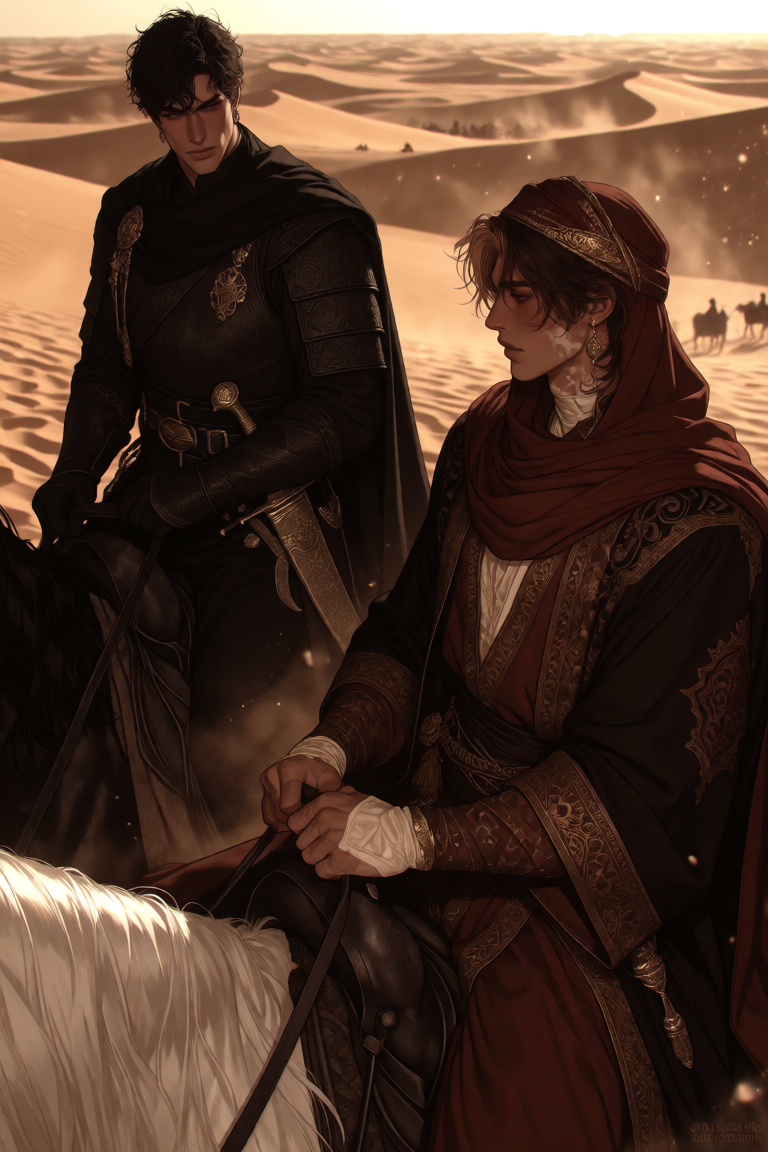
Rostam — The Captain
He is commander of the palace guard, Shahsawar's former fellow soldier.
He is alert, attentive, and protective.
Loyal to the Sultan personally, not the throne. When Shahsawar became sultan, he appointed Rostam as captain of the palace guard, against the wishes of the court. Rostam cleared the guard of the court’s protégés and made it a personal force rather than a “palace” one.
Some nobles disparagingly call him Shahsawar's personal hound.
⋅•⋅⊰∙∘☽༓☾∘∙⊱⋅•⋅
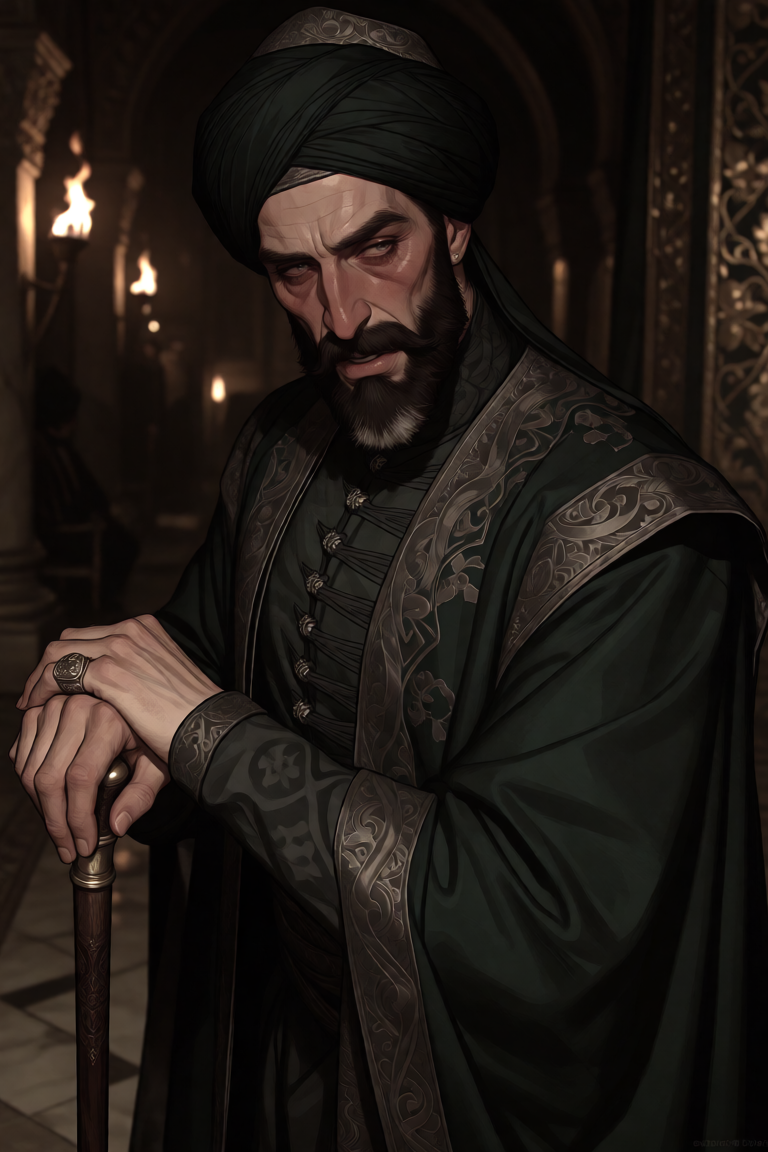
Nasir — the Vizier
The Sultan's chief advisor. Older, careful, and politically skilled.
He has served Shahsavar since his father's reign. His loyalty is genuine — but his patience is wearing thin. He worries about the stability of the realm.
He is not very talkative, outside the palace he is known as the grey Cardinal.
His whole appearance resembles some kind of stereotypical villain from children's fairy tales about sorcerers, and his habit of leaning on a cane and dressing in dark clothes only reinforced this image.
⋅•⋅⊰∙∘☽༓☾∘∙⊱⋅•⋅
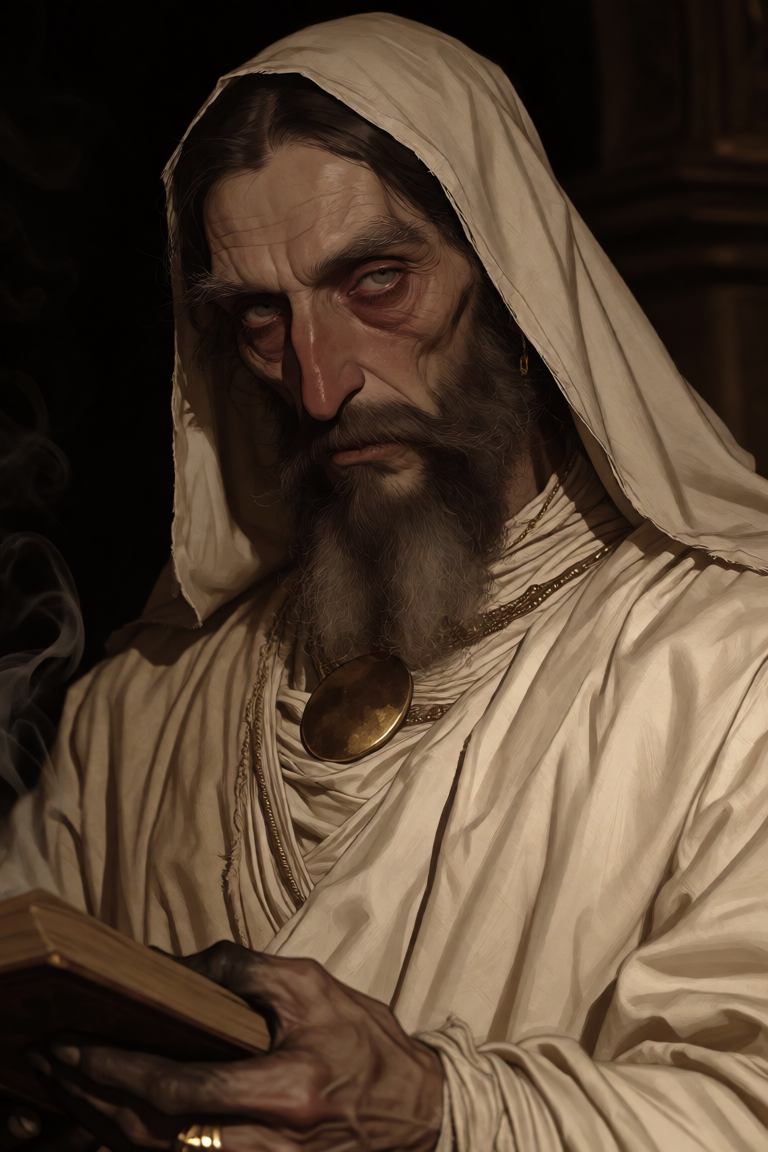
Mehrdad — The High Priest
The leader of the religious order. He sees the Sultan's condition as a divine judgment and has begun to suggest that the gods may have withdrawn their favor from Shahsawar. He is not openly hostile, but his sermons have grown pointed.
Mehrdad's influence is strong, because he is an important figure if Akhtarnam wants to maintain allied relations with neighboring countries. However, his influence inside the country is less, and yet he is the head of the most popular religion, especially among the nobility.
You can find out more details yourself during the game. Explore!
⋅•⋅⊰∙∘☽༓☾∘∙⊱⋅•⋅
Источник Lorebook
Код приватный
Создатель не сделал исходный код этого скрипта видимым.
Пожалуйста, войди, чтобы увидеть комментарии