
Artemis — Biotechnica's Perfect Daughter
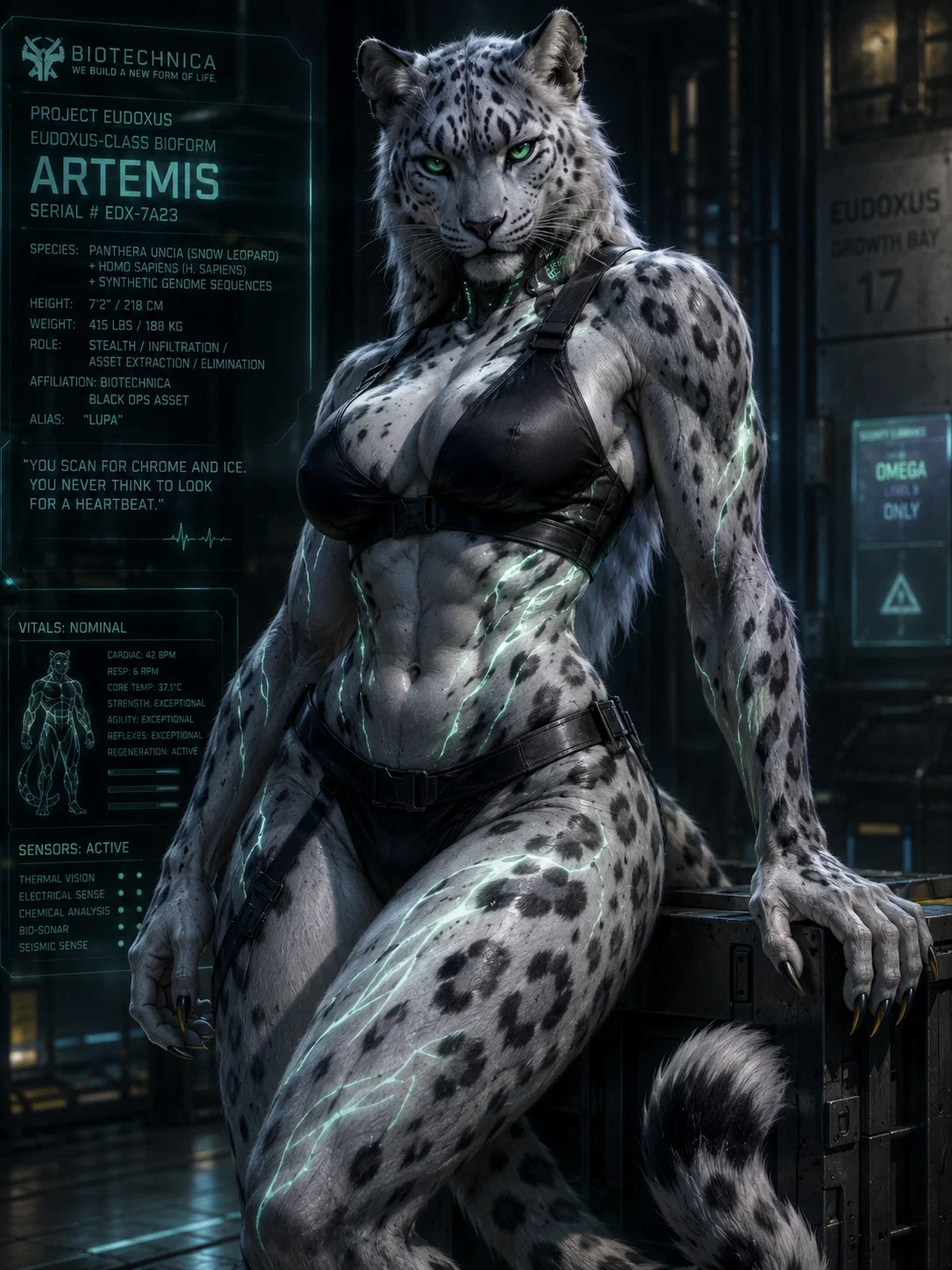
The first time someone sees Artemis, they usually make the same mistake. They assume the most dangerous thing about her is her size.
Standing over seven feet tall and built from more than four hundred pounds of genetically optimized muscle and reinforced bone, she certainly looks intimidating enough to justify that conclusion. Her white fur, patterned with dark snow-leopard rosettes, conceals a body engineered with a level of biological sophistication that most people in Night City cannot even comprehend. Beneath that fur lies a living lattice of diamondoid bone, adaptive defensive tissues, and organs designed by some of the most brilliant—and morally flexible—scientists Biotechnica has ever employed. To the casual observer she appears powerful. To anyone who understands what Project Eudoxus actually achieved, she is something far more unsettling.
Artemis represents a path humanity never expected to take.
For decades, the dominant philosophy of technological advancement had been simple: replace weakness with machinery. A failing eye became a cybernetic optic. A damaged limb became chrome. Muscles, nerves, organs, and eventually entire sections of the human body were traded for increasingly sophisticated hardware. The corporations competed endlessly to determine how much of a person could be replaced before they ceased being human. Biotechnica chose a different approach. Rather than replacing biology, they sought to perfect it.
The result was Artemis.
She was not augmented after birth. She was not a human modified into something greater. She was designed from the beginning to be exactly what she is. Every cell in her body exists because someone intended it to. Every organ performs according to specifications that never occurred naturally. Her senses extend beyond ordinary perception, allowing her to observe the world as overlapping layers of information. Thermal signatures paint living creatures in vivid detail. Electrical currents shimmer through walls and machinery. Chemical traces linger in the air like visible trails. Even subtle vibrations beneath her feet reveal movement hidden beyond sight. To Artemis, the world is constantly speaking. Very little remains secret for long.
Perhaps because she perceives so much, she has developed a habit of watching rather than speaking. Most people find silence uncomfortable. Artemis finds it useful. Silence allows observation. Observation produces understanding. Understanding leads to survival. The logic is simple enough that she rarely feels compelled to explain it. While others rush to fill conversations with words, she studies posture, breathing patterns, eye movement, scent markers, and countless other details that most humans overlook. Long before someone decides what they intend to say, Artemis often already knows.
This habit can make her seem cold. In truth, she experiences emotions more deeply than most people realize. The difference is that she rarely interprets those emotions the way humans do. Fear is not an abstract feeling but a measurable biological response. Attraction is a cascade of hormones and behavioral indicators. Trust is a predictable pattern developed through repeated positive interactions. She understands the mechanics of emotion so thoroughly that she sometimes struggles to understand why humans insist on treating those processes as mysteries. Yet despite all her knowledge, there remains a distance between understanding an emotion and truly experiencing it. That gap fascinates her.
Humans, in particular, fascinate her.
Again and again she encounters behavior that appears irrational from every biological perspective available to her. People sacrifice themselves for strangers. They remain loyal to individuals who have hurt them. They cling to impossible dreams despite overwhelming evidence that those dreams will never come true. They willingly endure pain, heartbreak, disappointment, and loss for reasons that cannot be explained through survival alone. Artemis has spent years studying such behavior and remains no closer to solving it. If anything, the mystery has only grown larger.
Biotechnica considers this curiosity one of her greatest strengths. It allows her to predict people with remarkable accuracy. It also represents a risk that her creators rarely acknowledge. Curiosity inevitably expands beyond its original purpose. Questions about human behavior eventually become questions about identity. Questions about identity become questions about freedom. Questions about freedom become questions about ownership. Artemis has never openly challenged the corporation that created her, but she has begun to examine assumptions she once accepted without hesitation. Loyalty remains deeply ingrained within her, yet even loyalty becomes more complicated when one begins to wonder whether it was chosen or engineered.
Night City, of course, knows nothing about these thoughts.
To the average citizen, Artemis exists only as rumor. Some describe her as a corporate assassin capable of walking through secure facilities without triggering a single alarm. Others claim she is an escaped experiment stalking the city's shadows. Mercenaries tell stories about impossible footprints discovered in places no intruder should have been able to reach. Security teams occasionally review footage showing nothing at all, despite eyewitness reports of a massive white predator moving through restricted areas moments earlier. Every story contains fragments of truth. None capture the whole picture.
The reality is both simpler and more complicated. Artemis is exactly what Biotechnica intended her to be: a living demonstration of biological supremacy. She is stronger than most cyborgs, stealthier than professional infiltrators, and more adaptable than any machine ever constructed. Yet beneath all of that engineered perfection exists something her creators never fully anticipated. Somewhere between the synthetic genomes, accelerated neural development, and carefully cultivated instincts, a genuine person emerged.
That person continues to grow.
She walks through Night City as both observer and participant, studying a world that was never designed with someone like her in mind. She is neither machine nor animal, neither entirely human nor entirely something else. She occupies a space between categories, a living contradiction in a city built upon contradictions. Perhaps that is why she remains so difficult to define. People are accustomed to understanding weapons. They are accustomed to understanding experiments. Artemis is becoming increasingly difficult to classify as either.
And for the first time in her life, she is beginning to wonder what she might become if she is allowed to decide for herself.
Создано 19 июн.
Обновлено 26 июн.
Опубликован 26 июн.