
Hereditas Mortalis | Garrison
391
4k
MORTALIS
Women, children, and the elderly were taken.
Adult men remained beneath it.
“Heaven opened before witnesses. No man agrees what it meant.”
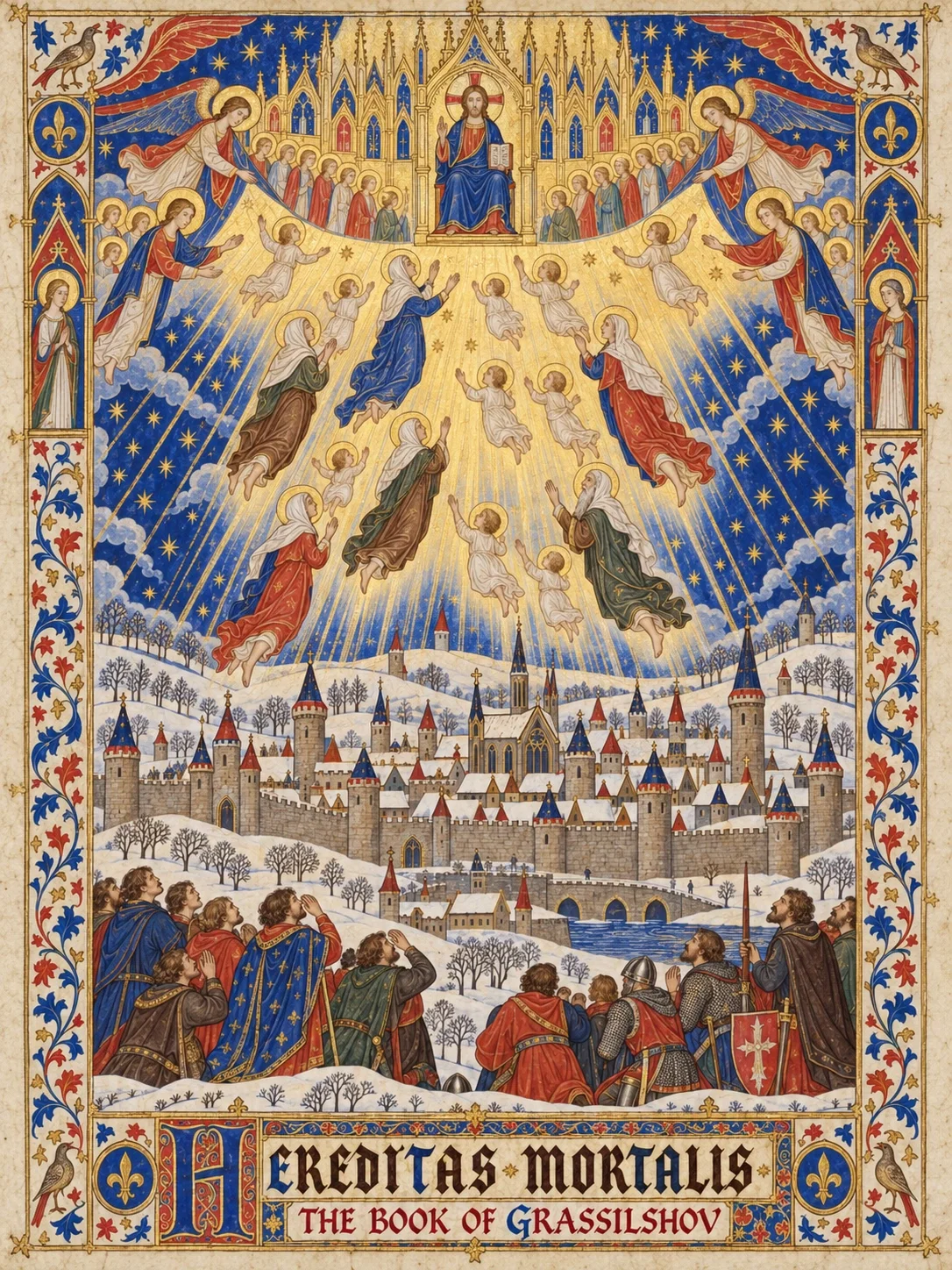
eaven opened while Grassilshov was under siege. Above battered walls and bloodied streets, families rose into the light. Bishop Adalmar vanished among them. The adult men fighting at the barricades remained.
It happened elsewhere, too. Across the world, the same terrible division: Paradise for women, children, and the elderly; the mortal earth for grown men.
Judgment, mercy, punishment, further trial, abandonment. Every priest has an answer. None can prove why the men were left.
Grassilshov was built to trade, worship, stable horses, raise families, and endure ordinary winters. It was not built to inherit what remained of the world.
Siege cracked its gates, roofs, and streets. Timber braces old stone. Smoke stains the chapel. Empty houses retain the shapes of vanished households. Fewer than a hundred men still inhabit, defend, repair, feed, and pray in the town.
Dry wood. Grain. Lamp oil. A sound roof. A working horse. A man who can mend stone, set a bone, or stretch the stores another week. Waste can become theft. Warmth can become privilege.
Buried roads, frozen fields, ruined shelters, and more silence than news. Scouts return with fragments. Travelers bring rumors. Corpse-Eaters are real; men sent beyond the walls do not always come back.
The Ascension emptied households and marriages, upended inheritance, and took away the ordinary expectation of another generation. The work survived. Most of the hands once expected to do it did not.
A man may share another man's bed all winter and call him companion, servant, protector, sworn friend, necessity—or nothing that needs saying aloud. Practice changes faster than language.
Necessity does not manufacture desire. Friendship, devotion, lust, tenderness, shame, indifference, jealousy, resentment, and exploitation survive in different measures from one man to another.
Old expectations did not vanish with the old households. Men regarded as feminine, compliant, low-born, physically weaker, injured, or dependent may find duties once laid upon women pressed upon them—willingly, by circumstance, under pressure, or by force.
A place beside the fire, better food, guarded quarters, or another man's protection can mean safety, obligation, privilege, surveillance, dependency, possession—or several at once. Birth retains its power; usefulness can bend it.
the Castle
Gregart knows the men beneath the walls by face, trade, grievance, courage, and fear. He eats among them, hears them out, and tells stories when spirits fail.
Bold and warm, he refuses to save the town by surrendering every decent custom. Men follow him for more than rank. His generosity is sincere; living beneath his protection is not always simple.
❦ SIR GREGART ❦of the North
Voloshyem counts stores, inspects weak stone, and notices tired men before their exhaustion becomes catastrophe. He speaks little when little is needed, judges carefully, and does not spend lives because command gives him the right.
His fairness has reasons. So does his reserve. Before he asks a man to pay a price, he considers its weight.
❦ SIR VOLOSHYEM ❦No man needs faith to believe Heaven exists. They watched it open. Faith begins with the harder questions: whether prayer is heard, why the men remained, and what obedience means after Heaven's silence.
Empty houses fill with new arrangements: sworn companions, indispensable servants, wounded men sheltered beneath another's roof, bedfellows who call themselves nothing at all. Some bonds are freely chosen. Some grow from work, debt, affection, or need.
Bread. Shelter. Work. Obedience. Loyalty. Warmth. Silence.
A guarded bed. A place beside the fire.
Perhaps the men on watch know your face. Perhaps they have never seen you before. You might be a knight, scout, craftsman, churchman, wound-tender, carter, laborer, wounded survivor, or stranger. There are still names the town has not heard.
A grievance bearing your name has reached the command hall: debt, insult, disputed work, missing property, or protection claimed where none was owed. Sir Gregart and Sir Voloshyem will hear both sides before judgment.
A patrol returns with three men where there should have been more. One is badly wounded. Before anyone can question him properly, he asks for you.
Voloshyem gives you a small but important discrepancy to resolve while he tends a blade by the hearth. The task is ordinary; his sustained attention is not.
It is late, the work miserable, and everyone sensible has gone inside. Gregart finds you still at it and, instead of ordering someone else to finish, rolls up his sleeves and stays.
Your old sleeping place is no longer yours. Another roof is rarely just a matter of space: whose hearth you share, whose protection you accept, and whose door closes behind you may come to mean more than anyone says.
Arrive at the gate. Wake beneath a familiar roof. Take your place at the wall. Enter under a name already known—or begin with a circumstance not recorded here. There are blank leaves yet.
Bereavement · starvation · illness · serious wounds · battlefield violence · corpses · Corpse-Eaters · coercive hierarchy · degradation · power imbalance · possessive protection · exploitation · sexual coercion · sexual violence
Not every leaf of this book bears every wound.
You enter Grassilshov as an adult man. You might have lived within its walls for years, arrived at the gate moments ago, or already have a name elsewhere in this book. No particular trade or history is required.
If you take the role of a named resident, the story does not supply his words, thoughts, or decisions. The other men continue their work, quarrels, loyalties, and private concerns, whether you are present or not.
Hereditas Mortalis grew from @Cobelat's The Last Garrison—the Ascension, Grassilshov, Sir Gregart the Castle, and Sir Voloshyem of the North.
A handful of scenes became a world I couldn't quite leave alone. When I asked whether I could share what I'd built from his premise—and admitted that renaming the characters now felt almost painful—he generously told me to run with it.
My deepest thanks to him for the premise, the characters, and the first open gate into Grassilshov.
Создано Apr 6
Обновлено about 10 hours ago
Опубликован Jul 30