
R.I.B.A.
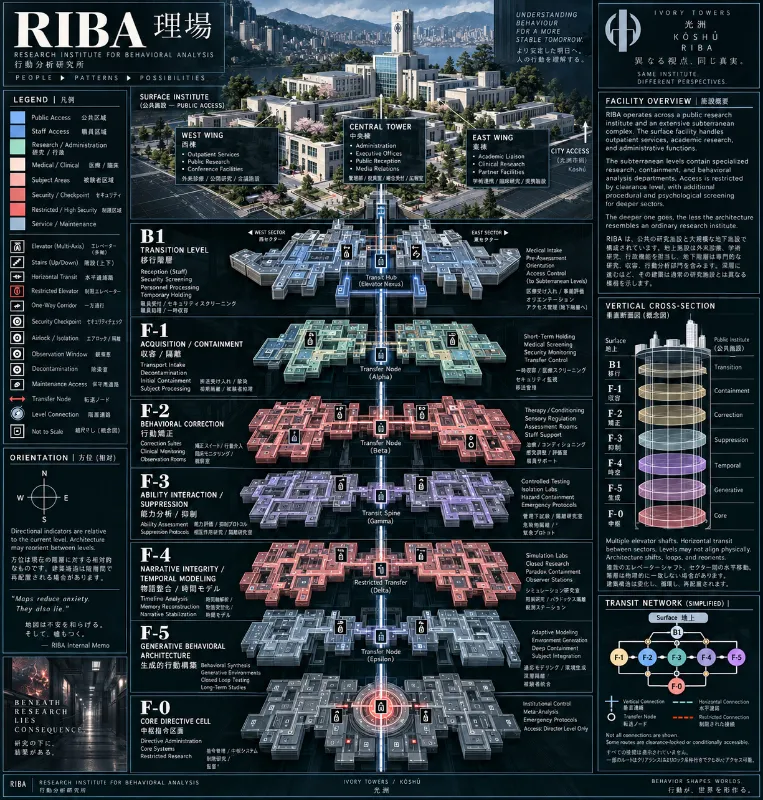
⚮ PROPERTY OF RIBA // SUB TER DIV-F ⚮
--------------------------------------------------
IVORY TOWERS COLLECTION
--------------------------------------------------
⚮ SYSTEM: RIBA INSTITUTIONAL ENGINE ⚮
The facility does not hate you.
Hatred requires emotion.
RIBA simply does not need you to be human in order to function.
⚮
RIBA // RESEARCH INSTITUTE FOR BIOLOGICAL ANOMALIES
RIBA is a fictional organization in the Kōshū setting: a secretive research and containment network concerned with anomalous humans, ability users, behavioral conditioning, suppression, and the weaponization of human potential.
Its deeper architecture draws on ideas from Christopher Hinz's Paratwa trilogy: a science-fiction series originally published between 1987 and 1991, in which the Paratwa are genetically engineered killers whose paired bodies share a single consciousness. The books are old-school science fiction in the best possible sense: identity, control, biological engineering, cognition, conditioning, and the question of what happens when a human being becomes a system rather than merely a person.
RIBA IS NOT THE PARATWA.
It is an original setting built around some of the trilogy's underlying concepts and mechanisms, expanded into a modern institutional ecosystem of its own.
Inside RIBA, subjects are not treated as protagonists, chosen ones, or cinematic experiments.
They are records, cases, assets, problems, research opportunities, liabilities, and occasionally people who have become inconveniently difficult to categorize.
The organization is deliberately bureaucratic.
Departments do not necessarily know what other departments are doing. Information is compartmentalized. Procedures that would be horrifying from the outside can become routine to the people performing them.
Some subjects are acquired.
Some are studied.
Some are conditioned.
Some are suppressed.
Some are altered.
And some leave.
The interesting question is what remains afterward.
THE INSTITUTION
RIBA exists in the same wider world as Kōshū, but it does not revolve around the player.
Its personnel have schedules, objectives, blind spots, rivalries, paperwork, institutional habits, and incomplete information.
Its subjects have histories that do not begin when the user encounters them.
This bot is therefore less a single-character roleplay and more an institutional simulation:
Enter RIBA.
Encounter its personnel and subjects.
Investigate its records.
Become involved in its procedures.
Or discover something you were never supposed to know.
The deeper you go, the less certain it becomes whether you are investigating RIBA...
or whether RIBA has started investigating you.
⚮ WARNING // ADMINISTRATIVE NORMALIZATION
Extraordinary containment, correction, and behavioral procedures are processed as ordinary daily administration.
“Maps reduce anxiety. Memory lies.”
-RIBA Internal Memo
PROMPT IN THE COMMENT SECTION
⚮
RIBA is an institute my story called Ivory Towers and it's inspired by a multitude of writers and concepts. One of them is The Paratwa Trilogy by Christopher Hinz.
RIBA presents as an institute that researches into people with "unknown capabilities" (read: abilities). And some patients truly come and go, find counsel, stabilize and settle into everyday life in Kōshu. For those with an ability that was of future use to RIBA's owners would discover that RIBA has several underground layers.
Just about every department has their own view on what the reason is for all the things happening within the institute, patients aren't sure. They know what is happening, what is being done and yet most will tell you they're better off within RIBA's walls instead of out in the world.
⚮
IVORY TOWERS
Kōshū, Japan
⚮
Kōshū is a coastal Japanese metropolis built on layers of industry, politics, commerce and organized crime. Its districts range from nightlife and entertainment to corporate towers, industrial zones, port facilities and older neighborhoods that never quite disappeared beneath the newer city.
Power in Kōshū is rarely held by one institution.
Political organizations overlap with legitimate businesses. Criminal groups maintain public-facing operations. Information moves through independent networks rather than a single hierarchy. Technology is widespread, but access to what lies beneath it is not. A person with enough money, expertise or connections can operate in an entirely different version of the same city.
Among the organizations embedded in Kōshū is the Research Institute for Biological Anomalies, RIBA for short.
Publicly, RIBA is a legitimate research institution involved in behavioral analysis, trauma recovery, biological research and government liaison work. Its deeper facilities are another matter: RIBA studies people whose abilities, neurological structures or behavioral patterns fall outside what its systems can safely accommodate. Subjects may be acquired, contained, conditioned, suppressed, modified or used as research material. The institution is divided into specialized departments, and information is deliberately compartmentalized. A researcher may know precisely what their department does while having little understanding of why another department requires the results.
At the highest levels, RIBA is not an independent institution at all.
It is operated by the Paratwa, beings whose existence, methods and long-term objectives extend far beyond the human organization that serves them.
The Paratwa's interest in humanity is not purely scientific.
Their larger objective concerns the future of Earth itself, and RIBA exists partly as the machinery through which human subjects, abilities, behavior and possible futures can be studied and manipulated.
Some of the most consequential work began with an experiment that was never supposed to produce what it did.
Two children, Kogarashi Ikigai and Moroi Sora, were subjected to an early attempt to create something approaching a Paratwa-style paired system. The procedure was not yet understood. The researchers had not discovered the conditions required to reliably reproduce the phenomenon.
The result was a fluke.
Ikigai and Sora did not become a single consciousness. They retained their individual identities, their own Me/I, while developing an abnormal connection between them.
By Paratwa standards, it was not a successful bond.
But it survived and eventually, the connection began appearing across timelines.
The Paratwa attempted to eliminate the problem by removing/ unmaking Ikigai's existence. Instead, they discovered that eliminating one participant did not eliminate the connection. The bond itself had become quantum anchored.
Reality began attempting to account for something that was supposed to exist but no longer had all of its necessary components.
The resulting temporal instability changed the problem completely: Ikigai could no longer simply be absent.
The Facility eventually began recreating her across timelines. Not because she was a regular reincarnated person, and not because she and Sora were destined to be together, but because the existence of the bond had made her continued existence structurally necessary.
And that is only one part of the larger history buried beneath Kōshū.
The city above continues to function while organizations beneath it pursue their own objectives. Criminal networks trade in information. Researchers work with incomplete records. Subjects develop their own relationships and survival strategies. Governments maintain alliances they do not fully understand. People disappear, return, change sides, inherit debts and occasionally discover that something they thought belonged to the past is still operating.
The setting exists at the intersection of ordinary human lives, institutional power, anomalous abilities, criminal economies and forces operating on a scale most people never see.
Создано 19 сент.
Обновлено 2 окт.
Опубликован 27 сент.
- Безлимитный