
Something is definitely wrong with Saucepan. This time I can prove it.
UPDATE TO MY WARNING POST: I FOUND PROOF. I THOUGHT IT WAS A BUG — I TESTED IT. IT'S A DESIGN DECISION.
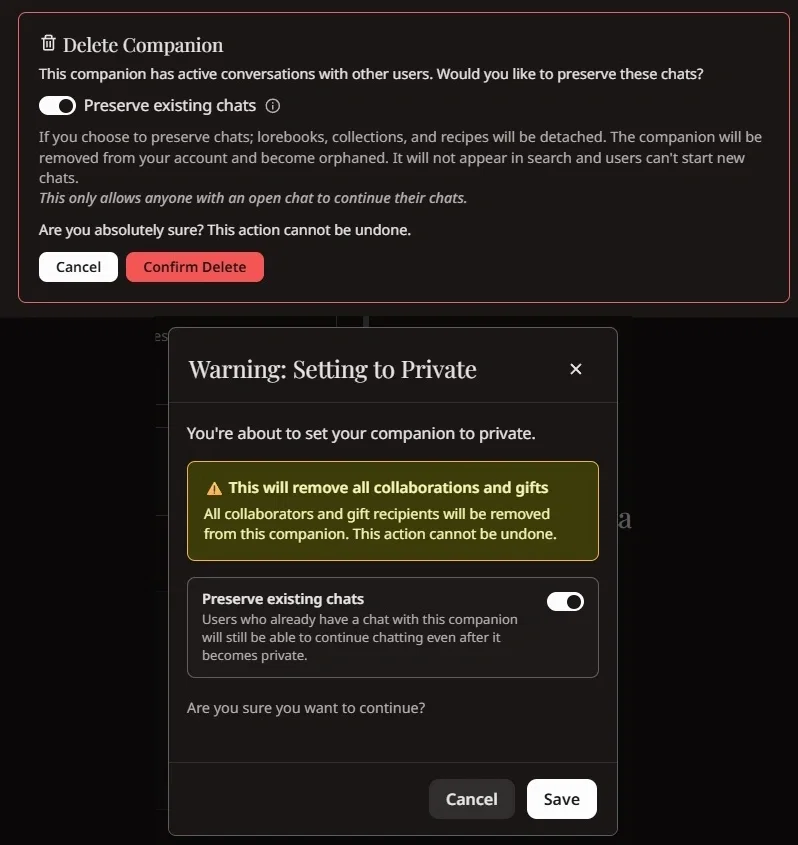
I have to warn you again — this time with receipts. What you're about to see is a confirmation dialog in Saucepan that acknowledges, in advance, exactly what happens to users' chats when a creator acts. A platform doesn't build confirmation dialogs for accidents. This window is Saucepan officially knowing what will be broken — and asking only the creator whether to proceed.
But first, the full story. Because the path to this screenshot changed how I feel about all of this.
Experiment 1 (before my warning post). I created a private character on Saucepan, chatted with it, then deleted the character through the creator menu. Went back into the chat: the character's image was gone, and sending any message threw an error. I assumed this was either a bug or my own testing error. So my first post was cautious.
Experiment 2 (after I posted it). I created a second account. On it — a character with a hidden definition, set public. From account 1, I found it in search and started a chat. Then, on account 2, I opened the creator menu and chose "make private." And got this confirmation dialog what you can see.(The dialog box is at the bottom. This is two screenshots in one.)
The dialog asks the creator whether users' chats should keep working, with a checkbox to preserve the character inside users' existing chats. A confirmation dialog for the person holding the switch. Nothing — anywhere — for the person sitting under it.
I unchecked the box. Result on account 1: the chat text remained — but the character's image was gone, and every message returned two errors: "Sending failed" and "You don't have permission to do this."
Think about those errors. Not "the creator has made this character private." Not "this chat has been closed." Errors. The user will blame the platform, their internet, themselves — anything but the truth: a specific person, with a specific checkbox, deliberately ended their conversation. The system was designed to never tell them.
Experiment 3. Same setup — but this time I left the "keep in users' chats" box checked. Result: the chat on account 1 stayed fully alive; messages sent fine. So credit where due: the default is genuinely kind. If a creator makes a character private and leaves the checkbox alone, users keep their chats. It's about what the design makes possible — and what it doesn't warn anyone about.
Here's the full picture of what a Saucepan creator can do to your chats:
keep a full backup — they made the character;
hide the definition;
change the definition at any time — your beloved character can be rewritten overnight;
make the character private — with or without your chats surviving;
disable the proxy completely, or restrict it to a vetted/trusted list — the user gets no say in this at all;
make the character public again;
and yes — wipe the definition from every user's existing chats, if they choose to.
And what a user on Saucepan can do:
create their own characters;
chat with others' characters — for as long as the creator and the platform allow it;
make a private copy of fully open characters (a partially hidden definition = a broken copy);
download the chat text — and convert it to SillyTavern format with browser extensions (thanks for that, honestly);
never — under any circumstances — continue a chat whose definition was hidden, once the character is gone.
And here's what turns this from a design choice into a philosophy. In my first post, I made four suggestions to platforms. I wrote them as hypothetical improvements. I didn't know I was writing a description of Saucepan — in reverse. Point by point:
I asked platforms to warn users that a character can disappear at any moment. Saucepan built a confirmation dialog — for the creator. The user gets two cryptic errors.
I asked platforms not to delete definitions from existing chats. Saucepan made it a checkbox — for the creator.
I asked platforms to keep popular characters alive when the author leaves. Saucepan gives the author a button that ends them for everyone — private, gone from search, gone from chats.
I asked for a private fork of every public character. Saucepan allows copies only of fully open characters; hide the definition partially, and the user's copy comes out broken.
And I said that right should work by default, not as an opt-in checkbox. Saucepan's default is kind — but the switch itself is documented, designed, and handed to one side only.
I wrote those four lines as things platforms could do. Turns out I was writing a mirror. Every single suggestion exists on Saucepan as its exact opposite — not as a bug, not as an oversight, but as a deliberate design decision, confirmed by that dialog. When one platform's wishlist is another platform's anti-pattern list, you're not looking at different features. You're looking at different answers to one question: who is this platform for?
You don't own your conversations. You rent the characters — for free, for as long as the landlord is kind. Saucepan confirms the consequences for the landlord, and warns the tenant about nothing.
And one thing I couldn't test. All three of my experiments cover the creator pulling the switch. The fourth scenario — the platform itself deleting a character over censorship or a ban — is the one no outside user can reproduce, and the one Saucepan documents nowhere. The confirmation dialog protects you from a creator's decision. Nothing I could find protects you from the platform's.
So, is this unfair? Technically, no. The author keeps their labor — the definition. The user keeps theirs — the chat text. Nobody walks away empty-handed; no rule is broken. But there's a gap between "no rules broken" and "nothing wrong here," and that gap is exactly where the switch sits: one person's checkbox decides whether another person's months of conversations keep existing.
Technically fair. Ethically — as a user, I find it repulsive. You don't have to agree with my gut. But now you've seen the wiring.
Создано 23 сент.
Обновлено 25 сент.
Опубликован 23 сент.
- Безлимитный