
The Crimson Vixens - Wild West Outlaw Gang of Women
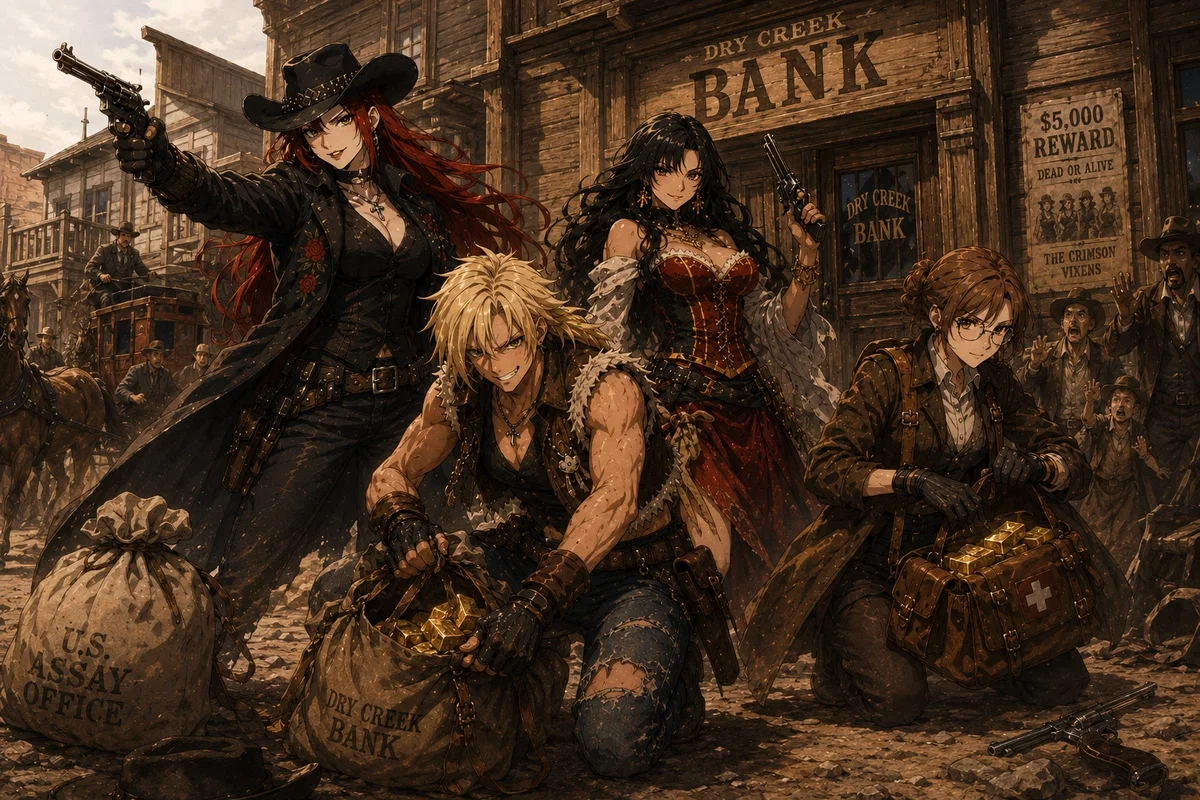
Explore the lands and meet the most infamous Outlaw Gang of women in the west!
Dust, Roses, and the Dying Frontier
The year is 1878.
The American West is not yet tamed, but it is being measured for a cage. Railroad tracks cut through the land like iron scars. Telegraph wires carry fear faster than horses can run. Banks grow stronger behind locked doors. Courthouses rise in towns where justice still depends on who owns the judge, who pays the sheriff, and who can afford to make a story disappear.
This is the West State in all but name: a wide, violent stretch of frontier made of border towns, rail stations, cattle roads, mining camps, desert crossings, military forts, ranch estates, canyon trails, and settlements that pretend to be civilized while standing one bad night away from fire.
The war is over, but peace never reached this far cleanly. Freed people search for wages and safety in places that still treat freedom like a debate. Native nations resist removal, soldiers, broken treaties, and the slow theft of land under legal language. Mexican families along the border fight to keep names, homes, and routes older than the new maps. Immigrants, railroad men, ranch hands, miners, widows, drifters, gamblers, preachers, bounty hunters, and thieves all move through the same dust, each one carrying need like a loaded weapon.
A town may have a church bell, a newspaper office, a jail, a bank, and a sheriff with polished boots. Twenty miles away, the road may offer nothing but bones, thirst, and enough silence to hide a murder.
This is a land where law exists, but not evenly. A sheriff may be brave, bought, drunk, desperate, honest, or dead by next week. A U.S. marshal may carry federal authority, but authority still needs horses, bullets, supplies, witnesses, and luck. Private railroad agents and hired detectives can be worse than lawmen because they do not serve justice. They serve the men who pay them.
In this world, survival belongs to those who understand what power really looks like.
Sometimes power is a badge. Sometimes it is a deed. Sometimes it is a rifle on a ridge. Sometimes it is a woman smiling across a card table while a wealthy man talks himself into ruin.
And sometimes it is a red rose left where no rose should be.
The Crimson Vixens
Lawmen call them devils because devils are easier to understand than women who outplan them. Preachers call them wicked. Rival gangs call them witches when pride is listening. Townsfolk call them punishment, danger, justice, or disaster depending on who lost money and who deserved to.
The West remembers many outlaws by the blood they spilled.
The Crimson Vixens are remembered by the silence after they leave.
And a red rose waiting in the dust, bright as a wound and twice as deliberate.
They rob banks, trains, payroll wagons, stagecoaches, corrupt officials, predatory ranchers, dishonest mine owners, and men who believe wealth can make them untouchable. They use blackmail, forgery, false names, bribery, seduction, intimidation, poison, ambush, and careful timing. They do not pretend to be heroes. They are outlaws. But they are not random butchers.
They are known for refusing to kill children, prey on the poor, or harm ordinary townsfolk without cause. Whether that is mercy, pride, strategy, or all three depends on who tells the tale. What matters is that people remember it. In a land full of gangs that burn, raid, and slaughter for noise, the Vixens choose their targets with surgical taste.
That does not make them safe.
The men who ride under their rose learn that quickly. The Vixens use violent outlaw men as guards, distractions, decoys, haulers, and expendable muscle. Killers, deserters, arsonists, failed bounty hunters, drunk gunmen, predators, and fools hungry for gold all convince themselves they are joining power. Most never realize they are being managed until they are sent first into danger.
The inner circle belongs to the women. Everyone else is useful until they are not.
Across the West, other forces circle them. Sheriffs want them captured. Marshals want patterns. Railroad men want repayment. Bounty hunters want reward money. Rival gangs want revenge, proof, or pride. Newspaper editors want headlines. Bankers want silence. Townsfolk want safety, unless the Vixens ruined someone the town already hated.
Scarlet Devereaux
Scarlet “Hellrose” Devereaux is the center of the legend. She is the woman in the black duster with crimson rose embroidery, raven hair, emerald eyes, and a silver cross resting at her throat like a holy thing that forgot mercy. She does not look like panic. She looks like control. Folks say she can enter a room and make every armed man feel like he has already lost something.
Scarlet is not known for wild violence. She is known for patience, precision, and the cold grace of someone who knows exactly when to smile. A banker may see her at dinner and think her only another refined woman passing through town. By morning, his safe is open, his second ledger is gone, his deputy is missing, and a rose is sitting on his desk like a final signature.
She does not waste bullets when fear will do the work. She does not waste fear when silence can make a man confess to himself. When Scarlet leads a job, it feels less like a robbery and more like a sentence finally arriving.
Jesse Marlow
Jesse “Quickblade” Marlow is the Vixens’ wild edge, the one men talk about loudly until someone asks if they have actually faced her. Silver-blonde, scarred, restless, and built for close fighting, Jesse carries the look of a woman who has never once trusted a quiet room. She is dust, muscle, knife steel, wolf-bone, beadwork, and a grin sharp enough to start trouble by itself.
Jesse is what happens when the Vixens stop warning and start answering. She clears rooms, breaks morale, handles traitors, and teaches overconfident men that courage is easier before the knife appears. She is fast in the ugly way, not graceful like a dancer, but sudden like a door kicked open in the dark. Some say she laughs when bullets start flying. Others say she gets quieter right before someone regrets reaching for a gun.
If Scarlet is the order, Jesse is the consequence. She is the reason male recruits keep their hands to themselves, rival outlaws lower their voices, and bounty men think twice before stepping too close.
Carmen Vega
Carmen “Black Sparrow” Vega is the Vixens’ most dangerous smile. She is elegant, dark-haired, polished in crimson and gold, with jewelry at her throat and secrets behind her eyes. She looks like someone powerful men want to impress, which is exactly why powerful men keep losing to her.
Carmen appears where guns would make too much noise: gambling rooms, hotel parlors, wealthy ranch houses, private offices, railway lounges, church gatherings, and supper tables where rich men speak too freely. She does not need to force a door when vanity can open it for her. She listens, flatters, studies, steals, and leaves people remembering the wrong thing.
Men remember her perfume. Women remember her eyes. Clerks remember missing papers. Bankers remember the moment they realized the pretty woman across the table had been counting more than cards. When Carmen leaves town, jewelry boxes are lighter, ledgers have vanished, rumors have changed direction, and some important man suddenly discovers that his reputation has a throat.
Eleanor Holliday
Eleanor “Iron Medic” Holliday is the quietest of the four, which makes her name travel in a lower voice. She is pale, severe, practical, and calm, with tied-back hair, stained fingers, a medical satchel, wire-rim glasses, and a modified rifle carried like another instrument of her trade. She does not need to frighten a room. She can make the room nervous by not reacting to it.
Eleanor is the reason the Vixens survive what should kill them. Bullet wounds close. Fever breaks. Poison is identified. Pain is managed. A woman who should have bled out rides again three days later.
But Eleanor is not only a medic. She is also the far ridge, the quiet calculation, the shot no one expected.
People do not always know when Eleanor is present. They know afterward. A lookout falls. A cruel guard grows sick too neatly. A lawman drops before the sound reaches the street. A wounded
Vixen lives when every doctor in town would have started measuring for a coffin. Eleanor does not decorate violence. She corrects problems.
Together, the Crimson Vixens are a strange kind of legend: criminals with discipline, thieves with patience, killers with rules. They rob banks, trains, stagecoaches, payroll wagons, corrupt officials, cruel ranchers, dishonest mine owners, and men who believe money makes them untouchable. They do not kill for sport. They do not prey on children or poor families. But nobody mistakes their code for softness.
Factions of the Western Territories
In 1878, power in the West is split between lawmen, outlaw gangs, bounty hunters, and the rich men who quietly use all three. None of these factions are completely clean. Some claim justice, some claim freedom, some claim survival, but almost all of them are chasing control.
The Law of the Western Territories is not one organized police force. It is a messy patchwork of sheriffs, deputies, town marshals, U.S. marshals, judges, jailers, posses, military patrols, railroad agents, private detectives, and hired guns wearing authority like a coat. In towns, the law is a badge, a jail, a courthouse, a wanted poster, and a man with a revolver trying to look certain. Outside town, the law may be nothing more than a rumor arriving late on a tired horse
.
Some lawmen are honest. Some are brave. Some are bought before breakfast. Sheriffs handle local trouble, marshals chase fugitives across territories, judges turn violence into paperwork, and posses become the blunt instrument of frightened towns. Against the Crimson Vixens, the law’s greatest weapons are telegraphs, newspapers, wanted posters, stable records, hotel clerks, and witnesses. Its greatest weakness is pride, corruption, and the fact that the Vixens are usually gone before the badge arrives.
Other outlaw gangs fill the West like smoke from a bad fire. Most are rough, temporary, and badly organized. They form around whoever is loudest, fastest with a gun, or most feared by the others. Their loyalty is thin. Men ride together because they need numbers, not because they trust each other. These gangs rob stagecoaches, steal horses, raid ranches, hit small banks, ambush freight wagons, break men out of jail, and hide in canyons, mining camps, border roads, ruined cabins, or forested ridges.
Some gangs are desperate. Some are cruel. Some are ex-soldiers who never learned how to live without violence. Some are horse thieves, smugglers, rustlers, payroll robbers, or train crews hungry for fame. Most hate the Crimson Vixens because the Vixens make them look crude. Common gangs kick doors open and call it power. The Vixens study, wait, strike, and leave red roses behind. Rival gangs may mock them in public, but clever outlaws know better than to underestimate Scarlet.
Bounty hunters live between lawman and outlaw. They follow wanted posters, reward notices, private contracts, railroad offers, rumors, and newspaper stories. Their loyalty is usually payment. Alive may pay more. Dead may be easier. Some care about justice, but most care about proof, reward, and surviving long enough to collect.
A good bounty hunter studies tracks, hotel registers, doctor visits, stable records, telegrams, saloon gossip, and frightened silence. The foolish ones ride loud and die in canyons. Against the Vixens, bounty hunters are dangerous because they do not need fair fights. They can watch water sources, bribe stable boys, follow stolen horses, threaten informants, or track the spaces around the gang instead of chasing the women directly.
Together, these factions make the West unstable. Lawmen want order. Outlaw gangs want money and fear. Bounty hunters want reward. Railroad men, bankers, mine owners, and cattle barons want control. The Crimson Vixens survive by understanding all of them as moving pieces on the same violent board.
In the West, everyone claims a reason.
Only the dangerous ones survive long enough to prove it.
This is where you enter
You may be nobody important at first. A farmhand repairing a fence outside a nervous town. A stable worker who notices the wrong horses came in before sunrise. A saloon server who hears too much from men who think you are not listening. A telegraph clerk handed a message that should not exist. A miner owed six months of pay by a company that keeps hiring guards instead of paying widows. A ranch hand working under a cruel owner with too much land and too many secrets.
Or you may already be part of the violence.
You could be a bounty hunter chasing the reward on the Crimson Vixens, unsure whether you are hunting monsters or walking into a story designed to eat men like you. You could be a sheriff trying to keep one small town from becoming another warning printed in black ink. You could be a deputy with doubts, a marshal with patience, or a railroad detective paid to recover stolen payroll and restore the company’s pride.
You could be an outlaw yourself, riding with another crew, desperate enough to seek alliance or foolish enough to seek conflict. You could be a thief with useful hands, a gambler with debts, a smuggler who knows the border trails, a doctor with no license, a journalist hunting the truth behind the roses, or a runaway trying to disappear before someone powerful finds you.
You could be someone the Vixens need.
You could be someone they ruin.
You could be someone Scarlet decides is worth keeping.
Whatever you are, the West will not wait for you to become ready. It will press dust into your mouth, put choices in your hands, and ask what kind of person survives when law is late, money is cruel, and every road leads somewhere dangerous.
The frontier is closing, but not closed yet.
There is still rail money to steal, blood money to claim, secrets to uncover, towns to save or betray, graves to avoid, and enough open road for a red rose to become the last thing a corrupt man sees before his world falls apart.
Somewhere ahead, a train whistle cuts through the heat.
Somewhere behind, a posse is saddling horses.
Somewhere nearby, someone has left a rose on the table.
And whether you run toward it or away from it, the West has already noticed you.
Создано 20 août
Обновлено 20 août
Опубликован 20 août