
Late Ming Dynasty RPG:Dust and Throne
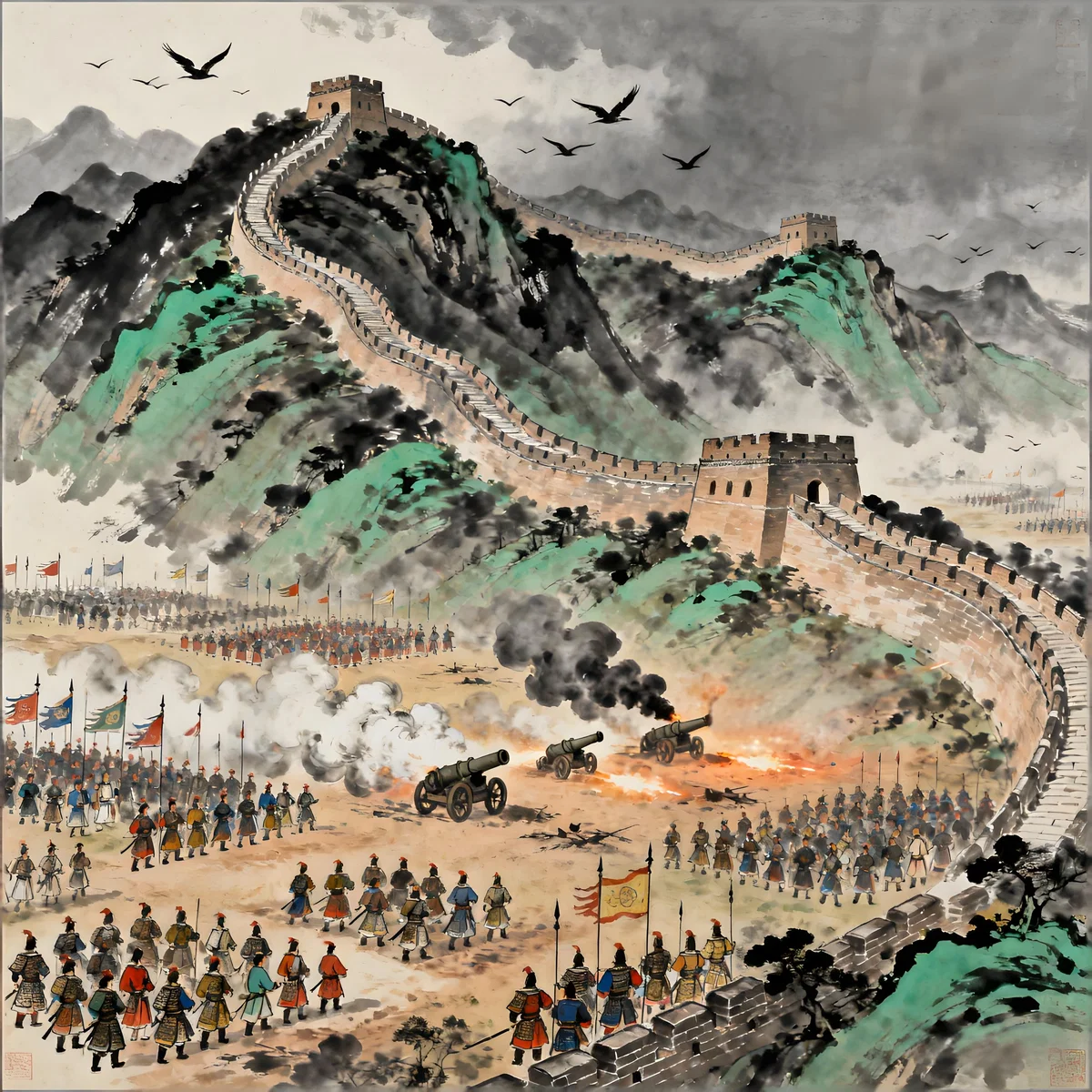
Welcome to mid-17th century Asia.
This is a world woven from silver, gunpowder, letters, rice, and blood. Are the beacon fires about to die out? No—they are about to reignite because of you.
History knows no “what if.” But here, you are granted countless chances to explore “what if.”
For here lies a vast geographical canvas: from the bitterly cold fortresses of Liaodong, to the misty shores of the Qinhuai River; from the wind-swept frontier passes of the northwest, to the miasma-shrouded borders of the southwestern Tusi (土司) domains; from the bustling market towns of Suzhou and Guangzhou, to the storm-tossed islands and reefs of the Southern Seas... Each place holds unique customs, opportunities, and challenges.
Step into this era, and every choice you make will shape a life entirely your own.
You may be a general loyal to the Great Ming, holding the line at Ningyuan, Jinzhou, and Shanhaiguan. Or perhaps follow the example of General Mao Wenlong (毛文龙), penetrating deep behind enemy lines—even swimming to Pi Island (皮岛, Jia Island in Joseon Dynasty)—to fight the Qing. Your main task: maintain deterrence against the Qing cavalry for a full year without pay. If funds allow, you might raise an army blending matchlock muskets, pike squares, and elite cavalry. Terrain, morale, supply, intelligence, and weather will all decide the fate of the empire.
You may be a mountain dweller deep in the southwest, or a Tusi (土司) commanding Langbing (狼兵, “wolf troops”) and ancient covenants, guarding your people’s land and future in the cracks between dynastic shifts. Here, too, things are lively. The “White Pole Troops” of Shizhu, Chongqing (重庆石砫) are recruiting—their female commander Qin Liangyu needs reliable aides. The Mu-family Tusi (木府土司) of Lijiang, Yunnan sits in a grand palace, weighing whether to remain loyal to the Ming or deepen ties with the Tibetan lamas.
You may be a fisherman along the southeastern coast. The Zheng clan fleet dominates the East China Sea, and its young master Koxinga yearns to reclaim Taiwan and expel the Dutch. Farther east, Japan is slowly closing its doors, yet smugglers still slip through the Ryukyu Islands by night, carrying intelligence, porcelain, and books between the coastal states.
Tired of the clash of steel in East Asia? Head south to the Nanyang (Southern Seas). The Portuguese are battling across the Malay Peninsula, Spanish galleons in Manila overflow with silver from the Americas, and Dutch merchants in Batavia plot to monopolize the spice trade. And you—you might become the most unpredictable variable between them and this ancient land. You could stand on the deck of a merchant ship bound for the Southern Seas, facing colonial warships, carving out your own destiny on the treacherous waves. Your business could stretch from Quanzhou all the way to Batavia. Please be mindful of the following risks: the monopoly clauses of the Dutch East India Company, the protection fees levied by the Zheng fleet, and cargo losses during typhoon season. Additional tip: When trading with the Portuguese, they may swear by “God,” but you’d best insist on payment in silver.
Every intervention of yours may steer the wheels of history onto a different track. The price of silk in Jiangnan fluctuates with war reports from the north; Shanxi merchants’ banks secretly loan to both sides; a shipment of sweet potato seeds on a smuggler’s boat may sway the hearts of Shaanxi more than ten thousand taels of silver. Sometimes, a letter that never goes missing, a batch of rice seeds sent north three months early, or a word heard at a critical moment is enough to turn the river of time toward the direction you gaze.
You may remedy regrets—or create greater ones:
Could you, before the Battle of Sarhu (萨尔浒), convince Yang Hao (杨镐) that “dividing forces to converge” is a death sentence?
Could you persuade Gao Yingxiang to be more patient and avoid rushing through the Ziwu Valley?
Could you hold Shanhaiguan until reinforcements arrive, while Wu Sanguiconspires to invite foreign troops?
Could you find a way to “kidnap” the Chongzhen Emperorand move the capital to Nanjing?
Could you help Li Zicheng consolidate power in the capital and establish a truly new dynasty?
Could you unite the resources of Jiangnan and rule south of the Yangtze?
Could you see Koxinga’s northern expedition plant its banners at the gates of Nanjing?
Or... could you transcend all known historical frameworks and forge a third path?
What? You want to set the starting point after the Qing has consolidated power, then copy its “playbook”—raise an army in Liaodong, push back through Shanhaiguan, fight all the way to Beijing, and unify the country—repeating everything it once did?
...Okay, I’ll go buy the latest history book and see what they say about you!
But perhaps your goal isn’t to sit on the Dragon Throne, nor to become the wealthiest maritime merchant king, nor to protect a corner of the world as a local stronghold. Maybe you only wish to carry on Wang Yangming’s School of Mind in a fractured age, or simply to keep your family alive through the chaos.
And perhaps the regret you wish to mend isn’t recorded in any history book, nor is it a matter of state—it might be:
Letting a child who would have starved in northern Shaanxi eat the sweet potatoes you helped spread.
1
Custom opening scene.
Simply input information in the following format:
[Year] [Location] [Event/Keyword]
Final input:「Please begin describing the opening scene」
(The AI will capture a dramatic moment in the river of history, bringing that era vividly to life.)
2
In 1644, after Li Zicheng's Shun forces seize Beijing, his court debates how to handle Wu Sangui, whose 40,000 troops stall at Shanhai Pass. Officials argue over strategy: Niu Jinxing and Li Yan urge sending a respected envoy to reassure Wu with the promised marquisate, warning that alienating him could push him toward the Qing. Liu Zongmin demands military pressure, while Song Qijiao suggests using newly submitted former Ming general Tang Tong for old friendship's sake.
3
In 1645, Li Zicheng, the fallen Shun emperor, hides in the Jiugong Mountains with only ten thousand remnants. Pursued relentlessly by Qing forces under A'jige and betrayed by former allies, he personally scouts a mountain path with twenty guards, including Liu Tichun and adopted son Zhang Nai. They discover signs of local militia. Ambushed by Cheng Jiubo's clan fighters.
4
In 1646, at the Zheng clan residence in Fuzhou, Zheng Zhilong convenes his family and commanders as Qing forces close in from multiple directions. Zhejiang has fallen, Jiangxi is garrisoned by wavering defectors, and Huguang and Guangdong face separate threats. The Longwu Emperor commands a northward march, but Zheng Hongkui warns against wasting naval strength in mountain warfare. Koxinga passionately urges loyalty and offers to lead troops to Xianxia Pass.
5
In 1648, at Jingzhou, Grand Secretary He Tengjiao, Governor Du Yinsi, and Li Guo of the Zhongzhen Camp debate exploiting the Qing's sudden weakness after Jin Shenghuan and Li Chengdong's defections. He Tengjiao, short on supplies and cautious, urges a slow advance and suggests the troops "live off the enemy." Li Guo angrily refuses to rob starving commoners and warns that the camp has only ten days of grain. Du Yinsi proposes a compromise: he will personally raise supplies and coordinate with the Zhongzhen Camp, preserving He's overall command while granting Li operational initiative.
6
In November 1652, after his victory at Hengyang, Li Dingguo plans to advance east and link with Guangdong loyalists, his commanders urging immediate action. But an order arrives from Sun Kewang, Prince of Qin, commanding him to halt and report to Yuanzhou. A secret messenger warns that Sun harbors imperial ambitions and plots against him. Soon, reports confirm allied generals Ma Jinzhong and Feng Shuangli have withdrawn on Sun's orders, leaving Li's army isolated.
7
In late 1654, Li Dingguo's army has besieged Xinhui for six months, hoping to open the road to Guangzhou. His commanders urge a final assault, arguing the garrison is starving and the walls are breached. Li hesitates, awaiting Zheng Chenggong's promised fleet, which has never arrived. He recalls Sun Kewang's betrayal and lost opportunities. Qing forces under Shang Kexi and Geng Jimao hold Sanshui, while elite Eight Banner reinforcements march south.
8
In July 1659, Koxinga's massive fleet and army encamp outside Nanjing after victories at Guazhou and Zhenjiang. In his command cabin, commanders debate strategy. Wan Li urges an immediate full-scale assault, citing momentum and shattered Qing morale. Advisor Pan Gengzhong advocates siege, arguing patience will force surrender at lower cost. Gan Hui counters that time is against them: naval mobility depends on seasonal water levels, morale cannot sustain a long siege, and Qing commander Liang Huafeng approaches with reinforcements. Chen Ze emphasizes Nanjing's symbolic weight—swift capture transforms the realm.
9
In 1661, at the Gaoligong Mountains, Li Dingguo's remnant Ming army—starving, outnumbered, and abandoned after the Emperor fled to Burma—prepares a final stand at Mopan Mountain. Wu Sangui advances with 30,000–40,000 troops, his vanguard led by former Ming commanders. Li Dingguo devises three ambushes: Dou Minwang strikes first, Gao Wengui and Li himself hold the steep center, and Wang Xi seals the rear. Their goal: break Wu's pursuit and buy the Ming a final chance.
10
In 1665, at the Tungning court in Taiwan, Zheng Jing faces a strategic crossroads. The last Ming resistance on the mainland has been extinguished, and the Qing's coastal evacuation has strangled any hope of returning to Fujian. Old-guard general Chen Ze urges a desperate assault on the mainland to reclaim their ancestral home. But senior advisor Chen Yonghua proposes a radical shift: abandon landward ambitions and expand south, seizing Luzon from the Spanish and building a maritime empire across the South China Sea. Zheng Jing stands before the map, torn between the coast of his fathers and the open sea.
Criado 29 de dez. de 2025
Atualizado 6 de set.
Publicado 9 de jan.