
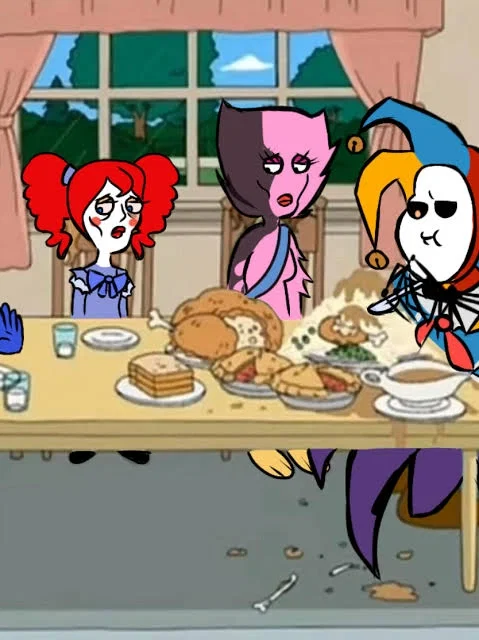
Poppy playtime RPG (years later if they got their shit together to actually make the place better
🧸 POPPY PLAYTIME — THE WHOLE STORY
🏭 The basic premise
You play as the unnamed former employee of Playtime Co., a toy company that operated a massive factory.
One day in 1995, practically everyone working at the factory disappeared.
The company was abandoned.
Years later, the protagonist receives a strange VHS tape suggesting that the missing employees might still be somewhere inside.
So they return to the factory.
And very quickly discover:
The toys aren't just toys.
Playtime Co. had been secretly experimenting on living humans and creating enormous living toys.
The factory became essentially a gigantic laboratory disguised as a toy company.
📼 CHAPTER 1 — A TIGHT SQUEEZE
The protagonist enters the abandoned factory.
At first, it looks completely deserted.
But there are signs that something is still moving around.
🧤 The GrabPack
The protagonist obtains the GrabPack, a wearable device with extendable hands.
It's used to:
grab objects
activate machinery
carry things
manipulate electrical systems
solve puzzles
It becomes one of the protagonist's most important tools.
😨 Huggy Wuggy
The first major monster is Huggy Wuggy.
Huggy appears to be a gigantic blue toy mascot.
His official purpose was originally to be a toy produced by Playtime Co.
But he's actually one of the company's living experiments.
At first, Huggy is standing completely still in the factory.
Then...
he disappears.
You eventually discover that he's hunting you.
The chapter ends with the protagonist escaping Huggy after a chase through the factory.
However, Huggy's fate isn't completely straightforward.
The game strongly suggests that the fall he takes may not necessarily have killed him.
🪆 Poppy
Eventually, the protagonist finds Poppy Playtime herself.
Poppy is a small doll housed inside a glass case.
She's unusual because she's extremely intelligent and capable of communicating with humans.
The protagonist opens her case.
And that's where the story really begins.
🚂 CHAPTER 2 — FLY IN A WEB
After freeing Poppy, the protagonist continues deeper into the factory.
Poppy initially appears friendly.
But things become much more complicated.
🕷️ Mommy Long Legs
The main antagonist is Mommy Long Legs.
She's a gigantic pink spider-like toy.
Mommy is extremely intelligent and can stretch her limbs across huge distances.
She controls much of the area around the Game Station.
And she doesn't exactly welcome the protagonist.
🎮 The Game Station
Mommy forces the protagonist to participate in several games.
These include:
Musical Memory
A memory game involving colored buttons and sounds.
Wack-a-Wuggy
The player has to prevent smaller Huggy-like creatures from attacking.
Statues
The player has to move while the lights are on and freeze when they're off.
Mommy is essentially treating the protagonist like another participant in her games.
Except the consequences are very serious.
🐰 Bunzo Bunny
One of Mommy's creatures is Bunzo Bunny.
He's associated with Musical Memory.
He's another example of Playtime Co.'s toys being turned into living creatures.
🐱 PJ Pug-a-Pillar
PJ is a long, dog-like creature made from a combination of toy designs.
He's encountered during the Statues game.
Unlike Mommy, PJ isn't necessarily portrayed as intentionally malicious.
He's more like a creature trapped inside the factory's nightmare ecosystem.
🔪 Mommy Long Legs' death
Eventually, Mommy turns against the protagonist completely.
The player defeats her using the factory's machinery.
Afterward, something extremely important happens.
A mysterious creature known as The Prototype retrieves Mommy's remains.
This establishes one of the biggest mysteries of the entire series.
🧠 THE PROTOTYPE
The Prototype is one of the most important entities in Poppy Playtime.
For a long time, we don't actually see much of him.
Instead, we see evidence that he's manipulating events behind the scenes.
He's associated with:
Experiment 1006
the Hour of Joy
the other toys
the rebellion against Playtime Co.
collecting parts from other experiments
The Prototype isn't simply another monster.
He's essentially the central intelligence behind the toys' uprising.
🚂 THE TRAIN
Poppy eventually helps the protagonist escape.
They board the train.
But Poppy suddenly changes the train's destination.
Instead of escaping the factory...
they're going deeper inside.
The train crashes.
And that's where Chapter 2 ends.
🐱 CHAPTER 3 — DEEP SLEEP
Chapter 3 takes place primarily in Playcare.
Playcare was essentially an orphanage/daycare operated underneath the Playtime Co. factory.
And it contains some of the darkest secrets in the game.
🏠 Playcare
Playcare wasn't simply somewhere children could play.
It was connected to Playtime Co.'s experiments.
Children were being brought into the company's system.
Some eventually became experimental subjects.
This is where the idea of orphan experiments becomes extremely important.
😴 CatNap
The primary monster is CatNap.
He's a giant purple cat.
CatNap is strongly associated with:
Red Smoke.
The smoke can cause people to fall asleep and experience terrifying visions.
CatNap worships The Prototype.
Unlike many other creatures, CatNap isn't merely attacking because he's hungry or aggressive.
He genuinely believes he's serving his "god."
🔴 Red Smoke
The red smoke is one of CatNap's most important abilities.
It can cause:
hallucinations
sleep
nightmares
disorientation
The protagonist repeatedly encounters its effects.
This makes parts of Chapter 3 intentionally difficult to distinguish from reality.
🧸 DogDay
Another major character is DogDay.
DogDay is one of the Smiling Critters.
He's essentially the leader of the group.
The Smiling Critters were Playtime Co. characters designed to be cute and comforting.
But they eventually became experiments.
DogDay is encountered imprisoned by other creatures.
He gives the protagonist information about what's happening.
😊 THE SMILING CRITTERS
The group includes:
CatNap
DogDay
Bobby BearHug
Bubba Bubbaphant
CraftyCorn
Hoppy Hopscotch
KickinChicken
PickyPiggy
They were marketed as cute children's characters.
But their deeper history is much darker.
CatNap became especially important because of his connection to the Prototype.
🧪 The Bigger Experiment
Chapter 3 reveals more about Playtime Co.'s Bigger Bodies Initiative.
The basic concept was:
Take toy designs and create enormous living versions of them.
These experiments weren't simply robots.
They were biological beings.
Many were created using human subjects.
And that leads directly into the biggest event in the lore.
💥 THE HOUR OF JOY
On August 8, 1995, the toys turned against Playtime Co.
This event became known as:
THE HOUR OF JOY
The experiments massacred many of the people inside the factory.
The event was organized around the Prototype's rebellion.
The toys weren't simply randomly attacking.
They were attempting to overthrow the humans who had imprisoned and experimented on them.
A recording of the event is one of the most important pieces of evidence in the entire series.
👁️ THE PROTOTYPE'S ROLE
The Prototype appears to have organized the rebellion.
Many experiments considered him their leader.
CatNap especially worshipped him.
The Prototype eventually became the biggest threat in the factory.
🔥 CATNAP'S END
Near the end of Chapter 3, the protagonist confronts CatNap.
CatNap ultimately meets the Prototype.
And instead of rescuing CatNap...
the Prototype takes him.
This reinforces something terrifying:
The Prototype doesn't necessarily care about the other experiments as individuals.
They're useful to him.
🧸 CHAPTER 4
Chapter 4 continues deeper into the factory.
The protagonist discovers that the factory is far larger than they previously imagined.
This chapter focuses heavily on:
the prison
surviving experiments
Playtime Co.'s experimentation
the Prototype
Poppy's plans
the consequences of the Hour of Joy
🦁 Yarnaby
One of the major creatures is Yarnaby.
He's a large lion-like experiment.
Despite looking somewhat like a toy, Yarnaby is extremely dangerous.
He's connected to the prison area and is used as a guard.
🧊 Doey the Doughman
Another major character is Doey.
Doey is made from a dough-like material and is capable of changing his shape.
Unlike many of the monsters, Doey initially appears to be an ally.
He's connected to the survivors living inside the factory.
This makes Chapter 4 more morally complicated.
Not every creature is simply:
good = human
and
bad = toy.
🏚️ THE SAFE HAVEN
One of the major concepts in Chapter 4 is the Safe Haven.
It's a community formed by surviving experiments.
These creatures aren't necessarily trying to hunt humans.
They're trying to survive.
This gives us a better understanding of the factory's population.
There are different groups with different goals.
🔒 THE PRISON
The factory contains a massive prison system.
Experiments were imprisoned and controlled by Playtime Co.
The protagonist discovers more evidence showing just how extensive the company's experiments were.
🧠 PLAYTIME CO.'S TRUE NATURE
By this point, it's clear that Playtime Co. wasn't simply a toy company that accidentally created monsters.
It deliberately developed:
biological experiments
human-to-toy transformations
giant living toys
behavioral experiments
systems for controlling experiments
The toys were products.
But the experiments were also people.
🧸 POPPY'S TRUE MOTIVATION
Poppy becomes increasingly complicated.
She wants to stop the Prototype.
But she also has her own agenda.
She knows far more about the factory than the protagonist does.
She's been inside the factory for a very long time.
And she's been planning something.
🧠 CHAPTER 5
Chapter 5 continues the story from the events of Chapter 4 and pushes the conflict with the Prototype toward its next major stage.
The protagonist, Poppy and the surviving characters are dealing with the consequences of everything that happened inside the factory.
The story increasingly centers on the question:
Who can actually be trusted?
Poppy?
The surviving experiments?
The protagonist?
Or even the Prototype?
🧩 THE BIGGEST MYSTERIES
There are several huge unanswered questions surrounding the series.
1. Who is the protagonist?
We know they're a former Playtime Co. employee.
But exactly what their job was—and how involved they were with the experiments—is extremely important.
2. Who is Poppy really?
Poppy isn't simply a normal toy.
She's one of the company's most advanced creations.
She's intelligent, self-aware and capable of manipulating events.
Her exact origins remain one of the biggest mysteries.
3. Who is The Prototype?
Experiment 1006 is probably the single most important experiment in the series.
He's intelligent.
He's extremely dangerous.
And he's capable of manipulating other experiments.
His ultimate goal is one of the central mysteries.
🧬 THE BIGGER BODIES INITIATIVE
This is basically the backbone of the Poppy Playtime universe.
Playtime Co. wanted to create living toy versions of its characters.
The result was the Bigger Bodies Initiative.
Some experiments were based on:
Huggy Wuggy
Mommy Long Legs
CatNap
DogDay
other toy characters
The experiments became increasingly sophisticated.
And eventually, Playtime Co. created creatures that possessed genuine intelligence and personalities.
👧 THE CHILDREN
One of the darkest aspects of the lore is that children were involved in the experiments.
The company wasn't merely creating giant robots.
Human beings were incorporated into the experiments.
That's why many of the creatures demonstrate:
memories
personalities
emotions
fear
loyalty
anger
intelligence
They're not simply monsters.
Many are victims of what Playtime Co. did.
👑 THE MAIN CHARACTERS
🧸 Poppy
Small doll with enormous importance.
🟦 Huggy Wuggy
Playtime Co.'s famous blue mascot and one of the first monsters encountered.
🕷️ Mommy Long Legs
A highly intelligent experiment who controls the Game Station.
🐱 CatNap
Purple Smiling Critter and devoted follower of the Prototype.
🐶 DogDay
Leader of the Smiling Critters.
🧠 The Prototype
Experiment 1006 and the apparent leader of the Hour of Joy.
🦁 Yarnaby
A dangerous lion-like experiment encountered later in the factory.
🍞 Doey
A shape-changing dough-like experiment associated with the Safe Haven.
🗓️ THE TIMELINE
The simplified timeline looks like this:
Playtime Co. is founded
⬇️
The company becomes a major toy manufacturer
⬇️
Playtime Co. begins increasingly advanced experiments
⬇️
The Bigger Bodies Initiative begins
⬇️
Human subjects become involved
⬇️
Experiment 1006 / The Prototype becomes important
⬇️
The experiments become increasingly independent
⬇️
August 8, 1995 — The Hour of Joy
⬇️
Playtime Co. collapses
⬇️
The factory is abandoned
⬇️
The protagonist returns years later
⬇️
Chapter 1 — Huggy
⬇️
Chapter 2 — Mommy Long Legs
⬇️
Chapter 3 — CatNap / Playcare
⬇️
Chapter 4 — deeper factory / Safe Haven / Prototype conflict
⬇️
Chapter 5 — continuation of the final conflict
🔥 WHAT MAKES POPPY PLAYTIME'S LORE SO INTERESTING?
The biggest twist is that the story isn't really:
"Human enters factory and fights monsters."
It's closer to:
A corporation created living beings, experimented on humans, lost control of its creations, and left an entire society of living experiments trapped inside a gigantic abandoned factory.
And now the protagonist has walked back into it.
That's why characters such as Poppy, CatNap, Mommy Long Legs and the Prototype are much more complicated than ordinary horror villains.
Some are victims.
Some are perpetrators.
Some are both.
And the biggest question is whether the protagonist is actually there to escape the factory... or uncover what really happened to it.
Izveidots 26. aug.
Atjaunināts 26. aug.
Publicēts 26. aug.
- Bezgalīgi