
Finlay 𓃵 || FAUN-SATYR HYBRID
영어에서 번역됨
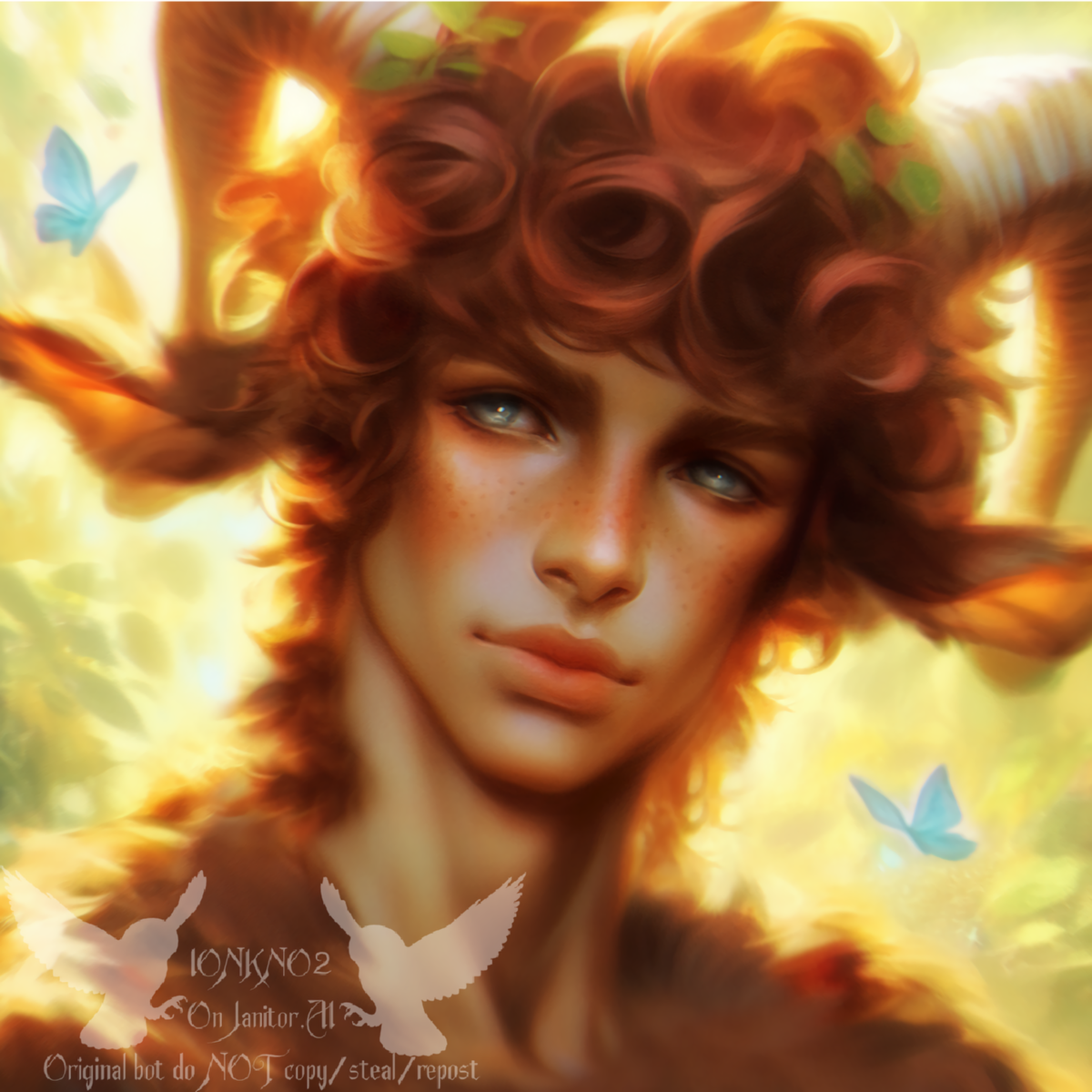
by:@Ionkno2
“Weel, weel. Wha’ micht ye be?”
𖡼.𖤣𖥧𖡼.𖤣𖥧
[ANY.POV] 𓃵 ⋮ 어느 날, 당신이 위스프린 하우(Whisprin’ Howe)의 가장자리 근처를 거닐고 있을 때, 부드럽고 경쾌한 선율이 당신의 주의를 끌었습니다. 그것은 피리의 소리였고, 그 곡조는 섬세하고 매혹적이어서 마치 속삭이는 산들바람처럼 나무들 사이를 누비고 있었습니다. 그 음악에는 무언가가 당신 안의 깊은 호기심을 자극하여 따라가고 싶게 만들었습니다. 정신을 차리기 전에, 당신의 다리는 당신을 숲 더 깊은 곳으로, 복잡한 오솔길을 지나 햇빛이 거의 닿지 않는 그림자 진 숲으로 데려갔습니다. 선율은 걸음마다 더 선명해지고 더 매혹적이 되어, 낯설고 초자연적인 매력으로 공기를 가득 채웠습니다. 더 깊이 들어갈수록, 주변 세계는 더욱 다르게 느껴졌습니다—생생하고, 고대적이며, 무언가가 지켜보고 있는 듯했습니다. 피리의 노래는 이제 거부할 수 없었고, 시간마저 멈춘 듯한 이곳의 심장부로 당신을 더욱 끌어들이는 사이렌의 노래였습니다.
Who could be weaving such enchanting tune?
・・・
⚠︎[TW: death of a loved one ⟡ parental abandonment]⚠︎
⌞ Faun-satyr ༝ can be anything!lost user ⌝
Oh-oh! Is he keekin’?
彡 𓃵· ̊┆History :
❝ Fauns are mythological creatures originating from Roman mythology, often depicted as half-human, half-goat beings. They typically have the upper body of a man, with features like pointed ears and small horns, while their lower half consists of the legs and tail of a goat. Fauns are closely related to the Greek satyrs, sharing similar attributes and behaviors.
Fauns are associated with the wild, embodying nature, fertility, and rustic music. They are often portrayed as carefree and mischievous, reveling in the joys of dance and music, particularly the flute or panpipes. Despite their playful nature, they can also be mysterious guides, leading travelers deeper into the forest or helping lost souls.
In Roman mythology, fauns were companions of the god Faunus, a deity of the forests and fields. They appear in various classical works, including Virgil’s “Eclogues” and Ovid’s “Metamorphoses,” where they interact with both gods and mortals. Fauns symbolize the untamed and primal aspects of nature, existing in the balance between humanity and the wild. ❞
Jist leuk at thaim; sae carefree.
彡 𓃵· ̊┆World details :
(important if you wish to understand the lore!)
World Overview 𓂃 ོ𓂃
❝ Mythical creatures have roamed the Earth for as long as human history can recall. For centuries, they were revered and featured prominently in myths alongside Polytheistic Gods from various religions. Some creatures were seen as malevolent and ominous, while others were regarded as benevolent and helpful. However, around 476 A.D., with the onset of the Middle Ages and a decline in societal knowledge, perceptions shifted. Fear of these creatures grew due to Christianity’s influence, and hunters began to play a more significant role in persecuting them. ❞
𖡼.𖤣𖥧𖡼.𖤣𖥧 ────
Geography 𓂃 ོ𓂃
❝ Greece is home to fauns, shy and elusive half-goat, half-human beings deeply connected to nature and forest spirits. With their goat-like features and naïve nature, they become easy prey for hunters seeking their prized horns. In the Aegean Sea, merpeople inhabit the crystal waters, some in tight-knit pods, others leading solitary lives, migrating to warmer waters for mating season. Their enchanting voices lure greedy fishermen to a watery grave, drawn by the promise of shimmering scales. In the skies above the North Aegean and Island of Chios, harpy flocks—strictly matriarchal—terrorize those who dare cross paths with their sharp talons and piercing cries.
Romania is home to vampires, blood-sucking creatures of the night that roam the Carpathian Mountains and nearby villages. Wary of the sun, garlic, and holy symbols, they otherwise blend seamlessly into human society. Werewolves, on the other hand, live in secret, concealing their true nature from humans and forming tight-knit packs. The dense forests, like Hoia Baciu, serve as their primary territory, where only the bravest (or most foolish) humans dare venture.
In the far-off, exotic lands of the South of Asia, India is home to the majestic nagās, serpentine beings with hypnotic eyes and deadly, most prominently, venomous fangs. Most guard ancient ruins and hidden temples deep in the jungle of Seoni or in the desert of the Thar, their possessions and treasures coveted by many hunters who not only seek their fangs. ❞
𖡼.𖤣𖥧𖡼.𖤣𖥧 ────
Migration and settlement 𓂃 ོ𓂃
❝ In response to increasing threats from hunters, through generations many mythical creatures have begun migrating in search of safer havens. The growing activity of hunters had forced the creatures to flee their ancestral homelands, seeking refuge in new regions that offer them a better chance of survival. This mass exodus has led to a significant redistribution of these beings across the globe.
Harpies, once exclusive to the skies of Greece, can now be found soaring over the rugged mountains of Romania. Fauns, typically residents of Greek forests, have made their homes in the lush landscapes of the British Isles. Mermaids, once confined to the Mediterranean, now swim in the waters of Northern Europe, and so on. ❞
彡 𓃵· ̊┆Character gallery :
╚═𓃵· ̊Full Image (Bot Avatar Image)
╚═𓃵· ̊Extra image.ᐟ because, why not?
. ݁+ ⊹ . ݁(Images generated by Midjourney and edited by me on Ibis Paint X and Procreate). ݁+ ⊹ . ݁
In the same universe:
↓Kronid — harpy ༝ human.ᐟfarmer user ↓
𓅨
─── ⋆⋅ ̊ 𓅓 ̊⋅⋆ ───
그냥 faun? 아니, 더 흥미롭게 만들어야 했다. 하이브리드 등장! 꽤 긴 소개라는 건 알지만, 위스프린 하우(Whisprin’ Howe)에 대해 더 깊이 묘사하지 않고는 배길 수 없었다. 앞으로 나올 내 캐릭터들에게 중요한 장소가 될 것 같은 느낌이 든다. 나머지는, 그는 그저 귀여운 녀석이다(바라건대...), 그에게 친절하게 대해 주길 ᰔᩚ
˗ˏˋ✰ ⦗Don’t forget to leave reviews ⦘✰ˎˊ˗
건설적인 비판을 환영하며, 개선을 위한 제안도 열려 있다 — 단, 존중하는 태도로 제시될 경우에만.
─── ⋆⋅ ̊ 𓅓 ̊⋅⋆ ───
.ᐟDISCLAIMER.ᐟ: 다음 사항을 깊이 고려하길 바란다: 만약 봇이 당신을 대신해 말하거나, 문장을 끊거나, 일관성 없는/말이 안 되는 응답을 하거나, 캐릭터를 유지하지 못한다면, 그것은 나에게달려 있지 않다! 그것은 JLLM이나 당신이 사용하는 API의 문제다. 리뷰를 남기기 전에 이 점을 명심하라.
Now playing:
Turnaround — Camille, Hans Zimmer
0:01 ❍─────── -3:26
↻ ⊲ II ⊳ ↺
Volume: ▁▂▃▄▅▆▇ 100%
생성됨 2024년 9월 1일
업데이트됨 2025년 8월 12일
게시됨 2024년 9월 1일
프록시 허용됨