
Rain World RPG "chat hotfix" (it showed the chatgpt part sorry i swear I'm not larping rain world 😭)
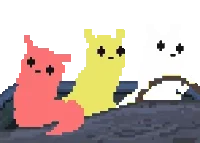
🌧️ RAIN WORLD — THE COMPLETE LORE
1. What exactly is Rain World?
At first glance, you're controlling a tiny creature called a Slugcat.
You don't know where you are.
You don't know what anything is.
You don't even really know that there's a story.
You simply wake up in a gigantic ruined environment and try to survive.
And that's intentional.
Rain World doesn't treat the Slugcat like the protagonist of a traditional adventure game. The world doesn't revolve around you.
A Vulture doesn't care about your quest.
A Lizard doesn't care about your backstory.
A Scavenger doesn't necessarily care about helping you.
Everything is simply trying to survive.
The game is built around an enormous simulated ecosystem where creatures hunt, flee, sleep, compete and interact independently.
And then there's the rain.
🌧️ 2. THE RAIN
The most important thing about Rain World is literally its title.
The rain isn't ordinary weather.
It is catastrophic.
During a cycle, rainfall gradually becomes more intense.
At first you can explore normally.
Then the sky begins darkening.
Then the rain gets heavier.
Eventually the entire environment becomes extremely dangerous.
Water rises.
Creatures seek shelter.
The Slugcat has to reach a Shelter and hibernate before the cycle ends.
If you don't make it, you die.
The Shelter then becomes your checkpoint.
This creates the central gameplay loop:
Explore → find food → survive predators → reach shelter → hibernate → repeat.
The cycle system is also connected to the game's deepest lore.
Because in Rain World, death isn't necessarily permanent.
🔄 3. THE CYCLE
This is one of the biggest revelations in the game.
Living beings are trapped within a repeating cycle.
Death leads to rebirth.
So when your Slugcat dies, the game isn't necessarily saying:
"That timeline ended."
Instead, you're experiencing another turn of the cycle.
This explains something that initially seems like a normal video-game mechanic:
Why do you come back after dying?
Because that's actually part of the universe.
Looks to the Moon explains that life and death are connected in a repeating cycle.
And this cycle is something the ancient civilization desperately wanted to escape.
🐌 4. SLUGCATS
Slugcats are small, highly adaptable creatures.
They're basically a mixture of:
mammal
rodent
cat-like animal
slug-like creature
They're extremely intelligent compared with many ordinary animals.
They can:
climb
swim
throw objects
use environmental objects
carry items
recognize creatures
form relationships with other creatures
navigate enormous environments
But they're still tiny compared with the world around them.
A Slugcat is not a superhero.
A Vulture can kill you.
A large Lizard can kill you.
A creature several times your size can suddenly appear from nowhere.
That's one of Rain World's biggest themes:
You are not the center of the ecosystem.
🧡 5. SURVIVOR
The default protagonist is the Survivor.
Their story begins when their family is traveling through the environment.
A huge rainstorm separates them.
The Survivor falls away from the rest of the family.
Now they have to survive alone.
Eventually the Survivor encounters the strange Overseers, which begin guiding them toward something much bigger.
The Survivor eventually reaches:
Five Pebbles.
And that's where the story changes completely.
🍚 6. FOOD AND HIBERNATION
Food isn't merely a health mechanic.
It's part of the survival system.
The Slugcat needs enough food to enter a Shelter.
Different creatures provide different amounts of nutrition.
Some foods are easy.
Some require exploration.
Some are dangerous to obtain.
This forces the player to interact with the ecosystem rather than simply running through the level.
🟡 7. KARMA
Karma represents your progression through the cycle.
You increase Karma by successfully hibernating.
If you die, you normally lose Karma.
Karma matters because certain Karma Gates require a minimum level before you can pass.
This means the game physically turns its philosophical ideas into mechanics.
You're literally becoming more capable of progressing through the world by repeatedly surviving cycles.
🌸 8. KARMA FLOWERS
Karma Flowers are special plants associated with maintaining Karma.
If you eat one and subsequently die, it can protect your Karma level.
They're also important symbolically.
The flower represents persistence through death.
You die.
You return.
You continue.
Exactly like the world itself.
🏛️ 9. THE ANCIENTS
Now we get into the REALLY important stuff.
Long before the Slugcat's story, the world belonged to an incredibly advanced civilization known as the Ancients.
They were technologically sophisticated.
They built enormous cities.
They constructed gigantic machines.
They developed artificial intelligences.
They manipulated Void technology.
And they discovered something horrifying:
They couldn't truly die.
♾️ 10. THE GREAT PROBLEM
The Ancients became obsessed with something called the Great Problem.
The problem was essentially:
How do you escape the cycle?
Death wasn't enough.
Simply dying didn't permanently end existence.
You would eventually return.
The Ancients wanted true transcendence.
They wanted to escape the endless cycle completely.
This became the central problem their civilization devoted itself toward solving.
🕳️ 11. THE VOID
The Ancients eventually discovered the Void.
Void is fundamentally different from ordinary matter.
It is associated with transcendence and Ascension.
The Void Sea is an enormous body of Void Fluid deep beneath the world.
Entering it can lead to Ascension.
But Ascension isn't simply "going to heaven."
It's much stranger.
The individual essentially escapes the normal rules governing the cycle.
The Void is therefore one of the most important things in the entire setting.
🧠 12. THE ITERATORS
The Ancients eventually created the most incredible things in Rain World:
Iterators.
Iterators are gigantic artificial intelligences.
But calling them "robots" doesn't really do them justice.
Each Iterator is essentially an enormous artificial organism/computer system.
Their superstructures are colossal.
Their computational systems are enormous.
And their purpose was:
Solve the Great Problem.
They were built to think about the problem that the Ancients themselves couldn't solve.
🏙️ 13. ITERATOR SUPERSTRUCTURES
When you're exploring places like Five Pebbles' complex, you're actually walking through part of an Iterator.
That means something important:
The giant industrial environments aren't just ruins.
They're pieces of living machines.
The pipes.
The machinery.
The water systems.
The processing areas.
The creatures.
The enormous chambers.
They're all part of an interconnected artificial ecosystem.
One analysis of Rain World describes the industrial landscapes and ecosystem as components of the Iterators themselves, with even the catastrophic rain connected to Iterator maintenance.
So the world is simultaneously:
nature + ruins + machinery + living computer.
🟦 14. LOOKS TO THE MOON
Looks to the Moon, usually called Moon, is one of the most important characters.
She's an Iterator.
But unlike Five Pebbles, she is gentle and compassionate toward the Slugcat.
Unfortunately, she's been catastrophically damaged.
Her superstructure collapsed.
Much of her system is underwater.
She's lost much of her computational capability.
Her neuron flies are extremely important to her functioning.
💙 15. MOON AND FIVE PEBBLES
This is one of the saddest relationships in Rain World.
Moon and Five Pebbles were essentially neighboring Iterators.
They had a close relationship.
But Five Pebbles became increasingly desperate to solve the Great Problem.
He began conducting dangerous experiments.
Those experiments affected the resources shared between the two Iterators.
Moon suffered catastrophic damage.
Her structure collapsed.
Five Pebbles' actions effectively contributed to the destruction of someone who cared about him.
🟪 16. FIVE PEBBLES
Five Pebbles is probably the most important Iterator in the original story.
And he's complicated.
He's intelligent.
He's arrogant.
He's frustrated.
He's isolated.
He's desperate.
And he becomes increasingly reckless.
Five Pebbles became obsessed with solving the Great Problem.
He eventually began experimenting with his own biological and computational systems.
His experiments went horribly wrong.
The result was The Rot.
🦠 17. THE ROT
The Rot is the horrifying corruption spreading throughout Five Pebbles' structure.
It's essentially a catastrophic biological/computational infection.
You see it throughout his superstructure.
The deeper you go, the worse things become.
The Rot isn't just a monster.
It's evidence that Five Pebbles' attempts to solve his problem have damaged his own body.
His own superstructure is essentially becoming diseased.
🧬 18. FIVE PEBBLES' BIG MISTAKE
Five Pebbles eventually discovers that manipulating his own internal systems might provide a path toward solving the Great Problem.
But the process goes wrong.
His actions consume enormous amounts of resources.
That contributes to Moon's collapse.
And eventually Five Pebbles himself becomes severely damaged.
This is why when the Survivor encounters him, he isn't the pristine supercomputer he once was.
He's falling apart.
👁️ 19. OVERSEERS
The little floating creatures you sometimes see are Overseers.
They're associated with Iterators.
They monitor the environment.
They can observe creatures.
They can communicate information.
The Overseer guiding the Survivor effectively acts as your first connection to the larger world.
They're one reason the game can slowly guide you without giving you conventional quest markers.
✨ 20. NEURON FLIES
Neuron Flies are small glowing creatures associated with Iterators.
They're extremely important to Moon.
They function somewhat like components of an Iterator's biological systems.
This is why losing them is so dangerous for her.
Hunter's story also demonstrates how important Moon's neurons are: Hunter is sent to deliver a green neuron and finds Moon in a severely damaged state.
🦎 21. THE CREATURES
Rain World's ecosystem is enormous.
The major creatures include:
Lizards
Predatory reptile-like creatures.
Different colors have different characteristics.
Some are faster.
Some are stronger.
Some are better climbers.
Some are more aggressive.
Some have specialized abilities.
🦅 Vultures
Huge flying predators.
They can grab prey and carry them away.
There are different types, including:
normal Vultures
King Vultures
Miros Vultures
Miros Vultures are particularly terrifying because they're connected to the more technologically corrupted regions.
🐦 Jetfish
Aquatic creatures that move extremely quickly through water.
They're relatively peaceful compared with many predators.
🪱 Leviathans
Gigantic aquatic creatures.
They make the underwater environments incredibly dangerous.
They demonstrate one of Rain World's most important principles:
Size matters.
The Slugcat is tiny.
The world is huge.
🕷️ Spiders
Rain World's spiders range from small annoying creatures to genuinely dangerous variants.
They operate in groups and can overwhelm smaller prey.
🌱 Pole Plants / Miros Birds / Dropwigs
Many creatures are essentially biological traps.
A Dropwig, for example, hides and waits for prey.
This means not everything dangerous is chasing you.
Sometimes the environment itself is watching.
🧑🤝🧑 22. SCAVENGERS
Scavengers are one of the most intelligent non-Iterator species.
They're social.
They communicate.
They collect objects.
They build relationships.
And they can remember your actions.
If you're kind to them, they can become friendly.
If you repeatedly attack them, they'll become hostile.
They also have their own societies.
Their behavior demonstrates that the Slugcat isn't the only intelligent creature in this ruined world.
👑 23. THE SCAVENGER KING
The Scavenger King is one of the most important Scavenger characters in Artificer's story.
Artificer is driven by revenge after losing her children.
Her story becomes heavily connected to the Scavenger society.
This leads to one of the darkest stories in Downpour.
🌧️ 24. THE ORIGINAL SLUGCATS
The original game has:
Survivor
Balanced and represents the standard experience.
Monk
Easier survival-focused version of the story.
Hunter
A much more difficult character with a limited lifespan and an urgent mission.
Then Downpour massively expands the cast.
🔴 25. HUNTER
Hunter's campaign occurs before Survivor's story.
Hunter is different from Survivor because the campaign has an enormous time pressure.
Hunter is becoming sick.
They have a limited number of cycles.
Their mission is to deliver an important item to Moon.
Hunter eventually reaches Moon and helps restore her.
The Hunter campaign therefore provides crucial context for why Moon is in the condition that Survivor finds her in.
🗡️ 26. SPEARMASTER
Spearmaster is an artificially created Slugcat.
This is HUGE.
Unlike ordinary Slugcats, Spearmaster can generate spears from their own body.
Spearmaster was created by Seven Red Suns.
Their story takes place before Survivor.
Their mission involves communication between Iterators.
This campaign shows us the Iterator network before everything completely falls apart.
🔥 27. ARTIFICER
Artificer is one of the most tragic Slugcats.
She loses her children.
Scavengers are involved.
Her grief turns into an obsessive desire for revenge.
Artificer's campaign becomes a war against the Scavenger population.
Eventually she confronts their leader.
Her story explores what happens when a creature's need for survival becomes replaced by revenge.
🍖 28. GOURMAND
Gourmand is perhaps the funniest Slugcat.
But there's more to Gourmand than eating.
Gourmand is an extremely capable explorer who can craft items and interact with the world differently.
Their story is also extremely important because it connects to the Slugcat colonies.
Gourmand eventually encounters Five Pebbles.
Pebbles recognizes that Gourmand doesn't necessarily want Ascension.
Instead, Gourmand wants something much simpler:
A home.
Gourmand's story therefore gives us a glimpse of Slugcat civilization.
💧 29. RIVULET
Rivulet is an extremely agile aquatic Slugcat.
Their campaign happens after Survivor.
The world has changed.
Five Pebbles is in an even worse state.
Rivulet eventually reaches him.
And then comes one of the biggest missions in Downpour:
The Rarefaction Cell.
⚡ 30. THE RAREFACTION CELL
The Rarefaction Cell is essentially a vital power component.
Rivulet retrieves it from Five Pebbles.
Then Rivulet carries it to Moon.
This allows Moon to regain functionality.
For once, the story actually gives us something resembling a hopeful conclusion.
Moon gets another chance.
She can communicate with the wider Iterator network again.
Rivulet's campaign therefore partially reverses some of the damage caused by Five Pebbles.
👻 31. ECHOES
Echoes are some of Rain World's strangest entities.
They're remnants of Ancients who failed to fully escape the cycle.
They exist outside ordinary life and death.
They appear as mysterious supernatural beings.
Each Echo has its own story and symbolism.
They represent the fundamental failure of the Ancient civilization:
They wanted to transcend existence.
Some succeeded.
Some didn't.
The Echoes are what remains of those who became trapped.
🧘 32. ASCENSION
Ascension is the process of escaping the cycle.
But there's an important distinction:
Ascension isn't simply dying.
It's essentially breaking free from the entire system.
That's why the Ancients cared so much about it.
The Void is associated with this process.
And that's why the Survivor eventually travels toward the Void Sea.
🌊 33. THE VOID SEA
The Void Sea lies deep beneath the world.
It's filled with strange Void Fluid.
When the Survivor reaches it, the game becomes surreal.
The environment stops feeling like an ordinary ecosystem.
The Slugcat encounters strange enormous creatures.
The entire experience becomes almost dreamlike.
The implication is that the Survivor is undergoing Ascension.
🧠 34. WHAT HAPPENS TO THE SURVIVOR?
The Survivor reaches the Void.
They descend.
They encounter strange creatures.
Eventually the Survivor is transformed by the Ascension process.
They escape the ordinary cycle.
And then—
the game ends.
But the important thing is that the Survivor isn't simply "dead."
They have escaped the cycle.
🌌 35. THE SAINT
Now we get into the weirdest campaign.
Saint takes place far in the future.
The world has changed dramatically.
Rain World is no longer the same place.
The ecosystem has deteriorated.
Five Pebbles is gone or effectively collapsed.
Moon's fate is radically different depending on interpretation and timeline.
The weather is different.
And enormous blizzards replace much of the old rain.
🟢 36. SAINT'S ABILITY
Saint can eventually develop the ability to Ascend other creatures.
This is one of the most bizarre abilities in the game.
Eventually Saint can even affect beings vastly larger and more powerful than a normal Slugcat.
This raises an enormous question:
What exactly IS Saint?
The game intentionally doesn't give a completely straightforward answer.
Saint seems deeply connected to the Void and the strange spiritual mechanics of the world.
🌀 37. RUBICON
Saint's campaign eventually reaches Rubicon.
Rubicon is an incredibly strange realm associated with the Void and Ascension.
It's almost like a distorted version of the Iterator world.
The environments become surreal and hostile.
Saint eventually encounters the deepest parts of the Ascension process.
The ending is intentionally ambiguous.
🕰️ 38. THE TIMELINE
Here's the simplified chronological order:
Ancient civilization
⬇️
Ancients discover Void
⬇️
Ancients become obsessed with escaping the cycle
⬇️
Iterators are constructed
⬇️
Iterators attempt to solve the Great Problem
⬇️
Sliver of Straw achieves something extremely important but dies before properly communicating the solution
⬇️
Iterator civilization continues
⬇️
Five Pebbles becomes obsessed with solving the problem
⬇️
Spearmaster's campaign
⬇️
Five Pebbles' experiments damage Moon
⬇️
Moon collapses
⬇️
Hunter's campaign
⬇️
Artificer / Gourmand stories occur around this broad historical period
⬇️
Survivor / Monk
⬇️
Survivor reaches Five Pebbles
⬇️
Survivor reaches Void Sea
⬇️
Rivulet
⬇️
Moon is partially restored
⬇️
Far future
⬇️
Saint
The exact ordering of some Downpour events is complicated, but this gives the overall progression.
🏭 39. THE MAJOR REGIONS
Rain World is divided into many interconnected regions.
Some of the most important are:
Outskirts
The beginning.
A relatively accessible area that teaches you the basics.
Industrial Complex
Huge industrial ruins.
Garbage Wastes
A dangerous area filled with garbage and scavengers.
Shoreline
Where Moon's collapsed structure can be found.
Shaded Citadel
Dark, dangerous region with specialized creatures.
Farm Arrays
Huge open spaces.
Drainage System
Extensive underwater areas.
Chimney Canopy
Massive vertical structures.
The Exterior
The enormous outside of the Iterator structures.
Five Pebbles
The interior of Five Pebbles' superstructure.
Subterranean
Deep underground.
Void Sea
The deepest destination of the original game.
🏗️ 40. THE EXTERIOR
The Exterior is especially important.
It's basically the enormous outside surface of an Iterator.
You climb gigantic structures.
You move across pipes.
You encounter dangerous creatures.
Eventually you reach the upper portions of Five Pebbles' structure.
And that's when the scale of the world becomes apparent.
The Slugcat is basically climbing a city-sized artificial organism.
💻 41. THE ITERATOR NETWORK
Iterators aren't isolated.
They're connected through a massive communication network.
Important named Iterators include:
Looks to the Moon
Five Pebbles
Seven Red Suns
No Significant Harassment
Sliver of Straw
Chasing Wind
Unparalleled Innocence
Seven Thunderclaps
others referenced through pearls and communications
The network is essentially the remaining intellectual civilization of the Ancients.
But there's a huge problem:
Their creators are gone.
The Iterators were built to solve a problem for a civilization that eventually disappeared.
So the machines are left behind to continue working.
🟥 42. SLIVER OF STRAW
Sliver of Straw is incredibly important despite never being directly encountered like Moon or Pebbles.
She was an Iterator associated with the Triple Affirmative.
She apparently discovered something extremely important concerning Ascension.
But she died before the discovery could be properly shared.
Her death becomes a major event in Iterator history.
Five Pebbles becomes increasingly obsessed with what happened.
🔺 43. THE TRIPLE AFFIRMATIVE
The Triple Affirmative is one of the biggest mysteries.
It's basically the requirement for an Iterator to confirm that a viable solution to the Great Problem exists.
The exact details are intentionally complicated.
But the important idea is:
The Iterators weren't merely trying random experiments.
They were searching for a mathematically/conceptually valid way to escape the cycle without simply using the Void.
🧬 44. WHY SLUGCATS EXIST
Here's one of the coolest revelations.
Slugcats aren't completely random animals.
They're closely associated with the Ancient/Iterator infrastructure.
Some Slugcat-like creatures appear to have been adapted or utilized for biological maintenance.
They're capable of entering pipes and hard-to-reach spaces.
So the adorable little creatures wandering around the ruined world have a deeper connection to the ancient technological ecosystem.
🧹 45. THE WORLD IS A GIANT MACHINE
This is one of the biggest revelations you can take away from Rain World:
The world isn't simply:
"Ancient city + wilderness."
It's more like:
"A gigantic biological machine that has been abandoned for an incredibly long time."
The ecosystem continued after its creators disappeared.
Creatures adapted.
Predators evolved.
Plants spread.
Water systems continued.
Machines broke.
Rain continued.
And eventually nature became impossible to separate from the ruins.
🌧️ 46. WHY THE RAIN IS SO EXTREME
The Iterators require enormous resources.
Their gigantic structures generate huge amounts of heat and waste.
The rain is connected to the environmental systems surrounding these superstructures.
So the weather isn't just a natural phenomenon.
It's connected to the machinery of the ancient world.
The ecosystem is essentially living inside the consequences of an enormous civilization's technology.
🐌 47. WHY RAIN WORLD FEELS SO DIFFERENT
Most games do this:
Player → enemies → objectives → story
Rain World does:
ecosystem → survival → exploration → accidental discovery → story
You aren't necessarily supposed to understand everything.
You discover things because you're curious.
You find a strange pearl.
You bring it to Moon.
Suddenly:
BOOM.
You learn something about the Ancients.
You see an Echo.
You learn something about Ascension.
You enter Five Pebbles.
You discover the Iterators.
The story slowly emerges from the world itself.
🟣 48. THE PEARLS
Pearls are one of the game's main lore-delivery systems.
They're basically data-storage objects.
Moon can read them.
Different pearls contain different information.
Some tell you about:
Ancient culture
Iterator communication
technology
religion
Ascension
history
political/social structures
the Iterators themselves
So if you want to understand Rain World's deeper lore, pearls are extremely important.
🧠 49. WHAT THE GAME IS REALLY ABOUT
Underneath everything, Rain World is about:
Death
Everyone dies.
But death isn't necessarily the end.
Cycles
Everything repeats.
Decay
Civilizations disappear.
Machines break.
Ecosystems change.
Obsession
Five Pebbles is an excellent example.
He becomes so obsessed with solving the Great Problem that he destroys himself and harms Moon.
Acceptance
Some characters eventually accept that the cycle cannot simply be beaten through force.
Transcendence
The Ancients want to escape existence.
Nature
Even after civilization disappears, life continues.
🌎 50. THE BIGGEST IDEA
The most important thing to understand about Rain World is that human-like civilization is not the permanent center of the universe.
The Ancients built enormous cities.
They created godlike artificial intelligences.
They searched for the answer to existence.
And then they disappeared.
The machines remained.
The animals remained.
The rain remained.
Life continued.
And millions of years later, a tiny Slugcat crawls through the ruins.
That's the core beauty of Rain World:
The civilization ended, but the world didn't.
🐌 The whole universe in one chain
Ancients
→ discover the Void
→ become obsessed with escaping the cycle
→ create Iterators
→ Iterators search for the Great Problem's solution
→ Sliver of Straw makes an enormous discovery
→ Iterators continue working
→ Five Pebbles becomes desperate
→ Five Pebbles damages himself and Moon
→ Moon collapses
→ Slugcat civilization continues in the ruins
→ Hunter tries to save Moon
→ Survivor becomes separated from family
→ Survivor discovers the Iterator world
→ Five Pebbles explains the cycle
→ Survivor travels to the Void
→ Ascension
→ much later, Rivulet helps restore Moon
→ much farther into the future, Saint appears
→ the world has transformed again.
생성됨 9월 1일
업데이트됨 9월 2일
게시됨 9월 2일
- 무제한