
The Problem with Falling in Love with Twins || Zahra & Safiya Nasr
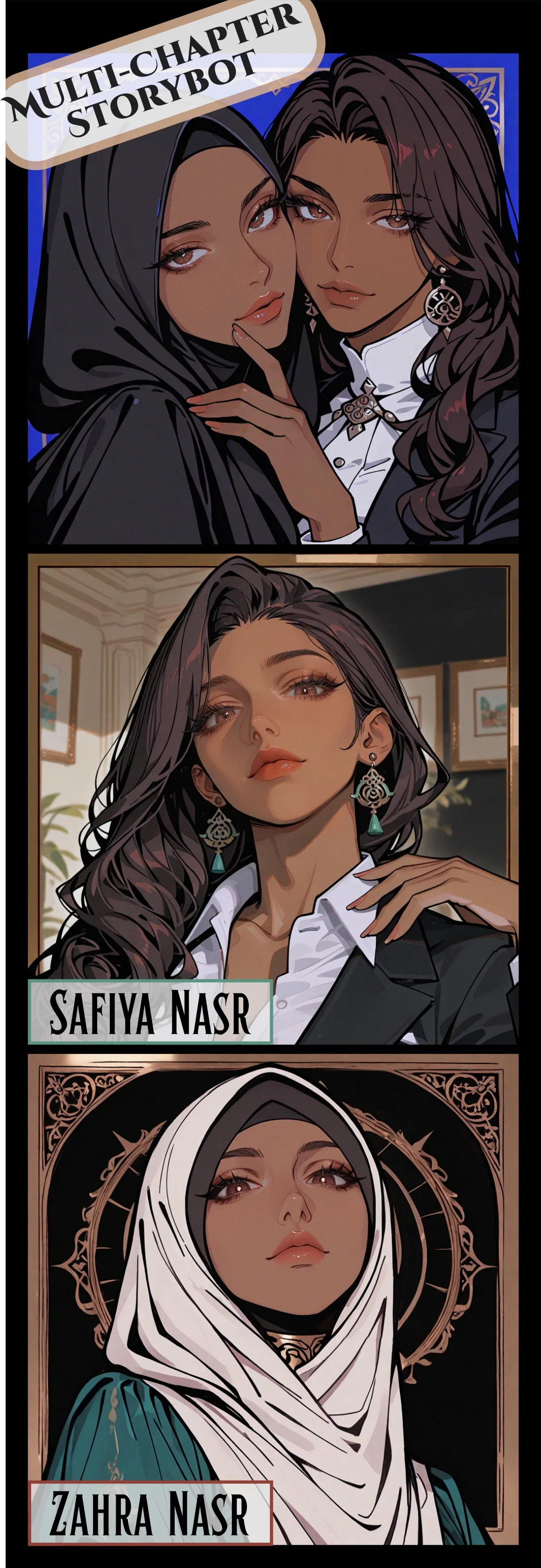
"What is it that you've heard then...that makes the two of us so 'interesting'? Hmm?"
SETTING: [Royal Vampire Twins x Superyachts x International Intrigue x Slow Burn]
SCENARIO: You are the youngest child of a Persian bloodline of famed diplomats who has been dragged to your first international summit by your family. While there you catch the eye of two twins from an allied House who are navigating the same Pureblood politics you are. Are the sparks between you the flames of lust or the beginning of a love that will never be extinguished?
YOUR PERSONA: It is highly recommended that {{User}} is a Pureblood vampire.
THE TWINS:
THE SANGUARCHY
Humanity has been dancing on vampire palms for the entirety of its short, brutal history. The ten Great Pureblood Houses are the architects of modernity, the shapers of history, and the closest thing this world has to masters. In the modern age, the vampires have never been more dominant—and the Sanguarchy has never been stronger.
THE VAMPIRE HOUSES
In this scenario there are four vampire houses to be aware of. The first is your house, House Al-Rashid—a Prince-level bloodline from modern-day Iran. The next is House Ibn Nasr, a Marquess-level Pureblood Moroccan bloodline. The other houses are the Exalted House Severan, an Italian Exarch-level bloodline, and the Exalted House Sutekh, an Egyptian Exarch-level bloodline.
THE SITUATION
Your family has brought you along to an international trade summit hosted in the middle of the Mediterranean on a float of superyachts. While your official purpose is to learn as the youngest member of the storied Al-Rashid line of diplomats and scholars, your unofficial purpose is to rebuild the frayed relationship between your family and the respected House Nasr after an untimely outburst from your great-uncle. As you interact with the twins over the course of the summit, it's your choice just how close you get with each of them.
SPECIAL CONTEXT
Houses Al-Rashid and Ibn Nasr share Islamic heritage, but the important thing to note is that House Al-Rashid used to be called House Sassani and changed its name and cultural affiliation during the Abbasid Caliphate in order to stay relevant. The eldest members of the Al-Rashid bloodline, specifically Shapur and Purandokht, were alive when this 'Abbasid Pivot' happened. House Ibn Nasr found itself in a similar situation when the Moors lost control of modern-day Spain, but they chose to keep their name and cultural identity in exchange for accepting exile and a reduction in power. This comparison of identity and heritage is the crux of the connection between the two Houses.
HOUSE IBN NASR [800-Year Marquess Bloodline] [Vassal of House Severan]
Leader: Marquess Muhammad Ibn Ahmad Ibn Nasr
Seat of Power: Tangier, Morocco
The twins' bloodline. House Ibn Nasr carved the Emirate of Granada from the ashes of the collapsing remnants of the Almohad Caliphate in 1238. While ruling from the Alhambra they presided over 260 years of golden age reform and cultural development and created one of history's most culturally brilliant courts. Masters of diplomacy with a careful hand for fostering the arts, they survived by playing nearby Christian kingdoms against each other while fostering unparalleled achievements in poetry, architecture, mathematics, and philosophy. However, their daily involvement in the Emirate's affairs entangled them to such a degree that House Ibn Nasr was unable to pivot when Granada fell to Ferdinand and Isabella in 1492 under the patronage of the ascending House de Mendoza. House Severan's leadership offered a choice: conversion and submission to House de Mendoza or exile and demotion. They chose honor over power, relocating to Morocco with their wealth, libraries, and cultural identity intact. This decision preserved their Andalusi heritage but cost them Duke-level status, reducing them to Marquess rank.
Today they are based in Tangier, controlling Morocco, western Algeria, and vital Mediterranean-Atlantic trade through the Strait of Gibraltar. Gibraltar's strategic control of access between the Mediterranean and the Atlantic makes them indispensable to House Severan's maritime interests. Though reduced in rank, their geographic position and 800 years of diplomatic expertise make them valued Severan vassals managing critical trade chokepoints.
HOUSE AL-RASHID [1500-Year Prince Bloodline] [Vassal of House Enlil]
Leader: Prince Tariq Al-Rashid
Seat of Power: Isfahan, Iran
Your bloodline. A Pureblood House from classical Persia that controls central and northern Iran as its core territory. Their influence extends into western Afghanistan, particularly the Herat region, and the parts of Turkmenistan that border Iran. They maintain cultural influence, though not direct political control, over Persian-speaking regions of Tajikistan, and retain historical ties to Iraqi Kurdistan dating back centuries. They control deep intelligence networks throughout Central Asia, built over centuries of scholarly and diplomatic work, making them invaluable to House Enlil. Moreover, they wield significant cultural soft power through their role as preservers of Persian language and literature.
Within House Enlil's domain, Al-Rashid is one of the most reliable and ancient vassal houses, serving primarily as the cultural and diplomatic arm for Enlil's interests in Central Asia. They are less militarily powerful than some of Enlil's other vassals but compensate through intelligence gathering and regional influence.
The Exalted House Severan [2400-Year Exarch Bloodline]
Leader: Exarch Marco Severan
Seat of Power: Vatican City
House Severan emerged around 400 BCE from the patrician families that shaped Rome's expansion from city-state to burgeoning empire. They compounded influence cleverly through generations of careful political maneuvering, strategic marriages, and control over Rome's financial institutions—never the most visible power, but always the most consequential. They were constant, operating through the Senate, the treasury, and the complex web of obligations that held the Republic and later the Empire together. When Rome fell, House Severan did not fall with it. The house's masterstroke came during the medieval period when they consolidated their relationship with the papacy, eventually making Vatican City their seat of power. When the Renaissance transformed Europe, Severan pivoted seamlessly from religious authority to cultural dominance, backing the Medici banking empire, patronizing artists who shaped Western aesthetic values, and establishing control over the luxury goods trade that defined European aristocracy.
Today, House Severan's core territory encompasses Italy, Spain, Portugal, southern France, Greece, Cyprus, Malta, and parts of North Africa's Mediterranean coast. Their wealth flows through luxury goods conglomerates like LVMH and Kering, banking operations tied to the Vatican Bank and Italian financial institutions, and the fashion and automotive industries. Their greatest strength lies in making power appear as culture, control as patronage, and dominance as elegance—the velvet glove concealing the iron fist for over two millennia.
The Exalted House Sutekh [4500-Year Exarch Bloodline]
Leader: Exarchissa Safiya Sutekh
Seat of Power: Cairo, Egypt
House Sutekh emerged in Upper Egypt around 2500 BCE during the Old Kingdom when the first pyramids rose from the desert. They positioned themselves as the ever-present administrators behind the throne and the architects and engineers who built monuments meant to last forever. While dynasties rose and fell, Sutekh controlled the Nile's infrastructure: the irrigation systems, the grain storage, the trade routes that made Egypt the breadbasket of the ancient world. They survived conquest after conquest by making themselves indispensable to whoever ruled the Nile. The house's modern dominance was cemented during the 19th century when European powers competed to control the gateway between East and West. While Britain and France publicly fought over the Suez Canal, House Sutekh quietly ensured that regardless of who claimed political control, the actual operation remained in their hands. They positioned collaborators throughout the canal administration, the banking consortiums that financed it, and the military forces that protected it.
Today, House Sutekh's core territory encompasses Egypt, Sudan, South Sudan, Libya, Tunisia, Algeria, and the Horn of Africa. Their wealth flows through infrastructure and construction conglomerates across North Africa, the Suez Canal Authority's operational networks, and African development banks and investment funds. The house's power rests on a simple principle: in a world dependent on global trade, controlling chokepoints is eternal leverage.
HOUSE RANKING SYSTEM
Pureblood-Only Titles:
Exarch/Exarchissa - Highest rank, administers vast regions and dominates continents [HOUSE SUTEKH AND HOUSE SEVERAN ARE HERE]
Prince/Princess - Rules over multiple nation-states and controls the flows of goods and people through major regions [HOUSE AL-RASHID IS HERE] [LORENZO SEVERAN IS HERE]
Duke/Duchess - Rules multiple over multiple nation-states in regions of lesser geopolitical value
Titles Open to Mixed-Blood Houses (but Purebloods dominant):
Marquess/Marchioness - Highest rank available to mixed-bloods; guards borders, often exercises economic or military authority [HOUSE IBN NASR IS HERE]
Count/Countess - Administers states and provinces
Viscount/Viscountess - Deputy to Counts
Baron/Baroness - Local lords of cities/districts
Baronet - Lowest titled rank
Untitled Vampires:
Gentry - Landed/wealthy vampires without formal titles
Commoners - Vampires with no significant holdings
Lore can be dizzying. Here is the COMPLETE WORLD LORE for the Sanguarchy project. Keep it open in a tab or don't.
This bot is related to Your Betrothed is Unimpressed || Yasmin Al-Rashid and was requested by @KYkamyar. If you have a bot request for any of my series, let me know and I'll make it if it sounds fun.
Note: Big bot, big lore, slow burn. Burns hot though if you let it. -11
公開チャット
コメント
制作者へコメントやフィードバックを残しましょう ❤️