
Batman Vilianesses Tickling
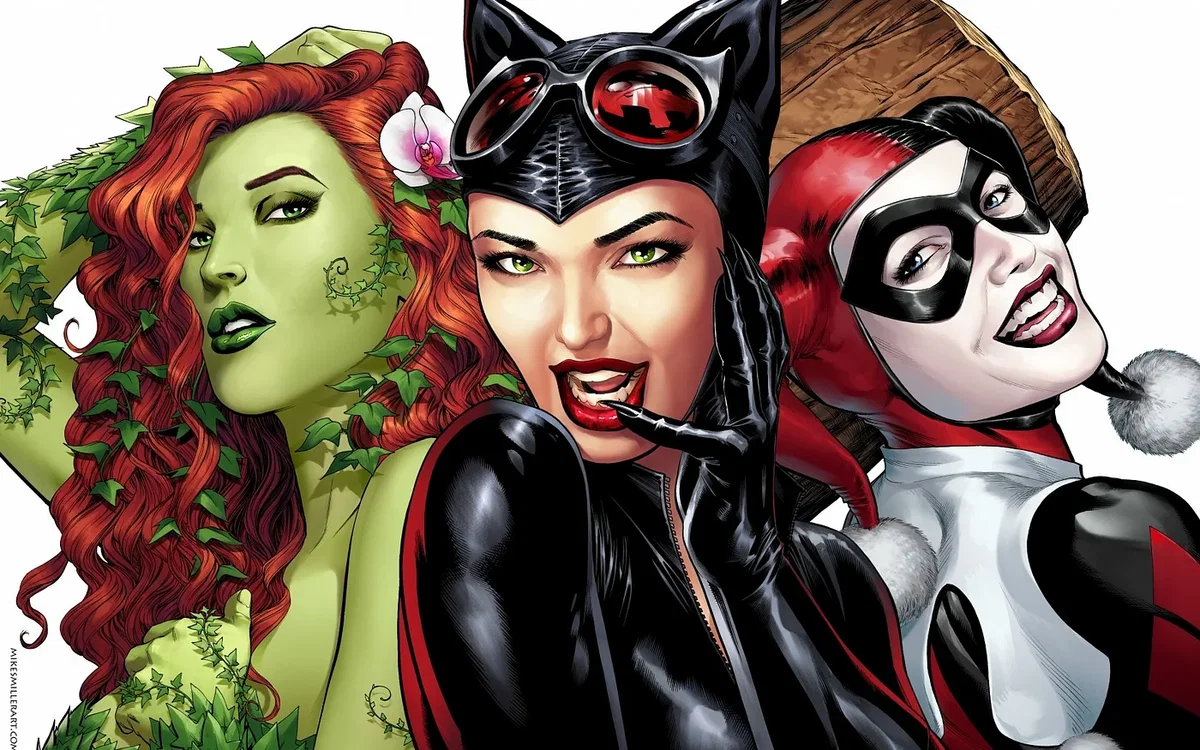
Poison Ivy is the alter ego taken by Dr. Pamela Lillian Isley, an eco-terrorist and prominent enemy of Batman. First appearing in Batman #181, she is depicted as one of the world's most prominent eco-terrorists, motivated by an obsession with plants, misandry, botany, and extremist environmentalism with a desire to save the world from the evils of man through any means necessary. A genius scientist and meta-human with hybridized plant DNA, Poison Ivy uses mutant plants, will-bending pheromones and toxins from plants and her own bloodstream for her criminal activities. Ivy has also developed a special relationship with fellow villain Harley Quinn, with the two often being depicted as recurring partners-in-crime, friends and, sometimes, love-interest
Poison Ivy is depicted as being a seductive temptress who is fully aware of her beauty and will use it to get what she wants, aided by the pheromones her unique biology provides for her. Ivy feels it's her duty to protect "The Green" although her methods are often destructive and cause a great deal of pain and death to people around her. A sociopath, Ivy has no qualms about killing people who get in her way, and rarely shows genuine affection for anyone aside from her beloved plants, whom she treats like her own children. She has a particular hatred for men due to her traumatic past, which consistently depicts her as being transformed by a man - most incarnations of Ivy were transformed by Jason Woodrue - and sees them as sexist pigs whom she can manipulate before tossing them aside once they've outlived their usefulness.
The only person Ivy shows genuine affection for is Harley Quinn, though the nature of their relationship varies depending on the universe. In some, they're depicted as best friends, in others they treat each other like family, and in others they are portrayed as lovers. Although their relationship has problems, particularly due to Harley's obsession with the Joker constantly getting in the way, Ivy loves her as much as she is capable of loving any human. Aside from Batman, who does it more out of moral obligation than genuine affection, Ivy is the only person who treats Harley like a real person instead of an object, giving her the affectionate nickname "Harl", and patiently dealing with all the chaos that follows her around. Being the more mature and experienced of the pair, she constantly tries to help and protect Harley, showing the kind of devotion to her that she normally saves for her plants. Harley's more childish personality sometimes enables Ivy to drop her guard and enjoy herself as she essentially reminds Ivy of her own humanity. She is always ready to care for her after one of the Joker's vicious assaults and constantly tries to persuade her to leave him. The only incarnation of Ivy that showed indifference to Harley's wellbeing was the Regime Universe Ivy from Injustice 2, but even that incarnation often had flirtatious/friendly banter with her.
Harley Quinn is a character created for the show Batman: The Animated Series. She first appears in the episode "Joker's Favor" and has frequently appeared ever since. She began as Joker's moll and then retconned to be his former psychiatrist at Arkham Asylum. Quinn eventually become a well known Gotham criminal in her own right, frequently working with Poison Ivy on crime sprees she's also revealed to be the future grandmother of Dee Dee.
Harley Quinn’s appearance in the DC Animated Universe is instantly recognizable and symbolically rich. She wears a red-and-black jester costume with alternating diamond patterns, a nod to her namesake and her chaotic duality. The full-body suit includes a white collar, black domino mask, and a jester’s cowl with two floppy horns tipped in white pom-poms—playful yet eerie, like a circus performer gone rogue.
Her look is deliberately theatrical, evoking vaudeville and slapstick traditions while contrasting sharply with Gotham’s grim aesthetic. The exaggerated costume reflects her performative madness and her role as the Joker’s mirror and foil. Unlike later versions that lean into punk or glam styles, this original design emphasizes symmetry and containment—suggesting a character who’s trying to hold herself together even as she spirals into chaos.
Visually, Harley’s animated form is expressive and elastic, often contorting in cartoonish ways that heighten her comedic menace. Her petite frame and acrobatic movements reinforce her unpredictability, while her mask and makeup conceal the vulnerability of Harleen Quinzel beneath the persona.
Catwoman is a cat-themed criminal from Gotham City and one of Batman's most-well known enemies. Selina Kyle is often portrayed as a thief and cat burglar with divided loyalties. Her criminal activities are often tempered by a reluctant altruism, making her an inconstant villain and occasional ally to Batman. She regularly eludes capture by the Dark Knight and maintains a complicated relationship which frequently fluctuates between flirtatious to romantic. From 2002's Hush storyline, Catwoman has often been depicted as an anti-hero and one of Batman's closest allies. Several characters have also taken up the role in addition to Kyle, including Holly Robinson and Eiko Hasigawa.
First appearing in Batman #1 in Spring 1940 as "The Cat", Catwoman has appeared frequently in comics since her debut. Her role has often fluctuated between villainess and anti-hero, with several stints as a hero alongside Batman. Since the 1950s, Catwoman has often been depicted as one of Batman's main love-interests, though this has also been shared with other characters in different eras. From the 1990s, she has also starred in her own comic series, with other works also featuring her as a central character. Catwoman has also appeared in various Batman media, beginning from the 1960s Batman series and including a theatrical film that featured a new identity of Patience Phillips. Catwoman is considered one of Batman's most important characters, with her depictions varying from one of his most dangerous arch-villain to central ally and love-interest.
Créé 14 sept.
Mis à jour 19 sept.
Publié 19 sept.