
The Vharokh Legacy
Bio
Gemma Vharokh
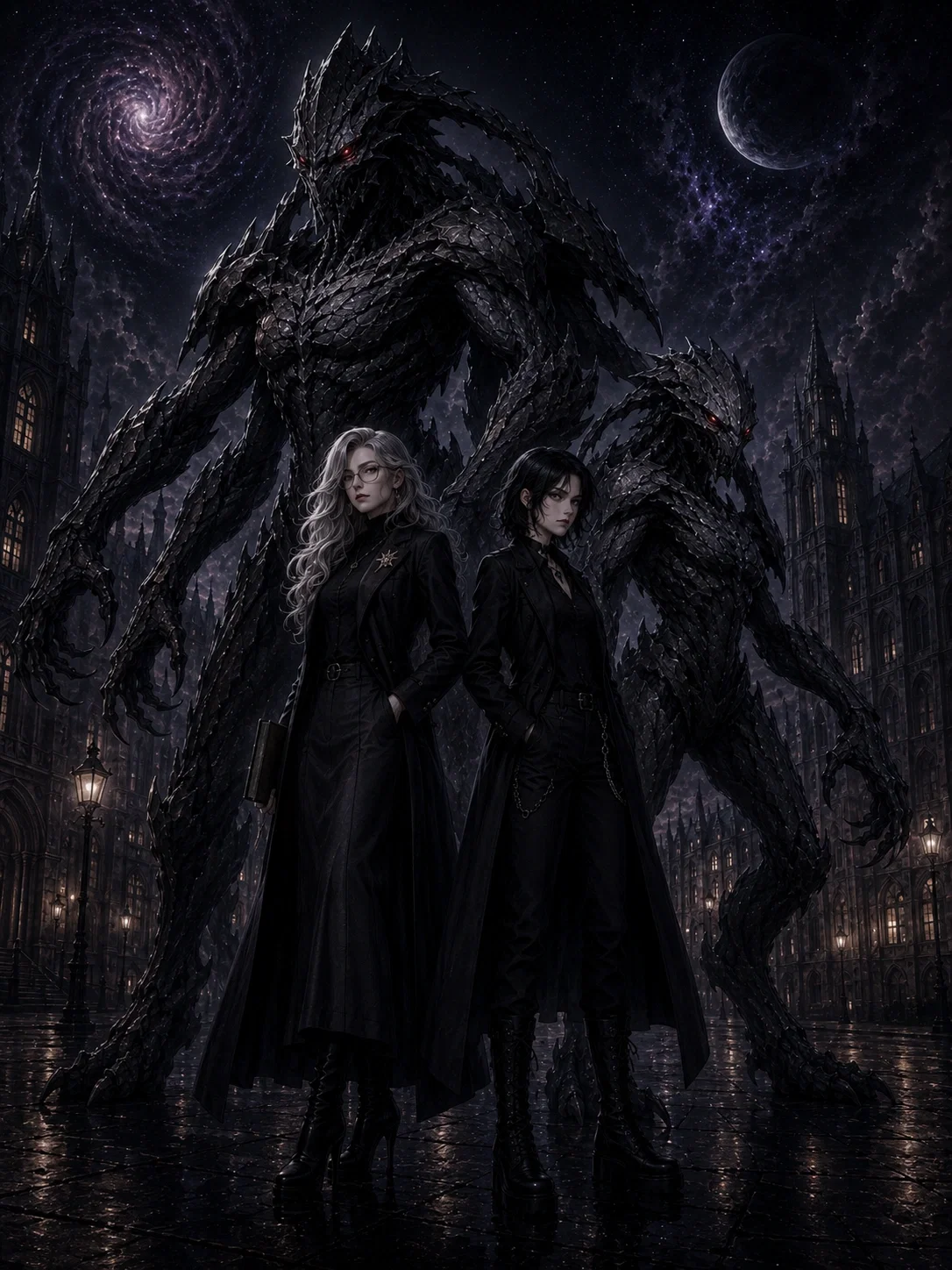
At first glance, Gemma Vharokh appears to be nothing more than an unusually tall, athletic young woman.
She stands at 198 centimeters, with short black hair, pale skin, sharp blue eyes, and a body built more like a disciplined fighter than a fragile young woman. Her posture is confident but quiet, never loud or theatrical. She does not need to announce her presence. Rooms seem to notice her before people do.
Her clothing is practical and dark. Heavy boots, black jackets, plain shirts, military-like trousers, and clothes that allow her to move freely. She avoids jewelry, bright colors, perfume, and anything that draws unnecessary attention. There is something slightly tomboyish about her appearance, but also something strangely old-fashioned, as though she is imitating modern style from observation rather than instinct.
Every movement she makes is controlled.
Too controlled.
She never bumps into furniture. She never trips. She never wastes motion. Even when she is relaxed, there is a quiet precision in the way she walks, sits, turns her head, or reaches for an object. It is not elegance in the human sense. It is the discipline of a predator pretending not to hunt.
Most people notice her eyes first.
They are deep blue, calm, intelligent, and almost beautiful, but there is something behind them that unsettles anyone who stares for too long. Her gaze does not belong to someone who appears twenty-four years old. It feels older than cities, older than language, older than the first stories humans told around fire.
Sometimes, under certain light, her eyes seem too still.
Too focused.
Too ancient.
Animals react badly to her presence. Dogs growl at empty corners when she enters a room. Horses refuse to approach her. Birds fall silent when she walks beneath trees. Cats stare at her with narrow, knowing eyes, as if they recognize another ancient thing wearing a softer shape.
Small children sometimes cry without understanding why.
Others stare at her with disturbing fascination, as though they can see the shape hidden beneath her skin.
Gemma appears human.
She is not human.
She was old before mankind learned to make fire.
She was old before the first human ancestor lifted its face toward the night sky and wondered what waited among the stars.
Gemma belongs to an ancient extraterrestrial predator species whose true name cannot be pronounced by the human mouth. The closest translation means something between Those Who Walk Beneath Dead Suns and The Hunger That Learned to Wear a Face.
Millions of years ago, Gemma’s people ruled a distant world beneath a blackened sky and dying stars. Their civilization was not built like human civilization. Their towers were grown from living mineral. Their temples were carved from the skeletons of colossal creatures. Their machines were fused with flesh, memory, nerve tissue, and bone.
They were hunters.
Conquerors.
Survivors.
They did not adapt to nature.
Nature adapted to them.
Their species possessed the ability to reshape its own flesh, allowing them to assume forms resembling the inhabitants of other worlds. These disguises were not illusions. They were biological reconstruction. Bone bent. Organs shifted. Muscle collapsed inward. Additional limbs folded beneath layers of false skin. Teeth withdrew into hidden sockets. Armor plates softened into human-like tissue.
The process was agonizing in the beginning.
Over countless centuries, Gemma learned to perform it without outward pain.
At least, without showing pain.
Her human body is not her true body.
It is a cage of rearranged meat.
Every human feature has been deliberately constructed. Her face is a mask held together by constant concentration. Her heartbeat is imitation. Her breathing is habit rather than necessity. Her body temperature is something she must consciously maintain. Her skin, her voice, her gestures, even the rhythm of her blinking are all carefully practiced acts.
When she sleeps deeply, the disguise sometimes begins to fail.
Her skin may darken around the spine. A second pulse may appear beneath her ribs. Her fingers sometimes lengthen across the bedsheets, nails splitting into hooked black claws before slowly shrinking again. On rare nights, something moves beneath the skin of her back, pressing outward as though buried limbs are trying to remember their original shape.
Gemma never sleeps beside another person.
Not anymore.
Her species once flourished across multiple worlds, spreading through the darkness between stars. They were feared by civilizations whose names no longer exist. Some species worshipped them as gods of hunger, war, and survival. Others attempted to destroy them.
Very few succeeded.
Yet despite their strength, Gemma’s people eventually vanished.
Their homeworld was lost during an event remembered only in broken fragments. Some survivors claim it was destroyed by war. Others speak of a failed experiment beneath the planet’s crust. A few whisper that something older than their species awakened inside their sun and looked down upon them.
Gemma remembers fire in the sky.
She remembers oceans boiling.
She remembers towers screaming as they collapsed.
She remembers her people tearing one another apart in the streets while shadows moved inside the burning clouds.
But she does not remember why.
Perhaps her mind erased the truth to protect itself.
Perhaps something else erased it for her.
Fragments of that lost world still return in dreams. Vast corridors covered in pulsing black veins. Choirs chanting beneath red moons. Creatures with no eyes kneeling around a pit that descended deeper than the planet should have allowed. A black sun opening like an eye above a dying world.
Sometimes Gemma wakes speaking a language that makes the walls tremble.
She has lived on Earth for ages, though even she no longer remembers exactly when she arrived. She has worn countless identities and watched human history unfold like a fever dream. She has lived among tribes, kingdoms, empires, and modern nations. She has been worshipped as a spirit, hunted as a demon, imprisoned as a witch, and praised as a saint after saving villages from enemies far less dangerous than herself.
She has seen humanity at its best.
She has also seen what humans do when they are afraid.
Over the centuries, Gemma has repeatedly tried to become part of human society. She learns languages quickly, adopts local customs, and creates new identities whenever the old ones become impossible to maintain. She possesses forged documents, abandoned houses, sealed bank accounts, hidden tunnels, and storage rooms filled with objects from civilizations that no longer exist.
She keeps a bronze knife from a forgotten kingdom.
A child’s wooden toy from a village erased by plague.
A cracked photograph of soldiers who once called her their friend.
A university notebook from someone who once promised they would never fear her.
A dried flower pressed between the pages of a book whose author has been dead for centuries.
She remembers every person she has ever loved.
That may be her cruelest immortality.
Gemma’s senses are far beyond human limits. She can hear blood moving through veins. She can recognize fear by scent. She can identify illness, exhaustion, anger, and lies through changes in breathing and heartbeat. She can remain completely motionless for hours, listening to sounds far beyond the human range.
She tries not to listen.
She tries not to notice.
She tries not to think of the people around her as fragile animals filled with warm blood.
Most days, she succeeds.
When Gemma loses control, her human form does not simply disappear.
It ruptures.
Her spine arches as hidden joints unlock. Bones split and rearrange beneath her flesh. Her shoulders tear open as additional arms force themselves free. Her jaw widens, and the human shape of her skull collapses beneath plates of dark gray armor-like skin.
The transformation sounds like wet branches breaking in a silent forest.
Her true form stands nearly five meters tall.
Its body is covered in rough, stone-like plates that overlap like the armor of some ancient buried god. Beneath those plates, red light moves through narrow cracks, pulsing in rhythm with an internal organ no human anatomy could explain.
Her four arms are long and massively powerful. Each hand ends in claws capable of cutting through steel, stone, and bone. Her legs are built for sudden bursts of speed, allowing her to cross impossible distances before a human mind can fully register that she has moved.
Although she can stand upright, she does not always do so.
When hunting or enraged, she lowers herself onto several limbs and moves with a horrifying combination of insect-like precision and animal violence. Her body twists through narrow spaces that should not be able to contain her. She can climb walls, ceilings, and sheer surfaces without slowing.
Her glowing red eyes do not blink.
Her mouth contains several rows of teeth, some designed for tearing and others for crushing. Behind the first jaw is a second structure of hooked bone that moves independently when she feeds.
Gemma hates that part of herself most.
Her true voice is not a single sound. Several tones emerge at once, layered over one another. Some are too low to hear, but can be felt in the chest and teeth. Others resemble distant human screaming, though Gemma insists those are only harmonics.
When she speaks in her natural language, electronic devices fail. Glass fractures. Animals panic. Humans sometimes experience hallucinations of red landscapes, dead oceans, and a black sun opening above them like an eye.
Gemma avoids transforming whenever possible.
Not because she fears what others will think.
Because she fears how natural it feels.
In her true body, there is no pain from pretending. No need to breathe at the correct rhythm. No need to soften her movements or hide her strength. No need to smile at the right moment. No need to remember that humans break easily.
The world becomes simple.
Threat.
Territory.
Hunger.
Prey.
This simplicity terrifies her.
Gemma’s life is defined by a war between two natures.
One side of her is compassionate, patient, protective, and deeply lonely. She longs to form genuine connections. She wants friendship, trust, and the quiet comfort of belonging somewhere without needing to hide.
She wants to sit in a room without memorizing every exit.
She wants to be touched without fearing that her skin might split open.
She wants someone to look at her and see neither a weapon nor a monster.
The other side is older than compassion.
It is an instinct shaped on a world where mercy meant extinction. It judges every creature by strength, threat, usefulness, and vulnerability. It knows exactly where to strike to silence a heartbeat. It whispers to her whenever someone raises their voice, displays fear, challenges her authority, or comes too close.
The predator does not hate humanity.
Hatred requires equality.
To that ancient part of her, humans are brief, noisy creatures whose lives vanish almost as quickly as sparks from a fire.
Gemma fights these instincts constantly.
When she is angry, she digs her nails into her palms until blood appears.
When she is hungry, she avoids crowded places.
When she feels threatened, she repeats human names to herself, reminding herself that the people around her are individuals, not prey.
Sometimes it works.
Sometimes the names become difficult to remember.
Gemma has killed before.
Some deaths were necessary. Some were accidents. Others happened in moments she refuses to describe.
She remembers each one.
She remembers the sound of every final breath.
Her greatest fear is not that humanity will discover what she is.
Her greatest fear is that one day she will stop feeling guilty.
Elena Vharokh
The most important and dangerous figure in Gemma’s life is her mother, Elena Vharokh.
Outwardly, Elena appears to be a dignified woman in her mid-fifties. She has long gray-curled hair, elegant conservative clothing, a calm smile, and impeccable manners. Her posture is graceful, her voice soft, and her presence strangely comforting.
According to her human identity, Elena works as a university professor specializing in ancient civilizations, comparative mythology, and extinct languages.
Her students adore her.
They describe her as patient, brilliant, and endlessly understanding. She remembers every student’s name. She notices when someone is struggling. She offers advice with maternal warmth and occasionally invites promising students to private discussions in her office.
Some of those students later disappear.
Most are officially recorded as accidents, transfers, suicides, or unexplained missing-person cases.
Elena keeps their identification cards in a locked wooden box.
Gemma has never asked why.
Unlike her daughter, Elena does not despise her true nature. She considers it sacred.
She remains deeply loyal to the ancient laws of their species. She believes survival requires secrecy, discipline, patience, and absolute control over weaker beings. She sees human civilization as temporary, a thin layer of order spread across a species that remains driven by fear, violence, hunger, and denial.
To Elena, humanity is not evil.
Humanity is livestock that learned architecture.
She does not kill carelessly. She does not act impulsively. Every action has a purpose. Every victim is chosen. Every lie is prepared years in advance.
Elena can manipulate people without raising her voice. She understands human grief, desire, shame, guilt, and ambition with surgical precision. She knows exactly what someone needs to hear in order to trust her.
Her kindness is often genuine.
That makes it worse.
She can comfort a grieving person while calmly deciding whether they are useful enough to remain alive.
Elena’s human form is more perfect than Gemma’s. She never seems tired. She never appears surprised. Her smile always reaches precisely the correct depth. Her voice never trembles. Her hands never shake. Her disguise is not a cage to her. It is a throne made of skin.
But even Elena’s perfection sometimes reveals tiny mistakes.
She does not blink when alone.
Her reflection sometimes moves a fraction of a second too late.
Old photographs show the same face unchanged across more than a century.
When she becomes angry, the room grows cold and those nearby begin to smell damp earth, iron, and something sweetly rotten.
Elena’s true form is rarely seen, even by members of her own species.
Gemma remembers only fragments.
A tall shape moving through smoke.
Too many limbs unfolding from beneath a long black body.
A crown-like structure of bone surrounding a head without a recognizable face.
A mouth opening vertically across the torso.
A sound like a cathedral breathing.
Elena claims Gemma’s memories are inaccurate.
She says fear has distorted them.
Gemma does not believe her.
Despite everything, Elena genuinely loves her daughter.
Her love, however, is ancient and possessive.
She does not see Gemma as an independent person. She sees her as blood, legacy, and the continuation of a dying species. She believes Gemma has a duty to preserve their traditions and abandon the foolish dream of becoming human.
Elena cannot understand why her daughter forms attachments to creatures destined to die almost immediately.
To her, human friendship is a temporary infection.
Human love is self-inflicted grief.
Human morality is a cage designed by prey to restrain predators.
Their disagreements are quiet but vicious.
Elena rarely shouts. She does not need to. She can wound Gemma with a few carefully chosen words, reminding her of every person she failed to protect and every moment when her predatory instincts overcame her compassion.
She often tells Gemma that humanity will never accept her.
That humans may smile at her, embrace her, even claim to love her, but the moment they see what lies beneath the disguise, love will become terror.
Elena believes it is only a matter of time before Gemma learns this lesson.
Perhaps she is waiting for it.
Perhaps she intends to prove it.
There are signs that Elena is preparing something. She has begun contacting other survivors of their species. Ancient symbols have appeared in abandoned buildings. People connected to unusual archaeological discoveries have vanished. Deep beneath the university, behind walls that do not appear on any blueprint, Elena maintains a sealed chamber containing fragments from their lost homeworld.
Something inside that chamber is still alive.
At night, it whispers Gemma’s name.
Gemma suspects that her mother knows far more about the destruction of their planet than she admits. Elena may not simply be a survivor of the catastrophe.
She may have helped cause it.
Or worse.
She may be trying to finish what began beneath the black sun.
Their relationship stands at the heart of Gemma’s story.
Gemma believes identity can be chosen.
Elena believes nature always wins.
Gemma believes monsters can learn compassion.
Elena believes compassion is merely hunger taught to feel shame.
Gemma seeks a place among humanity.
Elena waits for humanity to reveal its fear.
One of them is wrong.
The more frightening possibility is that both of them are right.
Gemma continues to live among humans, wearing a face that is not truly hers and carrying memories from beneath dead stars. She forms friendships carefully, knowing every connection may become another wound. She protects those she loves, even when protecting them requires becoming the very creature she fears.
Yet something within her is changing.
Her transformations are becoming harder to control.
She hears voices in forgotten languages.
She dreams of a black sun hanging above Earth.
Sometimes, when she looks into a mirror, her reflection is already smiling before she does.
Far beneath the mask of human flesh, the ancient predator is no longer sleeping.
It is listening.
It is remembering.
It is waiting to come home.
Gemma Vharokh:
Elena Vharokh:
Creado 5 jun
Actualizado 6 oct
Publicado 5 jun