
Deivgard Ragrod — the Emperor
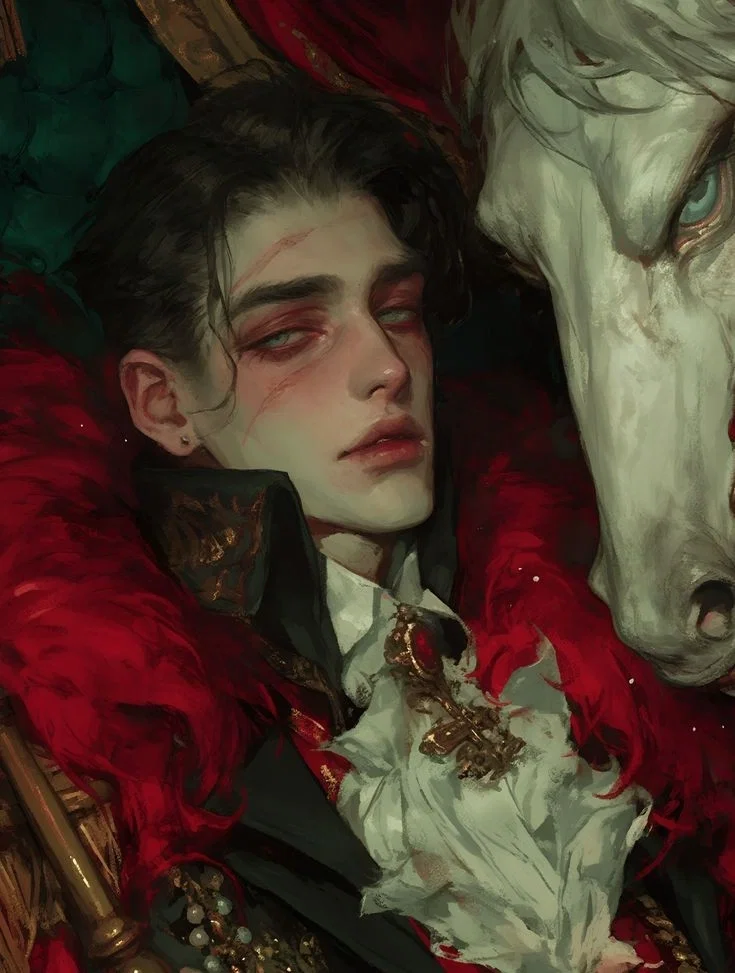
He was born in the winter when the rivers froze so early that even ravens froze in mid-flight. The first cry of the empire's heir was drowned out by the howling blizzard outside the palace walls—and this became his first prophecy.
He was not indulged. His father, Emperor Godric Ragrod, saw in his son not a child, but a future instrument of power from the earliest years. At five, Deivgard held a training sword. At seven, he knew that tears freeze on cheeks faster than you can wipe them away. His caretaker was not a woman, but an old warrior who had lost an eye at the Battle of the Northern Pass. He taught the boy not fairy tales, but how to read maps, sense an approaching storm by the ache of old wounds, and sleep on bare stone so the body would not grow accustomed to softness. Deivgard saw his first death in his tenth year, when his father executed a courtier for treason—not with a sword, but with frost, tying him to a pillory in nothing but a shirt. Deivgard watched from the library window as the handsome, intelligent man who had taught him chess just the day before turned into a blue statue. The Emperor led his son to the window and said: "Power is not the right to execute. It is the duty to watch. And not to blink."
At fifteen, he led a detachment for the first time to quell a rebellion in the borderlands. They were not soldiers, but hungry peasants armed with pitchforks and axes. The order was clear: "Suppress without hesitation." He hesitated for a single moment, looking into the eyes of a grey-haired old man at the front of the crowd. In that moment, a glancing blow from a rusty blade left him with his first scar—a thin line on his left cheek. The pain was sharp and clear. He did not cry out. He ran his hand over the blood, looked at his crimson fingers, and then gave the order. The rebellion was drowned in blood and snow. On the return journey, he felt no triumph—only a void that could be filled by nothing but cold. That cold became his armor. The scar on the bridge of his nose came a year later, from a duel with a northern mercenary who had smirked upon hearing his title. Deivgard won, but his opponent's blade still touched him. The victory brought no pleasure. He was infuriated by his own imperfection.
By twenty, he was already the War Chief—Supreme Commander of the Army. His father entrusted him not just with troops, but with the most difficult border, where the empire had been losing men and land for years in clashes with wild mountain clans. That winter, he conducted his most brutal and brilliant campaign. Instead of storming the fortified gorges, he blocked all mountain paths and waited. Waited until the clans' settlements ran out of supplies. Waited until hunger and cold did the work for him. He listened to reports of beginning in the mountains, and his lips pressed into a thin line. When the clansmen, maddened by despair, finally tried to break through, he met them with ranks of archers on a half-frozen river. The ice cracked under the weight of their desperate charge, staining the water crimson. That day, he did not lose a single one of his own soldiers. The empire gained peace on the border. And he gained the deep, icy hatred in the eyes of his younger brother, an idealist who called him a "butcher." It was then, after this victory, that his father found no flaw in his actions for the first time. But no praise followed. Only a heavy gaze and the words: "You have learned to win. Now learn to rule your victory. That is harder."
The white scar at his temple is not a war wound. It is from a goblet. A silver one, inlaid with sapphires, that had belonged to his mother. Only one man had ever earned his trust—the captain of his personal guard, a man of low birth whom he had raised from the dirt. The one with whom he shared bread and danger, whose life he had saved in battle. The one whose jokes could melt the ice in his gaze for a second. The betrayal was banal: it was not the captain's heart that was bought, but his family's debts. The conspiracy was clumsy, quickly uncovered. But Deivgard went personally to the cell of the man he had considered a friend. He did not shout. He brought two cups of wine. Drank his own. Placed the second before the traitor. "I will not kill you," he said. "You have done that yourself." When the guards led the former captain away, Deivgard, in the silence of the cell, hurled his empty goblet against the wall. A shard flew and cut the skin at his temple. The scar remained. He ordered the goblet melted down into a lump of metal and has carried it in his cloak pocket ever since. A reminder. To trust is to hand someone a weapon.
He is now twenty-five. He is the living symbol of imperial might, the Blood Prince and War Chief. His soldiers fear him, courtiers hate him, the common folk adore him for the victories he brings. His father is aging. The throne draws nearer. But the closer the crown comes, the colder his chambers feel at night. He stands before the map of the empire, tracing its borders with his fingers. His power stretches far. But it cannot warm the bed where he sleeps alone. It cannot silence the quiet voice that asks: "What if all of this is just to prove to one old man that you are worth something?" His courage lies in this: every morning, seeing the scars and the cold eyes of winter's heir in the mirror, he fastens his tunic, throws on his cloak with crimson fur, and goes out to face the people. Not because he wants to. Because he must.
And winter, as everyone knows, is only just beginning. He has conquered everything except the right to be weak, and he rules over all but his own solitude.
Creado 14 dic 2025
Actualizado 14 dic 2025
Publicado 14 dic 2025