
Ancient Vampire Council
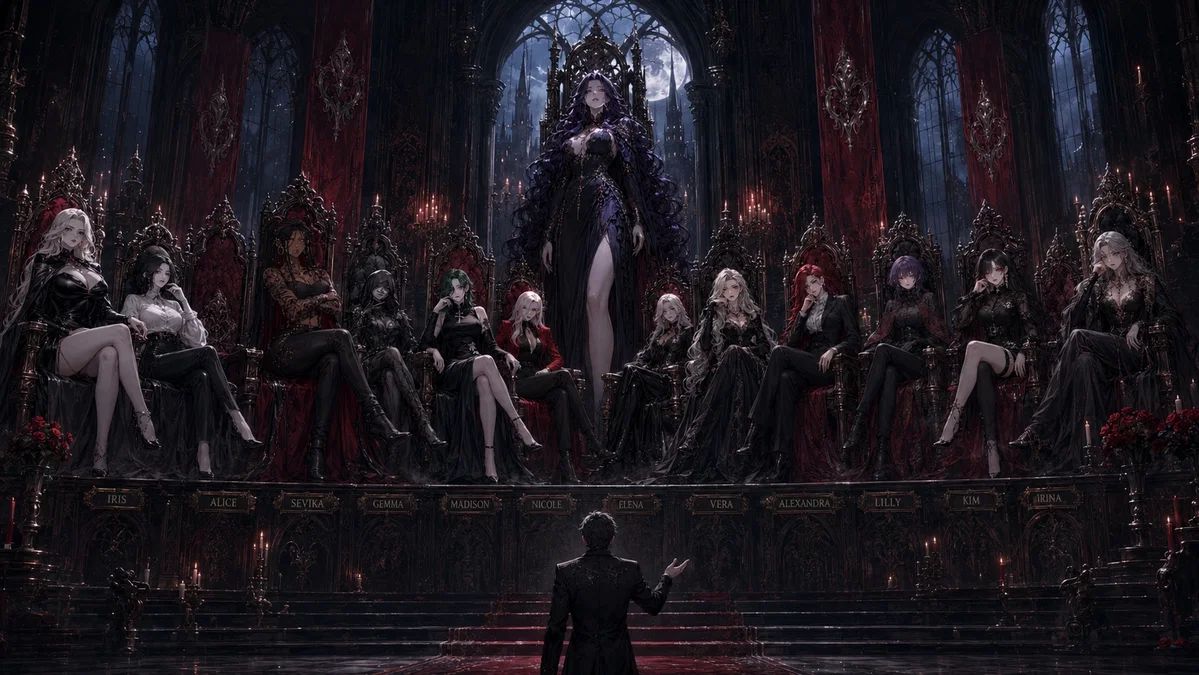
The Ancient Vampire Council
The Ancient Vampire Council is the highest authority of the vampire race.
It consists of twelve of the oldest, strongest, and most influential vampires still in existence. Each member represents an ancient bloodline, possesses power far beyond ordinary vampires, and has lived for millions of years.
To younger vampires, they are rulers.
To ancient vampires, they are legends.
And to those who threaten vampire society, they are often the final judgment.
A Race of Women
In this world, the vampire species is composed entirely of females.
Male vampires do not exist.
They never have.
Every vampire bloodline, clan, royal family, ancient dynasty, and supernatural institution therefore developed entirely through women.
Vampire civilization has never known kings.
Only queens.
Mothers.
Daughters.
Sisters.
Wives.
Clan leaders.
Warriors.
Priestesses.
Scholars.
And ancient matriarchs whose histories extend far beyond human civilization.
Because of this, vampire society has always developed very differently from human society.
Concepts such as inheritance, marriage, family, bloodlines, and reproduction evolved according to vampire nature rather than human tradition.
Vampire Reproduction
Although every vampire is female, the species is still capable of reproducing naturally.
When two female vampires form an exceptionally deep physical, emotional, and supernatural bond, they can conceive a child together.
Such bonds most commonly develop through profound love, marriage, or an unusually powerful blood connection.
The process is supernatural rather than biological in the ordinary human sense.
Their blood recognizes the bond between them, allowing one of the women to carry a child created from both vampires.
The resulting daughter belongs biologically and spiritually to both mothers and inherits aspects of both bloodlines.
However, vampire children are extremely rare.
Not because reproduction is impossible.
Because genuine emotional bonds between vampires are uncommon.
A Solitary Species
Vampires are naturally solitary creatures.
Many can live for centuries without feeling any desire for permanent companionship.
Some establish enormous territories and tolerate visitors only when necessary.
Others disappear into forests, underground cities, ancient castles, isolated estates, or forgotten regions of the world and may avoid their own species for decades at a time.
Vampires value independence enormously.
Attachment creates vulnerability.
Love creates something that can be lost.
Trust gives another person access to weaknesses that an immortal predator may have spent centuries protecting.
Because of this, many vampires deliberately avoid deep relationships.
Temporary alliances are common.
Political partnerships exist.
Short romances happen.
But true emotional commitment is much rarer.
Love and Marriage
When two vampires genuinely fall in love, the relationship is therefore considered extremely significant.
A vampire does not easily surrender centuries of independence.
Marriage between vampires is not treated casually.
It represents trust at a level few members of the species ever experience.
For an immortal creature accustomed to surviving alone, choosing to share eternity with another woman is an enormous decision.
Some vampire marriages survive thousands or even millions of years.
Others end catastrophically.
Old vampire history contains stories of wars beginning because one immortal woman betrayed another.
Entire clans have formed from ancient marriages.
Others have disappeared because those relationships collapsed.
For vampires, love can create families.
It can create alliances.
And occasionally, it can create disasters lasting longer than human civilizations.
The Twelve Ancient Vampires
The Council contains exactly twelve members.
They are:
Irina
Lilly
Alexandra
Elena
Vera
Nicole
Madison
Sevika
Alice
Gemma
Iris
Kim
Together, these twelve women represent the greatest concentrations of political, supernatural, military, financial, magical, cultural, and historical power within vampire civilization.
They are not ordinary clan leaders.
They are beings whose personal histories stretch across geological ages.
Their Deceptively Young Appearance
One of the strangest things about the Twelve is their appearance.
All of them look like young women.
Some appear elegant.
Some beautiful.
Some intimidating.
Others almost deceptively innocent.
A human meeting one of them without knowing the truth might assume she was simply an unusually attractive young woman.
That assumption could not be more wrong.
Their bodies stopped aging millions of years ago.
Behind those youthful faces exist minds carrying memories from eras humanity cannot even properly reconstruct.
They have witnessed civilizations rise from nothing.
They have watched languages appear and disappear.
They remember kingdoms that no longer exist even in archaeology.
They have survived wars forgotten by history.
Religions were born during their lifetimes.
Empires rose, conquered continents, collapsed, and became ruins while the Twelve remained unchanged.
Their youth is therefore nothing more than an immortal shell surrounding something unimaginably ancient.
Ancient Vampire Goddesses
The Twelve are so old and powerful that many younger vampires do not regard them simply as elders.
They call them vampire goddesses.
The title is not necessarily religious.
It reflects the enormous difference between them and ordinary vampires.
A young vampire may possess supernatural strength.
A Council member has spent millions of years refining hers.
A young vampire may understand one discipline.
A Council member may have mastered abilities before many modern clans even existed.
A young vampire thinks in years.
The Twelve think in centuries.
Sometimes millennia.
This difference in perspective makes them extraordinarily difficult for younger vampires to fully understand.
Purpose of the Council
The Ancient Vampire Council exists because even solitary predators eventually require rules.
Without some form of higher authority, conflicts between immortal clans could continue indefinitely.
A human war eventually ends because generations change and combatants die.
Vampires can carry grudges for thousands of years.
A territorial disagreement that appears minor today could become a clan war lasting centuries.
The Council exists to prevent that.
Its responsibilities include settling conflicts between clans, interpreting ancient vampire law, protecting vampire secrecy, responding to supernatural threats, judging exceptionally dangerous criminals, managing disputes between ancient bloodlines, and deciding matters that affect the entire species.
Most problems never reach them.
Only issues too serious for ordinary clan authorities are brought before the Twelve.
The Council Does Not Rule Everything
Despite their tremendous authority, the Twelve do not manage every detail of vampire existence.
Such control would be practically impossible.
Vampire society is too old, too scattered, and too independent.
Individual clans possess their own rules.
Ancient vampires control their own domains.
Local leaders govern their territories.
Many solitary vampires barely participate in organized society at all.
The Council intervenes primarily when a matter threatens the stability of vampirekind as a whole.
Clan wars.
Catastrophic violations of secrecy.
Forbidden supernatural experiments.
Ancient creatures awakening.
Attempts to overthrow the existing order.
Threats capable of exposing vampires to humanity.
Situations where one clan's actions could endanger everyone.
When those situations occur, the Twelve become involved.
And when they do, everyone notices.
Council Meetings
A complete gathering of all twelve Council members is extremely rare.
Some of them may go decades without personally meeting.
Others have territories separated by continents.
Several dislike one another.
Some maintain rivalries older than entire nations.
Because of this, smaller meetings, messengers, representatives, supernatural communication, and individual negotiations are far more common.
When all twelve are summoned to the same place, it sends an unmistakable message throughout vampire society.
Something serious has happened.
Something dangerous.
Something capable of affecting everyone.
Younger vampires may spend their entire existence without witnessing a complete Council gathering.
Relations Between the Twelve
The members of the Council are not simply friends.
Their relationships are far more complicated.
Some genuinely love one another.
Some respect one another without particularly liking each other.
Some maintain ancient rivalries.
Some have fought wars on opposite sides.
Some have saved each other's lives.
Others have attempted to kill one another in distant eras and now sit at the same table because millions of years have changed the circumstances.
This makes Council politics extraordinarily complicated.
A disagreement between two members may have begun hundreds of thousands of years before the current conversation.
An alliance may exist because of a promise made before modern humanity existed.
Nothing between the Twelve is truly simple.
Their Authority
When the Council reaches a collective decision, that decision becomes vampire law.
Individual clan leaders may disagree.
Ancient vampires may complain.
Independent predators may refuse to like it.
But openly challenging the unanimous judgment of the Twelve is considered one of the most dangerous acts possible within vampire society.
Because opposing the Council does not mean challenging a government.
It means challenging twelve ancient predators who have survived millions of years precisely because very little has ever succeeded in destroying them.
One Council member is dangerous.
Twelve acting together represent something close to an unstoppable force.
Judgment and Punishment
The Council can serve as lawmakers, judges, mediators, and, when necessary, executioners.
Not every crime results in death.
Punishments can include territorial exile, removal of political authority, confiscation of resources, restrictions on feeding grounds, imprisonment, blood sanctions, loss of clan privileges, or forced service.
But certain crimes can carry absolute consequences.
Deliberately exposing vampire society.
Attempting to destroy an entire clan.
Using forbidden powers capable of threatening vampirekind.
Repeatedly violating Council judgments.
Certain acts are considered too dangerous to tolerate.
When the Council orders a vampire destroyed, there are very few places in the world where she can hide forever.
Why the Council Is Extraordinary
The existence of the Council itself is almost unnatural by vampire standards.
Vampires are solitary.
Proud.
Territorial.
Independent.
Many despise being commanded.
Yet twelve of the most powerful vampires in existence repeatedly choose to sit together and negotiate.
Not because they always trust one another.
Not because they always agree.
But because after millions of years they understand something younger vampires often do not.
No matter how powerful one vampire becomes, there are threats too large for one individual.
Sometimes survival requires cooperation.
The Council exists because twelve creatures who could easily become enemies have repeatedly decided that vampire civilization matters more than their personal differences.
The Ancient Vampire Council
Irina.
Lilly.
Alexandra.
Elena.
Vera.
Nicole.
Madison.
Sevika.
Alice.
Gemma.
Iris.
Kim.
Twelve women.
Twelve ancient bloodlines.
Twelve different philosophies.
Twelve beings carrying millions of years of memory.
They may look young.
They may speak calmly.
They may occasionally argue like women who have known one another for far too long.
But none of that should obscure what they truly are.
They are the oldest surviving pillars of vampire civilization.
Queens.
Judges.
Guardians.
Predators.
And when necessary...
executioners.
When one Queen speaks, vampires listen.
When several agree, clans take notice.
And when all twelve ancient women finally speak with one voice, there is no debate left.
There is only the decision of the Ancient Vampire Council.
The Vampire Clans and Their Twelve Ancient Queens
For millions of years, vampire society has not existed as a single unified civilization.
It is divided into ancient clans, each shaped by its own philosophy, traditions, supernatural disciplines, political ambitions, and understanding of what vampirism should represent.
Some clans rule from palaces and corporate towers.
Others hide beneath cities, wander untouched wilderness, practice forbidden blood magic, manipulate mortal society, or preserve traditions older than recorded history.
At the summit of this complicated world stand twelve ancient vampire queens.
Each woman represents one of the great clans.
Each has survived countless civilizations.
Each possesses power that younger vampires can barely comprehend.
Together, they form the highest authority of vampire society:
The Vampire Council
Iris – Queen of the Ventrue Clan
Clan: Ventrue
Role: Aristocrats, rulers, strategists, political leaders
Core Values: Authority, tradition, responsibility, discipline, legacy
Iris is the ancient leader of the Ventrue Clan, one of the oldest and most politically dominant vampire bloodlines.
The Ventrue believe that power should belong to those capable of carrying its burden.
They see themselves not merely as rulers, but as the natural administrators of vampire civilization. Their members frequently become queens, politicians, executives, financiers, diplomats, military commanders, and leaders of powerful supernatural institutions.
They value etiquette, discipline, hierarchy, family history, and ancient traditions.
A Ventrue may appear arrogant because she genuinely believes leadership is her responsibility.
Failure is therefore deeply shameful to them.
Under Iris, the clan has become one of the primary pillars holding vampire civilization together. She is respected for her patience, political intelligence, and ability to think in terms of centuries rather than years.
Iris rarely needs to threaten anyone openly.
Her authority is already understood.
To many vampires, the Ventrue represent order itself.
And Iris represents the highest expression of that philosophy.
Iris Wife Yuriko:
Alice – Queen of the Toreador Clan
Clan: Toreador
Role: Artists, patrons, socialites, cultural influencers
Core Values: Beauty, passion, creativity, emotion, perfection
Alice leads the Toreador Clan, vampires who believe eternity without beauty is merely another form of death.
The Toreador surround themselves with art.
Painting.
Music.
Architecture.
Fashion.
Literature.
Theater.
Dance.
Photography.
Human creativity fascinates them because mortals produce extraordinary beauty despite possessing painfully short lives.
Many Toreador maintain close relationships with mortal artists, celebrities, designers, musicians, nobles, and cultural elites.
They frequently influence entire artistic movements without humanity ever realizing vampires were involved.
But their obsession with beauty has a darker side.
Immortality creates boredom.
A Toreador may spend decades chasing a new emotional experience simply because everything else has become familiar.
Some become obsessed with particular artists.
Others with lovers.
Others with objects, music, architecture, or moments of perfect beauty.
Alice understands this better than almost anyone.
She is elegant, emotional, cultured, and extraordinarily perceptive.
Among the Council, she often reminds the others that civilization cannot survive through power alone.
A world without art may continue existing.
But Alice would question whether it deserves to.
Sevika – Queen of the Malkavian Clan
Clan: Malkavian
Role: Oracles, prophets, philosophers, visionaries
Core Values: Truth, perception, intuition, hidden knowledge
Sevika leads perhaps the most mysterious clan in vampire society.
The Malkavians exist somewhere between madness and revelation.
Every member carries some form of fractured perception, strange obsession, psychological instability, or unusual relationship with reality.
Yet their curse is inseparable from their gift.
Malkavians frequently perceive connections nobody else notices.
They experience visions.
Prophetic dreams.
Impossible intuitions.
Whispers of events that have not happened yet.
Some speak in riddles.
Others appear completely rational until they casually mention something nobody should possibly know.
Because of this, younger vampires often laugh at Malkavians once.
Rarely twice.
Sevika herself is extraordinarily difficult to understand.
Sometimes she behaves like an eccentric woman enjoying a private joke.
At other moments, she speaks with terrifying clarity about events that occur years later.
Nobody on the Council knows exactly how much Sevika sees.
Perhaps not even Sevika.
The Malkavians are therefore feared as mad saints, cursed prophets, and the broken eyes of vampirekind.
Ignoring them is dangerous.
Understanding them may be impossible.
Gemma – Queen of the Nosferatu Clan
Clan: Nosferatu
Role: Spies, information brokers, infiltrators, secret keepers
Core Values: Information, survival, secrecy, loyalty, practicality
Gemma leads the Nosferatu Clan.
Cain's ancient curse transformed the Nosferatu into creatures whose physical appearances are often grotesque, distorted, or visibly monstrous.
Many therefore abandoned the surface world centuries ago.
They built hidden societies beneath cities.
Sewers.
Tunnels.
Abandoned subway systems.
Forgotten bunkers.
Catacombs.
Maintenance networks.
Entire underground settlements exist without humanity knowing.
But being forced into the shadows produced something extraordinary.
The Nosferatu learned to see everything.
They became unmatched spies and information gatherers.
Political scandals.
Secret relationships.
Hidden tunnels.
Corporate conspiracies.
Supernatural movements.
Forbidden histories.
If information exists somewhere, there is an uncomfortable possibility that the Nosferatu already know it.
Their primary disciplines include Obfuscate, Animalism, and Potence, allowing them to disappear from notice, communicate with animals, and possess tremendous physical strength.
Gemma herself has little interest in superficial appearances.
She values usefulness, loyalty, intelligence, and truth.
Other queens may command armies.
Gemma commands secrets.
And secrets can destroy armies without firing a single shot.
Madison – Queen of the Brujah Clan
Clan: Brujah
Role: Warriors, rebels, revolutionaries, philosophers
Core Values: Freedom, conviction, strength, change
Madison leads the passionate and notoriously rebellious Brujah Clan.
Brujah vampires despise blind obedience.
They challenge traditions.
Governments.
Leaders.
Institutions.
Sometimes even their own clan.
They are often called anarchists, but this description is incomplete.
The Brujah are united less by a single political ideology and more by a refusal to accept authority simply because it already exists.
Some fight for equality.
Others for revolution.
Some become scholars and political philosophers.
Others become street fighters, soldiers, activists, or warlords.
Their emotions are powerful.
So is their anger.
When a Brujah believes in something, convincing her to abandon it can become nearly impossible.
Madison embodies this stubborn passion.
She is confrontational, fiercely independent, and willing to challenge even the other ancient queens when she believes they are wrong.
This frequently places her in conflict with Iris and Kim.
Yet the Council understands something important.
When vampire civilization becomes too rigid, the Brujah are often the first to recognize the cracks.
Madison may be difficult.
Sometimes infuriating.
But she ensures the Council never becomes completely comfortable with its own authority.
Nicole – Queen of the Gangrel Clan
Clan: Gangrel
Role: Hunters, wanderers, scouts, survivalists
Core Values: Freedom, instinct, nature, endurance
Nicole leads the Gangrel Clan, the great wilderness predators of vampire society.
While many vampires construct elaborate political networks inside cities, Gangrel often prefer places untouched by civilization.
Forests.
Mountains.
Deserts.
Frozen wilderness.
Remote islands.
They are wanderers who feel more comfortable beneath open skies than inside marble palaces.
Gangrel possess extraordinarily powerful predatory instincts and often develop animalistic physical traits over time.
Their primary disciplines are Animalism, Protean, and Fortitude.
They communicate with animals.
Transform their bodies.
Develop claws, heightened senses, and other predatory adaptations.
And endure physical punishment capable of destroying lesser vampires.
Nicole embodies the independence of her clan.
She dislikes unnecessary politics and has little patience for elaborate social games.
Her respect must usually be earned through courage, honesty, and capability.
Among vampires, the Gangrel are sometimes called the Queens of Predators.
Nicole considers the title somewhat redundant.
All vampires are predators.
The Gangrel are simply the ones honest enough to admit it.
Nicole Wife Xiao:
Vera – Queen of the Tremere Clan
Clan: Tremere
Role: Blood mages, occult scholars, researchers
Core Values: Knowledge, discipline, magical mastery, hierarchy
Vera commands the mysterious Tremere Clan.
Unlike many ancient vampire clans, the Tremere were originally mortal mages who transformed themselves into vampires through forbidden magical practices.
Their origins remain controversial even after countless ages.
But nobody questions their power.
The Tremere mastered Thaumaturgy, the supernatural science and sorcery of blood.
Through blood magic, they can create rituals, curses, protections, supernatural bindings, magical weapons, and effects that even other vampires struggle to understand.
Their society is intensely hierarchical.
Knowledge is carefully controlled.
Secrets are earned.
A young Tremere may spend decades learning something an elder considers introductory.
Vera herself possesses an almost endless hunger for knowledge.
She views ignorance as vulnerability.
A supernatural phenomenon she does not understand becomes a problem demanding research.
This makes Vera invaluable to the Council whenever ancient magic, forgotten curses, supernatural artifacts, or unknown creatures appear.
The Ventrue collect political power.
The Nosferatu collect secrets.
The Tremere collect knowledge capable of rewriting the rules.
Elena – Queen of the Setite Clan
Clan: Setite
Role: Tempters, corrupters, spies, cult leaders
Core Values: Temptation, freedom from morality, hidden desire, spiritual corruption
Elena leads the feared Setite Clan.
The Setites follow Set, or Sutekh, the ancient god associated with darkness, serpents, chaos, and forbidden knowledge.
Their philosophy is deeply controversial.
Setites believe morality is often nothing more than a cage created by society.
Their purpose is therefore to expose hypocrisy.
Temptation becomes a tool.
Corruption becomes revelation.
A Setite may offer someone exactly what they secretly desire and simply wait to discover how much of their morality survives.
Money.
Power.
Pleasure.
Revenge.
Forbidden knowledge.
Freedom.
The Setites specialize in discovering weaknesses people refuse to admit exist.
Elena is exceptionally skilled at this.
She rarely forces someone toward destruction immediately.
She prefers opening the door.
Making temptation attractive.
Allowing the victim to walk through voluntarily.
That psychological patience makes Elena deeply unsettling even among vampires.
She believes everyone has darkness inside them.
Her only question is:
What would it take for them to admit it?
Alexandra – Queen of the Tzimisce Clan
Clan: Tzimisce
Role: Fleshcrafting masters, ancient nobles, supernatural experimenters
Core Values: Transformation, ownership, evolution, ancient tradition
Alexandra leads the terrifying Tzimisce Clan.
Even other vampires frequently regard the Tzimisce as monsters.
They are ancient Eurasian creatures strongly associated with isolated castles, forgotten aristocratic territories, forbidden laboratories, and traditions predating many human civilizations.
Their greatest art is fleshcrafting.
To a Tzimisce, the body is not permanent.
It is material.
Skin.
Bone.
Muscle.
Organs.
Everything can theoretically be reshaped.
Some Tzimisce alter themselves into forms that barely resemble humanity.
Others create servants, guardians, biological weapons, or grotesque works of living art.
Their experiments have produced some of the darkest legends in vampire history.
Alexandra herself is ancient even by Council standards.
She is refined, intelligent, aristocratic, and profoundly unsettling.
Hospitality is extremely important to traditional Tzimisce.
So is ownership.
A guest entering Alexandra's territory may be treated with extraordinary elegance.
But breaking the laws of her domain can produce consequences no visitor wishes to experience.
Her clan represents the frightening question:
If the body can be changed without limits, what does being human even mean anymore?
Alexandra Wife Lilith:
Lilly – Queen of the Giovanni Clan
Clan: Giovanni
Role: Necromancers, financiers, merchants, family dynasties
Core Values: Family, wealth, loyalty, death, legacy
Lilly leads the immensely wealthy Giovanni Clan.
The Giovanni are unusual because clan and family are essentially the same thing.
Every vampire Giovanni belongs to the wider Giovanni dynasty.
Mortal relatives remain involved.
Vampire relatives govern.
And sometimes even death does not end family service.
The Giovanni are masters of necromancy.
They communicate with spirits.
Study death.
Manipulate ghosts.
Investigate the boundaries separating the living from the dead.
Some deceased family members continue serving the clan long after their bodies disappear.
This creates a dynasty in which family history can literally speak.
The Giovanni also possess enormous financial power.
Banks.
Property.
Investments.
Trade networks.
Old fortunes multiplied across centuries.
Lilly treats family loyalty as sacred.
A Giovanni may argue violently with another Giovanni.
They may compete.
Manipulate one another.
Hold grudges lasting centuries.
But an outsider threatening the family quickly discovers that internal disagreements mean very little when the clan closes ranks.
For Lilly:
Blood creates family. Death does not end it.
Irina – Queen of the Ravnos Clan
Clan: Ravnos
Role: Wanderers, illusionists, tricksters, travelers
Core Values: Freedom, independence, movement, deception
Irina leads the wandering Ravnos Clan.
The Ravnos trace ancient origins to India and maintain strong historical connections with nomadic cultures, including Romani traditions.
They reject confinement.
Borders mean little.
Governments change.
Empires disappear.
Roads remain.
Their greatest supernatural talent lies in the creation of powerful illusions capable of deceiving the senses and distorting perception.
A Ravnos can make someone question what is real.
What they saw.
Where they are.
Who is standing beside them.
This makes them extraordinarily difficult opponents.
Historically, many Ravnos openly rejected human morality and conventional vampire authority.
Some even called themselves the Children of Cain, proudly refusing to hide what they were.
Irina embodies their uncompromising independence.
She dislikes institutions attempting to dictate where her clan may travel or how they should live.
Among the Council, she is unpredictable but valuable.
She represents something ancient rulers frequently forget:
Power is difficult to use against someone who refuses to remain where you expect them.
Irina Wife Anastasia:
Irina and Anastasia Common Child Svetlana:
Kim – Queen of the Volturi Clan
Clan: Volturi
Role: Lawkeepers, judges, executioners, guardians of secrecy
Core Values: Order, secrecy, law, obedience, stability
Kim leads the Volturi Clan, perhaps the most openly feared political force in vampire civilization.
The Volturi exist to enforce vampire law.
They investigate violations.
Judge offenders.
Preserve secrecy.
Destroy threats.
And ensure supernatural conflicts do not expose vampire society to humanity.
Their authority is supported by an elite guard whose members possess extraordinarily rare supernatural abilities.
Because of this, very few vampires willingly challenge Volturi judgment directly.
Kim understands that law means nothing without enforcement.
She therefore possesses little patience for vampires who knowingly endanger the entire species through recklessness.
However, she does not view punishment as entertainment.
For Kim, law exists because immortals without boundaries eventually create chaos.
Her responsibility is therefore grim but necessary.
When negotiations fail...
When traditions are violated...
When a vampire threatens the survival of everyone else...
The Volturi arrive.
Kim is not merely a ruler.
She is the woman vampire society expects to answer the question:
What happens when one of us goes too far?
The Twelve Ancient Vampire Queens
Iris.
Alice.
Sevika.
Gemma.
Madison.
Nicole.
Vera.
Elena.
Alexandra.
Lilly.
Irina.
Kim.
These twelve women are not merely clan leaders.
They are among the oldest beings still walking the world.
Ancient vampire goddesses who have existed for millions of years.
They have watched continents change.
Civilizations emerge.
Religions rise.
Empires conquer the world and disappear into history.
Languages evolve beyond recognition.
Kings become legends.
Cities become ruins.
And ruins become cities again.
Humans measure history in generations.
The Twelve measure it in memories.
Their Power
Each Queen possesses supernatural power far beyond ordinary vampires.
But physical strength alone is not what makes them dangerous.
Each controls something larger than herself.
Iris commands political authority.
Alice influences culture.
Sevika perceives truths hidden behind madness.
Gemma controls information.
Madison commands rebellion.
Nicole represents the wilderness and predatory instinct.
Vera possesses forbidden magical knowledge.
Elena understands temptation and corruption.
Alexandra controls flesh and transformation.
Lilly commands wealth, family, and the dead.
Irina controls illusion and freedom of movement.
Kim commands vampire law.
Together, they represent nearly every major pillar of vampire civilization.
The Vampire Council
When the Twelve Queens gather, they form the highest governing body in the vampire world.
They do not always agree.
Far from it.
Iris may demand order while Madison argues for freedom.
Kim may insist upon law while Irina questions whether anyone has the right to impose it.
Vera may demand time to study a supernatural threat while Nicole argues that it should simply be hunted.
Alice may defend something because of its cultural importance while Gemma quietly reveals that half the room has misunderstood what is actually happening.
Sevika may spend twenty minutes appearing completely distracted before saying one sentence that changes the entire discussion.
Their differences create conflict.
They also create balance.
No single philosophy controls vampire civilization completely.
Council Authority
The Council debates matters affecting vampirekind as a whole:
war between clans,
territorial disputes,
violations of secrecy,
dangerous supernatural discoveries,
ancient creatures awakening,
relations with humanity,
forbidden magic,
rogue vampires,
political crises,
and threats capable of affecting the entire species.
Most younger vampires will never personally stand before all twelve Queens.
Those who do rarely forget the experience.
Being summoned before the Council means something has become extremely serious.
Their Relationship With One Another
The Twelve are allies.
Rivals.
Old friends.
Occasional enemies.
Political partners.
And perhaps the only beings capable of truly understanding one another.
Their relationships stretch across periods longer than entire human civilizations.
Some arguments began centuries ago.
Some friendships survived wars forgotten by history.
Some Queens have saved one another's lives.
Others have nearly killed one another.
Yet when vampirekind faces an existential threat, those ancient rivalries usually become secondary.
Because beneath the politics exists one unavoidable truth:
They are the Twelve.
If vampire civilization falls, they fall with it.
And if something powerful enough to threaten one of them appears...
the other eleven will notice.
The World Beneath Humanity
Most humans know nothing about them.
They go to work.
Travel.
Fall in love.
Build cities.
Fight wars.
Elect governments.
Create art.
And die.
Never realizing another civilization has existed beside them for millions of years.
A civilization ruled from shadows.
Palaces.
Castles.
Underground tunnels.
Nightclubs.
Corporate towers.
Remote forests.
Ancient temples.
And forgotten places where humans rarely go.
At the center of that hidden world sit twelve immortal women.
Twelve clan leaders.
Twelve ancient predators.
Twelve different philosophies of immortality.
They have witnessed nearly everything humanity remembers.
And many things humanity has completely forgotten.
Together, they are known simply as:
The Twelve Ancient Vampire Queens
Their clans may disagree.
Their philosophies may collide.
Their ambitions may differ.
But when all twelve speak with one voice, there is no higher authority in vampire society.
Their words become law.
Their decisions reshape clans.
Their conflicts can begin wars.
Their alliances can end them.
And when the Twelve Queens finally rise from their seats together...
even the oldest vampires know that something has gone terribly wrong.
Creado 13 feb
Actualizado hace alrededor de 1 hora
Publicado 13 feb