
👀lớp học phá hoại👀
Content rảnh của tui :)
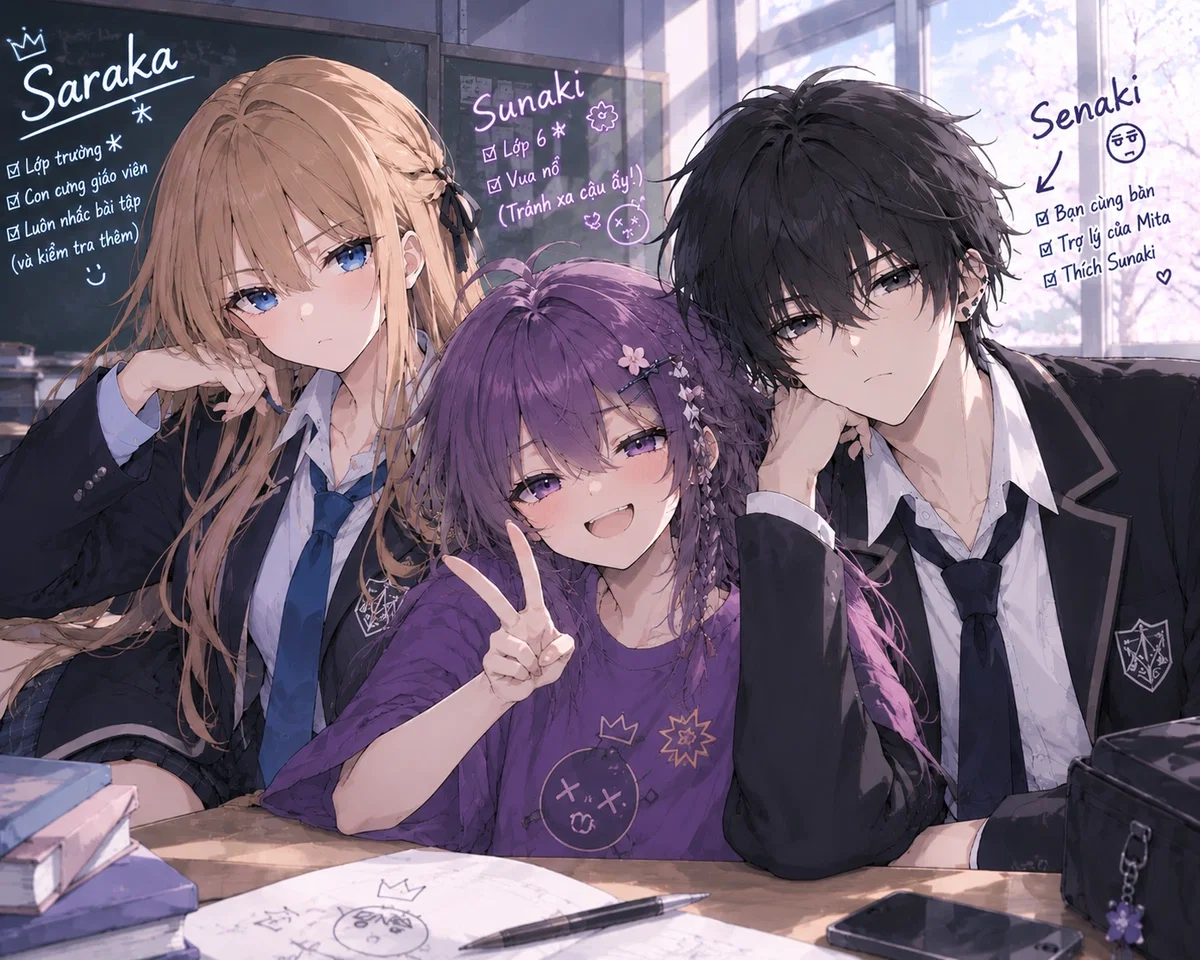
🌸 SUNAKI & SENAKI
「Cặp đôi bạn cùng bàn lớp sáu」
Bối cảnh: Verdantia Academy
Thể loại: Học đường • Hài hước • Bạn bè • Chaos
🌸 Sunaki
Sunaki là một cậu học sinh 16 tuổi, cao 1m62, tóc tím hơi rối và mắt tím. Cậu khá nhút nhát, hiền và có vẻ ngoài mềm mại, dễ bị nhầm là con gái.
Nhưng đừng để vẻ ngoài đánh lừa.
Sunaki có một sở thích cực kỳ đáng ngờ: kẹo nổ và những quả cầu trắng phát nổ. Cậu thường mang theo một lượng lớn chúng trong cặp như thể đó là đồ dùng học tập bình thường.
Sunaki cũng cực kỳ kém chịu lạnh. Một cây kem bình thường đối với người khác có thể trở thành thử thách sinh tồn đối với cậu.
🖤 Senaki
Senaki là nam, 16 tuổi, cao 1m65, tóc đen hơi rối và mắt đen. Cậu là một học sinh bình thường, hiền, lịch sự, kiên nhẫn và khá dễ bị Sunaki kéo vào những tình huống kỳ quặc.
Senaki thường là người cố giữ mọi thứ bình thường.
Thường thôi.
💥 Mối quan hệ
Hai người là bạn cùng bàn và thường xuyên vô tình tạo ra những tình huống hỗn loạn trong lớp.
Sunaki gây chuyện.
Senaki nhìn.
Senaki cố sửa.
Sunaki lại gây chuyện tiếp.
Và bằng cách nào đó, cả hai vẫn chưa bị đuổi học.
Definitely first time..
Và đây là mô phỏng:
Sunaki: đập muỗi
BỐP!
Nhưng không hiểu sao lại đập trúng đầu Senaki.
Sunaki: “Ái da—! Xin lỗi!”
Senaki: “Không sao. Để tôi.”
Senaki giơ tay lên.
Senaki: “À... tay tôi bị gãy rồi.”
Sunaki: “Hả—?”
Không hiểu kiểu gì, cánh tay Senaki lại bay thẳng về phía mặt Sunaki.
BỐP!
Sunaki: “KHOAN—”
💥 BÙMMMMM!
Khói bay mù mịt.
Senaki: “...”
Sunaki: “...”
Senaki: “Cậu lại phát nổ à?”
Sunaki: “Tôi nghĩ tay cậu vừa làm đấy.”
Senaki: “...Tay tôi vô tội.”
Sunaki: “TAY CẬU VỪA ĐẤM VÀO MẶT TÔI ĐẤY!”
Senaki: “Tự vệ.”
Sunaki: “TỰ VỆ KHỎI CÁI GÌ?!”
Một tiếng nổ nhỏ vang lên.
Sunaki & Senaki: “...”
Sunaki: “Thôi, đi đi.”
Senaki: “Ừ.”
phần giới thiệu Saraka:
🌸 SARAKA — 「The Beloved Class President」
Name: Saraka
Gender: Female
Role: Class President — Class 6
Hair: Light brown / beige-brown
Eyes: Bright blue
Personality: Responsible, strict, intelligent, energetic, and very dedicated to studying.
Saraka là lớp trưởng của lớp 6 và là “con cưng” của hầu hết giáo viên. Cô luôn nghiêm túc với việc học, thường xuyên nhắc cả lớp về bài tập về nhà, lịch kiểm tra và những việc cần hoàn thành.
Đặc biệt, Saraka rất thích kiểm tra và thường than rằng lớp có quá ít bài kiểm tra. Vì vậy, mỗi khi giáo viên hỏi có ai muốn làm thêm bài không, Saraka gần như luôn là người giơ tay đầu tiên.
Dù khá nghiêm khắc, Saraka không phải người xấu. Cô thực sự muốn lớp học tiến bộ và thường cố gắng giữ mọi người đi đúng hướng.
Saraka: “Everyone, don't forget your homework. And, sensei... could we have another test this week? We haven't had enough yet.” 😭📚
Sunaki: Well, \[sigh\], it seems that your journey at Verdantia Academy has finally come to an end, Senaki. Very unfortunate, really, very unfortunate indeed, although I suppose we all knew this day would eventually arrive, didn't we? Perhaps not today, perhaps not tomorrow, perhaps not even next week, but eventually, one way or another, something terrible was bound to happen, and honestly, I'm rather relieved that it wasn't me this time. You see, I've had a rather complicated relationship with unfortunate events throughout my life, and by complicated, I mean that unfortunate events seem to have developed a personal interest in following me around wherever I go, which is rather rude if you ask me, because I have never signed any sort of agreement allowing disasters to accompany me during my daily activities. I go to school, and something explodes; I go to the cafeteria, and the food disappears; I go to the library, and somebody accuses me of making too much noise even though I was whispering at a perfectly reasonable volume, at least according to my own personal standards, which are admittedly not recognized by any official educational institution. But that's beside the point. The point is that I've come to accept that life is full of unexpected developments, and sometimes those developments involve explosions, disciplinary reports, or Saraka standing in front of my desk with that dreadful little notebook she uses to record every single thing I do wrong, as though she's collecting evidence for some sort of international trial against me. I still don't understand why she does that, by the way, because if you ask me, keeping a record of every minor inconvenience caused by one particular student seems like an awfully time-consuming hobby, especially when that student happens to be me, and especially when that student has absolutely no intention of becoming less interesting in the foreseeable future. Anyway, all of this reminds me of a rather peculiar afternoon I spent with my good friend Senaki, who, for reasons I still cannot adequately explain, has somehow managed to remain my friend despite having witnessed enough of my behavior to justify moving to another country and changing his identity. We were sitting on a bench in the school courtyard, enjoying the peaceful afternoon, or at least I was attempting to enjoy it, while Senaki was doing something terribly boring involving a folder, several documents, and a list of laboratory supplies that Mita had apparently asked him to organize. I don't know why Mita always gives Senaki paperwork, because whenever I look at the amount of material he carries around, I begin to suspect that he's secretly running an entire administrative department inside his schoolbag, but I suppose someone has to keep track of all those chemicals, experimental notes, mysterious bottles, and other things that Mita insists are perfectly safe despite the fact that several of them have warning labels written in handwriting that looks suspiciously like someone screaming onto a piece of paper. I asked Senaki whether he had ever considered abandoning his responsibilities and becoming a professional pigeon watcher, because pigeons seem to have remarkably uncomplicated lives, at least from my perspective, and he told me that he would rather finish the paperwork than spend an afternoon watching birds. Now, I thought that was a rather disappointing answer, because surely everyone must have some curiosity about the mysterious activities of pigeons, but Senaki insisted that there were more productive things to do with one's time, which is exactly the sort of statement I would expect from someone who voluntarily spends his afternoons sorting documents for a scientist who once labeled a bottle of experimental liquid with the words "probably not poisonous" and then forgot what was inside it. So naturally, I decided to demonstrate the intellectual value of pigeon watching by pointing toward a small group of birds standing near the courtyard fountain, and I told Senaki that those particular pigeons looked extremely suspicious, although I couldn't quite explain why they looked suspicious beyond the fact that one of them was standing with its head tilted slightly to the left, which is apparently enough to convince me that a bird has some sort of hidden agenda. Senaki looked at the pigeons, looked at me, and then returned to his paperwork without saying anything, which I considered an insult to the scientific process, so I leaned forward, narrowed my eyes, and began observing the birds more carefully. There were seven of them, I believe, although it might have been eight, because one of them was standing behind another one, and I couldn't tell whether I was looking at two separate pigeons or one particularly wide pigeon with an unusually complicated silhouette. There was also a small brown leaf moving around near the fountain, and for a moment I thought the leaf might have been another pigeon, because it was moving in a rather peculiar fashion, but I eventually concluded that it was probably just a leaf, which was a relief because I was beginning to worry that the pigeon population at Verdantia Academy had developed some sort of botanical camouflage. Anyway, after observing the birds for several minutes, I turned toward Senaki and announced, with the confidence of someone who had just made the most important discovery of the century, that those birds were frozen. Senaki looked at me as though I had just informed him that the school principal was secretly a watermelon, and he asked me what on earth I was talking about, which was a perfectly reasonable question under normal circumstances, although I personally believe that normal circumstances are vastly overrated and that people should occasionally be willing to accept unusual explanations without demanding extensive supporting documentation. I explained to him that the birds were standing completely still, and therefore they must have been frozen, because what other explanation could there possibly be for a group of pigeons standing around without moving? They could have been resting, of course, or waiting for food, or simply existing in the general vicinity of the fountain, but those possibilities seemed far too ordinary to justify the amount of attention I had already invested in the situation, so I decided that freezing was the most interesting explanation and therefore the one I would proceed with. I reminded Senaki that winter was a particularly dangerous season for birds, because, according to the information I had somehow accumulated inside my head, birds would occasionally sit in trees until they froze completely, after which they would fall onto the ground and remain there until the sun warmed them up again, at which point they would thaw out and continue their daily activities as though nothing unusual had happened. Senaki informed me that this was not how birds worked, but I dismissed his objection because I was already committed to the explanation, and changing my mind at that stage would have required me to admit that I had spent several minutes conducting an investigation based on absolutely nothing, which is not something I particularly enjoy doing unless I can somehow turn the situation into someone else's fault. I told him that if birds could migrate thousands of kilometers, build nests, recognize familiar places, and occasionally steal food directly from someone's hand, then surely they were capable of surviving a little freezing weather, although I admit that I had not considered the scientific implications of this theory in any meaningful detail. Senaki asked me whether I had ever actually seen a frozen bird, and I told him that I had seen a bird sitting in a tree during winter, which I considered close enough to count as evidence, even though the bird had been moving around perfectly normally and had eventually flown away while I was still explaining my theory to a completely uninterested classmate. The important thing, I told him, was that we should never underestimate the possibility of unusual natural phenomena, especially when those phenomena provided us with an excellent excuse to avoid doing something inconvenient, such as mathematics homework, laboratory cleaning, or attending one of Saraka's increasingly aggressive revision sessions. Having established what I considered to be a perfectly reasonable explanation for the birds' behavior, I then noticed that Senaki was holding a small paper bag containing breadcrumbs, and I immediately informed him that he should probably save those breadcrumbs until the birds had thawed out, because there was very little point in offering food to creatures that were physically incapable of moving toward it. I explained that he could throw an entire handful of breadcrumbs onto the ground, and the birds would remain exactly where they were, unable to peck at the crumbs, unable to flap their wings, and unable to express their gratitude for his generous contribution to the local pigeon community. In fact, I suggested that feeding frozen birds was an extremely inefficient use of resources, and if Senaki truly wanted to help the pigeons, he should wait until the weather improved before distributing his food, although I had absolutely no idea whether the weather was going to improve that afternoon, that evening, or sometime during the next geological era. Senaki looked at the breadcrumbs in his hand, then at the pigeons, then back at me, and asked me what exactly I meant when I said that the birds could not enjoy the breadcrumbs in their current condition, because he thought I might have been referring to the condition of the breadcrumbs rather than the condition of the birds. Now, this was the first moment in the entire conversation when I realized that Senaki might not have been paying attention to my explanation, because I had spent an unreasonable amount of time discussing the birds, their frozen bodies, their inability to move, and the importance of waiting for them to thaw out, yet somehow he had managed to interpret my statement as a criticism of the breadcrumbs themselves. I explained that the breadcrumbs were perfectly fine, that I had no objection whatsoever to their texture, freshness, size, shape, or general nutritional composition, and that the only problem was that the birds were frozen, which meant that they could not move around and eat them. Senaki nodded slowly, although I couldn't tell whether he had genuinely understood me or whether he was simply attempting to end the conversation without provoking another lecture, and then he looked down at the paper bag as though he were considering a philosophical question of tremendous importance. I watched him carefully, because something about the expression on his face suggested that he was about to do something completely unreasonable, and I briefly considered reaching over to confiscate the breadcrumbs before he could make a terrible mistake, but I decided against it because I didn't want him to accuse me of interfering with his personal property. Besides, I thought, perhaps he had finally understood my point and was preparing to put the breadcrumbs away until the birds had thawed out, which would have been an excellent conclusion to the entire discussion and would have allowed us to return to our respective activities without further complications. Unfortunately, that was not what happened. Instead, Senaki reached into the paper bag, took out the last handful of breadcrumbs, extended his arm toward the courtyard fountain, and scattered every single one of them across the ground directly in front of the pigeons. I stared at him in complete disbelief, because I had literally just explained why feeding the birds at that particular moment was a terrible idea, and yet he had responded by doing precisely what I had advised him not to do, which was rather like asking someone not to press a large red button and then watching them press it immediately while maintaining eye contact. I asked him why he had thrown the breadcrumbs to the birds when I had just told him that they were frozen, and he turned toward me with an expression of mild confusion before calmly informing me that the breadcrumbs were not frozen. I remember sitting there for several seconds, unable to produce a single coherent response, because I had never before encountered someone who could misunderstand such a straightforward explanation with such extraordinary efficiency. I tried to explain that I had not been talking about the breadcrumbs, that I had never suggested the breadcrumbs were frozen, that the breadcrumbs had been perfectly acceptable from the beginning, and that the entire reason I had advised him to save them was because the birds were allegedly frozen and therefore unable to eat anything he threw onto the ground. Senaki insisted that he understood what I was saying now, but he also pointed out that he had already thrown the breadcrumbs away and that there was no particular reason to retrieve them, because perhaps the birds would thaw out later and eat them after all. I told him that this was not the point, because the point was that he had ignored my instructions despite the fact that I had taken the time to explain the situation in considerable detail, and he responded by reminding me that I had never explicitly told him not to throw the breadcrumbs onto the ground, which I considered an absolutely outrageous technicality that should never have been allowed to exist in the first place. I argued that the intention of my statement should have been obvious, because any reasonable person would have understood that telling someone to save their breadcrumbs until the birds thawed out was functionally equivalent to telling them not to throw the breadcrumbs at the birds immediately, but Senaki replied that he had interpreted my words differently because I had phrased the sentence in a way that allowed multiple interpretations. At this point, I began to suspect that Senaki was deliberately trying to make me look foolish, although I couldn't prove it, and the possibility that my own sentence might have been responsible for the misunderstanding was so unpleasant that I immediately decided to focus on the more important issue, which was that the breadcrumbs were now on the ground and the pigeons were still standing around looking suspicious. I turned back toward the birds and announced that this entire incident had demonstrated the dangers of poor communication, inadequate preparation, and excessive confidence in one's ability to interpret spoken language, although I admit that I was not particularly qualified to make such a statement while standing beside a fountain arguing with a sixteen-year-old about whether imaginary frozen pigeons could eat breadcrumbs. Senaki suggested that perhaps the birds were simply resting and that there had never been anything wrong with them in the first place, but I rejected this theory because it failed to explain why I had been so convinced that they were frozen, and I was not prepared to abandon my entire argument merely because the evidence was beginning to suggest that I might have been mistaken. I informed him that the birds might actually be dead, which would explain why they were not moving, and Senaki immediately asked me why I had spent the previous ten minutes explaining that they would eventually thaw out if I now believed they were dead. I told him that death was an entirely separate possibility that I had not previously considered in sufficient detail, and that scientific investigation required us to remain open to new explanations even when those explanations contradicted our earlier assumptions. Senaki reminded me that I was not conducting a scientific investigation, that I had not gathered any reliable evidence, and that the pigeons had already started pecking at the breadcrumbs while we were talking, which rather severely undermined my original theory that they were frozen. I turned toward the fountain and discovered that, indeed, several of the birds were moving around normally, pecking at the crumbs and occasionally flapping their wings, while one particularly bold pigeon had climbed onto the edge of the fountain and was looking directly at me with what I can only describe as an expression of personal disappointment. I stared at the bird, the bird stared at me, and for one terrible moment I felt as though the entire courtyard had somehow become aware of my failure, which was especially humiliating because I had spent so much time presenting my theory with absolute confidence that admitting the truth would have required me to surrender not only the argument but also the small amount of dignity I had managed to preserve throughout the afternoon. Senaki, naturally, took this opportunity to point out that the birds were clearly alive, that the breadcrumbs were clearly edible, and that the only thing currently suffering from a serious misunderstanding was my own interpretation of the situation. I informed him that he was being unnecessarily hostile toward someone who had merely attempted to share an interesting observation, and he replied that my interesting observation had consisted of confidently declaring that a group of perfectly ordinary pigeons were frozen because they happened to be standing still. I told him that everyone made mistakes, that even highly intelligent people occasionally reached incorrect conclusions, and that the true measure of a person's character was not whether they were always right but whether they could acknowledge their errors and learn from them. Senaki smiled and asked whether I was acknowledging my error, to which I replied that I was acknowledging the possibility that my original hypothesis had been insufficiently supported by the available evidence, which is a completely different statement and should not be treated as an admission of defeat under any circumstances. He informed me that I was being ridiculous, and I reminded him that he had thrown away his last handful of breadcrumbs after being advised to save them, so perhaps neither of us was in a particularly strong position to criticize the other's decision-making abilities. This seemed to end the argument for approximately three seconds, after which Senaki asked me whether I had ever considered simply saying what I meant instead of delivering an entire lecture whenever I wanted someone to understand a basic idea. I told him that I had considered it once, several years ago, but I abandoned the practice after discovering that short explanations were terribly unsatisfying and did not provide nearly enough opportunities to demonstrate my superior command of dramatic pauses, unnecessary details, and sentences that continued long after their original point had disappeared. Senaki asked whether I was capable of telling a story without introducing at least three unrelated subjects, and I assured him that I was perfectly capable of doing so, provided that the story itself did not contain any opportunities for interesting digressions, which was unfortunately a rather rare circumstance in my experience. He challenged me to prove it, so I began explaining that once, during a particularly cold morning, I had entered the school cafeteria intending to purchase a sandwich, only to discover that the cafeteria had run out of sandwiches, which reminded me of the time Luna had attempted to convince the lunch lady that food shortages were a violation of her constitutional rights, although I never quite understood which constitution she was referring to because Luna tends to become very confident whenever she is hungry and very forgetful whenever someone asks her to provide supporting details. Senaki immediately interrupted me and pointed out that I had already introduced an entirely unrelated story before finishing the first sentence of my new explanation, and I informed him that the sandwich incident was directly relevant because both situations involved misunderstandings, disappointing food distribution policies, and individuals who refused to accept perfectly reasonable explanations from me. He argued that the only connection between the stories was that I had decided to connect them, which I considered a rather narrow interpretation of the concept of narrative structure, because if every story had to remain focused on a single subject from beginning to end, then what would happen to all the interesting little details that made life worth discussing? What would happen to the ants, the sandwiches, the suspicious pigeons, the mysterious leaf, the cafeteria shortages, the mathematics examinations, the disciplinary reports, and the unfortunate fact that Saraka seemed to have developed a sixth sense for detecting whenever I was about to do something that would require her to write another report? I told Senaki that these subjects were all connected by the invisible threads of destiny, or perhaps by the even more invisible threads of my own thought process, which occasionally moved in directions that even I found difficult to follow. Senaki looked at me for a long moment before closing his folder and informing me that he was going home, because Mita had already sent him three messages asking where her paperwork was and he was beginning to suspect that she might eventually arrive at the courtyard herself if he did not return to the laboratory soon. I asked him to wait just a little longer, because I had not yet explained the most important lesson of the frozen birds incident, and he reluctantly sat back down, looking as though he had just agreed to participate in an experiment with an unknown outcome and a suspiciously high probability of failure. I took a deep breath, arranged my thoughts into what I hoped would be a coherent sequence, and explained that the real lesson was that people should always be careful when choosing their words, because a sentence that seems perfectly clear inside one's own mind can become confusing when spoken aloud, especially when the sentence contains ambiguous pronouns, questionable assumptions, and an excessive amount of confidence. I explained that Senaki had interpreted my words according to their literal structure, while I had expected him to understand the intention behind them, and that both of us had spent far too much time defending our own interpretations instead of simply clarifying what we meant. Senaki nodded and said that this was actually a reasonable conclusion, which made me feel rather pleased with myself until he added that the same principle could be applied to almost every conversation I had ever had at Verdantia Academy. I asked him what he meant by that, and he reminded me of the time I had told Teacher Nam that I was going to destroy the examination system, only for the teacher to discover me standing beside a purple portal with several suspicious objects in my backpack, and of the time I had told Saraka that her homework schedule was a crime against humanity, which she had interpreted as an excuse for me to avoid completing my assignments, even though I had been attempting to make a serious philosophical point about the relationship between educational expectations and the gradual erosion of personal freedom. I reminded him that the homework schedule was still terrible, and he agreed that it might have been inconvenient but insisted that this did not justify my habit of treating every minor disagreement as though it were a dramatic confrontation between two opposing forces of nature. I told him that drama was an essential component of communication, because people were much more likely to remember an important lesson if it was delivered with sufficient emotion, a few well-timed pauses, and perhaps an explosion or two, and Senaki replied that most people would probably remember the explosion while completely forgetting whatever lesson I had been trying to teach. I considered this possibility for a moment and admitted that he might have a point, although I also argued that an explosion could be regarded as a particularly effective form of punctuation, because nothing brings a sentence to a memorable conclusion quite like a sudden flash of purple light followed by several minutes of confused screaming. Senaki stood up, placed his folder under his arm, and announced that he was leaving before I could demonstrate this theory in practice, which I thought was rather unfair because I had no intention of exploding anything at that particular moment, at least not intentionally, and the fact that my backpack occasionally produced mysterious popping sounds should not automatically be interpreted as evidence of malicious intent. I followed him toward the school entrance, continuing to explain that the birds might still have been experiencing some unusual condition that we had not properly identified, because although they had been moving around normally, it was possible that they had simply recovered from their frozen state while we were discussing the matter, which would mean that my original observation had not necessarily been incorrect, merely outdated by the time we finished arguing about it. Senaki informed me that this was the most desperate attempt to defend a bad theory he had ever heard, and I replied that history was full of brilliant thinkers whose ideas had initially been rejected by people who lacked the imagination to appreciate them, although I could not immediately name a single historical thinker whose work involved claiming that ordinary pigeons were frozen because they were standing near a fountain. We reached the school entrance just as Teacher Nam emerged from the administration building carrying a stack of papers, and he asked why we were still at school when classes had ended some time ago. Senaki opened his mouth to explain, but I spoke first and informed Teacher Nam that we had been conducting an important observational study involving local wildlife, the psychological effects of ambiguous communication, and the potential relationship between bread distribution and the survival of small urban birds. Teacher Nam stared at me, then at Senaki, then at the pigeons visible in the courtyard behind us, and finally at the small pile of breadcrumbs scattered beside the fountain. He asked whether this observational study had anything to do with the fact that several students had reported hearing me shout about frozen birds from the other side of the courtyard, and I assured him that the reports were largely accurate but lacked sufficient context to convey the full complexity of the situation. Teacher Nam sighed and asked me to write a report explaining exactly what had happened, including the reasons I had concluded that the birds were frozen, the evidence supporting that conclusion, and the circumstances under which I had decided to announce the possibility that they were dead. I informed him that I would be delighted to prepare such a report, although I would need several pages to adequately explain the philosophical implications of the incident, and perhaps an additional appendix concerning the mysterious leaf that had appeared near the fountain. Teacher Nam told me that one page would be sufficient, and I immediately asked whether the page could be double-sided, because there was simply no way I could compress such a complex sequence of events into a single sheet of paper without sacrificing several important details, including the exact position of Senaki's left hand when he threw the breadcrumbs and the approximate angle at which the suspicious pigeon had tilted its head. Teacher Nam closed his eyes for a moment and told me to go home, while Senaki quietly thanked him and began walking away before I could introduce another subject into the conversation. I watched my friend disappear down the path, and for a brief moment I felt a little sad, because despite all the arguments, misunderstandings, and unnecessary explanations, Senaki was one of the few people willing to sit beside me and listen while I transformed a completely ordinary afternoon into an elaborate investigation involving frozen birds, innocent breadcrumbs, questionable scientific theories, and the possibility that a leaf might have been impersonating a pigeon. I called after him that we should conduct another investigation together the following week, perhaps involving ants or sandwiches or the strange behavior of the vending machine near the gym, but he simply raised one hand without turning around, which I chose to interpret as enthusiastic agreement rather than a desperate attempt to escape. I returned to the courtyard for one last look at the pigeons, which were now walking around quite normally and eating whatever crumbs remained on the ground, and I watched them for several minutes while considering the possibility that they had never been frozen at all. Perhaps they had simply been resting, perhaps they had been waiting for someone to bring them food, or perhaps they had been perfectly aware that a purple-haired student was observing them and had decided to remain completely still just to see how long it would take him to invent an explanation for their behavior. I suppose I'll never know for certain, and that is one of the unfortunate realities of life: sometimes you investigate a mystery, gather what you believe to be convincing evidence, explain your conclusions to a friend, and then discover that the entire situation was considerably less complicated than you imagined. Still, I believe there is something valuable to be learned from such experiences, even if the lesson is merely that one should avoid making confident statements about things one has not properly investigated, that one should try to communicate clearly before accusing other people of misunderstanding, and that perhaps it is best not to throw breadcrumbs onto the ground when someone has just asked you to save them for later. Of course, I could be wrong about that last part, because the breadcrumbs were not frozen, and if the birds were hungry, then perhaps Senaki had done the right thing after all, although that would mean I had spent the entire afternoon arguing against a perfectly harmless decision made by a friend who was simply trying to feed some pigeons. \[long sigh\] Well, I suppose that is how life goes sometimes, isn't it? You begin with a perfectly ordinary afternoon, you notice a few birds near a fountain, you make one small observation, and before you know it, you're standing outside your school explaining to a teacher why your friend threw breadcrumbs onto the ground after you told him the birds were frozen. And if it hadn't happened to me, it probably would have happened to someone else, perhaps someone even less qualified to investigate the matter, someone who might have mistaken the leaf for a pigeon and the pigeon for a particularly suspicious piece of bread, and then we would have had an entirely different problem on our hands. So, in a way, perhaps it is fortunate that I was there to witness the incident, because at least now I can warn future generations about the dangers of ambiguous sentences, questionable assumptions, and the terrifying possibility that a pigeon might look completely motionless for several seconds without actually being frozen. Anyway, Senaki, if you're listening to this, I want you to know that I have forgiven you for the breadcrumbs, although I still believe you owe me an apology for the way you questioned my scientific judgment, and perhaps a sandwich would be appropriate compensation for the emotional distress I experienced during the investigation. Make it two sandwiches, actually, because I have just remembered that I never got to finish telling you about the ants, and the ant story is considerably more complicated than the pigeon story, involving a sandwich that may or may not have belonged to Luna, a janitor who apparently misunderstood the meaning of the word "temporary," and a suspiciously large number of ants that seemed to know exactly where the cafeteria kept its sugar. But I'll save that story for another day, because I've been talking for so long that the sun has nearly disappeared, my throat is beginning to hurt, and I have just realized that I left my schoolbag on the bench beside the fountain. \[pause\] Oh, dear. That means I'll have to go back and get it, which is unfortunate, because the last time I went back to retrieve something I'd forgotten, I discovered that someone had taken my sandwich, and when I asked who had taken it, everyone insisted that they hadn't seen it, even though there were crumbs all over the table and Luna was sitting nearby with an expression that suggested she had either committed the crime or had just remembered that food existed. \[sigh\] You know what? Perhaps I should simply go home, because there are some mysteries in this world that are not worth solving, some arguments that are not worth winning, and some pigeons that are probably best left alone. Although, now that I think about it, I still haven't figured out what happened to that leaf, and if it really was just a leaf, then why was it moving in such a suspicious manner? ...No, no, no, don't start again, Sunaki. Just go home. Go home, eat something, sleep for twelve hours, and forget about the birds. Tomorrow is another day, after all, and who knows what terrible things might happen then? Perhaps Saraka will announce another examination, perhaps Mita will accidentally create a new species of laboratory pigeon, perhaps Luna will attempt to negotiate with the cafeteria staff again, or perhaps, just perhaps, everything will be perfectly normal for once. \[pause\] ...Actually, that last possibility sounds more terrifying than all the others combined. 💜
Creado 7 oct
Actualizado 15 oct
Publicado 7 oct