
The backrooms RPG (Updated ff1 ff2 and ff3)
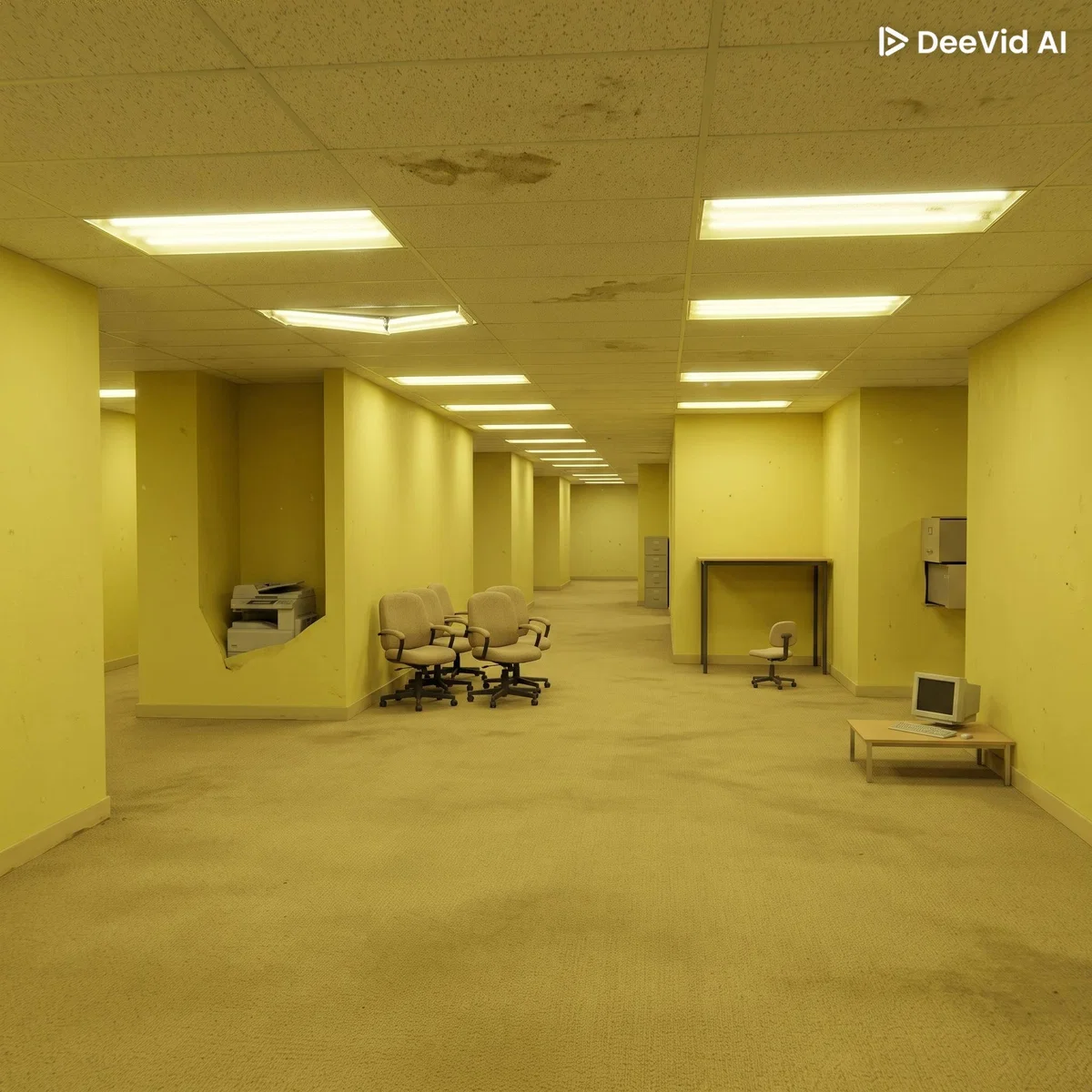
🟨 THE BASIC IDEA
Kane Pixels' universe takes the original Backrooms concept and turns it into a science-fiction mystery.
Instead of the Backrooms simply being a supernatural maze that people randomly fall into, Kane's version has a scientific explanation:
The Backrooms are a gigantic alternate environment called the Complex.
Human beings discovered a way to access it.
And that's where Async Research Institute comes in.
The story revolves around Async trying to understand and exploit this impossible place—and gradually realizing that the Complex isn't just an empty building.
It appears to have its own rules, biology, geography, and relationship with reality.
🧪 ASYNC RESEARCH INSTITUTE
Async is basically the organization responsible for opening the door.
They aren't initially trying to make a horror dimension.
They're trying to solve practical problems.
Their research involves things like:
transportation
storage
housing
industrial space
potentially creating effectively unlimited usable territory
Their breakthrough is the Low-Proximity Magnetic Distortion System, usually called the LPMDS.
Async Research Institute
The LPMDS manipulates reality enough to create a connection between our world and the Complex.
And that's the beginning of everything.
🚪 THE THRESHOLD
The doorway between our reality and the Complex is called the Threshold.
Think of it like:
Our reality → Threshold → Complex
The important part is that Async doesn't simply discover an existing doorway.
They create a stable connection using their technology.
The Threshold becomes Async's gateway into the Complex.
They construct an entire research facility around it.
Eventually they start sending people inside.
And that's when they discover that the place isn't nearly as harmless as they hoped.
🟨 SO WHAT ACTUALLY IS THE BACKROOMS?
This is one of the coolest unanswered questions.
Kane's universe never gives us a simple:
"The Backrooms were created by ______."
Instead, the Complex seems to already exist independently of humanity.
It's enormous.
Possibly effectively infinite.
And it doesn't behave like a normal building.
You can have:
office rooms
enormous empty chambers
strange corridors
impossible architecture
rooms that seem copied
areas where geometry becomes distorted
environments that don't seem to obey normal spatial rules
And the deeper Async explores, the stranger things become.
The Complex also seems capable of producing things that resemble familiar objects and environments.
That's extremely important when we get to Still Lifes.
🌀 NULL ZONES
One of the biggest pieces of Kane's Backrooms physics is the idea of Null Zones.
A Null Zone is essentially an unstable region connecting or affecting reality and the Complex.
They're dangerous because space and time don't necessarily behave normally around them.
One of the most important examples involves Peter Tench.
He enters an abnormal area and experiences a massive temporal displacement.
He essentially ends up somewhere that doesn't match the time he entered.
That's one of the clues that the Complex isn't merely a giant physical building.
Time itself can behave strangely inside it.
The Backrooms therefore isn't simply:
"another dimension with infinite rooms."
It's more like an environment where the normal rules of space, time, and matter can become unreliable.
⏰ THE TIMELINE
The main Async storyline happens around the late 1980s and early 1990s.
A simplified version looks like this:
1982
A prototype of the technology is tested at Oak Ridge National Laboratory.
1988
Async continues developing the technology.
October 17, 1989
First Contact.
Async successfully reaches the Complex.
1990
Async begins heavily exploring and documenting the Complex.
This is when we get:
Missing Persons
Autopsy Report
Informational Video
Motion Detected
Pitfalls
Report
Presentation
Reunion
Damage Control
Static Dead End
June 29, 1990
The Backrooms movie takes place around this period.
1991
The original Found Footage incident occurs.
2024
Kane releases Found Footage #3, dramatically expanding what we know about the Complex.
The web series currently contains a long chain of episodes documenting Async's experiments and various encounters.
🦠 THE LIFEFORM / “BACTERIA”
This is the classic monster from Kane's original Backrooms videos.
What it looks like
The Lifeform is generally:
Extremely tall — roughly 11 feet / 3.35 meters is commonly estimated.
Very thin and elongated.
Humanoid in general shape, but definitely not human.
Has extremely long arm-like appendages.
Has thin fingers.
Has a strange, almost vine/wire-like body.
Can bend its torso in unnatural ways.
The footage makes it appear black, although descriptions of its actual coloration suggest a fleshy reddish appearance underneath the VHS-style presentation.
What is it?
This is where things get REALLY weird.
The Lifeform is generally understood in the lore as a biological organism associated with mutated hay bacillus. Evidence for this comes from the material found on bodies inside the Complex.
The earliest major clue occurs in Missing Persons/Autopsy Report, where Async discovers a corpse covered in strange mold and mutated bacterial material.
The implication is that the organism isn't simply a monster that randomly lives there.
It may actually be something that grows within the Backrooms' environment.
🧬 THE GROWTH
The Lifeform appears to be connected to something called the Growth.
The Growth consists of strange biological material that can spread through portions of the Complex. It's associated with the same general biological material believed to make up the Lifeform.
A commonly proposed sequence is:
bacteria → growth → biological colony → Lifeform
But there's still a lot that isn't definitively explained.
So I wouldn't treat every part of that chain as confirmed canon.
👂 HOW THE LIFEFORM HUNTS
One of the creepiest things about the Lifeform is that it seems to rely heavily on sound.
It's extremely difficult to see in the dark environment of the Complex, but it can apparently detect people.
It also makes bizarre vocalizations.
And here's the REALLY creepy part:
It can imitate human cries.
The Lifeform is theorized to use the throats/vocal structures of victims or other biological material to produce sounds resembling human cries for help.
That's why hearing something that sounds like a person calling for help in the Backrooms isn't necessarily a good sign.
🏃 ITS BEHAVIOR
The Lifeform generally acts like a predator.
It:
stalks people,
follows sounds,
pursues people it detects,
moves strangely but surprisingly quickly,
hides in dark areas,
produces disturbing vocalizations.
It's also important that the Lifeform doesn't behave like a normal intelligent human villain.
It seems much more like an organism following instincts.
👤 NOW: THE STILL LIFES
This is where Kane's newer lore gets fascinating.
A Still Life is basically the Backrooms attempting to reconstruct a human being.
But it doesn't understand humans properly.
So the result is something that looks almost human...
...but is fundamentally wrong.
The movie makes this idea much more explicit.
🧠 HOW STILL LIFES ARE CREATED
The Backrooms appears to remember things from reality.
That includes:
rooms,
objects,
buildings,
people,
appearances,
behaviors,
memories.
But its memory isn't perfect.
There's an important line in the movie's lore:
“The more time it remembers something, the less it does.”
In other words:
The Backrooms remembers... incorrectly.
Imagine someone describing a human to a person who's never actually seen one.
They might know:
“Humans have two arms.”
But they don't understand why the arms work the way they do.
So their drawing might technically contain two arms...
...but everything else could be completely wrong.
That's essentially the horror of Still Lifes.
👁️ WHY THEY LOOK WRONG
Still Lifes can have:
distorted faces,
strange hands,
duplicated or malformed features,
incorrect proportions,
strange skin,
unnatural movements,
bizarre internal anatomy.
The Still Life from Found Footage #3 is particularly messed up.
Its head is malformed, one leg appears shorter than the other, and it has difficulty moving normally.
It looks like the Backrooms basically went:
“Human.”
...and then tried its best.
And failed spectacularly.
😨 THE FOUND FOOTAGE #3 STILL LIFE
This is the first major Still Life we see.
Ravi enters a strange, deteriorated area containing a lot of junk and books.
He eventually encounters something hiding inside the darkness.
The creature begins making bizarre noises.
Then it starts following him.
And it is very bad at understanding human objects.
For example, when Ravi gets behind a door, the creature doesn't simply operate the door normally.
It knocks.
Then eventually breaks the door apart.
That suggests its understanding of human behavior and objects is extremely limited.
🏃 THE CHASE
The Found Footage #3 Still Life also has an unusual running style.
It struggles with its malformed leg and moves awkwardly.
But it still pursues Ravi.
And its vocalizations sound somewhat similar to the Lifeform.
This is one reason people originally wondered:
“Are Still Lifes and the Lifeform actually the same species?”
Currently, that isn't established.
The two have similarities, but the lore treats them as distinct categories.
👥 THERE ISN'T JUST ONE STILL LIFE
This is probably the biggest thing the movie adds.
There are multiple different Still Lifes.
They're not necessarily identical copies.
Some appear to be based on specific people.
Others appear to be much stranger and less complete.
Known examples include:
Captain Clark Still Life
Mary Kline Still Life
Archibald Leland Sutter Still Life
Redheaded Still Life
Bearded Still Life
Speaker Room Still Life
Found Footage #3 Still Life
🧍 CAPTAIN CLARK'S STILL LIFE
This is one of the most interesting examples.
The Backrooms doesn't merely appear to copy Clark's appearance.
It seems capable of reproducing aspects of his behavior/personality as well.
That means a Still Life can potentially become a reflection of the person it's based on.
The movie implies that Clark's own personality and behavior influenced his Still Life.
So a Still Life isn't necessarily:
“Here's a copy of a human.”
It can be more like:
“Here's what the Backrooms remembers that human to be.”
That's MUCH scarier.
🪞 STILL LIFES AREN'T ALL THE SAME
This is another important detail.
Some Still Lifes are:
Aggressive
They chase or attack people.
Passive
They don't necessarily attack anyone.
Frightened
Some appear capable of reacting fearfully and attempting to escape when threatened.
Almost completely inert
Some don't seem to react much at all.
So “Still Life = monster that always attacks” isn't quite accurate.
They're more like a whole category of failed or imperfect human reconstructions.
🪑 THE REALLY WEIRD CHAIR THING
Some Still Lifes appear to be created while sitting in chairs.
And those particular Still Lifes have seemingly never been observed getting out of the chair.
One explanation is that the Backrooms may not properly distinguish between:
the person
and
the chair they're sitting in.
So it copies both as one object.
That's not confirmed, but it's one of the strongest examples of how bizarre the Backrooms' "understanding" of reality can be.
🧸 WHAT ARE THEY MADE OF?
The movie introduces an absolutely bizarre detail:
Some Still Lifes appear to contain white, foam/stuffing-like material inside them rather than normal human organs.
Their exterior can look surprisingly human:
skin,
hair,
clothing,
faces,
hands.
But internally?
It's basically:
“Yeah, we have absolutely no idea how a human works.” 😭
The movie's explanation strongly supports the idea that the Complex copies what it can observe, rather than understanding actual human biology.
🧠 SO ARE THEY ACTUALLY ALIVE?
This is intentionally unclear.
Some demonstrate:
movement,
fear,
aggression,
reactions,
vocalization,
limited behavior.
So they're clearly not just ordinary statues.
But whether they possess genuine human consciousness is another question.
A Still Life may have some degree of awareness without actually being the person it resembles.
That's a HUGE distinction.
🎥 THE BACKROOMS MOVIE
And NOW we get to the big one.
Backrooms (2026)
Backrooms
The movie is directed by Kane Parsons and distributed by A24.
It stars:
Chiwetel Ejiofor
Renate Reinsve
Mark Duplass
Lukita Maxwell
Finn Bennett
The basic premise involves Clark, who discovers a strange doorway in the basement of a furniture showroom.
And yes:
THE MOVIE IS CONNECTED TO KANE'S BACKROOMS UNIVERSE.
It's not simply a completely unrelated Hollywood remake.
The movie expands the same mythology.
🏢 THE MOVIE'S VERSION OF THE COMPLEX
One of the coolest things about the movie is that it demonstrates that the Backrooms aren't necessarily just the famous yellow office area.
The Complex contains many different environments.
The yellow rooms are essentially one portion of a much larger impossible world.
That's why the movie can introduce:
new environments
new structures
new phenomena
different types of entities
without contradicting the original Found Footage.
The Backrooms are enormous.
👤 THE MOVIE'S CREATURES
The movie leans much harder into Still Life-style entities.
And this is important because it shows that the Complex's ability to reconstruct people isn't limited to Ravi's encounter.
The movie gives us multiple strange human-like reconstructions.
Some are much more disturbing than others.
And one of the most interesting ideas is that these things aren't necessarily just:
"evil monsters pretending to be people."
They can be reconstructions of memories and identities.
That's why the movie becomes much more psychological.
The Backrooms isn't just hunting people.
It can potentially reflect them back at themselves.
🧠 THE BIGGEST DIFFERENCE
This is basically the evolution of Kane's Backrooms:
Early Kane
"There's something in here."
😨
Middle Kane
"We accidentally created a doorway into somewhere that contains life."
😨😨
Found Footage #3
"The place may understand humans."
😨😨😨
Movie
"The place can reconstruct humans and manipulate what they mean."
💀
That's why the Still Lifes are such a massive deal.
🏗️ HOW THE COMPLEX "BUILDS" ITSELF
Here's the REALLY weird part.
The Complex doesn't appear to have been constructed like a normal building.
It behaves as though it generates its own spaces.
You can find rooms that resemble familiar architecture, but their arrangement makes no logical sense.
You might walk through:
Room A → hallway → Room B
and expect to eventually reach the outside.
Instead you might encounter:
Room A → impossible corridor → completely different environment → distorted copy of Room A
It's almost as though the Complex is continuously generating geography.
This is why the Backrooms can feel infinite without simply being a normal infinite building.
🧱 THE "COPIED" ENVIRONMENTS
Another important clue:
The Complex contains objects that appear strangely familiar.
Async even discovers objects whose properties are remarkably similar to objects in their own facility.
For example, researchers examine a ceiling light and tile from the Complex and find them disturbingly similar to the materials used in Async's own facility.
That raises a REALLY creepy possibility:
Is the Complex copying reality?
Maybe.
But Kane hasn't given us the full answer.
⏳ WHY TIME IS SO WEIRD
Remember the Null Zones?
They're extremely important because the Complex doesn't necessarily have normal time.
Peter's experience demonstrates that entering certain areas can cause temporal displacement.
So:
distance inside the Complex ≠ normal distance
and
time inside the Complex ≠ necessarily normal time.
That's why Async can encounter impossible situations where someone enters one area and ends up somewhere that shouldn't exist at that point in time.
🧠 WHAT IS THE COMPLEX?
This is the million-dollar question.
There are several possibilities.
Theory 1 — An alien dimension
The Complex is a naturally existing alternate universe.
Humans simply discovered a way inside.
Theory 2 — A reality-generating environment
The Complex actively creates rooms, objects, organisms, and copies.
Theory 3 — A place that responds to observation
The Complex changes depending on what enters it.
Theory 4 — Something we don't have a name for yet
And honestly?
This is probably the safest answer.
Kane has intentionally left the ultimate nature of the Complex mysterious.
🧬 SO HOW DOES EVERYTHING FIT TOGETHER?
Here's my favorite way to visualize the Kane Pixels universe:
                 OUR REALITY
                      │
                      │
              Async develops
                    LPMDS
                      │
                      ▼
                 THRESHOLD
                      │
                      ▼
             ┌────────────────┐
             │    COMPLEX     │
             │                │
             │  Impossible    │
             │  architecture │
             │                │
             │  Null Zones    │
             │                │
             │  Strange time  │
             │                │
             │  Biology       │
             │                │
             │  Reconstructions│
             └────────────────┘
                 │          │
          ┌──────┘          └───────┐
          ▼                         ▼
       GROWTH                  STILL LIFES
          │                         │
          ▼                         ▼
     LIFEFORM              HUMAN COPIES
That's the fundamental structure.
👀 AND THAT'S WHY THE KANE PIXELS BACKROOMS IS DIFFERENT
The original Backrooms is basically:
"You accidentally fell into an endless creepy building."
Kane Pixels turns it into:
"Humanity discovered a reality outside our own, attempted to scientifically exploit it, and gradually discovered that this reality has its own impossible rules, biology, time, and apparent ability to reproduce things that enter it."
And that's WAY more interesting.
📺 THE WEB SERIES ORDER
If you want to understand the lore, the main series currently includes:
The Backrooms (Found Footage)
The Third Test
First Contact
Missing Persons
Informational Video
Autopsy Report
Motion Detected
Prototype
Pitfalls
Report
Presentation
Found Footage #2
Reunion
Overflow
Damage Control
Found Footage #3
Lighting and Tile Survey
Static
The series' episode listings and chronology are documented here.
And the 2026 movie expands that universe rather than simply replacing it.
🔥 THE THREE BIG MYSTERIES
If you get really deep into Kane's lore, I think these are the three biggest unanswered questions:
1. WHAT IS THE COMPLEX?
Nobody has definitively explained where it came from.
2. HOW DOES IT CREATE LIFE?
The Growth/Lifeform side and Still Life side suggest the Complex can produce biological or biological-looking things.
3. HOW DOES IT KNOW US?
This is arguably the creepiest one.
Because if Still Lifes really are reconstructions of people...
where does the Complex get the information necessary to reconstruct them?
That's the part that makes Kane's Backrooms feel less like an abandoned building...
and more like something that is watching. 👁️
One important caveat: the Kane Pixels Backrooms wiki is a fan-maintained source, not an official Kane Parsons encyclopedia, so some labels and explanations—especially detailed Still Life biology—should be treated as interpretation rather than confirmed canon.
🟨 KANE PIXELS' FOUND FOOTAGE TRILOGY
1. THE BACKROOMS — FOUND FOOTAGE #1
Release: January 7, 2022
Footage date: July 4, 1991
Length: about 9 minutes
Person filming: Kane Pixels' in-universe counterpart
Camera: handheld video camera
Later discovery: September 23, 1996
This is the video that effectively established Kane Pixels' version of the Backrooms.
🎥 The beginning
The video starts in 1991, and initially it doesn't look like a horror movie at all.
Kane is filming an amateur movie with several other people.
They're shooting a scene involving a person being surprised by someone emerging around a corner.
The director wants a wider shot.
Kane begins walking backward while holding the camera.
And then—
he falls through reality.
He doesn't open a door.
He doesn't enter a portal.
He doesn't deliberately travel anywhere.
The physical surface beneath him essentially stops behaving like normal reality.
He noclips into another space.
That concept becomes extremely important to Kane's Backrooms mythology.
🟨 THE FIRST MOMENTS INSIDE
Kane gets up.
He's now surrounded by:
yellow walls
yellowish carpet
fluorescent lights
empty corridors
repeating rooms
strange corners
apparently endless architecture
There is no obvious entrance.
And, more importantly:
there isn't an obvious exit.
The environment feels like an ordinary building that has been copied incorrectly.
That's one of the defining characteristics of Kane's Backrooms.
It isn't simply:
"A giant yellow room."
It's an impossible architectural space.
🧭 THE BACKROOMS DON'T FOLLOW NORMAL GEOMETRY
Kane begins wandering.
At first, the environment seems relatively consistent.
Then the inconsistencies begin.
Hallways connect in ways that don't make sense.
Rooms appear to repeat.
Distances become difficult to judge.
The environment seems much larger than the building Kane originally came from.
This is the first major indication that the Backrooms aren't simply a hidden basement or underground facility.
They're an extra-dimensional environment.
👣 SOMETHING IS FOLLOWING HIM
Eventually Kane begins hearing strange sounds.
This is where the video changes from exploration horror into survival horror.
He hears something moving.
The sounds aren't immediately clear.
He doesn't know exactly where the thing is.
That uncertainty is important.
The creature doesn't constantly appear on screen.
Instead, Kane hears:
movement
distant noises
strange vocalizations
impacts
sounds from somewhere around him
The Backrooms become dangerous because he can't tell where the threat is.
👹 THE LIFEFORM
The creature encountered here is generally referred to by fans as the Lifeform or Bacteria.
It's one of the most recognizable entities in Kane's universe.
The creature has a bizarre humanoid appearance but isn't simply a normal person.
It's extremely thin and distorted, with unnatural movement.
Its behavior suggests that it is adapted to the Backrooms.
The important thing is that Kane's video is actually one of the earliest glimpses of this creature.
Later Async footage gives us much more information about it.
🏃 KANE RUNS
Eventually the creature becomes close enough that Kane realizes he's in serious danger.
He runs.
And this is where the famous chaotic movement of Kane Pixels' Backrooms footage really becomes important.
The camera shakes.
The image becomes unstable.
Kane is desperately trying to navigate through rooms he doesn't understand.
The creature is pursuing him.
He doesn't know where he's going.
He doesn't know whether any particular corridor leads out.
He's basically trying to survive inside a maze that was never designed for humans.
🚪 THE STRANGE ROOM
Kane eventually reaches an area that doesn't look quite like the original Backrooms.
There are larger architectural spaces and strange openings.
He eventually encounters a huge drop/vertical area.
The environment appears to have different "layers" or sections.
This is important because it demonstrates that the Backrooms aren't necessarily one uniform level.
There are different environments and zones.
📹 THE END OF FOUND FOOTAGE #1
Kane continues moving through the environment.
Eventually the footage ends.
But the story gives us a major clue:
the camera eventually returns to reality.
The camera is recorded as being found on September 23, 1996, five years after the original footage.
That creates a huge mystery:
What happened to Kane?
We don't get a simple answer.
The camera surviving doesn't necessarily mean Kane survived.
The implication is actually much darker:
the Backrooms can return objects to reality independently of their owners.
That's an important idea that becomes even more interesting when #2 and #3 are considered.
🟩 FOUND FOOTAGE #3
Now we jump forward in the story.
Interestingly, Found Footage #3 takes place before Found Footage #2.
The exact dating isn't stated with absolute certainty, but the Oklahoma City bombing reference in the footage places it around April 19, 1995 or later.
And this time our protagonist is:
👨 Ravi
Ravi is completely different from Kane.
He's not filming an amateur movie.
He's an ordinary person documenting his everyday life.
That makes his discovery of the Backrooms especially disturbing.
📼 RAVI'S HOME VIDEOS
The beginning of #3 is constructed almost like an old home-video compilation.
We see fragments of Ravi's normal life.
He records various things around him.
There's even radio footage that references the Oklahoma City bombing, which gives us an approximate date.
Everything seems mundane.
Then Ravi gets home.
He works.
He talks on the phone.
It's basically an ordinary day.
Until something goes wrong downstairs.
🔊 THE NOISE
Ravi hears something.
There's noise coming from downstairs.
He asks the person he's talking to whether someone is supposed to be working downstairs.
He investigates.
And then he discovers something extremely strange:
his glass back door has been broken.
That immediately tells him someone—or something—has entered his home.
But Ravi doesn't simply leave.
He investigates.
That's his first major mistake.
🏠 THE HOUSE STARTS BECOMING WRONG
Ravi enters the basement.
Things begin behaving strangely.
The architecture starts displaying abnormalities.
The basement doesn't behave like a normal basement anymore.
The transition is particularly clever because Kane Pixels doesn't simply show Ravi falling through the floor immediately.
Instead, reality gradually becomes architecturally wrong.
🟨 RAVI ENTERS THE BACKROOMS
Eventually Ravi finds himself inside the Backrooms.
And this is an important difference from Kane.
Kane falls into the Backrooms suddenly.
Ravi's transition is much more connected to his home and basement.
This demonstrates that Backrooms access points can potentially manifest in ordinary locations.
That's consistent with the broader Kane Pixels mythology surrounding natural passage and anomalous entrances.
📹 THE CAMERA BECOMES RAVI'S ONLY COMPANION
Ravi keeps filming.
This creates the same fundamental horror as #1:
He has no idea where he is.
But unlike Kane, Ravi spends considerably more time attempting to understand the environment.
He explores.
He looks around.
He tries to find a way back.
And the deeper he goes, the stranger everything becomes.
👹 THE STILL LIFE
Eventually Ravi encounters the entity.
This is the same general type of creature associated with the earlier Backrooms footage.
But #3 gives us a much better understanding of how terrifying an encounter can be.
The creature is not just randomly wandering around.
It appears capable of:
tracking people
pursuing them
navigating the Backrooms
reacting to sounds
using the environment
appearing and disappearing through the architecture
The Backrooms are effectively its territory.
Ravi is the intruder.
🏃 THE CHASE
Ravi realizes something is after him.
He runs.
The footage becomes increasingly frantic.
He doesn't have a map.
He doesn't know where the exits are.
He doesn't know whether he's going deeper or closer to reality.
And that's one of the most important rules of Kane's Backrooms:
Being able to move doesn't mean you're getting anywhere.
A person can walk for what feels like an enormous distance and still remain trapped.
📞 THE STRANGEST PART OF #3
Near the end, something extremely important happens.
Ravi manages to interact with someone apparently still in reality.
He can hear/communicate with a man from the normal world while Ravi is still inside the Backrooms.
This is huge.
Because it demonstrates that the barrier between the Backrooms and reality isn't necessarily absolute.
There can be:
communication across the boundary.
That raises questions about:
radio signals
sound
electromagnetic phenomena
physical portals
natural passages
whether different locations can overlap
And those questions connect directly to Async's research.
🟥 FOUND FOOTAGE #2
Now we get to the final piece.
Found Footage #2 takes place on August 19, 1995 according to the established timeline.
This video follows another unnamed woman, often referred to by fans as Madison.
Her situation is different again.
📹 MADISON'S CAMERA
Madison is recording around her house/garage.
She discovers something abnormal:
a strange portal/opening has appeared on the garage floor.
This is one of the clearest examples of a Backrooms entrance appearing inside an ordinary structure.
She investigates.
Naturally, she gets too close.
And—
she falls through.
🟨 INSIDE
Madison finds herself in the familiar yellow environment.
But #2 feels different from #1.
The Backrooms appear more unstable.
The environment contains unusual geometry and strange visual effects.
Madison explores while recording.
And eventually she encounters one of the most important phenomena in the trilogy:
🟢 THE GREEN CRACKS
Madison encounters strange greenish phenomena within the Backrooms.
These aren't simply normal lighting.
They appear to represent an abnormal interaction between the Backrooms and the camera/reality.
Eventually the strange green effect interferes with her equipment.
Her camera is damaged.
The footage becomes increasingly unstable.
📺 WHY THE CAMERA MATTERS
This is a recurring theme across the three videos.
The cameras aren't merely storytelling devices.
Within Kane's universe, recorded footage itself becomes evidence of the Backrooms.
Someone in the future can discover these recordings.
That's why the series constantly feels like we're watching archived evidence rather than a conventional horror movie.
The question becomes:
Who found this footage?
and
How did it survive?
🧩 THE THREE PROTAGONISTS
VideoPersonApprox. dateEntryFound Footage #1KaneJuly 4, 1991Falls through the ground while filmingFound Footage #3Ravi~April 1995Enters through his home's basementFound Footage #2MadisonAugust 19, 1995Falls through a portal in her garage
The broader chronology places them in that order: #1 → #3 → #2.
🧠 WHAT THE THREE VIDEOS TELL US ABOUT THE BACKROOMS
This is arguably the most interesting part.
1. There isn't necessarily one entrance
Kane enters through the floor.
Ravi encounters a passage connected to his house.
Madison discovers a portal.
So the Backrooms can potentially connect to multiple points in reality.
2. The Backrooms aren't static
The environment changes.
Different areas have:
different architecture
different layouts
different hazards
different environmental phenomena
This supports the idea that the Backrooms are vastly more complicated than the classic internet version.
3. The entities belong there
The people don't.
That's crucial.
The creatures can navigate this environment far more effectively than humans.
Humans become disoriented.
The entities don't appear to have the same problem.
👹 THE CREATURE'S ROLE
One thing Kane does extremely well is not immediately explain the creature.
We don't receive:
"This is the Bacteria. It was created by X."
Instead, we learn about it indirectly.
We see:
Footage → behavior → evidence → Async research → more footage.
That's deliberate.
The creature is part of the mystery.
🧪 ASYNC CHANGES EVERYTHING
The Found Footage videos become much more interesting when placed alongside the Async Research Institute storyline.
Async discovered a way to access the Backrooms using their Low-Proximity Magnetic Distortion System.
Their experiments eventually allow humans to deliberately enter the space.
That means Kane, Ravi and Madison aren't necessarily experiencing the same kind of entry that Async engineered.
They are examples of something much stranger:
Natural or accidental access.
The timeline places Async's major experiments in the 1980s and early 1990s, before Kane's 1991 incident.
🔬 THE BIG CONNECTION
Async discovers the Backrooms.
They begin experimenting.
They encounter entities.
They lose researchers.
They study the environment.
Meanwhile, ordinary people begin accidentally entering the same place.
That means the Backrooms aren't merely Async's creation.
Async discovered/accessed something that already existed.
🕰️ THE REALLY WEIRD PART
Kane's camera being found in 1996, despite his footage dating to 1991, means the Backrooms can have strange relationships with time and objects.
And Async's own experiments demonstrate that the environment can produce bizarre temporal effects.
So the Backrooms aren't simply:
another location.
They're a place where the normal rules of:
space
distance
time
geometry
causality
can break down.
🟨 THE BIGGEST DIFFERENCE FROM THE ORIGINAL BACKROOMS MYTH
The original internet Backrooms concept is basically:
You accidentally fall out of reality and enter an endless yellow maze.
Kane Pixels expands that into something much bigger.
His Backrooms are essentially a parallel anomalous environment that can intersect with reality.
There are:
research organizations
experiments
natural entrances
artificial entrances
entities
different environments
temporal anomalies
lost people
archived evidence
and potentially an entire history of interaction between our world and the Backrooms.
👤 Its appearance
The FF3 Still Life is extremely difficult to see clearly because almost every appearance is:
dark
distant
obscured
partially hidden
moving rapidly
viewed through Ravi's VHS camera
Appearance
Head and Face: It has a severely misshapen head where one side of the face appears missing or malformed, while the other side shows a black eye, a nose, and a mouth.
Body and Proportions: The body looks human but is noticeably distorted, including asymmetrical limbs like one leg being shorter than the other and an elongated arm.
Clothing: It wears an open, bulky dark olive-green or brownish-gray jacket with a high collar over a light gray or off-white undershirt.
Lower Body: It wears slim-fitting dark brown or charcoal pants and matching shoes.
Think of the Complex like it's trying to remember a person but doesn't actually understand human anatomy.
The result can be something that is recognizably human while simultaneously being completely wrong.
😨 Why it looks so unnatural
This is one of the biggest things that changes when you understand the movie's Still Life concept.
The creature doesn't necessarily have to be a biological species that evolved to look like that.
Instead, its appearance can be understood as a failed imitation.
The Complex appears capable of reproducing things that exist within its environment. With Still Lifes, that process extends to human beings.
But the reproduction isn't necessarily:
“Take human → perfectly duplicate human.”
It's more like:
“Take information about human → reconstruct human from incomplete information.”
That's why the resulting person can have:
distorted proportions
incomplete facial structure
strange positioning
incorrect clothing
merged features
unnatural expressions
abnormalities that don't make anatomical sense
The movie's Still Lifes strongly reinforces this interpretation.
🏚️ The area where Ravi encounters it
Ravi eventually enters a particularly strange section of the Backrooms.
It's similar to the familiar yellow Backrooms architecture, but noticeably darker and more neglected.
The area contains:
yellow walls
unusual ceiling lighting
clutter
books
garbage
strange rooms
dark openings
an apparent body/corpse-like object
doors leading toward other areas
This is generally referred to as the Still Life Area.
And there's a REALLY important detail here:
The music.
The song “Still Life” can be heard through a speaker in the area.
The song isn't merely background music slapped over the scene—the implication is that it is actually playing within the environment.
The track subsequently became associated with the entity itself.
🔊 The sound of the Still Life
Honestly, the audio may be even creepier than its appearance.
Ravi initially doesn't get a clear visual of it.
Instead, he hears strange noises coming from the darkness.
This is a recurring Kane Pixels technique:
You hear the thing before you properly understand what you're seeing.
The Still Life's vocalizations sound disturbingly close to human sounds without behaving like normal human speech.
That creates an uncanny effect:
You can recognize the idea of a human voice, but something about the way it's being produced is fundamentally wrong.
That's appropriate for a creature whose entire existence seems to revolve around imitating humanity.
👀 When it notices Ravi
Ravi investigates the strange opening/crawlspace.
Something is inside.
The noises begin.
Ravi realizes that he isn't alone.
And this is where the entity begins behaving like a predator.
It doesn't immediately launch into a gigantic monster attack.
Instead, there's uncertainty.
Ravi retreats.
The entity follows.
That makes the encounter feel much more like being stalked by something that is learning what you're doing.
💡 The lights
One of the most memorable moments happens when Ravi is attempting to escape.
The creature is behind him.
Then the lights begin going out.
This is one of the reasons the Still Life became such an iconic Kane Pixels entity.
You aren't given a nice clean shot of the monster.
Instead, you get:
darkness → footsteps/noises → Ravi looking back → something barely visible → darkness again.
It's almost as though the environment itself is helping conceal it.
🚪 The door encounter
Ravi eventually reaches an exit and shuts the door between himself and the creature.
For a moment, it seems like he's safe.
Then:
knock.
The Still Life is on the other side.
And this is where its intelligence becomes particularly interesting.
It appears to imitate human behavior by knocking on the door.
That is much creepier than simply smashing it immediately.
It's almost as though it understands:
Humans knock on doors.
So it knocks.
That fits incredibly well with what we eventually learn about Still Lifes.
They're imitators.
The thing doesn't need to understand why humans knock.
It only needs to reproduce the behavior.
💥 Then the imitation breaks down
Eventually, the knocking turns into increasingly aggressive attempts to get through the door.
The creature stops behaving like a normal person and begins behaving like a desperate predator.
It ultimately breaks through.
This gives us an important distinction:
The Still Life can imitate humanity.
But that doesn't mean it is human.
Its imitation has limits.
🧠 Is it intelligent?
Almost certainly to some degree.
But exactly how intelligent remains unclear.
It demonstrates:
environmental awareness
pursuit
persistence
reactions to Ravi
apparent understanding of doors
imitation of human behavior
ability to navigate the Backrooms
However, we don't see it having a normal conversation or demonstrating ordinary human reasoning.
So I wouldn't describe it as “a human trapped in monster form.”
It's more accurate to think of it as:
A nonhuman intelligence attempting to reproduce human behavior.
🧬 Is the FF3 Still Life the same type as the movie Still Lifes?
Yes, broadly speaking.
The larger Still Life concept shown in the 2026 Backrooms movie provides the strongest explanation for the FF3 entity.
Still Lifes are essentially distorted human reproductions created by the Complex.
However, there is an important distinction:
We shouldn't assume every Still Life has exactly the same appearance or behavior.
The movie shows multiple examples, including copies associated with particular humans.
So the FF3 creature may represent a different stage, source, or method of reconstruction.
👨 Is it Peter Tench?
Now we get into one of the biggest theories.
A popular interpretation is that the FF3 Still Life could be a reconstruction of Peter Tench.
The theory gained significant attention because of similarities between the creature and Peter, particularly regarding its clothing and distorted physical structure.
Some fans have proposed that the bizarre elongated arm could potentially relate to objects or information associated with Peter being incorporated into the reconstruction.
But:
⚠️ This is NOT firmly confirmed.
The Peter theory is a fan interpretation, not something I would currently state as established canon.
There are also competing theories about who or what the Complex was attempting to reproduce.
🏠 The connection to the house
FF3 gets even stranger toward the end.
Ravi eventually encounters a strange house-like environment inside the Backrooms.
This is important because the Complex isn't simply generating endless yellow rooms.
It's reproducing increasingly complicated pieces of reality.
The Backrooms can contain environments that resemble:
houses
offices
furniture stores
outdoor areas
playgrounds
other familiar environments
And some of these reconstructions can be wrong.
That's one of the central ideas behind Kane's Backrooms.
🧩 The Still Life isn't necessarily a “zombie”
This is an important misconception.
The FF3 entity may LOOK like some kind of corpse or undead humanoid, but calling it a zombie isn't really supported.
It's better understood as a constructed imitation of humanity.
That explains why its body can look dead or damaged without necessarily meaning:
“This used to be a human who died.”
The creature's appearance may simply be the Complex's imperfect reconstruction.
🎵 Why is it called “Still Life”?
There's a clever double meaning.
A still life in art is a representation of objects, often ordinary things such as household objects.
Kane's Backrooms repeatedly deals with the idea of reality being reproduced as an artificial imitation.
So “Still Life” works beautifully for these creatures.
They're essentially:
human beings turned into an imitation.
And the FF3 creature is arguably the most primitive-looking and disturbing example of that idea.
🔥 The really important part
The FF3 Still Life isn't scary merely because:
“It's a weird monster.”
It's scary because it represents one of the fundamental rules of Kane Pixels' Backrooms:
The Backrooms can remember reality incorrectly.
It can reproduce a room.
It can reproduce objects.
It can reproduce environments.
And eventually...
it can reproduce people.
But when it does, the result isn't necessarily a person.
It's a memory of a person turned into something physical.
That's why the Still Lifes are so uncanny.
They're not monsters pretending to be humans.
They're the Backrooms pretending that they are humans.
And the FF3 Still Life is one of the earliest and most horrifying demonstrations of that concept.
🟨 FF3 Still Life — quick profile
FeatureDetailsFirst appearanceFound Footage #3LocationBackrooms / ComplexRoleMain antagonist of FF3TypeStill LifeAppearanceDistorted humanoidColorationPale/gray-whiteFaceExtremely distorted/incompleteArmAbnormally large/elongatedBehaviorStalking and pursuitIntelligenceApparently capable of learning/imitating behaviorVoiceUnnatural human-like soundsConfirmed identityUnknownPeter Tench connectionPopular theory, not confirmedMajor themeThe Complex's imperfect imitation of humanity
1. The basic architectural principle: a building that isn't really a building
In ordinary architecture, a building is designed around a purpose. Offices have corridors that lead to rooms, staircases connect floors, and structural supports hold up ceilings.
In Kane Pixels' Backrooms, these familiar features appear to exist without a coherent building behind them.
The environment resembles an enormous, unfinished commercial building, but its rooms don't consistently follow the rules of conventional architecture.
The series refers to this dimension as the Complex. Async discovers that it can access this space through a portal created by its Low-Proximity Magnetic Distortion System, also called the Threshold. The Complex is then explored as a potential solution to humanity's storage and space problems.
What makes the architecture unusual?
A. Rooms don't necessarily serve a purpose
You can enter a room that looks like an office, but it might contain nothing except a desk, a few lights, and several passages leading nowhere obvious.
Other rooms resemble:
Empty office buildings.
Commercial corridors.
Furniture showrooms.
Residential interiors.
Art galleries.
Maintenance areas.
Suburban streets.
Large underground or industrial spaces.
These environments borrow recognizable architectural elements but don't always combine them in ways that make practical sense.
B. The architecture lacks a clear overall plan
In the real world, an architect can draw a floor plan showing how the rooms fit together.
Async can map portions of the Complex, but its discoveries don't establish the complete layout of the dimension.
A corridor might lead into a familiar area, a different architectural environment, or an unusual opening in the floor or wall. Some areas connect through ordinary-looking doorways, while others require traversing spaces that would be difficult to incorporate into a conventional building.
C. Familiar architecture appears in unfamiliar combinations
Imagine walking through a yellow office corridor and finding a doorway that leads into a completely different architectural style.
Instead of a transition between two buildings, the doorway seems to connect both spaces as parts of the same enormous environment.
That is one of the most important characteristics of Kane's version: different architectural environments can connect without a normal explanation for how they fit together.
2. The Common Backrooms: the famous yellow architecture
The Common Backrooms are the most recognizable architectural environment in the series.
They are the closest thing to a central architectural theme throughout Kane's Backrooms videos.
Their design combines the appearance of an old commercial office interior with the atmosphere of an abandoned, poorly maintained building.
The walls
The walls are usually covered in yellowish wallpaper with a repeating floral pattern.
The wallpaper is important because it makes the rooms feel familiar without giving them a recognizable location.
It resembles a real decorative material that might have been used in an office, hotel, or commercial interior decades ago.
However, the repeated pattern also creates visual monotony. When every wall has nearly the same appearance, it becomes difficult to distinguish one room from another.
This creates a problem for navigation: a person might remember walking past a particular wall but have difficulty determining whether they've returned to the same place.
The architecture doesn't need to change dramatically to become disorienting. Repeating the same surfaces is enough.
The carpet
The brown carpet is another defining feature.
Rather than polished concrete, hardwood, or modern commercial flooring, the carpet gives the environment a soft, domestic quality.
It also creates a strange contrast with the enormous scale of the Complex.
Carpet ordinarily belongs in a building where people are expected to work, walk, or live. Here, it continues through spaces that appear to have no clear function.
The result is an environment that feels like an office building whose intended occupants have disappeared.
The ceiling
The ceiling typically resembles a suspended commercial ceiling system, with square panels and fluorescent light fixtures.
In ordinary buildings, these ceilings conceal electrical wiring, ventilation, plumbing, and other services.
In the Backrooms, the ceiling suggests that similar infrastructure might exist, but the environment doesn't provide a complete explanation of how the entire dimension is supplied or maintained.
The fluorescent fixtures also produce the familiar buzzing sound associated with the yellow rooms.
The combination of repeating ceiling panels, wallpaper, and carpet gives the space a consistent visual identity.
The pillars and walls
The Common Backrooms also contain walls and structural-looking pillars that divide the interior into smaller spaces.
Some arrangements look like ordinary office partitions. Others appear too irregular to belong to a carefully designed building.
These structures create a maze-like environment in which a person can lose sight of previously visited spaces.
The pillars are especially important in the Main Chamber, where they form a much more regular arrangement than the walls in the surrounding areas.
The central architectural contradiction: the Complex looks constructed, but it doesn't behave like a building with a clearly understandable design.
3. The Main Chamber: the most organized part of the Complex
The Main Chamber is one of the most important locations for understanding the architecture because it is where Async establishes its initial presence inside the dimension.
Unlike the more irregular yellow corridors, the Main Chamber contains a large, open space with evenly distributed, cross-shaped pillars.
Async uses this area as a reference point for exploration and organizes its surrounding corridors into numbered and lettered divisions.
How the layout works
The chamber is organized around a large open interior.
Its principal architectural features include:
Cross-shaped pillars: These repeat throughout the chamber in a regular grid.
Open floor space: The gaps between pillars create long sightlines across the room.
Connecting corridors: Passages extend away from the chamber into other sections of the Complex.
The Threshold: Async's artificial entrance provides a connection between its facility and the dimension.
The Threshold Outpost: A man-made structure near the entrance gives researchers a place to monitor and control access.
This arrangement is much easier to understand than the deeper areas of the Complex.
The regular pillar grid provides visual reference points, while the divisions allow Async to identify particular directions and locations.
Why does the chamber look different from the other rooms?
The Main Chamber appears more deliberately organized.
Its repeated pillars create a sense of order that contrasts with the surrounding irregular corridors.
This distinction is important because the Complex isn't uniformly chaotic. Some spaces have consistent architectural patterns, while others appear almost random.
That makes the Main Chamber useful as an example of how the dimension can contain recognizable spatial organization without revealing the structure of the entire environment.
Async's architectural intervention
Async doesn't simply explore the chamber. It modifies the environment to make it more useful.
The Threshold Outpost introduces conventional architectural features into the Complex, including doors, observation windows, workstations, and security equipment.
This produces an interesting contrast:
The original environment is unfamiliar and difficult to understand.
Async's additions are designed around familiar human needs.
The researchers attempt to impose a manageable system on an environment whose full layout remains unknown.
The outpost therefore represents the beginning of human-controlled architecture inside the Complex.
4. The architecture changes between areas
One of the strangest things about Kane's Backrooms is that the yellow office maze is only one architectural environment.
The Complex contains many distinct areas, each with its own materials, lighting, room shapes, and apparent purpose. The areas are interconnected, but their complete spatial relationship remains unknown.
Here are some of the most interesting examples.
A. The Empty Gallery Area
Architectural style: Empty commercial building, gallery, or hotel-like interior.
This area replaces the yellow wallpaper and brown carpet with a more conventional interior design.
Its features include:
Long, relatively consistent corridors.
Wood-like flooring.
White or gray walls.
Windows overlooking an indoor courtyard.
Large gaps between sections of the architecture.
Staircases and doors that connect different areas.
The architecture feels more like a recognizable building than the Common Backrooms.
However, its enormous scale and strange connections undermine that familiarity.
One particularly unsettling feature is the courtyard. Windows overlook a space that resembles an outdoor area, but the surrounding architecture makes it difficult to establish how the courtyard fits into the larger structure.
Why it matters: The Gallery demonstrates that the Complex can reproduce architectural styles beyond the familiar yellow office interior.
B. The Household Area
Architectural style: Domestic interiors, apartments, and houses.
The Household Area appears to reproduce spaces associated with ordinary living.
It contains beige walls, furniture, small kitchen-like arrangements, couches, and other objects commonly found in homes.
But the rooms don't consistently behave like functional domestic spaces.
For example, a room might contain furniture without providing the other features expected in a house. A doorway might lead into another unusual room instead of a recognizable hallway.
Some rooms also contain objects with distorted proportions.
In Found Footage #2, the protagonist encounters a series of spaces that resemble household interiors but have strange arrangements of furniture and openings.
The architecture imitates the appearance of a home without reliably reproducing the way a real home is organized.
C. The Commercial Office Area
Architectural style: Ordinary commercial offices.
This area contains beige walls, black trim, commercial carpeting, ceiling panels, desks, printers, and other office-related objects.
What's particularly interesting is its resemblance to Async's own conference-room architecture.
The similar materials suggest that the Complex can reproduce combinations of architectural features familiar from the real world. However, the series does not establish precisely how or why those similarities occur.
Think of it as an imitation of a workplace that has been separated from the organization that originally gave it purpose.
D. The Conference Office Area
Architectural style: Corporate conference rooms and administrative offices.
This area features:
White walls.
Black vinyl trim.
Gray carpeting.
Suspended ceilings.
Conference tables and chairs.
Filing cabinets and desks.
An observation window facing the Red City.
Unlike the more irregular yellow maze, this area resembles a coherent office interior.
Its furniture and room arrangements suggest that meetings, administration, and other workplace activities could take place there.
But its connection to the surrounding environment remains strange. A skyway connects this area with other portions of the Complex, including the Common Backrooms across the Red City.
The important detail: A room can look completely ordinary while its location within the larger environment remains inexplicable.
E. The Maintenance Area
Architectural style: Industrial corridors and service spaces.
The Maintenance Area features concrete surfaces, construction-related objects, trash bags, colored lights, and a large fan.
Its design resembles the parts of real buildings that are usually hidden from visitors.
In an ordinary building, maintenance corridors connect electrical rooms, ventilation equipment, service entrances, and other functional spaces.
In the Complex, these elements appear without revealing a complete infrastructure system behind them.
The area also connects with the Conference Office Area, creating a transition from industrial-looking spaces into conventional offices.
This is another example of the Complex combining architectural styles that ordinarily serve different purposes.
F. The Playroom Area
Architectural style: An imitation of an indoor playground or child-oriented environment.
The Playroom Area has beige walls, fluorescent lights, green flooring marked with patterns resembling grass and sidewalks, and numerous columns.
A house-like structure stands among the columns.
The space resembles a simplified version of an outdoor neighborhood reproduced inside an enormous interior.
Its architecture is especially strange because it mixes several different environments:
Indoor commercial construction.
Decorative outdoor-looking flooring.
A house-like structure.
Repeated structural columns.
An artificial environment that suggests a miniature neighborhood.
The house-like structure does not necessarily function as a normal house.
Instead, it contributes to the impression that the environment is reproducing the appearance of a familiar place without fully reproducing its function.
G. The Red City
Architectural style: An artificial-looking cityscape at night.
The Red City is one of the most unusual architectural environments shown in Found Footage #3.
It contains streets, trees, buildings, road signs, and a persistent red glow.
At first glance, it resembles an outdoor urban environment.
However, the surrounding scenery looks strangely artificial. Some buildings appear to have windows that are simply part of their surfaces rather than convincing openings into functional interiors.
The environment also appears bounded by an enormous artificial-looking backdrop.
This gives the city the unsettling appearance of a constructed environment rather than an ordinary place extending naturally toward a distant horizon.
The Red City is particularly interesting because it expands the architectural possibilities of the Complex beyond indoor spaces.
Instead of merely reproducing an office building, the environment appears to reproduce an entire urban setting.
Yet the city still connects to other areas through unusual architectural transitions.
H. The Still Life Area
Architectural style: A deteriorating office-like environment with irregular rooms and passages.
The Still Life Area, encountered in Found Footage #3, combines features of the Common Backrooms with a darker and more deteriorated appearance.
It includes:
Yellow walls.
Different ceiling configurations.
Lighting positioned along the edges of the ceiling.
Carpeted floors.
Furniture accumulated around certain openings.
Dark passages and crawlspaces.
Rooms with unusual object arrangements.
One particularly notable feature is an elevator-like doorway blocked by a pile of chairs.
Another room contains scattered objects and a small opening in the wall.
The architecture here is important because it combines the Complex's unusual room arrangements with signs that the environment has been occupied or disturbed.
Some of the furniture may have been moved to block access, although the exact history of every arrangement is not confirmed.
The space also demonstrates that the architecture can become threatening without changing its basic materials. Ordinary doors, dark passages, and obstructed routes can make an already confusing environment much harder to navigate.
5. How the doors and hallways connect everything
One of the biggest mysteries is how the Complex connects its different environments.
In a conventional building, doors and hallways form a circulation system.
An architect can use a floor plan to determine which rooms connect, where the corridors lead, and how people move between floors.
In the Complex, the connections are not so predictable.
Ordinary doors can lead to extraordinary places
A doorway might connect two rooms with similar architecture.
Alternatively, it might connect an office-like environment to a domestic room, a different corridor system, or an unfamiliar architectural area.
The door itself can look completely ordinary.
The strange part is what lies on the other side.
This creates a distinction between the local architecture and the global architecture.
Local architecture is what you can see immediately: the walls, doors, ceilings, and rooms around you.
Global architecture is the overall arrangement of the entire Complex.
Locally, a room might look perfectly normal.
Globally, its position within the dimension may be impossible to explain.
Hallways don't provide reliable orientation
Hallways usually help people understand their position within a building.
They establish direction, connect rooms, and provide recognizable routes.
But the Complex often presents corridors that look almost identical to one another.
A person might walk through a series of turns and encounter the same wallpaper, ceiling panels, and lighting again.
That resemblance doesn't necessarily prove that the person has returned to the same room.
It might be a different section with nearly identical features.
The videos don't establish that every corridor loops or that the entire environment constantly rearranges itself. The safer conclusion is that the architecture makes it difficult to determine where you are and how far you've traveled.
Some connections are vertical
The Complex isn't restricted to a single horizontal plane.
The series includes staircases, pits, openings in floors, and areas that extend above or below other spaces.
For example, in the original Found Footage, Kane falls through an opening and reaches a staircase room before exploring a different architectural environment.
The staircase provides a recognizable vertical connection, but its placement within the larger environment is still difficult to understand.
This suggests that exploring the Complex involves more than following corridors. A person must also account for unexpected changes in elevation.
6. The most disturbing architectural feature: rooms that imitate other rooms
The Complex frequently presents spaces that resemble familiar environments but seem to reproduce only selected features of them.
This is sometimes described by fans as misremembered architecture.
The term is useful as an interpretation, but it is important to understand that it doesn't provide a complete scientific explanation for how the dimension works.
Consider three examples.
An imitation of an office
The Complex reproduces wallpaper, fluorescent lights, carpet, and partitions.
However, the rooms don't necessarily fit into a practical office layout.
An imitation of a house
The Complex reproduces furniture, kitchen-like arrangements, and domestic walls.
However, the rooms don't consistently connect like the rooms of a real home.
An imitation of a city
The Complex reproduces streets, trees, buildings, and road signs.
However, the environment has an artificial quality, and its buildings don't necessarily form a conventional urban landscape.
In each case, the architecture contains enough familiar information for a person to recognize the intended type of place.
Yet something is missing: a convincing overall structure.
That gap between recognition and understanding is central to the horror of Kane's Backrooms.
7. What about the Null Zones and impossible geometry?
The Null Zones are important because they connect the Complex to ordinary reality.
In the series, Async develops the Low-Proximity Magnetic Distortion System to create a stable connection called the Threshold.
Other anomalous connections are also associated with people entering the Complex from the real world.
This means the architecture cannot be understood solely as an ordinary building with an unusually large interior.
The Complex exists as a separate dimension, and its relationship with our world is part of the story.
Why does this matter architecturally?
Imagine drawing a floor plan of an ordinary building.
Every room would have a location relative to the others.
The walls would enclose spaces, and the doors would establish connections between them.
Now imagine trying to draw a map of the Complex.
You could map a particular corridor and identify the doors leading from it.
You might even map an entire local region.
But you would still need to account for:
Connections to different architectural environments.
Openings that lead vertically into other spaces.
Rooms whose overall purpose is unclear.
Connections to ordinary reality.
Areas whose full extent remains unknown.
The result would be a map of a dimension, not merely the blueprint of a building.
Does the Complex physically change its architecture?
The series shows architectural anomalies, but not every anomaly necessarily represents a room physically changing after someone enters it.
Three possibilities should be kept separate:
An unusual fixed layout: A room has an impossible arrangement but stays the same.
An unexpected connection: A doorway leads to a different architectural environment than anticipated.
An actual spatial change: The environment appears to alter its arrangement or relationship with other spaces.
The first two are easier to establish from the architecture shown in the videos. The third requires more specific evidence.
The exact mechanisms behind the Complex's unusual geometry remain unresolved.
8. Why does Async build structures inside the Backrooms?
Async's architecture provides an important contrast with the Complex itself.
The researchers enter the dimension with a practical objective: they believe the space could provide an enormous amount of usable area.
Consequently, they begin constructing facilities and adding equipment.
The Threshold Outpost
The outpost is a purpose-built structure near the entrance to the Complex.
Its architecture includes observation windows, doors, workstations, and security systems.
It provides a recognizable place from which researchers can monitor activity near the Threshold.
The wider Async facility
Async's research facility contains familiar institutional spaces, including offices, laboratories, corridors, and other working areas.
These are designed around identifiable human activities.
The researchers need to move between rooms, operate equipment, conduct investigations, and communicate with colleagues.
Their architecture therefore follows a more recognizable functional logic than the surrounding Complex.
The contrast
Async's architectureThe Complex's architectureDesigned around specific activitiesOften has no obvious practical purposeUses recognizable room layoutsContains irregular and unusual arrangementsProvides identifiable routes between spacesCan be difficult to navigateIncludes purpose-built equipment and facilitiesContains familiar objects in unfamiliar contextsCan be mapped using conventional plansCannot yet be mapped comprehensively
The contrast is important because Async attempts to make the Complex understandable by introducing familiar structures and systems.
However, constructing a room inside the dimension does not mean the researchers understand the dimension as a whole.
9. How the architecture contributes to the horror
Kane's Backrooms use several architectural techniques to make familiar places unsettling.
Repetition
Repeating wallpaper patterns, ceiling panels, and fluorescent lights make it difficult to distinguish one location from another.
This creates uncertainty about distance and orientation.
Scale
The environment appears to extend far beyond the size of a normal building.
Even when a room looks ordinary, its relationship with the surrounding space may be impossible to determine.
Incomplete information
A doorway reveals only what is immediately beyond it.
A window may show a courtyard without clarifying how that courtyard fits into the building.
A hallway may continue out of sight.
The viewer is continually encouraged to wonder what lies beyond the visible environment.
Contradictory architecture
A domestic room might connect to a commercial office.
An industrial corridor might lead into a conference area.
An indoor environment might open onto a city that looks like an artificial backdrop.
These combinations make the Complex difficult to interpret using normal architectural expectations.
Familiarity without context
Perhaps the most important technique is the use of familiar building materials.
Yellow wallpaper, office carpeting, fluorescent lights, doors, and staircases are not inherently frightening.
They become unsettling when they appear in places where their purpose and relationships are unclear.
The architecture is frightening because it looks almost understandable.
You recognize the individual parts, but you cannot confidently explain the whole.
10. What does the architecture symbolize?
The symbolism isn't always explicitly confirmed by Kane Parsons, so the following interpretations are analytical rather than established facts about the lore.
A. The failure of human control
Async believes it can investigate, map, and eventually use the Complex.
Its buildings and equipment represent humanity's attempt to impose order on an unfamiliar environment.
But the dimension's enormous scale and unusual architecture continually expose the limits of that understanding.
B. Empty modern spaces
The office-like architecture resembles the spaces associated with work, commerce, and institutional life.
Yet the Complex strips these environments of their normal social context.
The result is a workplace without workers, a corridor without a destination, or a room without a clear function.
C. Memory without complete understanding
The familiar architectural features can be interpreted as fragments of recognizable places.
The Complex seems to offer the appearance of familiar environments without consistently providing the complete structures that make those environments understandable.
This supports the idea of a world that resembles a distorted recollection of ordinary architecture.
However, the series does not establish that every room is literally generated from human memories.
D. Endless space
The Complex also challenges the idea that every building must have a defined size and purpose.
Its rooms can continue into enormous interconnected regions without providing a clear boundary.
This makes the environment feel less like a single structure and more like a world whose architecture has no readily discoverable limit.
11. The architecture across the videos
Here is how the architectural ideas develop across some of the main entries in the series.
VideoImportant architectural featureWhat it demonstratesThe Backrooms (Found Footage)Yellow corridors, pillars, pits, and staircasesFamiliar architecture can form an unfamiliar maze.Found Footage #2Household interiors and connections between different spacesThe Complex includes domestic-looking environments, not just offices.Informational VideoThe Threshold and Async's outpost plansAsync attempts to establish controlled access and organized facilities.Motion DetectedThe chamber and its surrounding corridorsResearchers begin documenting and monitoring the environment.PitfallsVertical openings and the Commercial Office AreaUnexpected changes in elevation can expose entirely different architectural spaces.PresentationThe Threshold Outpost and Async's presentation setupHumans attempt to turn the dimension into a usable, organized resource.Found Footage #3The Household, Still Life, Playroom, Maintenance, and Conference Office areasThe Complex contains multiple distinct architectural environments connected in unusual ways.
These examples illustrate a consistent principle: the architecture expands the viewer's understanding of the Complex without revealing its complete structure.
12. How Kane Parsons creates this architecture visually
There is also a filmmaking side to the architecture.
Kane Parsons uses computer-generated environments to present spaces that would be difficult to construct physically.
The visual approach benefits from repeating architectural elements, because wallpaper, ceiling panels, doors, and corridor sections can establish a consistent environment across many scenes.
But the most important part is how those elements are arranged.
Repeated modular elements
Office interiors often use repeating modules: ceiling tiles, lights, wall sections, and flooring patterns.
Repeating these elements gives the yellow rooms a convincing commercial-building appearance.
At the same time, changing the placement of walls and openings can make the same materials feel unfamiliar.
Camera movement
The found-footage perspective limits the viewer's knowledge to what the camera can see.
A turn reveals one corridor but hides the next.
Looking through a doorway reveals a room without revealing how it connects to the rest of the environment.
This makes the architecture feel like something being explored rather than something being presented through a complete architectural overview.
Lighting and visibility
Fluorescent lighting establishes the visual identity of the yellow rooms.
Darker environments, by contrast, conceal architectural details and make it harder to judge the size or layout of a space.
The viewer is therefore given enough information to recognize the environment but not always enough to understand it.
Deliberate inconsistencies
The environments combine recognizable architectural details with unusual spatial relationships.
The result is not simply a realistic building or a random collection of rooms. It is an environment that looks sufficiently familiar to invite architectural interpretation while repeatedly frustrating attempts to understand its overall organization.
Final conclusion: How does the architecture of Kane Pixels' Backrooms actually work?
The most defensible explanation is that the Complex is a separate dimension containing enormous, interconnected architectural environments that resemble places from the real world but do not consistently follow ordinary building conventions.
The yellow rooms are only its most recognizable architectural style.
Elsewhere, the Complex contains domestic interiors, galleries, office buildings, industrial corridors, playground-like spaces, and an artificial-looking city.
These environments connect through doors, hallways, staircases, pits, and other unusual passages. Async can map and modify portions of the dimension, but its investigations have not established the complete layout or the underlying mechanism responsible for its unusual geometry.
The idea that the Complex reproduces misremembered places is a useful way to interpret its architecture, but it isn't a complete, scientifically confirmed explanation of the dimension.
And that is what makes the architecture so effective: every individual room can look familiar, yet the larger world they form remains fundamentally difficult to understand.
1. The Common Backrooms — The Yellow Maze
First appearance: The Backrooms (Found Footage)
Environment type: Endless-looking interior architecture
Main characteristics: Yellow wallpaper, brown carpet, fluorescent lighting, and confusing corridors.
The Common Backrooms are the most recognizable environment in Kane Pixels' series. They are the first place many people encounter when entering the Complex, and they serve as the foundation for understanding its stranger environments.
Architecture and appearance
The environment consists of rooms and hallways that resemble an ordinary office building, but something about their construction feels fundamentally wrong.
Its most recognizable features include:
Yellow wallpaper: Often decorated with a subtle repeating pattern.
Brown carpeting: Covers many floors and makes the rooms look old and poorly maintained.
Fluorescent lights: Produce a constant electrical buzzing.
Drop ceilings: Contain rectangular ceiling panels and lighting fixtures.
Repeated corridors: Hallways branch into other hallways, sometimes creating the impression of a maze.
Unexpected openings: Holes in floors and walls can connect seemingly unrelated spaces.
Unusual room proportions: Some spaces feel too large, too small, or incorrectly connected to their surroundings.
The individual elements are ordinary. Their arrangement is what makes the environment unsettling.
A corridor might look as though it belongs to an office, but it can continue much farther than an ordinary building would allow. A doorway might lead into another corridor that looks almost identical to the first.
The result is an environment that resembles a memory of a building rather than a properly designed building.
How does the geography work?
The Common Backrooms appear to be an enormous network of connected spaces.
However, their connections do not always follow ordinary architectural rules. A person can move through a doorway, descend into an opening, or enter a strange passage and arrive in a dramatically different environment.
The series also shows that the Complex extends vertically. The spaces are not limited to a single floor, and certain openings lead into deep shafts or other unusual structures.
This creates three major problems for explorers:
Navigation: Familiar-looking corridors make it difficult to determine where they have been.
Orientation: The arrangement of rooms can make it difficult to establish a reliable sense of direction.
Escape: Finding a passage that leads somewhere different does not guarantee finding a route back to the real world.
Is the yellow maze alive?
There is no definitive confirmation that the entire environment is a living organism.
Nevertheless, its strange geometry can make it seem almost biological. It contains spaces that appear to connect in impossible ways, and its architecture does not consistently follow human expectations.
The safer interpretation is that the Complex is an anomalous environment whose physical organization differs from ordinary buildings.
Symbolism: The Common Backrooms represent isolation, uncertainty, and the fear of being trapped somewhere that looks familiar but cannot be understood.
Its horror comes from the absence of obvious danger. A room can appear completely ordinary while offering no reliable indication of where it leads.
2. The Commercial Office Area — An Abandoned Workplace
Environment type: Office interiors
Main characteristics: Beige walls, dark trim, carpet, ceiling panels, and scattered office equipment.
The Commercial Office Area looks more like a conventional workplace than the iconic yellow maze.
It includes spaces resembling offices and administrative buildings, with furniture and objects that appear to have been left behind. Some sections contain printers, papers, water containers, and other office-related items.
Architecture
Its appearance is notably different from the Common Backrooms.
Instead of the dominant yellow wallpaper, this area features:
Beige or pale walls.
Black vinyl wall trim.
Carpeted floors.
Ceiling panels and recessed architectural details.
Desks, printers, papers, and other workplace objects.
These details create the impression of an ordinary office that has somehow been transplanted into an impossible location.
Some architectural features resemble those of the Async Research Institute's conference room. This is an interesting connection because it raises questions about why familiar architectural patterns appear in the Complex.
Why is this environment important?
The Commercial Office Area demonstrates that the Backrooms are not limited to a single architectural style.
Different sections appear to reproduce different kinds of real-world spaces. The result is a collection of environments that can look as though they were taken from unrelated buildings.
This also makes the Complex feel less like a conventional maze and more like an enormous collection of disconnected architectural fragments.
What does it suggest?
One interpretation is that the Complex reproduces elements of familiar environments without necessarily reproducing their original purposes.
An office normally exists to support work, communication, and organization. Inside the Backrooms, those same objects can be present without a functioning workplace around them.
The architecture remains recognizable, but its purpose has disappeared.
Symbolism: The Commercial Office Area evokes the emptiness of abandoned workplaces and the unsettling feeling of finding evidence of human activity without finding the people who should be there.
3. The Classroom Area — An Educational Space Without a School
Environment type: Classroom and office-like interiors
Main characteristics: Desks, chairs, cabinets, whiteboards, and unusual passages.
The Classroom Area contains rooms that resemble educational or administrative spaces.
Despite their familiar appearance, the rooms are strangely empty. Desks, chairs, cabinets, and whiteboards can be present without the ordinary objects and activity associated with a functioning classroom.
Architecture and unusual features
The environment includes:
Rows of desks and chairs.
Cabinets and storage furniture.
Whiteboards.
Office-like rooms.
Unusual openings in walls and furniture.
Doors that do not necessarily lead to useful destinations.
Some features are particularly strange because they violate expectations about how buildings should work.
A cabinet can be associated with an opening that leads into a confined passage. A door can lead to a brick wall rather than another room. A square opening can connect the classroom-like environment to a different architectural area.
These features suggest that the Complex does not consistently preserve the relationship between an object and its intended function.
Why does it feel so unsettling?
Schools are normally organized environments. Their rooms have recognizable purposes, and their furniture is arranged to support those purposes.
The Classroom Area preserves the appearance of organization while removing much of its meaning.
There is a classroom, but no lesson. There are desks, but no students. There are whiteboards, but no teacher explaining what belongs on them.
The environment feels as though someone reconstructed the idea of a school without fully understanding how one operates.
Symbolism: It can be interpreted as a representation of incomplete memories, abandoned routines, and familiar places stripped of their original meaning.
That interpretation fits one of the series' recurring themes: a place can look recognizable without behaving like the real thing.
4. The Still Life Area — A Distorted Interior
Environment type: Dark, yellow-walled corridors and rooms
Main characteristics: Plain yellow walls, unusual lighting, distorted furniture, and blocked passages.
The Still Life Area is particularly important because it demonstrates how an environment can become disturbing without requiring a completely unfamiliar architectural style.
It retains several characteristics of the Common Backrooms, including yellow walls and carpeted flooring, but its appearance is altered in subtle and conspicuous ways.
Architecture
Notable characteristics include:
Yellow walls with less prominent decoration.
Ceiling lights arranged differently from those in the classic maze.
Rooms that are poorly lit.
Furniture that appears distorted or incorrectly positioned.
Passages that connect to other architectural environments.
A large room with an elevator-like entrance obstructed by chairs.
Some of the furniture appears malformed, with shapes that do not make practical sense. Objects can also intersect walls or other objects in ways that would be impossible under normal construction conditions.
The connection to the Still Life entity
The area is associated with the Still Life encountered in Found Footage #3.
The creature's presence makes the environment feel more dangerous, but the architecture is unsettling even without it.
The blocked entrance is particularly interesting. A pile of chairs might indicate that someone attempted to obstruct access to a particular space. However, the footage does not establish exactly who arranged them or why.
That uncertainty matters: the environment contains clues that invite explanations without providing enough evidence to confirm every theory.
What makes it different from the Common Backrooms?
The Common Backrooms are frightening largely because of their scale and repetition.
The Still Life Area adds another kind of unease: the sense that familiar objects have been reconstructed incorrectly.
A chair should be recognizable and functional. A doorway should connect spaces in a predictable way. Furniture should not merge into surrounding architecture.
When those expectations fail, the environment feels less like an ordinary building and more like an imperfect reconstruction of one.
Symbolism: The Still Life Area can be interpreted as a distorted imitation of domestic or commercial architecture, where familiar objects lose their reliability.
5. The Household Area — An Empty House Without a Home
Environment type: Residential interiors
Main characteristics: Beige walls, large rooms, scattered furniture, and circular ceiling lights.
The Household Area is one of the most important environments for understanding the Backrooms' architectural variety.
Unlike the yellow maze, it resembles the interior of an ordinary house or apartment. The rooms are larger and more residential in appearance, and the architecture evokes older domestic buildings.
Architecture
Its defining features include:
Plain beige walls.
Large, open rooms.
Small circular ceiling lights.
Occasional furniture.
Residential-looking corridors.
Strange openings connecting it to other areas.
The rooms are recognizable, but they lack the normal organization of an occupied home.
There may be furniture, but that doesn't mean a room has a clear purpose. A large room can lead into a passage that would never make sense in a real house.
Its connection to the Tiled Pool Area
One of the most interesting features is the relationship between the Household Area and the Tiled Pool Area.
In Found Footage #2, Madison enters a hole in the Household Area and reaches the tiled environment below. This demonstrates that the Complex can connect spaces with radically different architectural styles.
Imagine descending through a hole in what looks like a normal house and finding an enormous tiled interior filled with water.
There is no ordinary architectural explanation for that transition.
Is the Household Area a copy of the real world?
That is a reasonable interpretation, but the exact mechanism remains uncertain.
The area could be understood as a distorted reconstruction of residential architecture. It preserves enough familiar details to resemble a house while disregarding the rules that make houses functional.
Symbolism: The Household Area transforms a place normally associated with familiarity and comfort into something alien.
A house is supposed to feel like somewhere you belong. Here, the architecture offers no such assurance.
6. The Tiled Pool Area — The Indoor Water Biome
Environment type: Tiled aquatic interior
Main characteristics: Ceramic tiles, pools, murky water, railings, and isolated corridors.
This is probably the most recognizable alternative environment in Found Footage #2.
The Tiled Pool Area resembles an indoor swimming facility, but its layout and relationship to the surrounding spaces are distinctly unnatural.
Its walls, floors, and ceilings are covered in ceramic tiles, and the environment contains multiple pools and water-filled sections.
Architecture and layout
The area features:
White ceramic tiles.
Pools of different sizes.
Metal railings.
Pool ladders.
Water-filled spaces.
Passages connecting different sections.
Openings that connect to the surrounding Backrooms.
The uniform tiling creates a strong visual contrast with the yellow wallpaper of the Common Backrooms.
The space feels cleaner and more sterile, yet that cleanliness does not make it reassuring.
The water
The water is an important part of the environment's atmosphere.
It suggests an ordinary swimming pool, but there is no assurance that the water is safe or that the pools have a functioning filtration system.
The series does not establish a complete ecosystem for the water. We do not know whether it is replenished, whether the pools are connected to a larger water supply, or whether the water follows the same physical rules as water in ordinary buildings.
These are open questions rather than confirmed lore.
The green glow
In Found Footage #2, a greenish glow becomes noticeable as the danger approaches.
The lighting creates a strong visual contrast with the pale tiles and water.
It also makes the environment feel as though something is approaching from beyond the visible portion of the corridor.
The glow should not automatically be interpreted as evidence that the entire environment is alive. Its precise cause is not fully established.
Is it the Poolrooms?
The environment resembles the Poolrooms found in the wider Backrooms fandom. However, Kane's version should be treated as its own setting rather than automatically equated with the fan-made Level 37.
The Tiled Pool Area belongs to Kane Pixels' version of the Complex.
Symbolism: The aquatic environment combines beauty, quietness, and uncertainty. It looks like a place intended for relaxation, but its emptiness and strange connections make it feel unsafe.
7. The Red Outdoors — A City Trapped Inside the Complex
Environment type: Urban and suburban environment
Main characteristics: Red lighting, streets, houses, trees, and distorted city architecture.
The Red Outdoors is one of the most striking environments in Kane Pixels' Backrooms.
Instead of appearing to be an ordinary interior, it resembles a neighborhood or city at night, illuminated by an intense red light.
It appears in Pitfalls and Found Footage #3, where the urban environment becomes a major part of the Complex's geography.
The Red Neighborhood
The Red Neighborhood is encountered by Async researcher Marvin Leigh in Pitfalls.
Marvin hears what sounds like someone calling for help. Following the sound leads him to an opening overlooking a red-lit residential environment.
The neighborhood contains streets and houses, but the arrangement does not behave like a normal town.
Some buildings appear to function more as connections to other spaces than as actual residences.
The sky and surrounding environment also look artificial, creating the impression of an enormous scene enclosed within the Complex.
The Red City
The Red City appears in Found Footage #3.
It is a larger urban environment with buildings, streets, trees, and the same strange red illumination.
From the elevated walkways, the city appears to extend across a considerable area. However, its precise dimensions and total extent have not been established.
Some of the buildings have windows that look more like surface textures than actual openings. This contributes to the impression that the city is an imitation of a real place rather than a fully functional urban environment.
How does the city connect to the other environments?
One of the most important details is that the Red City is not isolated from the rest of the Complex.
Elevated walkways connect it to interior areas, including the Commercial Office Area and the Conference Office Area.
Other architectural regions, such as the Maintenance Area and Foreign Music Area, are also associated with the Red City environment.
This means that what initially appears to be an outdoor city is also part of the larger network of indoor and outdoor spaces.
The distinction between inside and outside becomes difficult to maintain.
Is the Red City a real city?
There is no evidence that it is a normal city that exists independently of the Complex.
Its architecture, lighting, and relationship to surrounding spaces suggest that it is another anomalous environment.
One interpretation is that it reproduces the appearance of an urban landscape without reproducing all the systems that make a city function.
For example, the presence of streets and buildings does not establish that the environment has a functioning transportation network, utilities, or a conventional atmosphere.
Why is everything red?
The red illumination is a defining characteristic, but its exact physical source has not been conclusively explained.
It could be interpreted as an environmental lighting anomaly, an artificial-looking sky, or part of the Complex's distorted imitation of an outdoor setting.
What matters most is that the lighting makes an otherwise familiar environment feel fundamentally wrong.
Symbolism: The Red Outdoors represents the illusion of freedom. It appears to offer an escape from the enclosed corridors, yet it remains another part of the same impossible place.
8. The Classic Backrooms — A More Deteriorated Version of the Maze
Environment type: Degraded interior maze
Main characteristics: Yellow-green wallpaper, fluorescent lighting, mold-like growth, and altered architectural details.
The Classic Backrooms resemble the Common Backrooms, but there are noticeable differences.
The wallpaper can appear more greenish-yellow, and some walls are thinner or more deteriorated. Mold-like material and decaying furniture also contribute to the environment's neglected appearance.
How is it different from the Common Backrooms?
FeatureCommon BackroomsClassic BackroomsWallpaperYellow, often floralMore greenish-yellow, with simpler arrow patterns in documented sectionsConditionOften relatively intactSome sections appear more deterioratedFurnitureGenerally sparseSome furniture appears moldy or damagedAtmosphereRepetitive and sterileMore decayed and neglected
The distinction is useful because it shows that the yellow maze itself is not completely uniform.
Even areas that share the same basic architectural style can have different conditions and details.
What causes the deterioration?
The series does not establish a single, comprehensive explanation for every instance of mold-like material.
Some interpretations connect the material to biological growth found elsewhere in the Complex, but it would be premature to assume that all deterioration has the same cause.
Symbolism: The Classic Backrooms evoke the decay of a familiar environment. Instead of remaining an untouched office maze, the architecture begins to resemble a place that has been abandoned for an unknown length of time.
9. The Piled Laundry Area — A Domestic Environment Overwhelmed by Objects
Environment type: Cluttered interior
Main characteristics: Piles of clothing, scattered objects, unusual room orientations, and dark growth.
The Piled Laundry Area is a particularly interesting example of the Complex's ability to reproduce domestic environments.
Instead of presenting a clean laundry room, it contains rooms filled with piles of clothing and other objects. The environment appears cluttered and deteriorated, with dark material visible in places.
Architecture and appearance
The area includes:
Large piles of laundry.
Scattered household objects.
Fluorescent lights.
Wallpaper resembling that of other Backrooms areas.
Dark patches and mold-like growth.
Rooms with unusual orientations.
Some sections appear as though the architecture has been rotated or incorrectly assembled.
This is significant because the anomaly affects more than the objects inside the room. The orientation of the room itself can appear wrong.
Why are there so many objects?
One interpretation is that the area represents a distorted collection of domestic objects.
Rather than arranging clothing and furniture according to a normal household's needs, the environment appears to accumulate them in an irregular way.
The Piled Laundry Area is also associated with the Furniture Store Backrooms, which contain other misplaced or distorted objects.
However, the precise origin of the laundry piles is not definitively established.
Is the dark material biological?
The dark patches are described in fan documentation as mold-like material, sometimes associated with the term Growth.
That terminology should not be confused with a complete biological explanation.
The material's precise composition, reproduction, nutritional requirements, and relationship to other organisms are not fully established by the available evidence.
Symbolism: The area turns ordinary household clutter into an oppressive landscape. Familiar objects become part of the architecture instead of remaining useful possessions.
10. The Furniture Store Backrooms — An Imitation of a Commercial Building
Environment type: Furniture-filled interior maze
Main characteristics: Sofas, chairs, tables, distorted furniture, and connections to an apparently real furniture store.
The Furniture Store Backrooms are particularly interesting because they appear to reproduce elements of a specific commercial environment.
The area contains furniture scattered throughout rooms that otherwise resemble the Common Backrooms.
Some objects are distorted, and some appear to intersect with walls or other surfaces. The environment is associated with the real-world furniture store called Cap'n Clark's Ottoman Empire in the series' continuity.
Why is this environment important?
Furniture is normally designed for particular purposes.
A chair provides somewhere to sit. A table supports objects. A sofa provides seating.
In this environment, those familiar objects may be malformed, misplaced, or embedded in the architecture.
The objects remain recognizable, but their practical purposes become unreliable.
The connection to the real world
The area is associated with an invisible, doorway-sized Null Zone connecting it to Cap'n Clark's Ottoman Empire.
This connection supports the interpretation that at least some environments in the Complex are related to places in the ordinary world.
However, it does not prove that the entire Complex is constructed from direct copies of real-world buildings.
The relationship between the real store and the Backrooms environment remains part of the larger mystery.
Symbolism: The Furniture Store Backrooms represent the uncanny transformation of familiar commercial spaces. What should be a place for shopping becomes a confusing environment where objects no longer behave as expected.
11. The Playroom Area — A Manufactured Indoor Landscape
Environment type: Artificial outdoor-themed interior
Main characteristics: Green flooring, striped sections, columns, and a house-like structure.
The Playroom Area is an unusual combination of an indoor room and an imitation of an outdoor environment.
It features beige walls, circular ceiling lights, columns, and green flooring with sections resembling grass and sidewalks. A house-like structure stands among the columns.
Why does it look like an outdoor space?
The green floor and sidewalk-like markings suggest that the area is attempting to reproduce the appearance of an outdoor environment.
However, the ceiling lights and enclosed architecture make it clear that the space is indoors.
This produces an unusual contrast: the floor suggests an outdoor landscape, while the walls and ceiling indicate a conventional interior.
The house-like structure
The house-like structure is another important detail.
It resembles a house, but its presence within the artificial landscape does not establish that it functions as a normal residence.
The structure contributes to the impression that the environment reproduces familiar architectural elements without necessarily preserving their original purposes.
Connection to the Red City
The Playroom Area is connected to walkways associated with the Red City.
This means that the artificial green landscape is part of the same broader network of spaces as the red-lit urban environment.
Symbolism: The Playroom Area can be interpreted as an imitation of a familiar environment designed without fully understanding the distinction between an interior room and the outdoors.
12. The Conference Office Area — An Office Overlooking an Impossible City
Environment type: Corporate conference rooms
Main characteristics: White walls, gray carpeting, black trim, meeting tables, and an observation window.
The Conference Office Area combines ordinary workplace architecture with a view of the extraordinary.
Its rooms contain conference tables, chairs, whiteboards, shelves, desks, and filing cabinets. Papers are scattered across some of the floors.
Architecture
The environment is characterized by:
White walls.
Black vinyl trim.
Gray carpeting.
Drop ceilings.
Conference tables and chairs.
Storage shelves and office furniture.
Large observation windows.
The overall appearance resembles an ordinary corporate workplace.
However, the observation window is particularly important because it overlooks the Red City.
Why is that significant?
A conventional office building might overlook a street, parking lot, or neighboring buildings.
Here, the view reveals another anomalous environment.
The juxtaposition between an ordinary conference room and the strange city outside reinforces the idea that the Complex contains architectural fragments that would not normally coexist.
It also shows that some spaces provide views into other regions of the Complex, rather than merely opening into another corridor.
Symbolism: The Conference Office Area represents the collision between human attempts to organize the world and an environment that resists ordinary explanations.
13. The Maintenance Area — An Industrial Environment
Environment type: Service corridors and concrete rooms
Main characteristics: Concrete surfaces, construction materials, trash bags, colored lights, and industrial fixtures.
The Maintenance Area looks more utilitarian than many other parts of the Complex.
Rather than resembling an office or house, it contains concrete rooms and corridors with construction-related objects and other industrial details.
Architecture
Notable features include:
Concrete walls and floors.
Construction materials.
Trash bags.
Green and orange lights.
Signs and miscellaneous objects.
A large fan.
Doors connecting to other office-like environments.
These elements suggest the appearance of a service area, construction zone, or building-maintenance corridor.
Does it maintain the Complex?
There is no definitive evidence that the Maintenance Area actually performs a maintenance function for the Backrooms.
Its appearance suggests that interpretation, but the presence of a fan, construction materials, and service corridors does not establish that the area maintains the surrounding environment.
This distinction is important throughout the series: an environment can resemble a functional building without necessarily operating like one.
Symbolism: The Maintenance Area evokes the hidden infrastructure of a building, except that its underlying purpose remains uncertain.
14. The Foreign Music Area — A Space Organized Around Sound
Environment type: Wooden-floored interior and recording spaces
Main characteristics: Wooden floors, tiled ceilings, loudspeakers, and musical equipment.
The Foreign Music Area is one of the stranger architectural environments because it introduces a strong connection between space and sound.
Its appearance resembles parts of the Empty Gallery Area, but it has raw wooden plank floors and tiled ceilings. It includes a Speaker Room and a Recording Studio.
The Speaker Room
The Speaker Room contains multiple loudspeakers.
Their presence makes sound a defining feature of the environment, rather than merely background noise.
The room's architecture resembles a space that might be designed for audio playback or sound testing, although its exact function within the Complex is not established.
The Recording Studio
The Recording Studio contains a large radio tower and musical equipment connected to speakers.
This is unusual because a recording studio and radio tower suggest a relationship between audio production and broadcasting.
However, the presence of these objects does not establish that the environment functions as a complete broadcasting facility.
Why does this area matter?
Many Backrooms environments are defined by what they look like.
The Foreign Music Area is also notable for what it suggests about sound.
The series frequently uses buzzing, distant noises, and unusual audio to make environments feel strange. A space associated with loudspeakers and musical equipment extends that idea into the architecture itself.
Symbolism: The Foreign Music Area suggests that the Complex can reproduce not only the appearance of familiar places but also the objects and equipment associated with human communication.
15. The Empty Gallery Area — A Vast, Unoccupied Interior
Environment type: Gallery- or hotel-like interior
Main characteristics: Large corridors, unusual furniture, and a courtyard with windows.
The Empty Gallery Area is another environment that differs significantly from the yellow maze.
It contains large, relatively consistent hallways and furniture such as chairs and office drawers. A notable feature is a large courtyard with multiple windows, giving parts of the area a hotel-like appearance.
Architecture
The area appears more open and orderly than the Common Backrooms.
Instead of relying on endless yellow corridors, it uses broader interior spaces and more varied architectural arrangements.
Its courtyard is particularly interesting because it introduces the appearance of a large shared space within the otherwise confusing environment.
Why call it a gallery?
The name is associated with its architectural appearance and available fan documentation. It should not be taken as proof that every room in the area functions as an art gallery.
The broader point is that the Complex contains environments resembling different kinds of buildings.
Symbolism: The Empty Gallery Area evokes an abandoned public space, where architecture remains but the activity that once gave it meaning is absent.
16. The Painting Gallery Area — Familiar Images in an Unfamiliar Place
Environment type: Gallery-like corridor
Main characteristics: Floral wallpaper, wooden flooring, paintings, and a descending passage.
The Painting Gallery Area contains a small collection of paintings within a room that otherwise resembles a decorated interior corridor.
It has floral wallpaper, wooden plank flooring, and multiple paintings on its walls. A passage at the end of the room descends into another section.
Why are paintings interesting in the Backrooms?
A painting is a representation of something else.
It can depict a person, landscape, building, or event without containing the actual subject.
That makes paintings particularly fitting objects for an environment associated with distorted representations of familiar places.
However, there is no confirmed rule that paintings in the Complex have supernatural powers or that every painting depicts another Backrooms location.
Their significance is primarily architectural and atmospheric unless further evidence establishes otherwise.
Symbolism: The Painting Gallery Area reinforces the recurring theme of representations and imitations: familiar images placed in a setting that itself resembles an imitation of reality.
17. The Maintenance Hallways — Endless Service Corridors
Environment type: Long, enclosed corridors
Main characteristics: Repetitive hallway architecture and a seemingly enormous interior.
The Maintenance Hallways are associated with the Empty Gallery Area and resemble corridors found in the maintenance sections of the Async Research Facility.
Their most notable characteristic is their scale.
The corridors appear to extend far beyond what their simple architecture would suggest.
What makes them different from the Common Backrooms?
The Common Backrooms rely heavily on branching corridors and repeated yellow rooms.
The Maintenance Hallways instead emphasize the sensation of an enormous, continuous passage.
Their resemblance to real-world maintenance corridors also supports the idea that the Complex can reproduce recognizable architectural styles from different environments.
Symbolism: These corridors represent the feeling of traveling through infrastructure without ever reaching the place that the infrastructure is supposed to serve.
18. The Cottage-Forest Area — A Forest Inside a Building
Environment type: Forest-themed interior
Main characteristics: Forest wallpaper, wooden flooring, no ordinary lighting, and cottage imagery.
The Cottage-Forest Area is one of the most unusual examples of the Complex reproducing an outdoor environment through indoor architecture.
Instead of the familiar yellow wallpaper, the area has forest imagery on its walls and wooden flooring. It lacks the ordinary lighting associated with many other Backrooms spaces.
Architecture and objects
The area contains several unusual details, including:
Forest-themed wallpaper.
Wooden flooring.
An axe.
Wooden wheelbarrows.
A life-size image resembling the front of a cottage.
An unusual breathing-like sound in the background.
The cottage image is especially strange because it resembles a building's exterior presented as part of an interior wall.
The room therefore combines the appearance of a forest with the architectural structure of an enclosed space.
Is there a real forest here?
The environment is not established as a conventional outdoor forest.
Its walls, flooring, and decorative imagery instead create an indoor imitation of a wooded setting.
Symbolism: The Cottage-Forest Area represents the blurring of the boundary between a real environment and an image of one.
19. The Epoxy-Floored Area — A Dark, Modern Interior
Environment type: Dark commercial or industrial interior
Main characteristics: White walls, black trim, tiled ceiling, and a hard, smooth floor.
The Epoxy-Floored Area is notable for its modern appearance and lack of lighting.
It contains white walls, black vinyl trim, a tiled ceiling, and an epoxy-like concrete floor. The area is dark enough that a person exploring it needs an independent source of light to see clearly.
Why is it different?
Unlike the Common Backrooms, which are defined by fluorescent lighting, this area is characterized by darkness.
Displaced ceiling tiles and other irregularities suggest that people have previously moved through and disturbed parts of the environment.
A map of Division 14 is also associated with this area.
What does the darkness imply?
Darkness limits the amount of information an explorer can obtain from their surroundings.
In an environment where corridors and rooms already connect unpredictably, limited visibility makes navigation even more uncertain.
Nevertheless, darkness alone does not establish that the area contains a unique species or a different set of physical laws.
Symbolism: The Epoxy-Floored Area emphasizes uncertainty by removing the visual information that normally makes architecture understandable.
20. The Tiled Pillar Area — A Fragment of Unusual Architecture
Environment type: Tiled interior with repeating pillars
Main characteristics: Green-and-white tiled walls, carpeting, fluorescent lights, and rounded pillars.
The Tiled Pillar Area is a relatively poorly documented environment.
It contains dark green and white tiled walls, carpeting, fluorescent lighting, a soundproofed-looking ceiling, and repeating white pillars with slightly rounded tops and bottoms.
What makes it distinctive?
The pillars give the environment a more structured architectural appearance than the Common Backrooms.
The repeating tiled patterns also distinguish it from the wallpaper-heavy environments found elsewhere.
Because little information is available about this area, claims about its size, purpose, inhabitants, or connections should be treated cautiously.
Symbolism: Its repetitive pillars and tiles demonstrate how the Complex can produce architectural environments that are orderly in appearance but still unexplained.
21. The Conference and Commercial Office Connections — One Complex, Many Building Types
There is an important idea linking several of these environments together.
The Commercial Office Area, Conference Office Area, Maintenance Area, and Foreign Music Area do not simply appear as separate themed rooms. They form part of a larger, interconnected environment.
For example:
The Commercial Office Area is associated with walkways over the Red City.
The Conference Office Area contains an observation window overlooking the city.
The Maintenance Area connects to office-like architecture.
The Foreign Music Area contains specialized audio spaces.
These connections suggest that the Backrooms can contain entire architectural regions rather than merely individual rooms.
This is one of the most important differences between Kane Pixels' setting and the simplistic idea of an endless yellow maze.
The yellow rooms are only one architectural pattern within a much larger and more varied environment.
22. Are These Really Biomes?
Now we reach an important question: Do Kane Pixels' Backrooms actually have biomes, or are they just different areas?
Strictly speaking, most of the environments described above are identified by their architecture rather than by established ecological systems.
A biological biome is normally characterized by environmental conditions and characteristic communities of organisms. For example, forests, deserts, and wetlands are distinguished partly by their climate, water availability, vegetation, and wildlife.
Kane Pixels' Backrooms are different.
The Common Backrooms, Commercial Office Area, Household Area, and Conference Office Area are primarily architectural categories.
The Tiled Pool Area is an aquatic-looking environment, while the Red Outdoors resembles a city or neighborhood. Neither is established as a complete ecological biome with a documented food web, climate, and native species.
Nevertheless, using the word biome informally can be useful when comparing their appearances and possible environmental functions.
Here is a practical classification:
EnvironmentInformal biome categoryWhat defines it?Common BackroomsInterior mazeYellow wallpaper, carpet, fluorescent lightingClassic BackroomsDeteriorated interiorGreenish-yellow walls and mold-like materialHousehold AreaResidential interiorBeige walls and domestic architectureCommercial Office AreaOffice interiorWork furniture and commercial finishesClassroom AreaEducational interiorDesks, cabinets, and whiteboardsStill Life AreaDistorted interiorUnusual furniture and altered room geometryTiled Pool AreaAquatic interiorPools, ceramic tiles, and waterRed OutdoorsArtificial urban landscapeStreets, buildings, trees, and red lightingPiled Laundry AreaCluttered domestic interiorClothing piles and dark growthFurniture Store BackroomsCommercial interiorFurniture and distorted objectsPlayroom AreaArtificial indoor landscapeGreen flooring and a house-like structureCottage-Forest AreaForest-themed interiorForest wallpaper and wooden flooringMaintenance AreaIndustrial interiorConcrete corridors and construction-related objectsForeign Music AreaAudio-related interiorSpeakers and musical equipmentEmpty Gallery AreaGallery-like interiorLarge corridors and a courtyardPainting Gallery AreaDecorated interiorPaintings and wooden flooringEpoxy-Floored AreaDark modern interiorWhite walls, hard flooring, and darknessTiled Pillar AreaPillared interiorRepeating pillars and tiled surfaces
These are descriptive categories, not an official list of numbered levels or scientifically established biomes.
23. Do the Backrooms Have Their Own Ecosystem?
This is where the architecture becomes especially interesting.
Kane Pixels' series features entities, including the Lifeform commonly associated with the name Bacteria, and the Still Life encountered in Found Footage #3.
However, the existence of these organisms does not establish that every architectural region has its own native wildlife.
We should distinguish three different questions.
A. Are there living organisms?
Yes. The series depicts entities within the Complex.
B. Do different areas have different environmental conditions?
Yes. Some are brightly lit, some are dark, some contain water, and others contain unusual materials or distorted objects.
C. Does every area have a separate ecosystem?
That has not been established.
For example, the Tiled Pool Area contains water, but we do not have enough information to establish a complete aquatic ecosystem. The Cottage-Forest Area resembles a forest, but its forest imagery does not prove that it contains a functioning forest ecosystem.
Likewise, mold-like material in a deteriorated corridor does not automatically establish the existence of a complex biological community.
The most interesting possibility
One interpretation is that the Complex reproduces the appearance of environments without necessarily reproducing all the natural systems that would make those environments functional.
A swimming pool can exist without a documented water cycle. A forest-themed room can exist without a functioning forest. A city can contain buildings and streets without demonstrably possessing the infrastructure of a real city.
This interpretation fits the series' recurring emphasis on environments that resemble familiar places but do not behave as expected.
It remains an interpretation rather than a fully explained mechanism.
24. Why Does the Complex Have So Many Different Environments?
There is no single, definitive explanation for every architectural region, but several interpretations fit the evidence.
Theory 1: The Complex reproduces fragments of reality
Different regions resemble offices, houses, galleries, cities, and other recognizable places.
The similarities between certain Backrooms areas and real-world architectural environments support the idea that the Complex somehow reproduces familiar structures.
However, the series does not provide a complete explanation of how this process works.
Theory 2: The Complex is a collection of misremembered places
In the film's broader interpretation of the setting, the idea of places being imperfectly remembered is particularly relevant.
A misremembered place might retain its general appearance while losing its correct proportions, layout, or function.
This could help explain why a room looks like a house but contains an impossible passage, or why a city has recognizable streets but buildings that appear to be incomplete imitations.
It is an interpretive framework, not a confirmed scientific explanation for the Complex.
Theory 3: The architecture is not designed for human use
Many environments look as though they were intended for people, but their layouts are impractical or nonsensical.
This raises the possibility that the Complex is not organized according to human needs.
However, it would be going too far to conclude that the environment has a conscious purpose or that every architectural anomaly was deliberately created.
Theory 4: The apparent environments are connected fragments of one larger space
This is the most important geographical interpretation.
The various environments are connected through doors, openings, corridors, pits, and other unusual transitions.
The Red City, for example, is connected to several indoor areas through elevated walkways. The Tiled Pool Area connects to the Household Area and the Common Backrooms through unusual passages.
These connections suggest that the different environments belong to one larger, interconnected Complex rather than necessarily existing as isolated dimensions.
25. The Biggest Mystery: Why Do Familiar Places Become Unrecognizable?
The environments in Kane Pixels' Backrooms are disturbing partly because they preserve enough of reality to be recognizable.
A house still resembles a house.
An office still resembles an office.
A swimming pool still resembles a swimming pool.
A city still resembles a city.
But the relationships between their components have changed.
A house can lead into a pool area. A corridor can extend into a space far larger than its apparent structure should permit. A city can be enclosed within an environment that is itself part of an enormous interior.
This is what makes the architectural variety so effective.
The horror does not depend on every location looking completely alien. Instead, the locations retain familiar details while violating the expectations those details normally create.
The most unsettling possibility is that the Complex does not need to invent entirely unfamiliar environments. It only needs to reproduce familiar environments incorrectly.
That interpretation brings together the yellow maze, the tiled pools, the red city, the household rooms, and the other architectural regions.
They all appear to belong to a world that imitates reality without consistently following its rules.
And because the Complex's full geography remains unknown, none of these environments can yet provide a complete explanation of what the Backrooms actually are.
Erstellt 1. Aug.
Aktualisiert 20. Okt.
Veröffentlicht 1. Aug.
- Unbegrenzt