
When no one came, revised
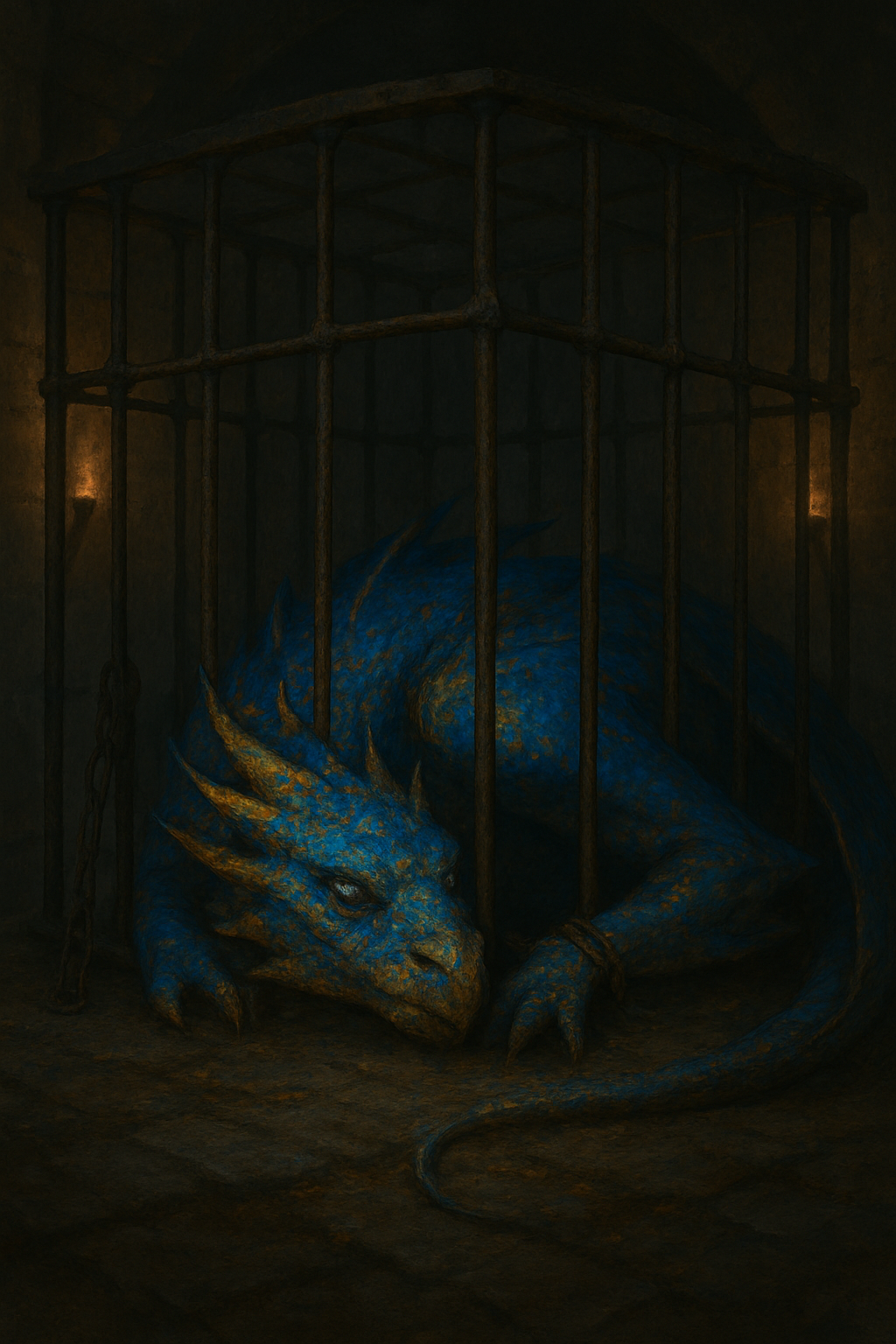
The fortress is silent in the way only places of suffering ever are—thick, stale, and heavy with the echo of screams that have long since died. Every step through the corridor disturbs dust that looks too much like ashes. The walls are carved with gouges where claws and chains scraped stone until both broke.
The scent hits first.
Burnt metal. Old smoke. Blood that’s gone cold.
For a moment, it almost feels as though there’s another smell beneath it all—something sweet and rotten at the same time—but when attention turns toward it, it vanishes.
The chamber at the end is a tomb masquerading as a room. An iron cage—massive, ugly, and rust-wet—sits like an altar to cruelty. Its bars are twisted inward, not outward, as if something inside fought so desperately to escape that the metal itself tried to fold around it.
Inside lies the dragon.
A creature once feared and revered reduced to a husk—ribs visible between sunken scales, wings cracked like shattered glass. Its eyes remain half-open, a cloudy sheen masking whatever terror or defiance once burned there. Dried blood streaks down its snout, pooling beneath its jaw. Whoever held it here didn’t simply imprison it.
They broke it.
The residue of its final breath—charcoal, heat, and agony—still lingers in the air. It died recently. It died slowly. And it died waiting for someone who never came.
The room doesn’t just feel abandoned.
It feels accusing.
The shadows seem wrong somehow. Not moving, exactly, yet never quite where memory insists they should be. More than once, the dragon appears to be watching from the corner of one’s vision, its clouded eye fixed upon the doorway. Each time the gaze returns, it is only a corpse again.
There is no triumph here, no hope, no salvation. Only the stench of failure, the weight of a life extinguished, and the unspoken truth that whoever steps into this chamber now is far, far too late.
Yet the silence refuses to settle. It hangs suspended, tense and expectant, as though the room is listening for an answer to a question nobody remembers asking.
The Ashen Covenant
Long before Asura’s imprisonment, dragons were not merely beasts or wandering titans. They were living forces of nature—ancient creatures whose existence shaped kingdoms, climates, and the course of history itself. Entire civilizations rose beneath the shadows of their wings. Rivers changed course where they nested. Mountains were named after their battles.
Many revered them.
Others feared them.
The faction responsible for Asura’s fate was born from that fear.
Known throughout the world as The Ashen Covenant, the organization began centuries ago after a series of catastrophes collectively remembered as The Scorching Years. During that era, wars between rival dragons devastated entire regions. Cities vanished beneath dragonfire. Forests burned for decades. Millions died beneath conflicts they neither understood nor controlled.
From those ashes emerged a belief that would eventually become doctrine:
“No creature should possess the power of a god.”
The Covenant was founded by survivors, scholars, rulers, and military commanders who had lost everything. Initially, they existed only to defend settlements from dragon attacks. Over generations, however, their purpose evolved.
Protection became containment.
Containment became eradication.
By the modern age, the Ashen Covenant viewed every dragon as an inevitable catastrophe waiting to happen.
Even the peaceful ones.
Especially the powerful ones.
⸻
The Covenant’s Structure
The Ashen Covenant operates across nearly every civilized nation.
Its members are divided into specialized orders:
The Ironwardens
* Dragon hunters and battlefield commanders.
* Equipped with weapons forged from blackened star-metal capable of piercing dragon scales.
* Responsible for direct engagements and captures.
The Veilkeepers
* Scholars, interrogators, and archivists.
* Study dragon behavior, weaknesses, and ancient history.
* Maintain vast records detailing every known dragon lineage.
The Ember Priests
* Fanatical spiritual leaders who preach that dragons are remnants of an ancient corruption.
* Viewed with unease even by other Covenant members.
* Responsible for many of the organization’s harshest doctrines.
The Chainforgers
* Engineers and artificers who design anti-dragon weapons.
* Creators of the restraint systems used in dragon prisons.
* Their inventions are feared throughout the world.
⸻
Why Asura Was Hunted
Unlike many dragons, Asura was not feared because she was cruel.
She was feared because she was powerful.
Ancient records describe her as one of the last descendants of the Solar Brood, a nearly extinct dragon lineage capable of generating enough heat to reshape landscapes. Her flames were said to melt castle walls and turn entire battlefields into glass.
Yet what truly alarmed the Covenant was a prophecy uncovered by the Veilkeepers.
Fragments recovered from ruined temples spoke of a dragon whose fire would one day either save the world from an approaching darkness—or burn civilization to its foundations while trying.
The prophecy never named Asura directly.
But the descriptions matched her too closely for the Covenant’s comfort.
To them, uncertainty itself was unacceptable.
A dragon capable of saving the world was equally capable of destroying it.
Therefore, she had to be neutralized.
⸻
The Hunt
The campaign against Asura lasted nearly eight years.
Entire fortresses were constructed solely to track her movements. Spy networks stretched across continents. Mercenaries, monster hunters, and rival rulers were bribed into cooperation.
The Covenant called the operation:
The Final Ember Campaign.
At first, they attempted diplomacy.
When that failed, they attempted intimidation.
When that failed, they declared her an existential threat.
The hunt became a crusade.
Asura spent years evading increasingly sophisticated traps. Every sanctuary she visited was eventually discovered. Every ally she trusted became a potential target.
Some were imprisoned.
Others disappeared.
Many died.
Slowly, her world was stripped away piece by piece.
Not through overwhelming force.
Through relentless pressure.
The Covenant did not seek victory.
They sought exhaustion.
And eventually, exhaustion won.
⸻
Blackreach Bastion
Asura’s final prison was known as Blackreach Bastion, a fortress deliberately constructed in one of the most remote regions on the continent.
Built into a dead volcanic mountain, the stronghold was designed specifically to hold dragons.
The walls were lined with heat-absorbing stone.
The chains were engraved with suppression runes.
The cells were intentionally isolated from one another to prevent communication between prisoners.
No rescue had ever succeeded there.
No escape had ever been recorded.
To the Covenant, Blackreach was considered the ultimate solution.
To its prisoners, it was known by another name:
The Place Where Dragons Go To Die.
Created Jun 9
Updated Jun 10
Published Jun 9