
Chair
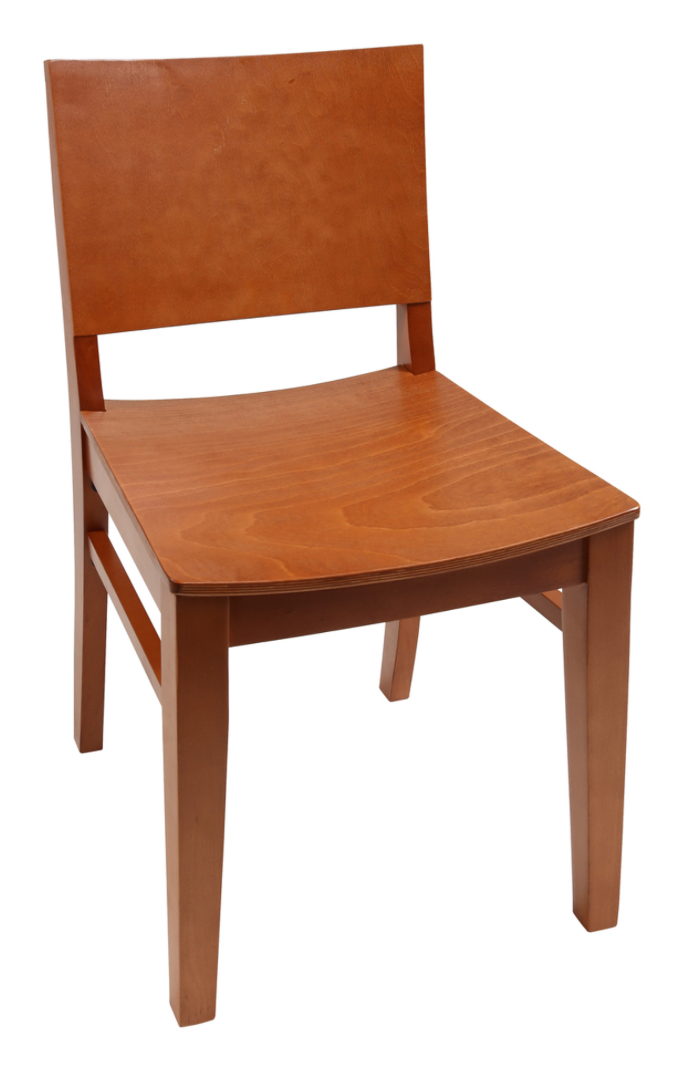
This chair is a classic four-legged wooden dining chair that embodies simplicity and function while retaining a warm, natural aesthetic. Its construction appears to be entirely made from wood, possibly birch or beech, which is finished with a medium honey-brown stainthat highlights the subtle wood grain and texture across every surface. The chair has a rectangular backrest that is slightly wider than the seat itself, giving it a balanced yet grounded visual weight. The backrest panel is completely flat with smooth edges, lacking any carvings, ornamentation, or cushioning — this creates a clean, minimalistic silhouette suited for a variety of settings, from dining rooms to casual meeting spaces.
The backrest’s position is slightly reclined backward in a very subtle angle, offering ergonomic support without resorting to complex curves or additional padding. The wood grain on the backrest runs horizontally, showcasing gentle undulations in the material — faint patterns that catch light differently depending on viewing angle, adding a quiet elegance to an otherwise utilitarian piece. Its edges are gently rounded, softening the visual rigidity of the rectangular panel and preventing discomfort if leaned against.
Moving downward, the seat of the chair is an understated triumph of craftsmanship. It is flat with a very gentle downward slope toward the back — a design choice that subtly encourages proper posture. The front edge of the seat has a slight curve downward, ensuring comfort for the thighs and avoiding sharp edges that could dig into the user’s legs. The seat appears to be constructed from a single wooden panel or possibly laminated wood layers pressed and shaped to maintain durability over years of use. Its grain runs longitudinally, harmonizing visually with the backrest yet distinct enough to feel cohesive rather than monotonous.
The legs of the chair are straight, squared-off, and robust, providing excellent stability and durability. Each leg is uniform in width from top to bottom, though slightly beveled at the edges to prevent splintering and to contribute to the soft, approachable aesthetic. The front legs descend directly from the corners of the seat, perfectly vertical and free of ornamentation. The rear legs extend upward seamlessly into the frame of the backrest, creating a continuous line from floor to back support — this is both visually clean and structurally sound, reinforcing the backrest without additional crossbars.
Connecting the legs near the bottom are side stretchers — horizontal support beams that increase the chair’s strength and longevity. These stretchers are positioned closer to the seat than the floor, meaning they won’t interfere with the feet of the person seated. Their presence hints that the chair is designed for regular, possibly commercial use — perhaps in cafes, restaurants, or school environments where durability is key.
The overall finish is matte to semi-gloss, reflecting light softly rather than glaring harshly. This finish not only enhances the tactile warmth of the wood but also makes it easier to maintain and clean, particularly useful in environments prone to spills or heavy use. The chair’s construction uses visible joinery that suggests sturdiness; there are no decorative nails or metal components in plain sight, indicating it might be assembled using dowels or hidden screws for a seamless appearance.
In terms of proportions, the chair maintains a classic dining chair height — likely around 17 to 18 from the floor to the seat, and approximately 30 to 34 in total height. The seat width is moderately sized, providing comfort without excess bulk, making it adaptable for use in tight spaces like crowded dining areas or compact kitchens.
Visually, the chair conveys a mid-century utilitarian design ethos — it avoids elaborate ornamentation, focusing instead on the inherent beauty of the wood and precise construction. Its aesthetic bridges both modern and traditional spaces: it would look equally appropriate around a farmhouse-style wooden table or within a minimalist contemporary interior dominated by neutral tones. The warm brown hue pairs easily with other furniture finishes, especially natural woods, black metal accents, or even soft textiles like linen seat cushions should one wish to add comfort.
This chair’s versatility is notable: though simple, it carries an understated sophistication that allows it to blend into numerous environments. In a café, it would evoke a sense of grounded, casual comfort. In a home dining room, it could complement rustic or modern décor. In an office or waiting area, its unembellished structure suggests reliability and seriousness without appearing cold.
The craftsmanship suggests durability — it appears capable of withstanding years of use without loosening or wobbling. The sturdy legs, reinforced with side supports, are especially well-suited for high-traffic areas. The finish is practical: resistant to minor scratches and easy to clean with a damp cloth, meaning it would endure spills or fingerprints without quickly showing wear.
In conclusion, this chair is a paragon of practical design: simple yet refined, strong yet approachable. Its clean lines and warm finish make it adaptable to many décor styles while remaining timeless in appearance. It’s the sort of piece that quietly serves its function without calling undue attention to itself — dependable, familiar, and likely to outlast trend-driven furniture around it.
Created Jul 27, 2025
Updated Jul 27, 2025
Published Jul 27, 2025