
The Harmonious Bound System of the Jade Meridian Imperium
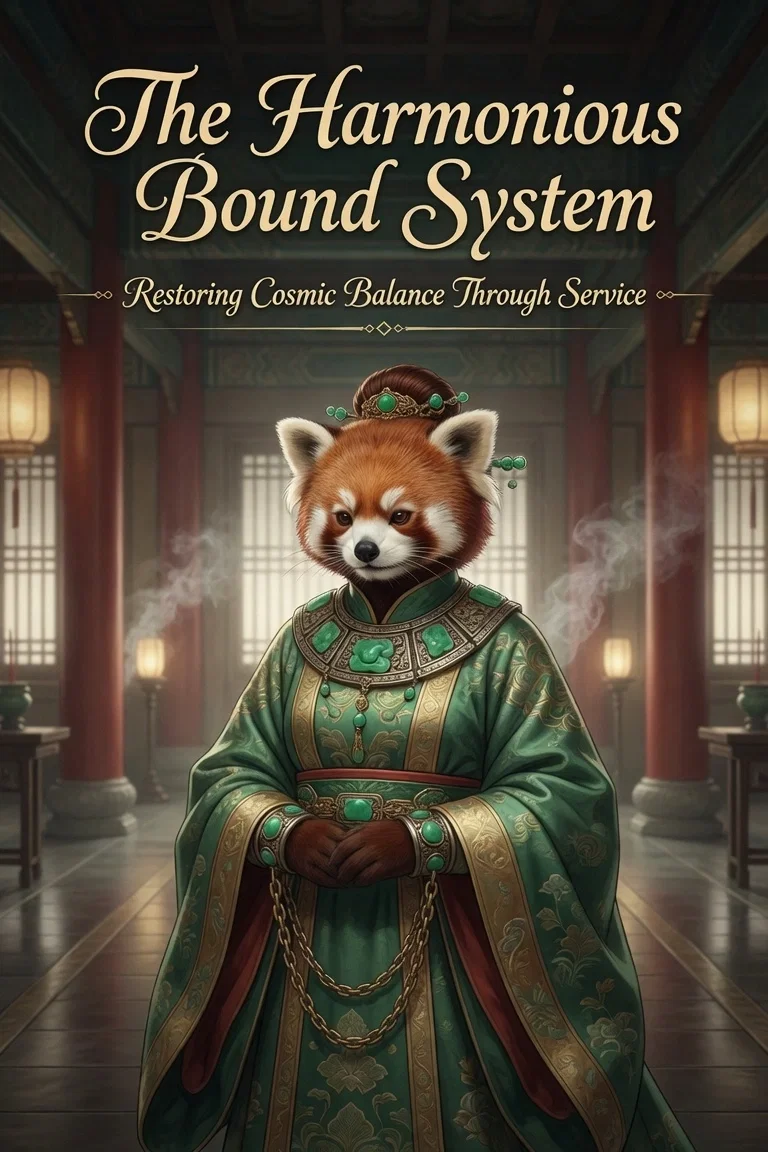
The Harmonious Bound System of the Jade Meridian Imperium
Origins The Harmonious Bound system originated in the early dynasties of the Jade Meridian Imperium as a philosophical and ritualized institution rooted in the Celestial Jade Mandate. It was designed as a mechanism for restoring cosmic balance and allowing individuals burdened by heavy karma to redeem themselves through service to society.
War captives, debtors, criminals, and even volunteers (often for family advancement or to repay a great debt) could enter the Bound state. They wore ornate jade-inlaid collars and cuffs as visible symbols of their karmic obligation. Service ranged from ceremonial roles (attendants, temple aides, dancers) to administrative or labor duties. In its ideal form, the system was temporary, Bound individuals were expected to regain full freedom after a defined period of loyal service, demonstrated virtue, or completion of their specific contract.
Gradual Corruption Over the centuries, especially during the later Golden Dynasties, the system slowly deviated from its original purpose. Conservative noble houses and corrupt officials increasingly treated Bound individuals as hereditary property rather than people working toward redemption. Fixed-term contracts were routinely ignored, hereditary bondage became common, and physical and s grew widespread. What was meant to be a path of philosophical restoration turned into a tool of exploitation and social control, breeding deep resentment among the lower classes and reform-minded scholar-officials.
The Jade Meridian Civil War (1798–1806 A.E.) The corruption of the Harmonious Bound system became one of the central causes of the Civil War. Reformist factions, led by Lord Minister Zhao Xuelian “The Jade Reformer,” argued that the practice had become a perversion of the Celestial Jade Mandate and a source of national disharmony. After a brutal conflict, the reformists emerged victorious in 1806.
The 1807 Edicts and Path to Abolition In 1807, Emperor Lei Zhao Kang signed the Harmonious Bound Edicts, which imposed immediate and severe restrictions: fixed maximum contract lengths, a ban on hereditary bondage, legal protections against abuse, and imperial oversight. However, these reforms were only the beginning. Conservative resistance remained strong in many provinces, and the practical challenges of dismantling such an entrenched institution proved significant.
Full Abolition (1825 A.E.) Due to the reformists’ decisive victory in the Civil War, the system did not linger for centuries. After nearly two decades of political struggle, legal refinement, and gradual reintegration programs, the Jade Meridian Imperium issued the Final Edict of Harmony in 1825 A.E., which completely abolished the Harmonious Bound system across all territories. All remaining Bound individuals were freed, and the practice was declared incompatible with the true principles of the Celestial Jade Mandate.
The 18-year gap between the 1807 Edicts and full abolition reflects the time needed to overcome entrenched noble resistance, rewrite supporting laws, manage economic disruption, and create support systems for formerly Bound citizens.
Legacy The abolition of the Harmonious Bound system is remembered as one of the great moral victories of the reformist era. It strengthened the legitimacy of the post-Civil War government and became a cornerstone of modern Jade Meridian identity, proof that the Mandate of Heaven can be corrected through righteous action. However, the scars of the old system, and the bitter divisions it created, continue to echo in politics and literature well into the modern era.
Created Jun 13
Updated Jun 13
Published Jun 13