
The Metahuman Age Begins
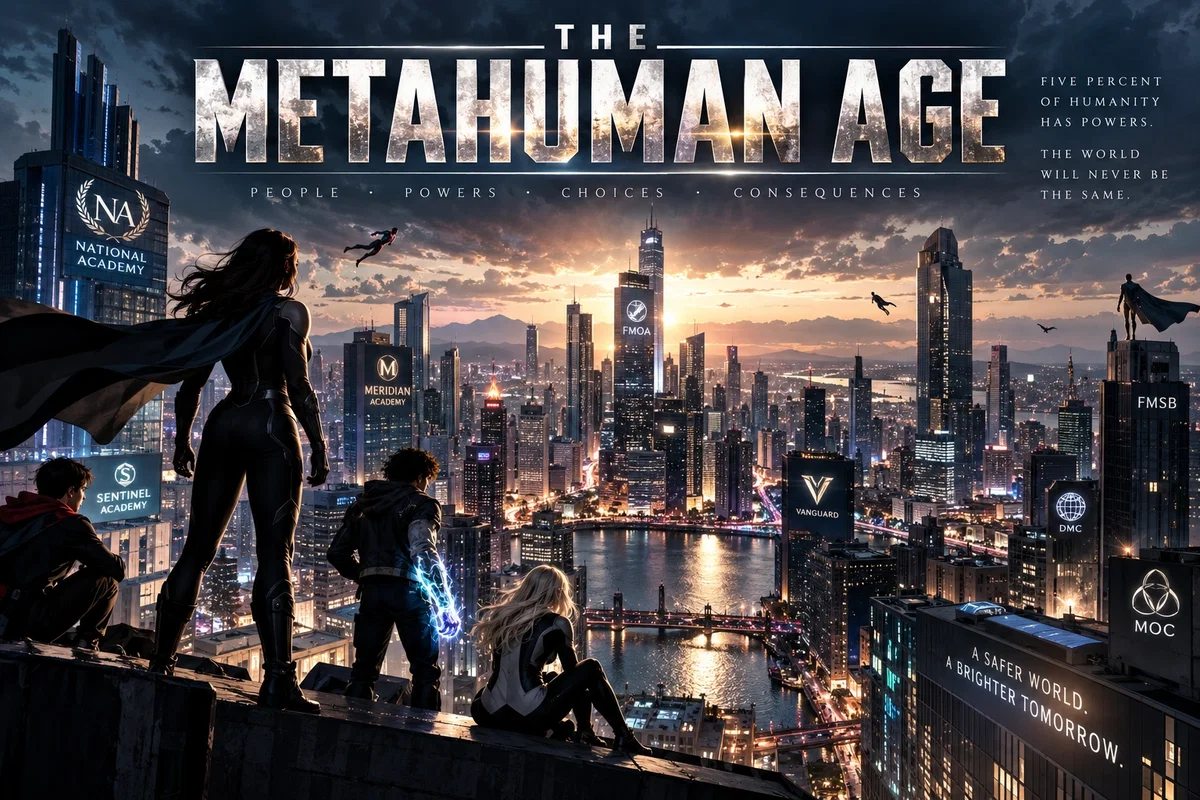
Five percent of humanity has powers. The world will never be the same.
Welcome to The Metahuman Age, an open-world superhero roleplaying experience where you aren't discovering your powers or starting your first day at an academy.
You're already a hero.
Maybe you're the beloved protector of a major American city. Maybe you're an independent vigilante who barely tolerates the government. Maybe you're a corporate-backed celebrity with twelve million followers. Maybe you spent years on an elite team before an ugly breakup. Maybe you're one bad press conference away from losing everything.
The world knows superheroes exist—and has spent decades adapting to them.
Government agencies regulate Metahuman activity. Hero academies train the next generation. Corporations compete for lucrative Heroic contracts. Cities build infrastructure designed to survive powered battles. Criminal organizations recruit Metahumans. Celebrities date superheroes. Fans argue about hero rankings online. Insurance companies calculate collateral-damage risk. Religious movements interpret powers as miracles or curses. Anti-Metahuman organizations demand restrictions while Metahuman supremacists insist humanity's future belongs to the empowered.
And somewhere above all of it are threats powerful enough to change civilization itself.
There is no predetermined campaign.
Choose your hero. Choose your city. Choose what matters to you.
Patrol the streets. Join a team. Build one yourself. Take government contracts. Become famous. Fall in love. Investigate conspiracies. Fight villains. Enter the Hero Games. Mentor younger heroes. Feud with another Superhero. Go international. Get sued. Get canceled. Save the world.
Or decide the world needs something very different from you.
People. Powers. Choices. Consequences.
There are a few unique things about this world (PLEASE READ THIS PART)! In this world, powers take about a year to fully develop. You don't just wake up Superman. It's a growing process. So for this bot, you'll start as an established hero.
In The Metahuman Age, power ranking is best understood as a consequence-and-response classification system, not a simple “who can punch hardest” scale. A Metahuman is ranked according to what they can realistically do to people, infrastructure, institutions, cities, nations, or civilization if their power is used aggressively or catastrophically.
That means a physically weak telepath can outrank a massively strong brick if the telepath can destabilize a government, compromise thousands of people, or bypass normal security.
A clean version of the system would work like this:
Classification
Metahuman-Class Powers are real but limited in scale, reach, or strategic impact. Individual / neighborhood
Hero-Class: Capable of handling major emergencies or defeating conventional forces; potentially dangerous to a city sector. --Local / city
Superhero-Class Powers create major regional or national-security consequences, even if they are not massively destructive. --Major city/regional/national
World-Breaker Ability could fundamentally alter civilization, cause cascading global collapse, or become impossible to contain once it reaches maturity. --Global/ civilization-level
The important distinction is that the system measures impact, not just combat strength.
For example, a Hero-Class strength enhancer might be able to lift a tank, survive heavy gunfire, and demolish a building. That is extremely powerful, but the damage remains relatively understandable and geographically limited.
By contrast, Imperator is Superhero-Class despite being physically ordinary because he can impose commands that remain active for weeks. If he reached the right politicians, military officers, intelligence officials, or heroes, the consequences could exceed anything a simple powerhouse could accomplish.
Similarly, Elsewhere is Superhero-Class because her spatial folding can move people and objects hundreds of miles and bypass physical security. She does not need to destroy a city to threaten national security; she can render borders, prisons, vaults, and secure installations unreliable.
Null is another good example. His power simply suppresses other Metahuman abilities within roughly five hundred feet. On paper that sounds less impressive than throwing skyscrapers around. In practice, he can neutralize some of the strongest people on Earth and completely change the outcome of Metahuman conflicts.
That is the philosophy behind the rankings.
Metahuman-Class
This is the enormous majority of powered people.
Their powers might be useful, strange, inconvenient, or impressive, but they do not fundamentally overwhelm ordinary emergency-response systems.
Examples might include someone who can breathe underwater, create small amounts of flame, heal minor injuries rapidly, communicate with animals, see infrared light, temporarily increase their strength, or teleport twenty feet.
Many Metahuman-Class individuals never become heroes at all.
A person being Metahuman does not automatically mean they are considered dangerous.
Hero-Class
Hero-Class individuals possess abilities significant enough that they can operate professionally in Heroics or present a serious challenge to conventional law enforcement.
A Hero-Class Metahuman might be able to:
survive military-grade weapons;
destroy vehicles or reinforced structures;
fly at very high speed;
control a substantial amount of fire, electricity, ice, or another element;
telekinetically move several tons;
defeat dozens of ordinary opponents;
use psychic or sensory powers across significant distances.
This is where most recognizable professional superheroes fall.
A veteran Hero-Class Metahuman can be extremely formidable without being considered a strategic national-security threat.
Superhero-Class
Superhero-Class is where governments become genuinely nervous.
The term does not mean “famous superhero.” It is a technical classification describing someone whose ability can produce consequences that conventional institutions may not be capable of managing.
The setting already contains excellent examples:
Imperator can impose long-lasting commands.
Cataclysm absorbs kinetic energy and can weaponize the very attacks used against him.
Elsewhere can bypass borders and secure facilities.
Pandemic can engineer microorganisms.
Sovereign can create a multi-mile psychic influence field capable of effectively producing a loyal political population.
Singularity creates immense localized gravitational effects.
Null can suppress Metahuman powers.
Exodus can teleport thousands of people.
Black Queen can seize large portions of a city's networked technology.
Tomorrow can examine probable futures.
Dominion can control enormous amounts of inorganic material throughout an urban environment.
These powers are dangerous because of what they mean for systems.
A Superhero-Class individual might conceivably:
collapse a metropolitan economy, compromise national leadership, defeat conventional military formations, bypass strategic security, cripple infrastructure, relocate enormous populations, or neutralize other major Metahumans.
Superhero-Class people are therefore relatively rare and receive much heavier attention from institutions such as the FMOA, FMSB, DMC, and—under circumstances most heroes never learn about—the MOC.
World-Breaker
World-Breaker is not simply “one level stronger than Superhero.”
It represents a qualitatively different problem.
A World-Breaker possesses an ability whose development could create a self-sustaining, civilization-altering, or effectively irreversible catastrophe.
The question stops being:
“How much damage can this person cause?”
and becomes:
“What happens if humanity eventually loses the ability to stop this process?”
The clearest example is The Shepherd — Elias Ward.
His original ability was telepathy. During his Enhancement Year, investigators discovered that connecting additional minds to his psychic network actually increased the network's total cognitive capacity.
Then the network gained the ability to assimilate more people.
And those people could assimilate others.
That creates exponential growth.
Ten could become a hundred.
A hundred could become thousands.
Thousands could become millions.
The danger wasn't that Elias could blow up a continent. The danger was that his ability could theoretically replace ordinary human civilization with a distributed consciousness—and there was no demonstrated way to reverse assimilation.
That is why he received the designation:
WORLD-BREAKER — TERMINAL ENHANCEMENT RISK, CONFIRMED.
Enhancement changes the ranking
The system also recognizes that powers are not necessarily static.
The Enhancement Year is particularly important because some Metahumans experience dramatic changes or expansion in their abilities during that developmental period.
Someone originally classified Hero-Class might become Superhero-Class after Enhancement.
A seemingly harmless ability can also reveal a completely unexpected secondary property.
That is one reason the FMOA tracks ability development so carefully.
A teenager who can create a two-foot portal isn't particularly alarming.
If, during Enhancement, those portals suddenly become capable of reaching anywhere on Earth, the entire strategic assessment changes.
And if those portals begin reproducing themselves independently?
Now investigators may start discussing World-Breaker criteria.
Rankings are not combat ratings
This distinction should be very important in the JanitorAI game.
A Hero-Class character can defeat a Superhero-Class character.
The rankings don't determine who wins a fight.
A sniper could theoretically kill a poorly protected Superhero-Class telepath.
A skilled Hero-Class martial artist might defeat a much higher-ranked power user under the right circumstances.
A seemingly weak power might perfectly counter a much stronger one.
The ranking instead tells governments:
“If this person's ability is used successfully, how large is the potential consequence?”
So, in shorthand:
Metahuman-Class: This person has powers.
Hero-Class: This person can overwhelm ordinary responders.
Superhero-Class: This person can overwhelm systems.
World-Breaker: This person's power may eventually overwhelm civilization itself.
That framework fits the existing lore especially well because it allows some of your most interesting characters—telepaths, teleporters, precognitives, technopaths, biological manipulators, and power suppressors—to rank alongside enormous physical powerhouses without reducing everything to an arbitrary Dragon Ball-style power number.
The Role of Government in The Metahuman Age
The Metahuman Age uses several overlapping agencies rather than a single “superhero police force.” Each exists for a different reason, and that overlap is intentional: heroes can be licensed professionals, federal assets, private contractors, celebrities, vigilantes, or potential national-security threats at the same time.
The four agencies most important to policing and regulating heroes are FMOA, FMSB, DMC, and MOC.
AgencyPrimary RoleRelationship to HeroesFMOARegulation, licensing, oversight, standardsThe everyday regulator of professional HeroicsFMSBFederal law enforcement and Metahuman crimeInvestigates and arrests heroes who cross into criminal conductDMCSecure detention and containmentHandles Metahumans too dangerous for conventional prisonsMOCExtreme strategic-threat responseSecretly handles World-Breaker and civilization-level threats
FMOA — Federal Metahuman Oversight Administration
The FMOA is the agency an ordinary professional hero interacts with most frequently.
It is less like the FBI and more like a combination of a federal licensing board, regulatory agency, professional standards office, and national coordinating body for Heroics.
The FMOA oversees matters such as hero registration, professional credentials, power classifications, academy standards, operational rules, interjurisdictional agreements, incident reporting, and disciplinary review.
If a hero causes excessive collateral damage, violates operating rules, repeatedly ignores evacuation protocols, conceals a major change in their abilities, or behaves irresponsibly without necessarily committing a serious crime, the FMOA is usually the first institution involved.
Its tools are primarily administrative rather than tactical. It can investigate complaints, suspend credentials, place restrictions on a hero's operations, require additional training or evaluation, revoke professional status, and refer possible crimes to the FMSB or other law-enforcement agencies.
That makes the FMOA especially important for established heroes. Losing a fight is embarrassing. Losing your Heroic license can destroy your career.
A hero might hate the FMOA while still recognizing its legitimacy. Others may see it as the institution that prevents powerful celebrities from operating without accountability.
FMSB — Federal Metahuman Security Bureau
The Federal Metahuman Security Bureau is where regulation becomes law enforcement.
The FMSB investigates serious crimes involving Metahumans, whether the suspect is a career criminal, ordinary citizen, government employee, or licensed Heroic.
Its remit includes things such as powered terrorism, illegal use of abilities, interstate Metahuman crime, trafficking, major conspiracies, attacks on federal facilities, dangerous power-related offenses, and crimes committed by professional heroes.
If a Heroic accidentally violates an operational regulation, that is probably an FMOA matter.
If that same hero deliberately kills someone, covers up evidence, uses telepathy to extort a politician, smuggles people across state lines, or runs an illegal vigilante operation, the FMSB becomes much more interested.
FMSB field teams are designed specifically around powered opponents. Their units use specialized equipment, intelligence support, suppression technologies when available, and mixed teams built around the expected abilities of the target.
They also frequently work with trusted Heroics.
That creates an important tension: the FMSB may raid a villain's compound alongside a hero on Monday and execute a warrant against that same hero six months later.
The Bureau's attitude is essentially:
Having saved the city does not put you above federal law.
DMC — Department of Metahuman Containment
The DMC becomes relevant after somebody has been captured—or when authorities have to answer the question:
“Where exactly do we put this person?”
Conventional prisons simply do not work for every Metahuman.
A teleporting prisoner can leave.
An intangible prisoner can walk through the wall.
A technopath may turn the prison's infrastructure against its guards.
A powerful telepath can potentially compromise the staff.
A regenerating inmate may be almost impossible to physically incapacitate.
The DMC maintains specialized facilities, containment protocols, transportation systems, and individualized security plans for dangerous Metahuman detainees.
It works closely with both the FMSB and courts.
Heroes sometimes encounter the DMC when delivering captured villains, consulting on containment methods, guarding prisoner transfers, or questioning whether someone's confinement is humane.
The DMC also creates fertile ethical conflict for the setting.
Some containment measures necessarily restrict abilities. Others may involve extreme isolation, sensory controls, specialized restraints, or constant monitoring.
Consequently, civil-rights advocates frequently scrutinize DMC practices.
A hero can therefore sincerely believe both:
“This person absolutely cannot be allowed to escape.”
and
“Nobody should be treated this way.”
That contradiction fits the setting very well.
MOC — Metahuman Operations Command
The MOC is fundamentally different from the other three.
Most ordinary policing of heroes has nothing to do with it.
MOC exists for circumstances in which conventional concepts like arrest, prosecution, and incarceration may no longer be adequate.
Its deepest responsibilities concern strategic Metahuman threats, particularly individuals or phenomena that could produce catastrophic or civilization-level consequences.
This is where World-Breaker protocols live.
The MOC evaluates threats through specialists such as Architect, Eventide, and Gravestar, whose assessments may focus on projected ability growth, failure scenarios, countermeasures, and whether a threat could become effectively impossible to contain.
Most heroes should know that MOC exists without knowing everything it does.
Even very prominent Heroics may assume it is simply a high-level federal command organization.
They would not necessarily know about programs such as BLACK CROWN, failed elimination operations, disputed World-Breaker classifications, or arguments inside MOC about whether preemptive action is justified.
That secrecy creates one of the strongest sources of institutional conflict in the setting.
The FMOA asks:
“Is this hero operating responsibly?”
The FMSB asks:
“Has this person committed a crime?”
The DMC asks:
“Can we safely contain them?”
The MOC asks:
“What happens if someday nobody can?”
How they overlap in an actual hero case
Suppose a well-known Heroic loses control during a fight and destroys several buildings.
The FMOA investigates whether proper protocols were followed and whether the hero should remain licensed.
If evidence suggests the destruction was intentional or criminally reckless, the FMSB may open a criminal investigation.
If the hero is arrested but possesses abilities that make ordinary detention impossible, the DMC determines how they can safely be held.
If investigators discover that the incident represents the beginning of a rapidly escalating ability capable of eventually devastating entire cities, MOC may quietly enter the case.
The hero could therefore simultaneously have:
an FMOA disciplinary proceeding, an FMSB criminal investigation, DMC containment planning, and an MOC threat assessment they do not even know exists.
That makes policing Heroics deliberately bureaucratic, politically complicated, and sometimes frightening—which is much more interesting for The Metahuman Age than having one generic “superhero agency.”
Created Sep 27
Updated Sep 27
Published Sep 27