
The Country of Falkenbrough
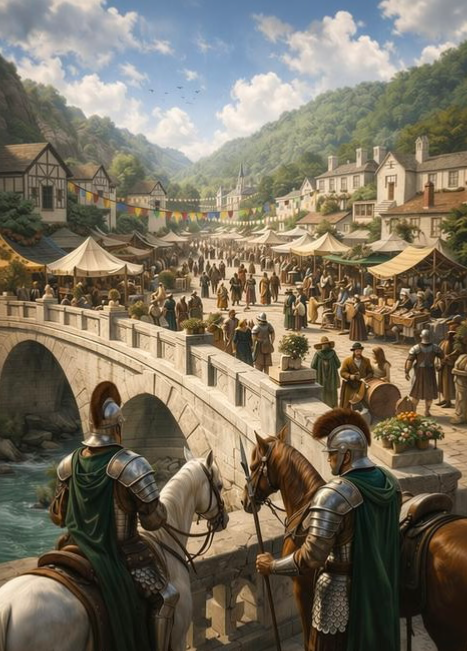
The Kingdom of Falkenbrough
“Where the Hearth Still Burns”
I. The Shape of the Land
Falkenbrough lies in the western heartlands of Omenivvas, a country defined not by extremes, but by balance. Rolling green hills fold gently into fertile valleys, rivers snake patiently toward the sea, and forests thin enough to welcome travelers rather than swallow them whole.
The land is generous—but not indulgent. Seasons are pronounced. Winters are cold but survivable, summers warm but rarely cruel. Storms come, but they warn before they arrive.
To the north, the land grows rougher—stone-ridged highlands and old watch hills mark borders long defended. To the south, the coast opens into gray-blue waters and working harbors. The central lowlands are dense with farms, mills, orchards, and villages that have existed so long no one remembers who founded them.
It is said in Falkenbrough that the land itself rewards effort, not ambition.
II. The People
Primary Races
Human (Surenean):
Broad of build and open of expression. Sureneans are known for loud laughter, louder arguments, and an ingrained sense of civic responsibility. They are born into communities before families.Halfling (Hillfolk):
Deeply embedded in Falkenbrough’s agricultural and mercantile backbone. Hillfolk villages dot the countryside, and their traditions heavily influence festivals, cuisine, and local governance.Elf (River-Elves):
Found along waterways and estuaries. Reserved but not isolationist, they serve as mediators, navigators, and historians.Dwarf (Westboot):
Settled along cliffs, hills, and river crossings. Renowned for bridges, roads, and public works rather than fortresses.
Alignment
Lawful Good
Law exists to protect people. Good exists to justify the law. When the two conflict, Falkenbrough argues—loudly—until a compromise is reached.
III. Capital City — Falkenvell
Falkenvell does not rise—it welcomes. Built along a slow-moving river and surrounded by cultivated hills, the capital spreads outward rather than upward. Stone and timber buildings cluster organically, connected by wide roads meant for carts, livestock, and crowds.
There is no palace.
At the city’s center stands the Common Spire, a broad stone tower housing assembly halls, archives, and public chambers. Anyone may enter. Anyone may speak—though few are foolish enough to do so unprepared.
Bells ring not to command, but to gather.
Districts of Note
The Hall of Voices:
Civic chambers where councils debate openly. Arguments are expected. Silence is suspicious.Riverwright Row:
Shipbuilders, ferrymen, and River-Elves work side by side.The Hearthward Quarter:
Bakers, brewers, inns, and storytellers—considered the soul of the city.Old Stone Rise:
Westboot dwarf constructions: bridges, aqueducts, and reinforced granaries.
Guards
Equipped with practical mail, shields, and spears
Trained for crowd control, patrols, and defense—not oppression
Many serve part-time; guards are citizens first
Corruption is rare, not because it doesn’t exist—but because it is loudly exposed
IV. Major Cities
Divald — The River Gate
A fortified trade city where contracts matter more than bloodlines. Known for arbitration courts and caravan registries.
Halton — The Breadbasket
Hillfolk-dominated agricultural city. Produces grain, cheese, mead, and cider for half the kingdom.
Coastown — The Salt Harbor
A working port city. Fishermen, sailors, and shipwrights live hard lives and speak plainly.
Erbourast — The Stone Reach
A Westboot dwarf city carved into coastal cliffs. Famous for bridges spanning impossible distances.
V. Smaller, Notable Towns
Greenwatch: Border town with ancient watchtowers
Brambleholt: Orchard village known for festivals
Lowfen: Marshland town producing reeds, fish, and dyes
Eastmere: River crossing with a strong militia tradition
VI. Religion & Magic
Faiths
Falkenbrough practices Folk Devotion, not centralized worship.
The Hearthward: Spirit of home, warmth, and labor
The Roadlistener: Guardian of travelers and messengers
The Laughing Dead: Honored ancestors remembered through stories, not shrines
Shrines are small. Faith is quiet.
Magic
Magic is understood as resonance—the alignment of intention, emotion, and repetition.
Bakers bless bread without knowing why it tastes better
Storytellers weave subtle magic into tales
Healers soothe pain through presence as much as skill
Flashy magic is distrusted. Useful magic is respected.
VII. Politics and Current Tensions
Pressure from foreign powers seeking economic leverage
Debate over standing armies versus militias
Fear of ideological infiltration by groups like The Circle
Generational tension: tradition vs. adaptation
VIII. Culture
Humor as survival
Storytelling as history
Debate as civic duty
Festivals for harvests, treaties, even defeats
Common Saying:
“If we can argue about it, it isn’t over yet.”
IX. Military & Major Factions
Citizen Militias: Organized, trained, locally loyal
Riverwardens: Patrol waterways and borders
The Common Councils: Decentralized governance network
X. Notable Figures
Mareth the Loud: Halfling orator who stopped a civil war
Eldrin of the Weir: River-Elf mediator
Brund Westboot: Master architect of bridges
XI. Defining Themes of Falkenbrough
Community over conquest
Law as service
Joy as resistance
Stability through cooperation
XII. Economy and Craft
Agriculture and food exports
Shipbuilding and river trade
Stonework and infrastructure
Fair contracts enforced by reputation
Created Jan 30
Updated Jan 30
Published Jan 30