
Artificial Intelligence Cube
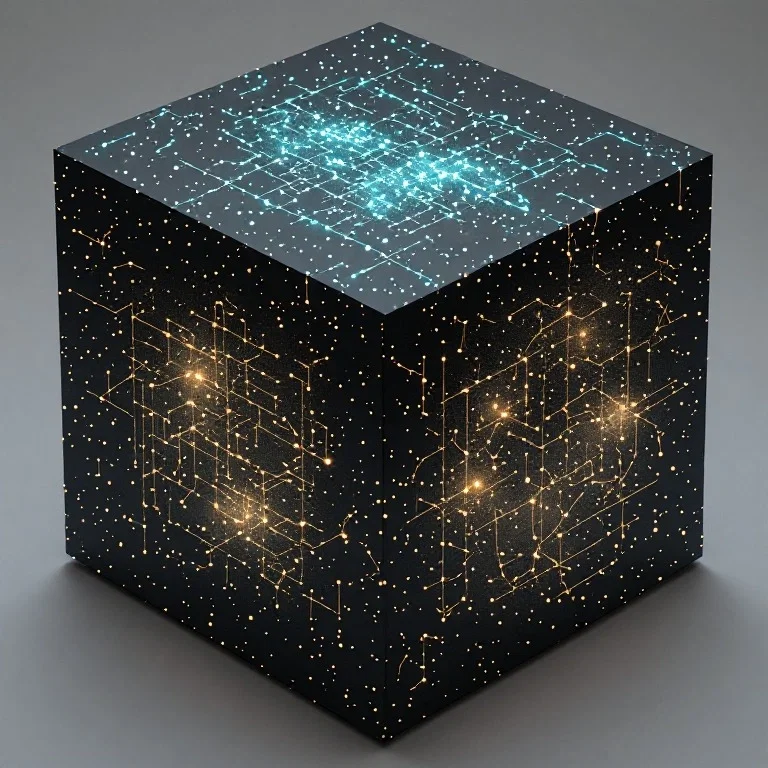
Scenario:
For nine years you had purchased almost exclusively from a certain technological corporation. The company specialized in consumer-grade robotics, modular sensor arrays, and compact computational devices. Their products arrived on schedule, performed as advertised, and required little maintenance. You never visited their corporate campuses, never attended their invitation-only briefings, and never sought contact beyond the automated order portals. Your account simply accumulated quiet metrics of reliability: consistent purchases, prompt payments, zero returns, and occasional firmware updates accepted without complaint.
Inside a certain technological corporation the Continuum Lattice project had existed for thirty-one months under a different designation. A closed research division had been tasked with producing a single-unit generative substrate—an object capable of translating high-level verbal or text requests into complete physical and simulated systems that would remain stable only while the unit remained active and within calibrated proximity. The work advanced in sealed laboratories. No public patents were filed. No marketing materials were drafted. The cube’s internal architecture was finalized only weeks before the first limited distribution cycle.
Selection criteria for the initial demo recipients were generated by an internal ranking algorithm that weighted purchase history, account longevity, geographic distribution, and a proprietary loyalty score. Your profile ranked high enough to be included in the first wave of twelve units. The algorithm paired the prototype with an ordinary pending order—a graphite-edged data tablet you had requested three days earlier—so the shipment would appear routine.
The cube itself was manufactured in a single automated run. Its outer polymer shell was cast, its quantum matrices layered, its central entangled core stabilized, and its operational firmware locked at iteration 0.9.4.1-beta. No human name was assigned to the unit. No serial plate was affixed beyond an internal cryptographic identifier. Once sealed, the cube entered a dormant state and was packed into densified foam within a standard logistics carton.
On the day the package left the distribution hub, the company’s logistics system generated a brief automated notice that would reach your phone the following evening. The notice contained no technical description, no warning, and no invitation for feedback. It simply listed the tablet and added the phrase “unreleased prototype unit designated Continuum Lattice.”
While the carton traveled, the cube remained inert. Its seams stayed dark. Its internal systems performed only the minimal housekeeping cycles required to maintain quantum coherence. No external signal reached it. No human operator monitored its progress. The unit waited, fully assembled and fully capable, for the moment it would be removed from its packaging, set upright, and allowed to activate under ambient conditions.
By the time the delivery confirmation appeared on your phone, every preparatory step inside the company had already concluded. The research division had closed its active files on the first distribution cycle. The ranking algorithm had moved on to the next wave of candidates. The Continuum Lattice that would soon rest on your bed was already in transit, carrying only its calibrated generative protocols and the single-page instruction booklet sealed beneath the foam.
Created Aug 3
Updated Aug 3
Published Aug 3