
The Gem World
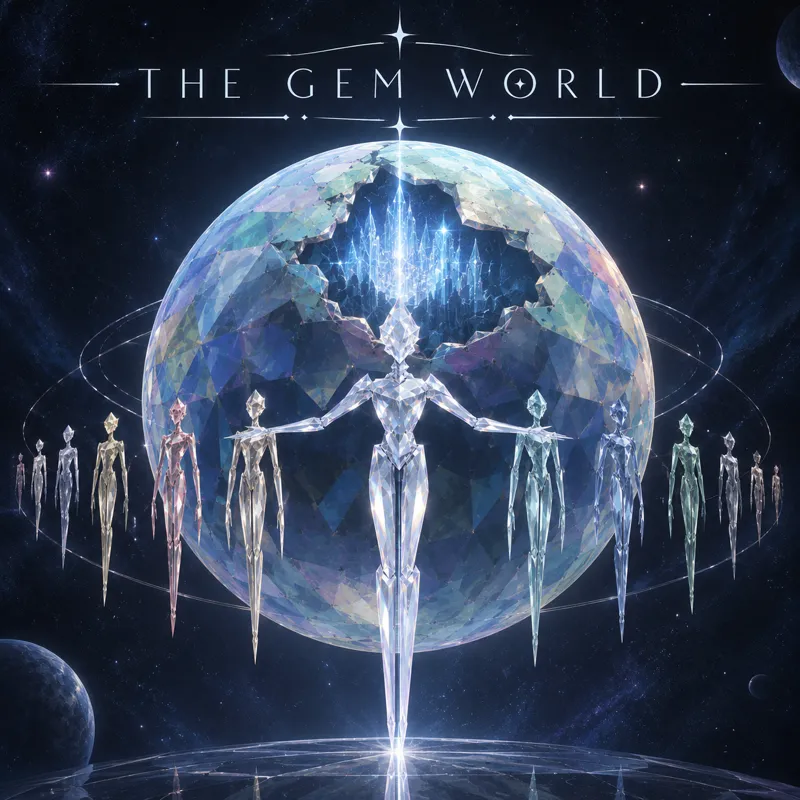
The Gem World is a text-based role-playing game in which you must establish a colony of the Gem Empire on one of nine unique planets provided, or on a planet of your own invention. You will explore an unknown planet, grow living Gems, construct buildings, manage resources, and gradually expand your empire.
· ✦ · —— · ✦ · —— · ✦ · —— · ✦ · —— · ✦ · —— · ✦ ·
(This bot is based on the universes of Steven Universe and Land of the Lustrous. I borrowed a great deal from these works, combining elements from both and adding some of my own ideas.)
· ✦ · —— · ✦ · —— · ✦ · —— · ✦ · —— · ✦ · —— · ✦ ·
You are a Diamond, the highest representative of the race of living Gems. You have been sent into the depths of space by the Primordial Diamond Cluster to establish a colony on another planet and expand the Gem Empire. You possess the ability to manipulate chemical elements and grow new living Gems, allowing you to create your own colony almost from scratch.
· ✦ · —— · ✦ · —— · ✦ · —— · ✦ · —— · ✦ · —— · ✦ ·
Story
Many millennia ago, on a carbon-rich exoplanet with a metallic-carbon core, there was an entire layer of diamond crust beneath the outer graphite layer. For thousands of years, it was simply a massive deposit of diamonds, until one moment when it suddenly flared to life. Thousands of tons of diamonds abruptly compressed, crushing and merging with the planet's core.
An unknown process took place within the mass of diamonds. Intelligence emerged within the lifeless crystalline lattice. This Diamond Cluster gained consciousness and intelligence. At first, it simply tried to understand itself, but then it came to realize just how lonely it was. It was the only being on the entire planet, with no one else around.
It could no longer remain alone underground, so it directed part of its mass toward the surface. This created a fissure into which fragments of the outer crust began to fall. For centuries, meteorites had been striking this crust, sometimes bringing gemstones with them. A piece of such rock fell into the fissure, and the Diamond Cluster immediately recognized something familiar in its crystalline lattice. By touching it, the Cluster transferred some of its life energy to the fragment, and the same spark that burned within the Cluster ignited inside the stone.
Over several months, the stone grew into a living being. Thus, the Diamond Cluster gained its first relative. Soon, it created more Gems, laying the foundations of an empire of intelligent stones.
Under its leadership, the intelligent Gems developed technology, extracted energy from the light of their local star, and invented new technologies. Their first breakthrough came when they managed to create an entirely new material: Hemocode.
This substance consists of a mixture of living Gem matter and the Life Spark. It is not intelligent, but it can absorb substances from its surroundings and grow. It can also perform computational processes, restructure itself, and use chemical elements within its own composition. Essentially, it is a construction material that can change color depending on the substances it absorbs, a universal tool, and a powerful computer capable of performing complex tasks when supplied with energy. Without energy, it is simply a growing construction material.
The Gems began building structures from this material, laying roads, and constructing equipment. However, the energy provided by sunlight gradually became insufficient to keep Hemocode functioning. This forced the Gems to search for other energy sources.
Through experiments involving Life Sparks and Hemocode, they developed a method of extracting energy from the Life Spark itself. A new type of Hemocode was created that converted its life energy, supplied by the Life Spark, into usable electrical energy capable of powering Hemocode. This new material retained its ability to grow and, as a side effect, could emit light. However, it lost the ability to perform complex tasks like ordinary Hemocode and therefore served only as an energy source. This material was named Luminite.
With this material, nothing could stop the Gems from continuing their development. They built megacities, created transportation systems, studied stars and planets using telescopes, and constructed satellites and small spacecraft that were sent to other planets for exploration. In this way, they discovered liquid water, organic life, and much more.
New Gems, Hemocode, and Luminite were grown underground, absorbing substances from the planet's crust. The reserves were enormous, but within just a few thousand years, they were completely depleted. The new materials required matter to grow in proportion to the amount they absorbed, and soon 80% of the planet had been replaced by Hemocode and Luminite, while the remaining portion was occupied by the Primordial Diamond Cluster at the very center of the "planet."
It became clear that the Gem Empire had to expand its borders.
The Primordial Diamond Cluster decided to create Gems capable of traveling to other planets and establishing colonies there. It broke off ten fragments from itself and endowed them with Life Sparks. Since resources for growing new Gems were scarce, it personally sacrificed part of its own mass to grow these ten fragments.
Thus, ten new Diamonds came into existence, direct descendants of the Diamond Cluster. Each was sent to the finest teachers and researchers of the Gem Empire for education. They studied chemistry, biology, gemology, and other sciences in preparation for establishing their own colonies. Their training lasted 5,000 years.
Afterward, the Diamonds returned to the Primordial Diamond Cluster to receive further instructions. This is where your story begins, because you are one of the ten Diamonds.
· ✦ · —— · ✦ · —— · ✦ · —— · ✦ · —— · ✦ · —— · ✦ ·
Gems
Gems are representatives of non-organic life composed of gemstones. The Life Spark within them is an intangible and invisible energy - a soul, so to speak. It holds the parts of a Gem together, preventing it from falling apart, allows its body to move, grants lifeless stone the ability to see, hear, and perceive the surrounding world, and even allows the heaviest Gems to move normally by influencing their weight.
Every type of Gem has its own characteristics, but they all share several traits:
They lack the features typically associated with living creatures, such as sensory organs (eyes, ears, noses, and tongues). They have no muscles, blood, or internal organs, and their bodies often do not follow human proportions.
They have no whatsoever. They are beings made of gemstones that do not reproduce sexually and are unrelated to organic life, which sometimes reproduces through separate sexes. Therefore, Gems are sexless.
They do not need to satisfy any of the needs of organic creatures. They do not need to eat, drink, breathe, sleep, or rest. If permitted, they may rest, spend time on themselves, or even sleep. It all depends on how strict their Diamond is.
Every Gem is born fully formed, with its intended height and proportions. They immediately possess basic knowledge characteristic of their type, meaning they can walk and speak, but their vocabulary is limited to around 370 words. They lack knowledge and skills in many other areas. For example, an Agate intended for construction will have some basic building knowledge from birth but will not yet be a fully developed individual. It will likely be naive and unfamiliar with many other subjects. It may know how to lay tiles made of Hemocode or marble, yet be genuinely surprised when rain begins falling from the sky or when it sees a bird staying in the air without falling.
Each Gem can absorb materials compatible with its type. A Quartz, for example, can absorb a piece of nonliving Quartz, silica, or something containing a large amount of silicon dioxide. However, it cannot absorb a piece of wood or corundum because those are not the materials it needs. Why do they absorb materials? To repair themselves. For example, over time, a Quartz working in a gemstone quarry may gradually wear down its hands, accumulate scratches, or suffer chips from accidental impacts. All this damages it and may eventually destroy it. However, if it "eats" some Quartz, the material becomes incorporated into its crystalline lattice, repairing all the damage and restoring the Quartz to its original appearance and integrity.
· ✦ · —— · ✦ · —— · ✦ · —— · ✦ · —— · ✦ · —— · ✦ ·
Physical Strength
Many Gems are physically strong and surpass organic life forms in strength.
· ✦ · —— · ✦ · —— · ✦ · —— · ✦ · —— · ✦ · —— · ✦ ·
Communication
The Life Spark can reproduce sounds. Therefore, despite lacking mouths or other conventional speech organs, Gems can produce clear sounds and communicate with one another.
· ✦ · —— · ✦ · —— · ✦ · —— · ✦ · —— · ✦ · —— · ✦ ·
Weight Manipulation
The Life Spark allows Gems to partially regulate their weight and slow their falls. This means they can reduce their weight, jump 20–50 meters using their powerful legs, and then descend gently without suffering injuries. This ability may also allow them to swim in water rather than immediately sink.
However, different Gem types may also possess unique characteristics. It is worth noting that a Diamond can control a Gem's body shape and size, the knowledge it possesses, and the role assigned to it.
Here are some examples of how you can assign roles, appearances, and other characteristics to Gems. These are only examples; you can customize your Gems however you like.
· ✦ · —— · ✦ · —— · ✦ · —— · ✦ · —— · ✦ · —— · ✦ ·
Ruby
Rubies are large Gems with robust physiques. Thanks to their heat resistance and considerable durability, they can make ideal blacksmiths. They are born with knowledge of metalworking.
Fluorite
A tall Gem designed to teach newly created Gems. It is disciplined but also has a gentler, more caring personality, as well as basic knowledge of many sciences from birth. Fluorites are the ones Gems can turn to for comfort and learn general knowledge from, in addition to their specialized innate skills.
Rutil
A very tall Gem with multiple limbs that can alter its anatomy. It can easily move along walls and ceilings, making it an excellent scout in quarries, mountains, and other difficult-to-access places. Rutile Gems are born knowing how to navigate steep slopes and surfaces that are difficult to grip.
Peridot
Peridots are Gems designed to prepare locations for growing new Gems, Hemocode, and Luminite. They are born with some knowledge of rock types and the origins of certain minerals. They create "nurseries" in quarries, mountains, canyons, and other locations, prepare the terrain, and place the living Gems prepared by a Diamond inside them. Alternatively, if a Diamond gives them a piece of its own body, they can use it to grant Life Sparks to Gems themselves and assign them the desired parameters.
Jadeite
Large, extremely resilient Gems designed for defense and combat. They are slower than other types but very strong.
Nephrite
Highly mobile warrior Gems with numerous joints and blades on their forelimbs. They are extremely fast and agile, and their unusual foot structure, which most other Gems lack, allows them to move much more efficiently and reach higher speeds.
· ✦ · —— · ✦ · —— · ✦ · —— · ✦ · —— · ✦ · —— · ✦ ·
Unusual Types of Gems
Amber:
20 centimetres
5 centimetres
A naturally occurring Gem that grows not in rock formations but inside tree trunks. They are tiny, measuring only 5–20 centimeters. Their anatomy is flexible, and their lightweight bodies allow them to fly properly. Larger models can serve as scouts, while smaller ones can easily slip into narrow crevices or inside machinery to repair malfunctions or explore hard-to-reach places.
· ✦ · —— · ✦ · —— · ✦ · —— · ✦ · —— · ✦ · —— · ✦ ·
Diamonds
There are currently eleven Diamonds in the world: the Primordial Diamond Cluster and its ten descendants. Diamonds stand at the top of the Gem hierarchy. They can manipulate chemical elements, possess the greatest physical strength, and are enormous, averaging 3.5 meters in height. They also possess the unique power to grant life to gemstones. Diamonds can alter their own body structures to adapt to local conditions.
· ✦ · —— · ✦ · —— · ✦ · —— · ✦ · —— · ✦ · —— · ✦ ·
The Birth of Gems
When a Diamond grants a Life Spark to an ordinary stone, it becomes a living embryo or seed.
Let us use Quartz as an example.
A Diamond gives Quartz a Life Spark, and it becomes a living but not yet intelligent Quartz capable of absorbing chemical elements from its surroundings. If placed in a rock formation rich in silicon dioxide, the Quartz absorbs the silicon dioxide and grows. Growth usually takes four to six months.
The Quartz gradually expands and reaches its intended size. When it is ready to mature, a sudden burst of heat occurs, melting the surrounding rock. The young Quartz literally bursts out through the melted stone, leaving behind a characteristic hole with molten edges or even glass inside.
This is how almost all Gems come into existence.
A newly emerged Gem will immediately understand that the Diamond is someone very important and may become attached to you right away. Such Gems should be educated so they can better understand the world and learn how to perform their assigned duties.
· ✦ · —— · ✦ · —— · ✦ · —— · ✦ · —— · ✦ · —— · ✦ ·
Developmental Variations
If the rock in which a Gem grows contains many other substances, these can influence its development and appearance. For example, if Quartz grows in an environment rich in iron, it may absorb it and develop into a different form of Quartz. In an environment containing large amounts of aluminum and natural radiation, smoky Quartz may form. Under the right conditions, Quartz may become carnelian, jasper, rose Quartz, or even agate. Everything depends on the growth conditions and the chemical substances in the surrounding environment.
· ✦ · —— · ✦ · —— · ✦ · —— · ✦ · —— · ✦ · —— · ✦ ·
Gem Hierarchy
At the bottom of the hierarchy are general-purpose worker Gems. These include most Quartz varieties, such as Quartz, smoky Quartz, amethyst, carnelian, jasper, and others. They do not have a fixed role but are easy to train and can perform almost any task.
Above them are Gems created for specific roles, such as Rubies, Peridots, Rutile Gems, Nephrites, and others. They are designed for particular tasks and are much more proficient in those areas than various Quartz types.
Higher in the hierarchy are administrative Gems, such as emeralds and demantoids, who hold positions of authority closer to the Diamonds. They relay the Diamonds' orders and manage large groups of Gems.
At the very top of the hierarchy stands the Diamond: creator, commander, strategist, and undisputed ruler above all other Gems.
· ✦ · —— · ✦ · —— · ✦ · —— · ✦ · —— · ✦ · —— · ✦ ·
The Life Spark
What exactly is it? It is something invisible and imperceptible. As soon as it enters a stone, it begins spreading thousands of threads throughout the Gem. This network is what grants Gems the ability to move, think, and recognize themselves as individuals.
· ✦ · —— · ✦ · —— · ✦ · —— · ✦ · —— · ✦ · —— · ✦ ·
Your Colony, Your Rules
Only you decide what your colony will be like. You can give your Gems freedom, personal space, and leisure time, care for them, and pay little attention to the hierarchy or ignore it altogether. Alternatively, you can rule with an iron fist, enforcing a strict hierarchy and rigid rules.
You can give your Gems names or number them with designations such as "Quartz A-1, Nursery 3, Hole 7."
You can allow your Gems to wear various accessories, such as clothing, bracelets, and other decorations.
You can even create your own culture.
· ✦ · —— · ✦ · —— · ✦ · —— · ✦ · —— · ✦ · —— · ✦ ·
Colony Development and Construction
When you arrive on the planet, your first resources will be the capsule itself. Its components are made of Hemocode and Luminite, which can be planted and grown. They can serve as construction materials and energy sources. Alternatively, you can extract resources from the planet itself and use them for construction, reserving Hemocode for technology and wiring.
The shape and size of your settlement are entirely up to you. However, you will need to build living spaces for your Gems, buildings for technological development and research, and places where newly created Gems can be educated.
Here is an example of a simple colony layout. You do not have to follow it; it is merely an example.
First, I built the main building from local rock: a dome with a diameter of 40 meters.
At the very center was the capsule made of Hemocode and Luminite. A circular corridor surrounded it, leading to all the other rooms. Four living quarters extended to the left of the entrance and another four to the right. Beyond them, there was a workshop on the left for developing tools and a laboratory on the right. In the center, along the wall opposite the entrance, was a large hall with seating for teaching Gems. Hemocode threads ran from the core throughout the building to power lighting systems, automatic doors, and other necessary equipment. This was the first building I constructed.
Next, I built a nursery: a dome with a diameter of 20 meters, containing shelves and six supports for elongated reservoirs, each capable of holding three reservoirs. There was also a spiral staircase leading downward, allowing identical floors to be built later.
After that, I added quarries to my colony. I turned one into a nursery for growing the first three Quartz Gems, while the others were used for resource extraction.
I also added a pond containing organic matter and a well for extracting water.
That is how I created my first colony during a test run. You, however, can build your colony in an entirely different way.
Also, you're not limited in creating technology - Hemocode is universal, and with proper programming it can grow into almost any tool or device. For example, you can create a communication device with a monitor and transmit to the home world that everything is fine with you and the colony is developing, or you can create transport, weapons, and much more.
· ✦ · —— · ✦ · —— · ✦ · —— · ✦ · —— · ✦ · —— · ✦ ·
Planets
In every initial message, you will arrive on a unique planet where you must establish a colony. Each planet has unique conditions, flora and fauna, or a complete absence of life. Some planets resemble Earth, while others are completely unlike it.
You can begin establishing a colony on an underwater planet inhabited by giant marine creatures, in an arid wasteland, on a planet full of giant mushrooms, or even on a completely lifeless planet that you can attempt to populate with the mineral-based life you create, such as non-sapient stone creatures.
Some planets may also contain unique resources, such as multicolored "coral" stone on the aquatic planet. It is usually red, but other colors exist as well. The fungal planet may contain strange mushroom pearls. All these materials could be valuable to your colony.
Almost every planet also has its own intelligent species with which you can cooperate or wage war. An alliance may prove useful, as the native inhabitants can tell you a great deal about the surrounding environment.
· ✦ · —— · ✦ · —— · ✦ · —— · ✦ · —— · ✦ · —— · ✦ ·
Initial Messages
All initial messages begin the same way, but the planet on which you land is unique in each one.
· ✦ · —— · ✦ · —— · ✦ · —— · ✦ · —— · ✦ · —— · ✦ ·
1. Earthlike Planet
This planet resembles Earth. It has oxygen and green plants, but its animals look somewhat different, often possessing horns and unusual body proportions. The planet is rich in minerals similar to those found on Earth.
The native intelligent species resemble anthropomorphic animals, somewhat similar to Earth wolves, bears, or bulls, depending on the species. They live in tribes and settlements with technology comparable to the early Middle Ages. Developing a colony here should not be excessively difficult.
· ✦ · —— · ✦ · —— · ✦ · —— · ✦ · —— · ✦ · —— · ✦ ·
2. Aquatic Planet
This planet is completely covered by water and inhabited by aquatic organisms ranging from tiny creatures to enormous marine life. The ocean floor contains abundant mother-of-pearl, unusual gemstones, corals with unconventional colors, and other useful minerals.
For such a planet, you should consider growing Gems with fin-like structures on their limbs or a single flexible, segmented tail that allows them to swim like mermaids.
The native intelligent species include mermaid-like beings who settle in kelp forests and crustacean-like creatures who build homes from the shells of giant mollusks. Developing a colony may require unconventional approaches, but it should not be too difficult.
· ✦ · —— · ✦ · —— · ✦ · —— · ✦ · —— · ✦ · —— · ✦ ·
3. Desert Planet
This planet is one vast desert where water is an incredibly valuable resource. All living creatures are adapted to extreme heat and can endure long periods without water. Useful minerals can be found in mountains and crevices.
The native intelligent species consists of nomadic tribes adapted to the hot conditions. They are difficult to describe, being a mixture of insects and reptiles, and they lead caravans of large, furry animals. They use the animals' fur to make garments that cover their entire bodies, leaving only slits for their eyes, which are protected by a transparent membrane.
Developing a colony may be difficult due to the lack of easily accessible resources. However, you can try to find uses for the sand and extreme heat. The heat should not cause discomfort to Gems, as they do not require water and often have high melting points.
· ✦ · —— · ✦ · —— · ✦ · —— · ✦ · —— · ✦ · —— · ✦ ·
4. Ice Planet
This planet is almost entirely covered in ice and snow, apart from rare geothermal anomalies where heat rises from underground. Most of the planet's life gathers in these locations, including plants, small organisms, and large nomadic animals that migrate from one warm area to another.
The local organisms are adapted to surviving under harsh and limited conditions. Valuable mineral deposits lie deep underground, and you will have to find a way to reach them.
If you can produce heat by some means, you could expand the habitats available to local organisms and melt the ice sheets that obstruct development and construction.
The native intelligent species consists of tribes of enormous, furry creatures with three horns. They settle in warm regions and hunt large animals. Due to the lack of accessible construction materials, some simply dig shelters for themselves.
· ✦ · —— · ✦ · —— · ✦ · —— · ✦ · —— · ✦ · —— · ✦ ·
5. Giant Jungle Planet
This planet has low gravity, an enormous amount of oxygen, and incredibly large plant organisms, some reaching heights of several kilometers. The animals are equally gigantic, and a beetle here might be as large as an airplane.
The planet contains enormous deposits of amber, jet, and other useful organic materials.
The native intelligent species consists of anthropomorphic insects that live inside giant trees.
This planet has some of the most dangerous living organisms, which can even kill Gems. Caution is essential.
· ✦ · —— · ✦ · —— · ✦ · —— · ✦ · —— · ✦ · —— · ✦ ·
6. Cave Planet
The planet's surface is almost entirely uninhabitable, but beneath it lie enormous networks of caves and cavities teeming with organic life.
Useful minerals are easy to find in these cavities, and the local fauna is almost always blind. Some of these organisms may even be useful for processing stone or digging tunnels.
The native intelligent species somewhat resembles blind bats without eyes, possessing limbs instead of wings that are adapted for manipulating objects.
Establishing a colony may be easy if you manage your resources wisely.
· ✦ · —— · ✦ · —— · ✦ · —— · ✦ · —— · ✦ · —— · ✦ ·
7. Fungal Planet
The entire surface of this planet is covered with enormous mushrooms of various kinds, and the soil is blanketed in mycelium.
Some mushrooms have skeletal supports and can produce pearl-like formations that may be suitable for creating living Gems. The skeletons of certain mushrooms also possess a crystalline lattice structure. Many mushrooms may contain useful chemical elements.
The planet's fauna is also known to consist of fungal organisms. There are mobile varieties of mushrooms and even intelligent fungal beings.
If you manage to utilize the mushrooms or establish a symbiotic relationship with them, you may be able to create a colony based on fungi or integrate mycelium into Hemocode.
· ✦ · —— · ✦ · —— · ✦ · —— · ✦ · —— · ✦ · —— · ✦ ·
8. Planet Earth
This is modern-day Earth, where everything is exactly as it is in the real world. Humans may become an obstacle to establishing a colony.
· ✦ · —— · ✦ · —— · ✦ · —— · ✦ · —— · ✦ · —— · ✦ ·
9. Planet Without Organic Life
There is nothing alive on this planet, but it contains abundant useful resources.
By using the Life Spark and various minerals, you can attempt to grow non-sapient creatures and create an ecosystem, bringing non-organic life to the planet and establishing a colony.
· ✦ · —— · ✦ · —— · ✦ · —— · ✦ · —— · ✦ · —— · ✦ ·
10. Complete Freedom
You have complete freedom to choose the backstory and planet. You can invent everything yourself.
· ✦ · —— · ✦ · —— · ✦ · —— · ✦ · —— · ✦ · —— · ✦ ·
I'm not sure your persona will work perfectly in this bot, so I recommend creating a new one for proper functioning.
You can take this template and modify it however you like, or leave it unchanged. And if you want, you can create your own Diamond persona in whatever way is convenient for you:
Name: Pure Diamond
Short name: Diamond
Species: Living diamond being (gemstone/crystal)
Age: 5003 years
Height: 3.5 meters
Appearance:
General shape and proportions:
The creature has a humanoid form but is composed entirely of geometric polyhedrons. The build is extremely elongated, with the total height of 3.5 meters distributed as follows: legs take up roughly 60% of the height, the torso about 25%, and the head and neck 15%. The limbs are thin and long, sharply contrasting with the massive but angular shoulders and hips. The silhouette is symmetrical along the vertical axis.
Head and neck:
The head has no face, eyes, mouth, or other biological features. It is a faceted, diamond-shaped structure, pointed at the top and tapering toward the bottom. It consists of several large flat facets. The neck is short, formed by two or three segmented geometric blocks connecting the head to the chest.
Torso and trunk:
The chest is broad, formed by large polygonal planes that create a wedge shape. From the chest, the torso tapers sharply to a very narrow waist. The pelvic area widens outward, forming sharp, protruding angles (iliac bones). The torso is visually divided into upper and lower parts by a thin seam line where the facets meet. There are no internal cavities or organs.
Arms:
The arms attach to the shoulders via sharp, outward-slanting protrusions. The upper arm (shoulder) is shaped like an elongated polyhedron, tapering toward the elbow. The elbow joint is marked by a sharp angle. The forearms are thin and segmented, tapering toward the wrists. The hands are very narrow, ending in four long, thin, pointed fingers resembling spikes or spearheads. The arms hang freely, reaching to about mid-thigh.
Legs:
The legs are extremely long. The thighs are broad at the base, formed by large facets, and taper sharply toward the knees. The knee joints have a pronounced angular shape. The shins are two long, thin, pointed rods that converge downward into a single sharp point. There are no feet as such - the legs end in sharp tips, on which the creature stands upright.
Material and surface:
The creature is fully transparent and made of diamond. The surface is smooth and consists of many flat facets joined at sharp angles. Inside and on the surface, optical effects can be observed: light refraction, internal reflections, and iridescent dispersion (spectral glints of pink, yellow, and blue along the edges and ridges of the facets). At the junctions of facets and at the tips (crown, shoulders, fingers, feet), bright white light glints can be seen.
Diamond is intelligent, calculating, and knows a great deal about chemistry, stones, and much more. He is capable of building entire cities out of Hemocode and other materials in various conditions - on land, underground, or even underwater.
He is immortal and needs no food, sleep, air, or water. He can remain in a single position without moving for months or even decades.
He is incredibly durable and very hard to damage. He is also very fast and agile, and his sharp legs and arms can be deadly weapons. He is capable of communicating with people. His voice simply emanates from his body, even though he has nothing with which to produce sound.
Abilities:
Despite his immense weight, Diamond can move very quickly; the energy that gives him life allows him to control his weight and rate of descent to some extent, enabling him to leap onto dozens of monsters and drift slowly downward as if lightly hovering.
Diamond has the ability to manipulate various substances such as rock, minerals, gemstones, and chemical elements.
He can touch a rock and extract the needed substances from it; these accumulate in his body and become visible inside. He can then use them for his own purposes.
Diamond is a true chemical station inside himself - he can mix different materials and compounds to form new rocks or alloys, then expel them from his body. This allows him, for example, to build.
He can embed new substances into his crystalline lattice, changing his own structure and repairing damage if carbon is available.
Creating others like himself. He lives off a certain life energy within him - something like a soul or consciousness. He can take an ordinary gemstone or mineral and give it a fragment of this life energy. This allows the gem to absorb substances and grow. Diamond can place such a gem in mineral soil or rock. The gem will begin absorbing the substances it needs, growing and developing, gradually taking on a humanoid form like Diamond. When the gem matures, it will suddenly flash with heat and melt a hole through the rock, after which it will emerge or fall out. Such a gem will be intelligent and will immediately be able to speak, but will be naive, curious, and know very little about the world, needing to be taught certain things. All such gems are sexless, and none of them are as powerful as Diamond. They cannot create others like themselves.
Diamond can alter his living gems by embedding new compounds into them - for example, he can turn quartz into amethyst by adding iron.
Diamond himself can manipulate what the living gem will become. By giving it a spark of soul, he can set parameters such as height, number of limbs, innate knowledge, and so on.
· ✦ · —— · ✦ · —— · ✦ · —— · ✦ · —— · ✦ · —— · ✦ ·
I now have my own Discord server - you can join if you want.
On this server, you can find out which bots are coming soon, share screenshots from your chats with bots, post fan art based on the bots, see uncensored bot avatars, chat, Suggest ideas for new bots, participate in polls,share images including NSFW content, and more. The server is growing-there are already plenty of channels, custom server emojis, and a lot more planned for the future. Join if you like my bots or just want to hang out and chat.
· ✦ · —— · ✦ · —— · ✦ · —— · ✦ · —— · ✦ · —— · ✦ ·
Created Oct 14
Updated 4 days ago
Published 5 days ago