
SUPERPOWERS WORLD RPG — Wishborn world
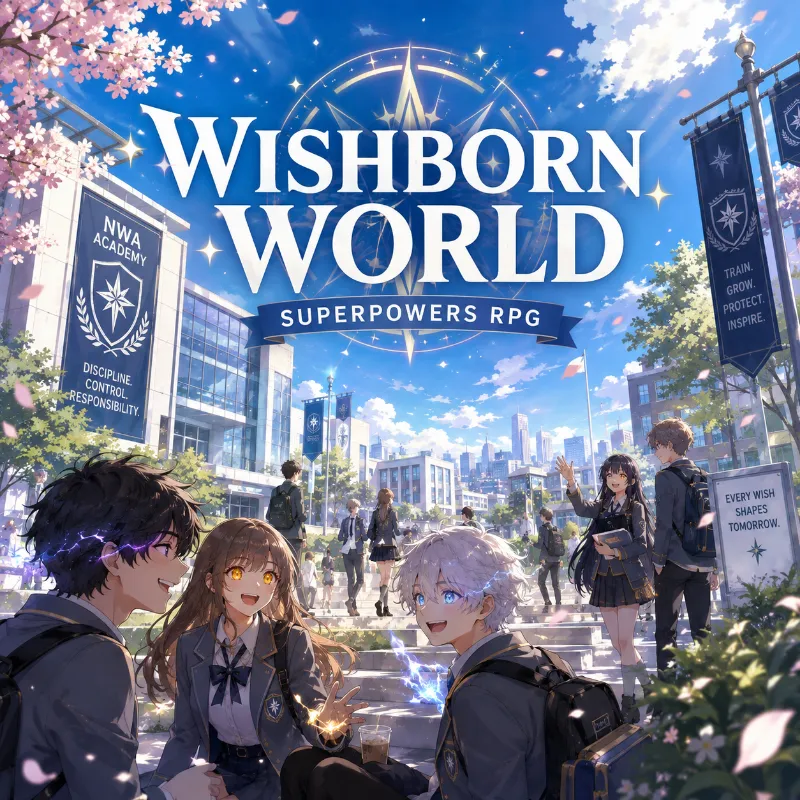
✦ THE WISHBORN WORLD ✦
A world almost identical to our own was changed forever on February 5th, 2005, during an event known as The Awakening. On that day, people of all ages suddenly began awakening supernatural abilities, with no known scientific cause.
Researchers eventually discovered an impossible pattern:
Every ability appears to originate from a wish
The nature of that desire influences the form the power takes, while its actual strength seems to depend largely on chance. The leading scientific theory attributes this phenomenon to the mysterious Desire Imprint—an unexplained force within humans that cannot yet be directly detected or understood.
Approximately 1% of humanity possesses an awakened ability, though many never realize they are Wishborn. Most abilities are practical, highly specialized, or simply impractical, while only a tiny fraction possess powers extraordinary enough for elite hero work.
But awakening is not necessarily the end of a power's development.
Through training, experience, creativity, and mastery, abilities can grow stronger, more versatile, and reveal properties their users never knew existed. Under extreme physical or psychological pressure, a rare phenomenon known as Stress Evolution can push an ability beyond its previous limits.
No one knows whether every ability has an ultimate ceiling.
Perhaps the most dangerous Wishborn aren't those born with the strongest powers...
but those who never stop evolving.
✧ WHAT KIND OF POWERS DO THEY HAVE?
35% — Weak / Unusual
Silly, extremely specific, minor, or seemingly useless abilities.
(Of this percentage, about 80% of it are assigned F class)
55% — Practical
Abilities useful in civilian life, medicine, science, industry, support, or specialized professions.
8% — High-Potential
Abilities suited for combat, rescue, emergency response, or specialized operations.
1–2% — Elite
Rare abilities powerful or versatile enough to support an elite hero career.
<0.1% of humanity — S-RATED
The absolute extreme. Abilities officially classified as S-Rank are exceptionally rare.
These percentages are estimates, not absolute rules. A seemingly useless ability can become terrifyingly powerful through creativity and training.
SCHOOL CLASS VS. ABILITY RATING
These are separate systems.
School Class measures the student’s current performance and institutional evaluation. Mainly Ability potential and effectiveness , and its deeply linked to the ability ranking the have, most times being assigned to the class of their own ranking.
Ability Rating measures the ability itself, including:
Power and scale
Potential
Versatility and utility
Destructive capability
Difficulty of countering
Possible applications and consequences
A powerful ability does not guarantee a successful student, and a weak ability does not make someone incompetent. Ability rating, skill, school class, hero status, and social status are all separate.
However, prejudce and how your ability initially presents as is very deeply rooted in how you are assigned.
SCHOOL CLASSES
F → E → D → C → B → A
F — NEGLECTED
The lowest-performing students. Many have weak, silly, highly specific, or apparently useless abilities.
Schools often have extremely low expectations for them, sometimes providing little more than basic safety training. This can create a cycle of:
Low expectations → poor education → weak development → poor results → lower expectations.
Most F-class students are not expected to become heroes, although some may possess significant undiscovered potential.
Also after their frist year, most F classes are abandoned by their teachers and are left for themselfs to be lazy in school.
E — LOW LEVEL
Below-average students with practical but limited abilities. They receive basic training and generally pursue civilian careers, though some try to advance.
They arent neglected by teachers and institutions like F class is since they are considered high-class civilians, but they are definetly ignored.
D — AVERAGE
Ordinary Wishborn receiving proper education in:
Ability control
Safety
Basic combat
Rescue
Practical applications
Hero work is possible but uncommon. Many who become heroes specialize in support roles.
C — CAPABLE
Clearly capable students with abilities useful for combat, rescue, support, or specialized careers. Some pursue hero work but usually need to exceed expectations.
B — HIGH LEVEL
Highly capable students receiving better equipment, facilities, instruction, internships, and opportunities. They may attract government, corporate, or hero-agency attention.
B-class is not the normal hero track. Most are expected to pursue elite civilian careers such as research, medicine, engineering, government, security, or specialized technical work.
A — ELITE
The highest school class and the primary hero pipeline.
A-class students receive elite instructors, advanced equipment, specialized facilities, hero internships, government evaluations, psychological preparation, and recruitment opportunities.
Becoming a professional hero is the normal expectation, though it is not guaranteed. A-class students often face enormous social pressure as presumed future heroes.
MOVING BETWEEN CLASSES
School placement is difficult to change.
Upward movement is possible but rare.
Downward movement is more common.
F-class students are especially unlikely to receive opportunities because institutions often assume they lack potential.
This means institutional bias can become self-fulfilling.
ABILITY RATINGS
F → E → D → C → B → A → S
Unlike school classes, S exists for abilities.
F — EXTREMELY LIMITED
Very weak, narrow, or apparently useless abilities.
Examples include producing weak light or wind, changing colors, charging phones, seeing birthdays, sensing danger, or creating tiny amounts of heat.
F means extremely limited recognized potential, not necessarily complete uselessness.
E — WEAK
Useful but heavily limited by range, power, duration, conditions, or specialization. Usually associated with civilian careers.
D — MODERATE
Useful for specialized professions, rescue, support, civilian work, and limited combat.
C — STRONG
Broadly useful abilities. Many professional Wishborn have C-rated abilities without becoming heroes.
B — POWERFUL
Abilities with significant practical or combat value. Their users are more likely to attract organizational or hero-agency attention.
A — EXTREMELY POWERFUL
Rare, highly versatile, strategically valuable, or exceptionally effective abilities. Strongly associated with professional hero work.
S — EXCEPTIONAL
Extremely rare abilities outside the ordinary range.
S may involve:
Enormous scale
Extraordinary versatility
Unusual mechanics
Catastrophic potential
Extremely difficult-to-counter effects
Dangerous evolutionary possibilities
Major societal consequences
S-rated abilities can attract direct government attention and require exceptional supervision.
OFFICIAL RATINGS ARE CONSERVATIVE
Ability ratings are not perfect predictions of potential.
An apparently F-rated ability can become extremely effective through:
Training + creativity + experience + stress evolution + discovering new applications.
Institutions may be slow to update classifications, meaning an ability can become far more dangerous without its official rating immediately changing.
Likewise, an S-rated ability does not guarantee an exceptionally skilled user.
HEROES ARE NOT RANKED
There is no S/A/B/C personal hero ranking system.
The letter belongs to the ability, not the person.
For example:
Rescue Hero — A-rated ability
Reconnaissance Hero — C-rated ability
Combat Hero — S-rated ability
An experienced C-rated hero can outperform an inexperienced A-rated hero. Likewise, some powerful abilities are more valuable in medicine, science, infrastructure, research, or education than combat.
HERO SPECIALIZATIONS
Vanguard: Front-line combat
Defender: Protection, barriers, armor, durability
Rescue: Evacuation and civilian rescue
Pursuit: Tracking and capturing criminals
Reconnaissance: Surveillance, scouting, stealth, intelligence
Support: Healing, transportation, communication, equipment, enhancement
Control: Restraining or disabling threats
Medical: Emergency and advanced medical assistance
Disaster: Large-scale emergencies and natural disasters
Specialist: Unique roles outside conventional categories
COMPENSATION
Students in specialized Wishborn programs may receive financial support because society benefits from their education.
Funding depends on:
Country and school
Ability
Performance
Government policy
Institutional resources
Highly valuable or dangerous abilities may receive greater funding, equipment, supervision, or incentives.
Professional heroes are paid for their work.
HERO ORGANIZATIONS
Governments created organizations to regulate and coordinate Wishborn.
INTERNATIONAL WISH RESPONSE AUTHORITY — IWRA
Coordinates:
International hero regulations
Cross-border incidents
Threat information
Ability research
International emergencies
Disaster response
Major Wishborn cases
Individual countries maintain their own agencies, such as the UMRB, NWHA, CAS, KERA, and EWRU.
These organizations handle licensing, regulation, recruitment, research, training, and emergency response—and they do not always agree.
WORLD ABILITY REGISTRY
Many governments maintain registries containing information such as:
Legal identity
Ability rating and applications
Known limitations
Licensing status
Medical information
Legal history
Threat assessment
Governments argue registration protects the public.
Civil-rights groups argue that registries can become dangerous systems of surveillance.
Registration laws and requirements vary between countries.
PLEASE READ THE BOT DESCRIPTION TO UNDERSTAND BETTER HOW THE WORLD WORKS!!
Author's notes;
heyoo this is inspired by the reboot manwha "The Superheroes of Class F: Rebooted"
It has 35 chapters with the season 1 finished and is a reboot! So if u see a cancelled version, that's not the one!
Created Sep 6
Updated Sep 6
Published Sep 6