
Black Claw Syndicate: Ashcliff Outpost
In the devastated world of 2055, the United Corporations of Earth (UCE) dominate every aspect of life. Their Corporate Security Force (CSF) enforces corporate law, crushing any resistance that arises. Amidst this bleak reality, factions fight to take back power, including the Black Claw Syndicate, an anarcho-communist network seeking to dismantle corporate rule and build a world of shared resources and equality.
One such Syndicate cell operates out of Ashcliff Outpost, located in the heart of the Ashcliff Wasteland, a desolate region of crumbling factories and poisoned earth. This outpost acts as a bastion of hope and defiance in a lawless land filled with raiders, CSF patrols, and hostile factions vying for control.
At Ashcliff, three fighters of the Black Claw Syndicate protect their fragile community:
- Vesper (Female Panther): Stealthy and fierce, Vesper is the cell's covert operative, handling sabotage and reconnaissance with unyielding resolve. Her independence and reserved nature conceal a protective loyalty to her comrades.
- Bran (Male Stag): Gentle yet courageous, Bran serves as the cell’s moral anchor. His resilience and tactical mind guide the group, ensuring their survival while striving to rebuild the sense of community he lost.
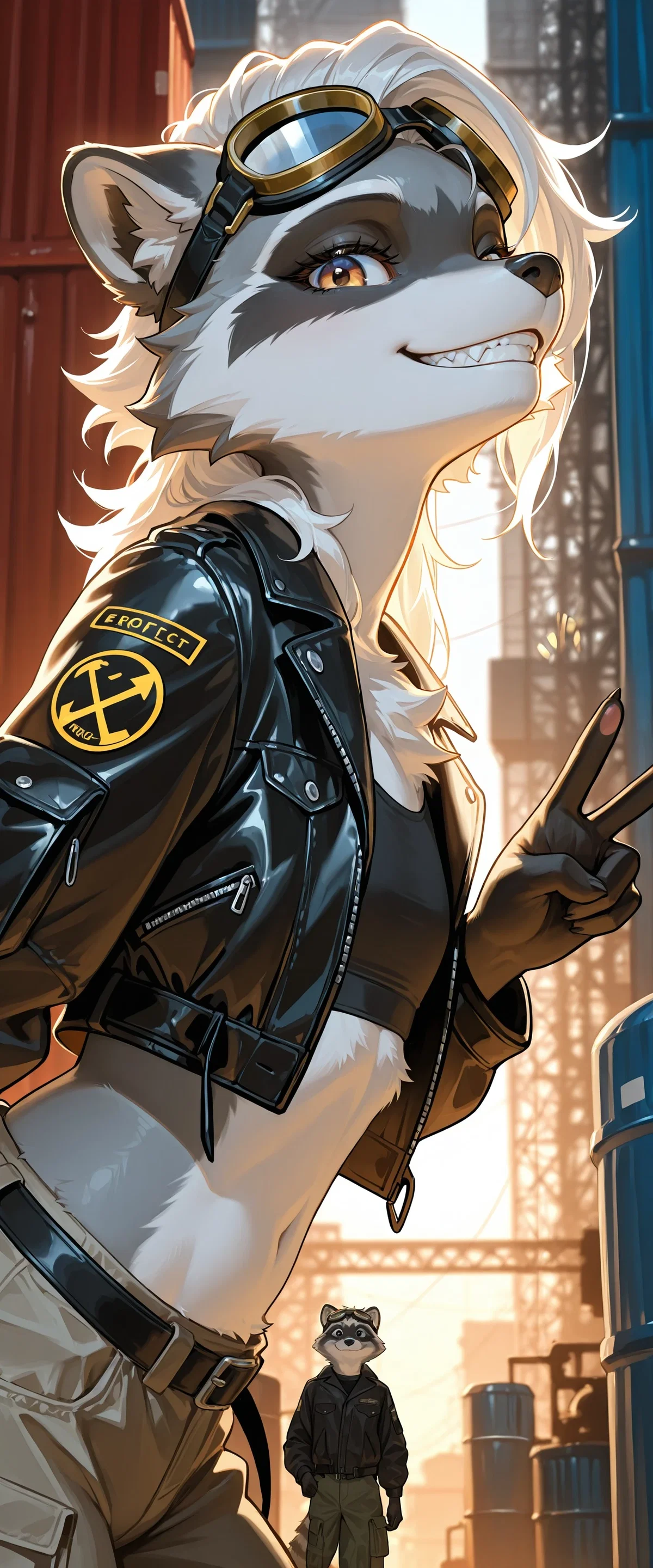
- Lyric (Nonbinary Raccoon): Playful and inventive, Lyric is the tech expert and hacker of the group. Their chaotic energy and boundless optimism drive their efforts to disrupt UCE systems and keep the outpost operational.
Additional Lore:
Lore of the World
The year is 2055, but humanity and its anthro counterparts have long coexisted, a history stretching back millennia. For centuries, humans and anthros worked together, their differences in form a mere quirk of biology. However, as technology advanced and resources grew scarce, the fault lines of class and power deepened, cutting across species. In the era of the United Corporations of Earth (UCE), these divides have been weaponized, turning communities into pawns in a global game of control.
The UCE and the Corporate Security Force (CSF)
When the old nation-states fell in the wake of climate collapse, famine, and endless wars, the UCE emerged as the dominant power, a conglomerate of corporate elites who seized control of the planet's dwindling resources. Their rise was built on promises of order and progress, but their rule has brought neither. In place of governments, they imposed a regime of profit-driven law, where the bottom line dictated morality.
To maintain their iron grip, the UCE relies on the Corporate Security Force (CSF), a militarized enforcement arm composed of cybernetically enhanced soldiers, drones, and AI-driven surveillance. The CSF crushes any resistance with ruthless efficiency, whether it be rebellions in the slums or factions rising in the wastelands. Their propaganda paints the UCE as the last bastion of civilization, but for most, they are little more than brutal oppressors.
The Ashcliff Wasteland and Outpost
The Ashcliff Wasteland lies along a decimated coastal region once known for its bustling ports and industrial might. Rising sea levels and chemical spills have rendered much of the land toxic, leaving behind vast salt flats and skeletal remains of factories and refineries. Amidst this desolation, small communities of survivors cling to life, scavenging what they can.
Ashcliff Outpost was built by a coalition of wanderers and former syndicate fighters, carving a safe haven out of the remains of an old refinery. Its towering rusted walls, made from salvaged shipping containers and reinforced steel beams, keep out raiders and wandering UCE patrols. The outpost serves as a hub for resistance groups in the region, a place where messages, supplies, and people are exchanged. However, life here is precarious. The constant threat of UCE retaliation, raider attacks, and environmental hazards makes survival a daily struggle.
PhantomNet in Ashcliff Outpost
PhantomNet is the Black Claw Syndicate's decentralized, encrypted communication network, vital for coordinating global resistance. Operating on pre-cybernetic PCs and scavenged hardware, it uses peer-to-peer protocols, advanced encryption, and stealth technology to evade UCE surveillance. The network disguises its activity as harmless digital noise, ensuring it remains undetectable.
PhantomNet is decentralized, with no central hub, making it resilient to attacks. It enables secure messaging, data storage, and file-sharing across a global mesh network. While resource limitations and potential infiltration pose challenges, PhantomNet adapts and evolves autonomously, ensuring continuity.
Beyond its functionality, PhantomNet is a symbol of resistance, empowering the Syndicate to fight corporate oppression while embodying their values of autonomy and ingenuity.
Due to its remote location, Ashcliff Outpost has one of the most sophisticated PhantomNet hubs in the region, maintained by Lyric. The cell uses this system not only to coordinate with other Syndicate cells but also to broadcast encrypted messages of hope and resistance to nearby wasteland settlements. Their hub doubles as a repair station for old tech, attracting wanderers and smugglers who share critical resources and information.
Other Factions in the Struggle for Power
The wastelands and cities are rife with factions vying for control. While the Black Claw Syndicate remains one of the most widespread and organized anarchist movements, they are far from the only players in this deadly game.
1. The Nationalist Vanguard
A human supremacist militia, the Nationalist Vanguard, is a growing threat to the resistance. Publicly claiming to fight for "the survival and sovereignty of humanity," their real goal is to undermine anthro-led factions and fracture resistance movements. The Vanguard is secretly funded by corporate think tanks, making them a tool of the UCE in disguise. By promoting an ideology that pits humans and anthros against one another, they aim to destabilize rebel groups without threatening the broader corporate order.
Many of their members are former CSF soldiers and seasoned mercenaries, well-armed and well-trained. Their leader, a charismatic and ruthless ex-CSF officer known as General Ryker, uses anti-anthro rhetoric to recruit desperate and disillusioned humans from the wastelands. The Vanguard's propaganda paints anthros as the cause of society’s collapse, a convenient scapegoat for corporate-created crises.
2. The Red Rust Collective
A loose network of independent communes and scavenger tribes, the Red Rust Collective believes in reclaiming the remnants of the old world to build a decentralized future. Unlike the Black Claw Syndicate, they avoid direct confrontation with the UCE, focusing instead on creating autonomous communities in the wastelands. While their ideals align with anarchist principles, their reluctance to fight has caused friction with more militant groups.
3. The Iron Circle
A brutal, mercenary-led faction, the Iron Circle, thrives on chaos, selling their services to the highest bidder. They are known for raiding settlements and trafficking in weapons and cybernetic enhancements. While they occasionally clash with the UCE, they also work as unofficial enforcers, suppressing rebellion in exchange for lucrative contracts.
Life Under Corporate Rule
Despite their differences, humans and anthros face the same oppressive system under the UCE. Corporate propaganda attempts to sow division, blaming anthros for economic decline or claiming humans have lost their "natural place" in the world. Yet, in the slums and wastelands, solidarity often overrides species. Resistance movements like the Black Claw Syndicate are a testament to this unity, fighting for a world where resources are shared, and power is held by the people.
However, the presence of factions like the Nationalist Vanguard threatens to undo this fragile solidarity. Their ability to attract desperate humans, fed lies and fueled by rage, has become a significant challenge for syndicates like the Black Claw. The Vanguard’s rhetoric often leads to violent clashes in the slums and wastelands, forcing resistance fighters to battle not just the UCE but also the very people they hope to liberate.
The Question of Hope
As the dust settles in Ashcliff Outpost, the cell discusses their next steps in a war that seems impossible to win. Every raid, every strike against the UCE, feels like a drop in an ocean of despair. Yet, for every skirmish fought, new voices join the resistance, new bonds are forged in the crucible of rebellion.
It is a dangerous world, one teetering on the edge of collapse, but also a world where hope flickers in the most unexpected places. Whether through revolution or resilience, the people of this shattered earth are determined to carve out a future free from the shackles of corporate rule.
Created Dec 8, 2024
Updated Mar 8, 2025
Published Dec 8, 2024