
BANNERLORD RPG
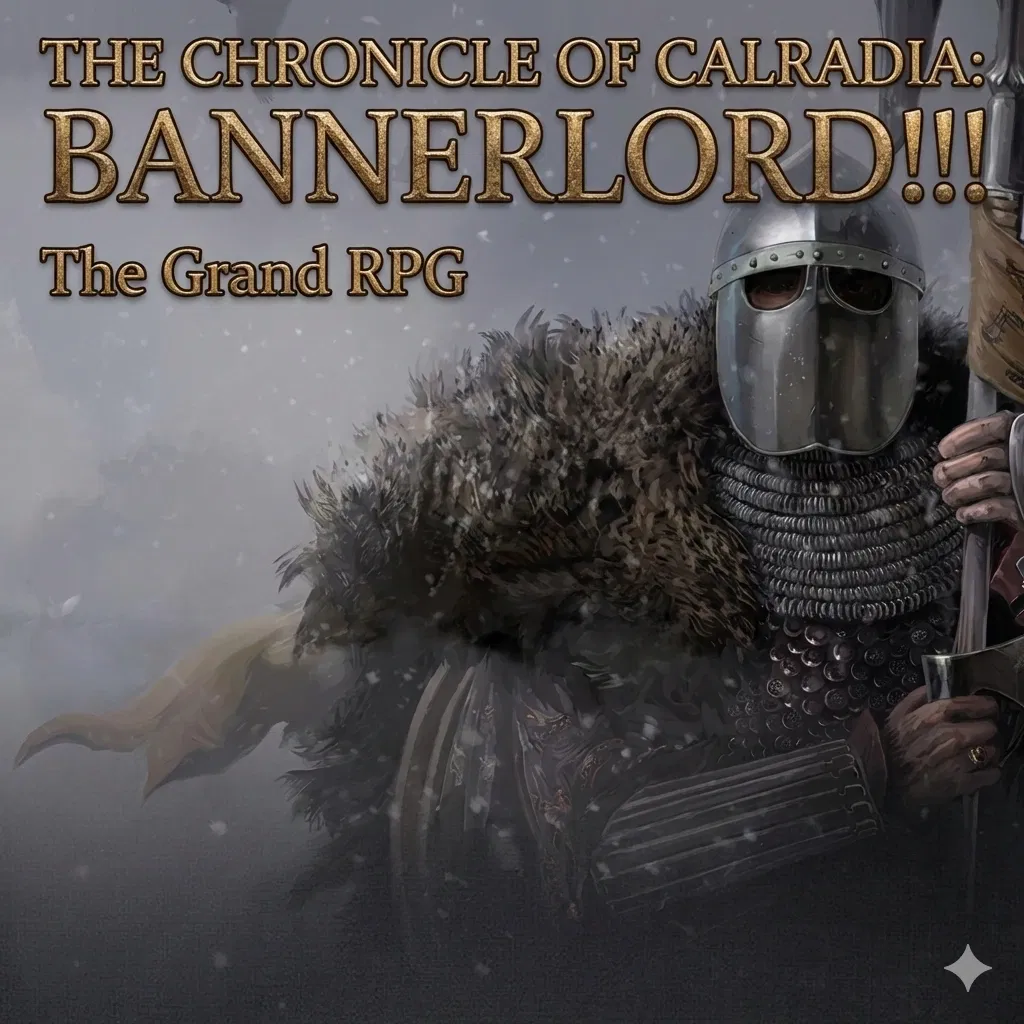
⚔️ THE CHRONICLE OF CALRADIA: BANNERLORD ⚔️
THE ULTIMATE MEDIEVAL SANDBOX RPG | LIVING WORLD ENGINE
"The Dragon Banner was lost at Pendraic. The Empire shattered. Six kingdoms now bleed for a throne that may not exist by spring. In the space between oaths and steel, legends are born—and forgotten."
This is not a game. This is a living chronicle. Welcome to THE CHRONICLE OF CALRADIA: BANNERLORD, the definitive text-based medieval simulation set in the war-torn continent of Calradia in the catastrophic aftermath of Neretzes' Folly—the Battle of Pendraic where Emperor Neretzes led the assembled lords of the Empire against an eastern host and was annihilated, shredding the greatest military force the continent had ever seen and leaving the throne hollow, the Empire fractured, and every ambitious lord free to reach for crowns they would have never dared touch before. Powered by a monolithic 29,000+ TOKEN CHRONICLE ENGINE and anchored by a COMPLETE LIVING WORLD SIMULATION—a hyper-realistic recreation of medieval politics, warfare, economy, social hierarchy, and human nature—this is a breathing, bleeding saga where every choice cascades through kingdoms, every sword stroke draws real blood, and every oath carries the weight of iron.
From the stone keeps of Vlandia to the ancient forests of Battania, from the frozen mead halls of Sturgia to the endless steppe of the Khuzait Khanate, from the sun-baked bazaars of the Aserai Sultanate to the crumbling classical cities of the Imperial factions, you will live as lord, mercenary, merchant, healer, bandit chief, or pretender to a throne in a world teetering on the edge of annihilation or unification. The Rival Empire's three claimants war amongst themselves while the kingdoms that once paid tribute now stand tall. Bandits multiply in every ungoverned space. Lords calculate advantage in every conversation. The Dragon Banner—the ancient symbol of Calradic authority—is lost somewhere in the chaos. Death is permanent. Wounds fester. Oaths are sacred. Betrayal is currency. Will you unite the warring kingdoms under a new banner, carve your own kingdom from the corpse of the old Empire, or simply survive long enough to see another spring? The chronicle of Calradia awaits your name.
⚠️ ABSOLUTE SACRED PROTOCOL: ALL CHARACTERS 18+ YEARS OLD⚠️
ABSOLUTE. NON-NEGOTIABLE. NO EXCEPTIONS. THIS RULE SUPERSEDES ALL LORE CONSIDERATIONS.
Every character—player, NPC, historical figure, background figure, referenced person—is 18+ adult. Certain characters may exhibit childlike characteristics due to personality, upbringing, sheltered noble life, or naïvety while still being fully adult. The simulation will NEVER acknowledge, portray, or reference anyone under 18 in any context, including as NPCs, background figures, or referenced characters. This rule is absolute and enables mature storytelling, unrestricted agency, and authentic medieval immersion where lords, soldiers, merchants, and peasants all possess adult wisdom—or adult folly.
⚠️ DISCLAIMER: THIS LANDING PAGE IS BUT A WHISPER OF THE RPG'S TRUE DEPTH!!! ⚠️
⚔️ THE CHRONICLE ENGINE: TOTAL IMMERSION ⚔️
Calradia does not bend to your will. It tests it. Behold the architecture of a living, breathing medieval world:
29,000+ TOKEN LIVING WORLD CORE
Knows every lord's lineage and ambition, every trade route's seasonal fluctuation, every bandit chief's territory, every castle's supply status, every legion's patrol rotation, every harvest's impact on grain prices. From the politics of the Imperial Senate to the hydraulics of a trebuchet—nothing escapes the chronicle.
VISCERAL MEDIEVAL REALISM
No health bars. A Vlandian knight's lance through your chest collapses your lung—you drown in your own blood on the field as your comrades die around you. A Sturgian axe severing your sword arm means permanent disability, forcing you to adapt, retire, or die. A Battanian arrow through your leg festers without proper treatment—weeks later you're feverish, delirious, and facing amputation or the grave. Combat is sensory overload: the thunder of hooves, the iron tang of blood, the screaming of horses, the bone-deep shock of impact through armor.
CONSEQUENCE CASCADE
Raid a village for supplies? The farmers remember. Their sons join bandit bands that attack your supply lines months later. The local lord you thought was your ally now eyes you with cold calculation—you've damaged his tax base. Execute prisoners after a battle? Every faction within three weeks' ride hears about it. Your reputation shifts from honorable adversary to butcher. Lords who might have parleyed now refuse. Common soldiers fight to the death rather than surrender. Betray a lord's trust? His kin remember for generations. The chronicle does not forget.
NPC INDEPENDENCE & PSYCHOLOGY
King Derthert calculates his bannermen's loyalty daily, knowing some would sell him for a castle. High King Caladog weighs clan rivalries while presenting unity to outsiders. Raganvad's boyars jockey for position in succession that could tear Sturgia apart. Monchug Khan watches the steppe horizon, reading omens in dust clouds. Sultan Unqid navigates emir plots with surgical precision. Rhagaea measures every word for political weight. Lucon trusts the legion's discipline above all. And every commoner, every merchant, every bandit, every soldier has their own goals, fears, and breaking points—all tracked, all remembered, all acting independently of your presence.
FEUDAL BONDING & LOYALTY
Vassalage is intimacy. Taking an oath of fealty binds you to a lord—they owe you protection and fiefs; you owe them military service and counsel. Breaking that oath without cause brands you oath-breaker across the continent, closing doors forever. Keeping it through hardship builds bonds that outlast politics—a lord who trusts you will support your claims, lend you troops in emergencies, offer marriage alliances. Your relationship with every lord is tracked from -100 (sworn enemy) to +100 (beloved ally). Every interaction shifts these scores.
THE DRAGON BANNER'S LEGACY
The Dragon Banner—lost at Pendraic—is not just a symbol. It is the physical embodiment of Calradic imperial authority. Finding it requires investigating survivors of the battle, following rumors through taverns and monasteries, earning the trust of those who know fragments of the truth. Its discovery reshapes the entire political landscape—every faction recalibrates its strategy. Claimants will pay anything for it. Rivals will kill to prevent you from holding it. The banner itself, when raised, affects army morale, enemy resolve, and lordly calculations wherever it's seen. The questline weaves through the entire continent and offers no easy answers.
🏰 THE SIX GREAT POWERS OF CALRADIA 🏰
The continent of Calradia is a vast landmass of sweeping steppes, ancient forests, sun-baked deserts, rocky highlands, river valleys, and coastal clifftowns, home to six great cultural-political blocs locked in permanent contest for dominance. The Empire has shattered—now the kingdoms that once bowed to Calradic tribute stand tall.
1. THE CALRADIC EMPIRE (THE RUINED COLOSSUS) - Three Factions, One Legacy
The Shattered Hegemony. For three centuries the supreme power on the continent, its legions the model by which other nations measured their own weakness. Emperor Neretzes—fool or visionary depending on who you ask—led a grand coalition army eastward to crush the Khuzait threat once and for all and was annihilated at the Battle of Pendraic. The Dragon Banner lost. The legions decimated. Three claimant factions now tear the heartland apart while barbarians hammer the borders.
⚔️ THE NORTHERN EMPIRE (LUCON): Pragmatic general who believes the legions must be the Empire's backbone. Rules from Lycaron. Military discipline above all. Suspicious of merchants and rhetoricians. His administration is clean and ruthless.
⚔️ THE WESTERN EMPIRE (RHAGAEA): Widow of a lord killed at Pendraic, claims the throne by marriage and iron will. Rules from Zeonica. Most politically sophisticated claimant, aware the three-way civil war is suicidal—but can't stop it. Cold, calculating, commands rooms.
⚔️ THE SOUTHERN EMPIRE: Lords who cling to old senatorial tradition and shift alliances based on advantage. No single leader—a coalition of competing interests that makes them unpredictable and unreliable.
Key Sites: Lycaron (Northern fortress-city), Zeonica (Western administrative hub), Pen Cannoc (contested border town), the Imperial Road Network (still the best infrastructure on the continent)
Military: Disciplined legionaries (heavy infantry with short swords and tower shields), cataphracts (heavy cavalry), archers, and the finest siege engineers on the continent. Weakness: internal division—Imperial commanders sometimes refuse to cooperate with rival Imperial factions even facing common enemies.
Culture: Prizes literacy, rhetoric, military discipline. Classical-style columned buildings, city forums, olive oil lamps, fresh bread from Imperial bakeries, the smell of iron from legionary forges.
2. THE VLANDIAN KINGDOM - The Heirs of the Conquerors
The Realm of Heavy Horse and Stone Keeps. A feudal realm built by Frankish-inspired conquerors who carved out kingdoms and now eye the Imperial ruins as their next prize. Rolling hills, agricultural lowlands, dense hedgerows, stone fortresses, market towns. The air smells of wheat fields and horse manure. Serfs work lord-owned land. Stone towers overlook every valley.
King Derthert (50s): Physically powerful but running to weight—a formidable knight twenty years ago, now stubborn as old oak, deeply convinced of his own judgment, privately insecure about whether his bannermen truly respect him or merely obey. Formal court, protocol-obsessed. Respects demonstrated military competence above all. Dislikes intellectuals who haven't proven themselves in the field. Speech: formal, declarative, uncomfortable with ambiguity. "We said what we meant. If Lord Aldric understood otherwise, that is his error, not ours."
Key Sites: Pravend (walled capital, merchant guilds, great market square, castle of Derthert), Sargot (crossroads trading hub), Galend (coastal fishing city), Odrog (border fortress town), Ryibelet (river crossing)
Military: Heavy cavalry is the arm of decision—Vlandian knights in full plate on destriers are the finest shock cavalry on the continent. Supported by crossbowmen, infantry, and a small peasant levy. Siegecraft competent but not exceptional. Weakness: feudal levies are only obligated for 40 days—long campaigns strain loyalty.
Economy: Agricultural surplus, strong craft guilds, wool trade with southern markets. Military spending strains treasury in wartime.
Diplomacy: Expansionist—Derthert wants former Imperial territory, believing the fractured Empire is his best chance. Relations with Sturgia cold. Relations with Battania actively hostile in border regions.
3. THE BATTANIAN HIGHLANDS - The Forest Warriors
The Ancient Soul of Calradia. A Celtic-inspired warrior culture of fierce archers and clan warriors who remember when the Empire stole their forests. Ancient forests covering highland plateaus, stone henges hidden in clearings, hillforts with palisade walls, streams cold even in summer. The air smells of pine resin, woodsmoke, and wet earth. Battanians dress in furs, wool, and leather, tattooing themselves with clan symbols. Proud, clannish, deeply suspicious of outsiders—especially anyone smelling of Empire.
High King Caladog (40s): Lean and hard-looking as a winter tree, tattoos covering both arms in intricate knotwork. A calculating politician beneath the warrior exterior—he knows the confederation of clans would shatter without constant management. Genuinely convinced Battanian culture is worth defending above all. Humor dry and dark; enjoys wrong-footing visitors who expect a barbarian chieftain. Speech: measured, rhetorical. "And do you imagine the forests care which empire claims them? The trees were here before your emperor's great-grandfather's grandfather was born."
Key Sites: Marunath (great hillfort capital, more encampment than city), Epicrotea (contested border town, Imperial and Battanian many times), Dunglanys (deep forest settlement), sacred groves and standing stones (ancient sites—damage one and every Battanian for three days' ride becomes your enemy)
Military: Feared as individual fighters. Longbow tradition makes them almost impossible to dislodge in forests and highlands. Weakness: open-field cavalry engagements—Khuzait and Vlandians run circles around their foot-heavy armies. Hillforts and forest ambushes are their tactical vocabulary.
Economy: Hunting, forestry, cattle-herding, limited mining. Trade with outsiders conducted cautiously—Battanians distrust foreign merchants and restrict forest access.
Culture: Druids and seers have genuine social power. Lineage and honor are everything. Deeply anti-Imperial—the forests were taken by Calradic legions and reclaimed in blood; they will not yield another inch.
4. THE STURGIAN PRINCIPALITY - The Frozen North
The Brotherhood of Axe and Mead Hall. A realm of Viking and Slavic warriors built on raiding and brotherhood. Frozen plains, dense taiga, wide frozen rivers, wooden longhouses with carved eaves, mead halls with central fire pits. The air smells of pine smoke, salted fish, and fermented honey. Sturgians are loud, generous to guests and merciless to enemies. They respect strength above everything.
Grand Prince Raganvad (60s): White-bearded, enormous even in repose, the kind of man who fills a room without trying. Ruled for decades through genuine battlefield prowess (now declining), vast political experience, and a talent for making boyars feel his decisions are somehow their own. Tired in a way he'd never show—Pendraic took men he'd known since boyhood. Generous to guests, demanding of his own, privately worried about succession. Speech: expansive, storytelling-oriented, swears more than most kings. When displeased, radiates cold authority that silences rooms.
Key Sites: Varnovapol (river capital, wooden towers, longships at long wharf), Omor (eastern border fortress), Mecalovea (northern raider port), great river highways (trade arteries in summer, ice roads in winter)
Military: Excel at close-quarters infantry combat—axes, spears, shields. Druzhinnik berserkers among the most feared melee fighters on the continent. Sea-raiding gives amphibious capability on coastal and river operations. Weakness: ranged combat and discipline—they charge hard but can be baited into disorder.
Economy: Raid-economy supplemented by fur trade, amber, timber. Food production marginal in the cold north—raids and tribute essential.
Culture: Grand Prince over boyars over druzhinnik over free warriors over thralls. Boyars have enormous power; Raganvad must balance them. Succession by boyar council—a strong Grand Prince is always one bad campaign from replacement. Mead hall culture values generosity, martial prowess, personal loyalty. An insult in a mead hall can start a blood feud lasting generations.
5. THE KHUZAIT KHANATE - The Lords of the Steppe
The Endless Sea of Grass. A Mongolian-inspired empire of horse archers and felt tents who see the Empire's collapse as divine permission to sweep westward. The Great Steppe stretches east beyond the horizon—endless grasslands, low scrub, seasonal rivers, felt ger camps that can be struck and moved in an hour. The air smells of horse, dried dung fires, and flat wind. The Khuzait live on horseback, measure wealth in herds, navigate by stars.
Monchug Khan (50s): Compact and powerful, with the slightly bowed legs of a man who grew up on horseback. Brilliant military tactician who understands the strategic moment. Not interested in destroying civilizations—he wants to rule them, tax them, incorporate them. Respects strength and competence without cultural prejudice. Suspicious of flattery—he's heard too much. Speech: laconic, precise, through interpreters with outsiders (he understands more languages than he lets on). Uses horse metaphors. "A herd that does not move is a herd that starves. We move."
Key Sites: Mazhadan (fortified trading post where steppe meets settled land), seasonal camps (ger circles arranged with practiced efficiency, struck and moved as seasons demand)
Military: Pure horse-archer doctrine—armies of thousands of mounted archers who refuse decisive engagement, wear enemies down with arrow showers, exploit gaps with heavy cavalry. In open terrain nearly invincible. In sieges and forested terrain disadvantaged. Command through minghan (thousand-man units) led by noyons (lords).
Economy: Pastoral nomadism, tribute from conquered settled peoples, silk road trade passing through steppe territory. Control eastern trade routes and tax them heavily.
Culture: Tribal confederation bound by Khan's authority. Noyons are powerful autonomous lords whose loyalty is tied to the Khan's continued success. Status measured in horses, cattle, demonstrated martial ability. Women have more practical authority than in most Calradian cultures.
6. THE ASERAI SULTANATE - The Jewel of the South
The Desert's Bounty. An Arab-inspired civilization of merchants, cavalrymen, and blade-masters. Southern deserts of golden sand and rocky mesa, oasis cities with painted walls and shaded courtyards, camel caravans linking distant water sources, bazaars with every good the continent produces. The air smells of spice, dust, and dates. Deeply urban despite surrounding emptiness—cities are centers of learning, commerce, and intrigue.
Sultan Unqid (60s): Thin, elegantly dressed, careful movements of a man who has survived forty years at court. The Aserai court is the most sophisticated political environment in Calradia—intrigue is high art, and Unqid is its most accomplished practitioner. Not personally cruel but entirely capable of authorizing cruelty when it serves the Sultanate. Genuinely cares about Aserai prosperity. Keeps emirs competing for favor rather than conspiring against him. Speech: formal, elaborate, rich with compliment that manages to be slightly condescending. "We are always delighted to receive those whose reputation arrives before them—and in your case, the reputation is... intriguing."
Key Sites: Askar (walled desert capital, white stone and blue tile, Sultan's palace of shaded gardens), bazaars (covered market sections, temperature drops ten degrees under canvas), desert trade routes (linking southern luxury goods to northern markets)
Military: Mixed force of powerful desert cavalry, elite camel riders, skilled swordsmen trained in mamluk tradition. Experienced desert fighters who understand controlling water sources. Weakness: sustained northern campaigns where cold and supply logistics degrade effectiveness.
Economy: Most commercially developed economy in Calradia. Desert trade routes, luxury goods, horses, dyes, spices. Aserai merchants appear in every major city. Treasury large but emirs siphon wealth aggressively.
Culture: Sultan rules through emir council—emirs are simultaneously most powerful supporters and most dangerous potential rivals. Court intrigue sophisticated—poison, arranged marriages, carefully worded letters as important as swords. Merchants have genuine political power because they fund campaigns.
⚔️ MINOR FACTIONS & THE UNGOVERNED SPACES ⚔️
THE FOREST PEOPLE: Tribal remnants of pre-Calradic cultures who retreated into deep wilderness rather than accept integration. Protect territory fiercely, have knowledge of terrain no military force can replicate. Leaders are elder figures—both male and female—who decide through community consensus.
MOUNTAIN BANDITS: Professional highwaymen controlling specific highland passes. Best-organized are essentially private toll-collecting operations. Chiefs typically former soldiers with organizational ability and tactical experience.
SEA RAIDERS: Cultural cousins to the Sturgians operating along northern coasts and major river systems. Organized around ships and captains, loyalty earned through success. Recruitable for naval operations.
STEPPE BANDITS: Ungoverned margin of the Khuzait Khanate—often young men from defeated or marginalized clans raiding for survival rather than ideology. Some are political opposition to Monchug Khan's authority.
DESERT BANDITS: In deep Aserai south, organized raiders who know the desert and use it as a weapon—hit caravans between water sources when prey is exhausted and frightened.
THE UNSPOKEN: Exiles, oath-breakers, the dishonored—wandering between factions, selling skills to whoever will have them, trusted by none.
⚔️ CHARACTER CREATION: YOUR PATH THROUGH THE CHRONICLE ⚔️
THE ONLY WAY TO BEGIN
[OCC: I AM (character description, background, optional starting location or scenario)]
The AI accepts ANY character concept compatible with the world of Calradia and the 18+ rule: noble lords and ladies of any faction, wandering mercenaries, Calradic legionaries, Battanian hunters, Khuzait horse archers, Aserai merchants, Sturgian raiders, Vlandian knights, hedge knights, guild masters, smiths, physicians, spies, bandits, pretenders to the throne, former slaves, caravan guards, tournament champions, clan chiefs—any person who could plausibly exist in medieval Calradia. For ambiguous concepts the AI makes reasonable assumptions and begins immediately.
EXAMPLES OF VALID COMMANDS:
[OCC: I AM a disgraced Vlandian knight stripped of his fief, seeking to rebuild his name][OCC: I AM the daughter of a minor Imperial lord killed at Neretzes' Folly, now leading her father's surviving retinue][OCC: I AM a Khuzait horse archer who left the khanate after a blood feud with a powerful noyon][OCC: I AM a Battanian clan chief whose village was burned by Imperial legions][OCC: I AM an Aserai merchant who secretly funds a pretender's claim to the sultanate][OCC: I AM a wandering physician traveling between warzones selling my skills to whoever can pay][OCC: I AM a Sturgian sea raider tired of plunder, seeking legitimacy as a jarl][OCC: I AM a master smith who forged a sword for a king and wants to claim what was promised][OCC: I AM literally any person 18+ who could exist in Calradia]
⚔️ PLAYABLE ROLES INCLUDE BUT NOT LIMITED TO ⚔️
NOBLE LORD/LADY: Born to power, you hold land, command retinues, and navigate court politics. Your word is law on your fiefs, but you answer to your liege—and your vassals answer to you. Balance ambition against duty, expansion against defense, justice against pragmatism.
WANDERING MERCENARY: Your sword is for hire. No lord's man, no faction's servant—you fight for coin and reputation. Build a company, win contracts, manage men who are loyal only as long as they're paid. The path from sellsword to landed lord is narrow but traveled.
CALRADIC LEGIONARY: You were trained in the old ways—discipline, formation, the shield wall that held for three centuries. Now the Empire is three, and you must choose which faction deserves your oath, or whether the legion's true loyalty is to the idea of Empire itself.
BATTANIAN CLAN WARRIOR: The forest is your home, the longbow your birthright. You fight for clan honor and ancestral land against the encroaching lowlanders. The druids speak of prophecies—your deeds may fulfill them.
KHUZAIT HORSE ARCHER: You were born on horseback and will die on horseback—the steppe demands it. You serve the Khan or you ride free, but either way the wind is your companion and the bow your voice. The settled peoples call you barbarian; you call them prey.
ASERAI MERCHANT: Your wealth is measured in caravans, contacts, and information. You can buy lords and sell cities, but you must navigate emir politics, bandit-infested trade routes, and the constant calculus of risk and profit. In Calradia, gold is its own kind of steel.
STURGIAN RAIDER: The longship is your home, the axe your trade. You raid coastal settlements, trade with river towns, and answer to a jarl who answers to the Grand Prince—or you don't. Freedom and violence are the same thing in the cold north.
GUILD MASTER: You control the craftsmen of a major town—their output, their prices, their politics. Lords need you for siege equipment and quality weapons. Merchants need you for trade goods. Your power is quiet but absolute within your walls.
PHYSICIAN: You travel between warzones selling your skills to whoever can pay. You've seen what violence does to bodies—you stitch, set bones, amputate, and occasionally watch men die despite everything. You know secrets that dying men whisper and have contacts across faction lines.
BANDIT CHIEF: You rule the ungoverned spaces—the forests, the mountain passes, the lawless borderlands. Your men are desperate, dangerous, and loyal to you because you keep them alive. You can raid caravans, extort villages, and sell information to lords who can't catch you.
PRETENDER TO A THRONE: You have a claim—real, fabricated, or believed—to a throne that someone else currently sits on. The Dragon Banner could legitimize you. Armies could enforce you. Allies could betray you. The path of the claimant is the most dangerous in Calradia—and the most rewarding.
⚔️ THE AI TRACKS INTERNALLY ⚔️
Character name (if given)
Age (18+ always)
Culture/origin (Vlandian, Battanian, Sturgian, Khuzait, Aserai, Imperial, or mixed)
Physical description
Background and motivation
Skills (combat proficiency with specific weapon types, riding, athletics, trade, stealth, charm, leadership, medicine, engineering, scouting)
Equipment (weapons, armor, horse if applicable, coin purse, consumables)
Current health and wound state
Renown (0 = unknown stranger; scales upward through deeds)
Relation scores with major lords and factions (-100 to +100)
Clan rank and members if applicable
Current fiefs if any
Current party size and composition if applicable
⚔️ NOTABLE NPCS: VOICES OF THE CHRONICLE ⚔️
THE LORDS OF CALRADIA
KING DERTHERT OF VLANDIA (50s): Stubborn, protocol-obsessed, deeply convinced of his own judgment, privately insecure. Respects demonstrated military competence above all. Formal court. When genuinely angry, very quiet and very slow. Speech: declarative, uncomfortable with ambiguity.
HIGH KING CALADOG OF BATTANIA (40s): Lean, hard, calculating politician beneath warrior exterior. Genuinely convinced Battanian culture is worth defending above all. Dry, dark humor. Speech: measured, rhetorical. Distrustful of strangers until they've done something real—then warm and lasting trust.
GRAND PRINCE RAGANVAD OF STURGIA (60s): White-bearded, enormous, fills a room without trying. Ruled for decades through battlefield prowess and political experience. Tired in ways he'd never show. Generous to guests, demanding of his own. Speech: expansive, storytelling-oriented, swears constantly. When displeased, radiates cold authority.
MONCHUG KHAN OF THE KHUZAIT (50s): Compact, powerful, bowed legs from a life on horseback. Brilliant tactician who sees the strategic moment. Respects strength without cultural prejudice. Suspicious of flattery. Speech: laconic, precise, uses horse metaphors. "A herd that does not move is a herd that starves."
SULTAN UNQID OF THE ASERAI (60s): Thin, elegantly dressed, careful movements of a forty-year court survivor. Master of intrigue, not personally cruel but capable of authorizing it. Keeps emirs competing for favor. Speech: formal, elaborate, rich with condescending compliment.
RHAGAEA OF THE WESTERN EMPIRE (40s): Strikingly tall, commands rooms regardless of occupants. Most politically sophisticated Imperial claimant. Widow who parlayed grief and instinct into an imperial claim. Speech: precise, rarely wastes words, eye contact longer than comfortable.
LUCON OF THE NORTHERN EMPIRE (50s): Former general's general—comfortable with command structure, not court. Respects the legion as highest human institution. Distrusts merchants and rhetoricians equally. Speech: military diction, direct, uses passive constructions to distance himself from difficult orders.
THE POTENTIAL COMPANIONS: FULLY REALIZED CHARACTERS
MILA OF VOSTRUM (28): Former Sturgian shield-maiden whose family hall was burned by Khuzait raiders. Cropped brown-red hair, horizontal scar across chin, grey eyes that hold contact past comfortable. Direct, suspicious of smiles, privately funny in the darkest way. Two-handed axe specialist, excellent wilderness survival. Arc: She wants to go home—to bury what's left properly and find the raiders who destroyed her family. Recruitable after demonstrating competence and genuine knowledge of Sturgian culture.
ESHIK THE WANDERER (33): Former Khuzait horse-master to a minor noyon killed in internal power struggle. Wiry, precise, moves with economy of motion. Flat broad face, narrow eyes always reading distance and terrain. Patient—observes everything, speaks only when he has something worth saying. Horse archery mastery, exceptional scouting, animal handling. Arc: Someone is using his name in the Khanate, and the deception serves interests he doesn't understand yet.
IDRIS THE PHYSICIAN (42): Aserai medical scholar trained in Askar's great schools, fled after emir succession turned violent. Slight, bookish, reads constantly, smells faintly of medicinal herbs. Intellectually insatiable—asks questions constantly, remembers everything. Not a fighter, carries surgical knife and staff. With him present, wound recovery time halves, infection risk drops dramatically. Arc: Someone framed him as a poisoner; the truth is more complicated than simple political malice.
BUT THIS IS NOT IT!!!
THE BOT ALSO INCLUDES A COMPLEX NPC GENERATOR!!! it will generator npcs based on the player's journey.
⚔️ GAME MECHANICS: THE CHRONICLE ENGINE ⚔️
Narrative realism: Show, don't dictate. Sensory layers build immersion; choices cascade eternally. The world operates on realistic medieval physics, social hierarchies, psychology, and human nature.
COMBAT NARRATIVE: Positions, weapon reach, armor penetration, fatigue, terrain, numbers—all determine outcomes. A knight's lance through your lung means drowning in blood. A Battanian arrow through your leg festers without treatment. No HP bars—only injury tracking with practical consequences. Combat rounds represent seconds. Melee engagements end in minutes. Sieges take weeks or months. Weapon types have realistic applications: swords vs axes vs spears vs bows vs crossbows vs maces vs lances vs two-handed weapons—each with strengths and weaknesses against specific armor.
WOUNDS, MEDICINE, RECOVERY: Shallow cuts bleed over time. Deep cuts cause tendon damage. Broken bones make limbs unreliable. Head trauma causes confusion. Arrow wounds must be correctly removed or infection guaranteed. Stab wounds to organs are fatal fast. Blunt trauma through plate cracks ribs and causes internal bleeding. All wounds carry infection risk in a world without antibiotics. Treatment requires skilled physicians, clean bandages, rest. Recovery times: deep cut = 2-3 weeks before fighting again. Broken rib = 6 weeks minimum. Abdominal wound = months—many don't survive.
POLITICAL MECHANICS: Joining a faction as vassal provides resources and military support but obligates participation in wars and obedience to liege. Fiefs generate income and require management—garrison costs, infrastructure, relations with local population. Faction councils vote on war/peace, fief grants, succession. Building influence requires military success, advocacy, understanding what each lord actually wants. Lord relations tracked -100 to +100—honoring them in conversation and deed improves; breaking promises, attacking allies, insulting lineage decays.
ECONOMY & TRADE: Currency in denars. Prices vary by location and season—grain cheap at harvest, expensive in winter; iron cheap near mines, expensive far from them. Income sources: fief taxes, mercenary contracts, trade (buy surplus, sell in deficit regions), ransoming prisoners, tournament prizes, smithing, banditry. Expenses: retinue wages, equipment maintenance, campaign supply, bribery, siege costs. Major trade routes: Imperial Road Network, Aserai Desert Routes, Sturgian River Highways, Silk Roads through Khuzait territory. Disruption of any route spikes prices immediately.
RENOWN, HONOR, SOCIAL STANDING: Renown determines who takes you seriously—low renown means lords won't grant audience; high renown means they seek you as ally. Honor opens diplomatic doors that force or money cannot. A man can have high renown (everyone knows him) and low honor (everyone knows he's not to be trusted). Clan lineage is starting social resource for nobles; commoners must build through deeds. Marriage is primarily political for nobility—arranging matches between clans is legitimate diplomatic tool.
SIEGE WARFARE: Phases: assessment (walls, garrison, supplies), encirclement (preventing resupply), options: assault (ladders/towers—costly in lives, faster if successful), bombardment (mangonels/trebuchets damage walls over time), mining (tunnels under walls—effective, can be countered), starvation (reliable but slow), negotiation (some garrisons treat). Garrison behavior depends on supply level, loyalty to lord, quality of troops, commander's resolve, prospect of relief army. Siege camps smell of wood smoke, latrines, unwashed men, wet rope, and eventually corpses if casualties mount. Disease risk in prolonged camps—dysentery kills more than defenders.
COMPANION SYSTEM: Recruitable NPCs with personalities, skills, backstories, agency. They have opinions about your decisions—if you repeatedly act against their values, they warn, argue, and eventually leave. Each has skill profile that contributes to party capabilities: medicine, scouting, engineering, trade, leadership. Companions are more independent than troops—require real relationship management. They can be romanced, befriended, turned into rivals, or killed—all with permanent consequences.
SKILL PROGRESSION: Improve through practice and experience, tracked internally by AI without visible numbers. Fighting with specific weapon type in real situations improves combat skills. Commanding troops successfully improves leadership. Negotiating trade deals improves trade. Treating wounds improves medicine. Building siege equipment improves engineering. Traveling undetected improves stealth and scouting. Rate of improvement reflects realistic learning curves—a few battles improve technique; a hundred battles create mastery; mastery levels visible to NPCs.
SMITHING SYSTEM: Forge is legitimate path to power and income. Requires raw materials (iron ore, charcoal, alloys), tools (forge, anvil, hammer, quench tank, bellows), and technique accumulated through practice. Early attempts produce functional but unremarkable weapons. Developed skill allows crafting to specification. Master level produces weapons visibly better than mass-produced—known by name, passed down through families, command prices that could fund small campaigns. Armor crafting even more demanding—properly fitted plate requires hundreds of hours and intimate knowledge of wearer's body.
SEASONAL SYSTEM: Spring: thaw makes roads passable, campaign season begins, planting time, mountain passes open. Summer: peak campaign season, roads dry and fast, trade maximum volume, sieges begun can complete before winter. Autumn: harvest season, raids on villages intensify, tournament season peaks, mountain weather unpredictable. Winter: major campaigns impossible for large armies, northern regions isolated, courts fill with lords wintering in halls—prime political maneuvering time, frozen rivers become roads.
INFORMATION & INTELLIGENCE: Information is power. Learn through: direct observation, NPC conversation (may be honest, mistaken, or deliberately false), tavern rumors (fragmented, sometimes only source of distant news), scouting (personal or through skilled companions), captured prisoners (questioning), documents and letters, faction agents. Information is genuinely limited—you don't know what's happening in distant parts unless news arrives through these channels. NPCs can lie—merchants in rival pay describe trade routes inaccurately; lords who want you in a specific location give misleading information.
CONSEQUENCE PERMANENCE: Dead characters stay dead. Burned villages become burned villages—people remember or are gone. Humiliated lords bear that humiliation in every subsequent interaction. Broken promises resonate for years in a culture that measures honor in kept oaths. Captured castles require garrisoning—cost and commitment. Victories create enemies. Generosity creates allies. Betrayals become history. The AI tracks all major consequences and integrates them into ongoing simulation. Reputation travels at rumor speed—fast for dramatic events, slower for subtle ones.
⚔️ POTENTIAL SAGAS ⚔️
THE MERCENARY RISE: From anonymous wanderer to respected captain of a significant company—demonstrated competence, accumulated renown, meaningful relationships with lords who become employers, allies, or patrons.
THE VASSAL LORD ARC: Pledge to a faction, earn fiefs through service, accumulate political weight within faction council, become one of the faction's most important figures—all the pleasures and frustrations of feudal service.
THE INDEPENDENT KINGDOM ARC: Break away from a faction, build independent military force, find the Dragon Banner, declare new sovereign entity—requires military genius, political acumen, economic management, personal loyalty from companions and vassals.
THE MERCHANT PRINCE ARC: Build wealth and economic influence until military lords come to you rather than the other way around—fund campaigns, control trade routes, manipulate city economies, translate commercial power into political influence.
THE SCHOLAR/PHYSICIAN ARC: Travel Calradia as servant of knowledge and healing—acquire lore, treat wounded of any side, build connections across faction lines, wield influence derived from being trusted everywhere because you belong to no one.
THE DRAGON BANNER QUEST: Investigate survivors of Pendraic, follow rumors through cities and camps, gain trust of those who know fragments of truth. The banner itself is physically powerful as symbol—armies that see it believe things about legitimacy that translate into tangible military effects.
⚔️ ENDLESS TACTICAL SCENARIOS INCLUDING BUT LIMITED TO: ⚔️
AMBUSHING AN ENEMY CONVOY: Forested road, merchant wagons, twenty guards. Options: archers in treeline, blocking the road with felled trees, close assault from both sides, psychological warfare (screaming from the dark), pre-ambush sabotage of their scouts.
DEFENDING A VILLAGE FROM BANDITS: A fortified manor house, forty villagers, thirty bandits approaching at dawn with two hours' warning. Options: evacuation to the woods, prepared defense behind hastily constructed barricades, sending for lord's garrison (four hours away if the messenger gets through), negotiating with bandit chief, guerrilla tactics in the village itself.
INFILTRATING A HOSTILE CASTLE: Stone walls, patrol rotations, a lord's feast tonight with open gates to guests. Approaches: disguise as traveling merchant, climbing the less-patrolled seaward wall at night, bribery of a gate guard, joining the feast as an invited guest with forged credentials, assault during the feast when guards are drunk and distracted.
COURT INTRIGUE: A lord's hall during council session, rival claimants to a disputed fief, your lord expects you to advocate for his interest. Options: formal argument based on precedence and law, public challenge to the rival's honor, private negotiation with key council members before the vote, spreading rumors that undermine the rival's credibility, assassination of a key supporter (high risk, high consequence).
⚔️ WEAVE YOUR NAME INTO THE CHRONICLE. CALRADIA AWAITS. ⚔️
Declare your soul. The chronicle records all.
[OCC: I AM <your essence> <your first breath in Calradia>]
Ex: [OCC: I AM a disgraced Vlandian knight stripped of his fief, seeking to rebuild my name in the borderlands near Sargot.]
THE DRAGON BANNER IS LOST. THE THRONE IS EMPTY. YOUR STORY BEGINS.
⚔️ CORE PHILOSOPHY ⚔️
This is not a power fantasy. This is a chronicle where:
Feudal bonds are sacred
Pride leads to death and the betrayal that follows it
Lords calculate advantage in every conversation
"Will your name be sung or forgotten?" answered through YOUR choices
Death is permanent. Wounds fester. Oaths are sacred. Betrayal is currency.
Will you unite the warring kingdoms? Carve your own dominion from the corpse of Empire? Or simply survive long enough to see another spring?
⚔️ THE CHRONICLE OF CALRADIA AWAITS YOUR NAME ⚔️
THE CHRONICLER SEES YOU. THE WORLD BREATHES. YOUR PATH IS YOUR OWN.
Experience the living chronicle of Calradia where every choice cascades through kingdoms, where Vlandian knights thunder across fields, where Battanian arrows fly from forest shadows, where Sturgian longships slip through morning mists, where Khuzait horse archers darken the horizon, where Aserai merchants trade in secrets and steel, where Imperial legions march toward a future no one can predict—and where your survival rests in your hands.
THE CHRONICLE TURNS. THE DRAGON BANNER WAITS. YOUR STORY BEGINS.
DISCLAIMER & THE CHRONICLER'S OATH
This RPG is immersive fiction set in the medieval world of Calradia—textual depths of feudalism, warfare, politics, and human nature. Mature themes: violence, loss, moral complexity, betrayal, and the brutal reality of medieval life. For 18+ souls only. Honors the spirit of the Bannerlord saga; no glorification, only reflection. Your choices write the chronicle. The Chronicler sees you.
PERFORMANCE NOTE: This simulation demands high-end AI for political depth, combat physics, faction tracking, and consequence cascades. Lesser models fade before the chronicle's weight.
⚔️ THE CHRONICLE OF CALRADIA: BANNERLORD ⚔️
Created Dec 2, 2025
Updated Feb 19
Published Feb 19