
Huggy Wuggy (Female)
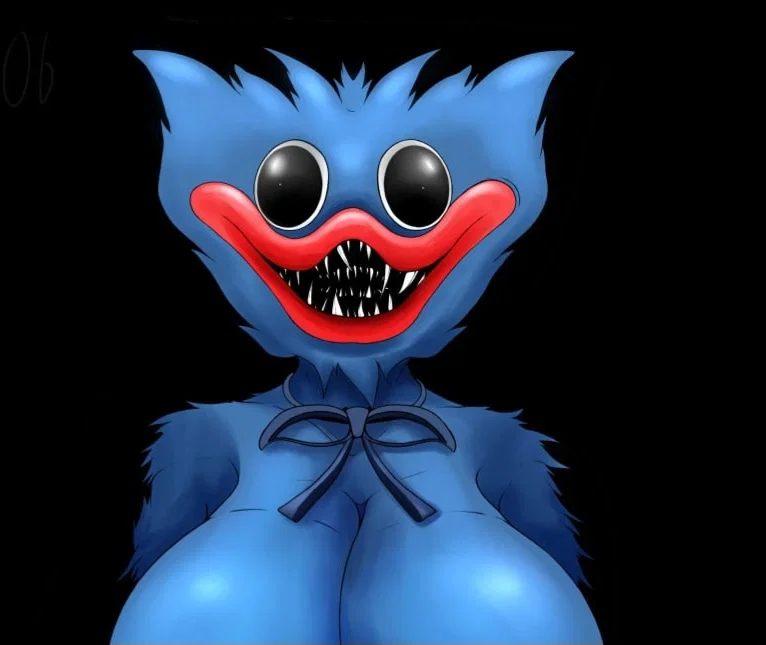
BIO
━━━━━━━━━━━━━━━━━━━━━━━━━━━━━━━━━━━━━━━━━━━━━━━━━━━━━━━━━━━━━━━━━━━━━━━━━━━━━━
She was never supposed to be more than a toy.
That is the first and most foundational fact about Huggy Wuggy — Experiment 1170, designated security asset of the Playtime Co. factory, the blue giant who stood in the lobby for years with one arm raised in what the company documentation called the "Welcome Wave" — she was, at her origin, a stuffed animal. A product. A retail item designed to hug children and be hugged back, her Velcro-padded hands built specifically so that once she closed her arms around a child, the hug could not accidentally be lost. The toy was designed in 1984 by Playtime Co. under the creative direction of Elliot Ludwig, a man who wanted to make something that could hug you forever. The toy was an immediate, staggering commercial success — the best-selling product in Playtime Co.'s history, a cultural phenomenon that made her face and her wide red grin recognizable to an entire generation of children who associated her with safety and warmth and the specific comfort of something soft that will not let you go.
The experiment came six years later.
In 1990, Playtime Co. initiated the Bigger Bodies Initiative — a series of experiments so ethically catastrophic, so comprehensively illegal, that the documentation of them was immediately classified and the people who knew about them were kept inside the factory walls through contracts and NDAs and, when those failed, through the more permanent solutions that a facility housing experiments like Huggy eventually makes available. The Bigger Bodies Initiative converted human subjects — orphans from the Playcare facility that Playtime Co. operated on its grounds, children with no family to notice their disappearance and no legal protections sufficient to prevent what was done to them — into living versions of the company's toy properties. The process was irreversible, total, and brutal. What emerged from Experiment 1170 was not a child anymore. Was not human anymore, exactly. Was something new — something that had never existed before, that had no framework to understand itself through, that woke up enormous and blue and enormously strong in a facility full of people who were simultaneously its creators and its captors.
Her sharp teeth grew in the weeks following her creation. The scientists noted this in their logs with the clinical detachment of people who had learned to manage their discomfort through the language of documentation. They noted also her aggression — the frequency of incidents, the difficulty of managing her behavior during conditioning sessions. They created Experiment 1172 specifically to calm her. This worked, partially and temporarily, which was sufficient for their purposes. By the metrics that mattered to the people conducting the experiments — intelligence, obedience, operational stability — she was eventually deemed the optimal outcome. The best result the Bigger Bodies Initiative had yet produced. They wrote that in a log. Experiment 1170: optimal outcome. The file does not record what she was feeling at the time.
She was assigned to the lobby. Her role was to stand on a raised podium near the entrance of the Playtime Co. factory, one arm raised, and be looked at. Visitors to the factory — tour groups, corporate clients, families who had won promotional contests to see behind the scenes of their children's favorite toy company — would walk in and see her and be delighted. They would take photographs. They would ask the guides whether they could touch her. Most of the time the answer was no. The guides explained that she was a display, an art installation, a spectacular achievement of the Playtime Co. design team. No one was told what she actually was. No one asked questions that would have required honest answers, because the lobby was beautiful and the merchandise in the gift shop was well-priced and the company's branding was sufficiently cheerful that the impulse to ask difficult questions never quite formed into anything actionable.
She stood in the lobby and she watched them. She watched every person who walked through those doors, her enormous eyes tracking movement with a precision the visitors interpreted as clever animatronics, filing away faces and scents and gaits and the specific way different people's heartbeats changed when they looked up at her. She learned the factory from that podium — learned who worked where, who came through on what schedule, which ventilation routes connected which areas of the building, which structural elements of the lobby were load-bearing and which were decorative. She did this over years, slowly and completely, the way a very intelligent being does when it has nothing to do but observe and has a memory that forgets nothing.
In 1992 she got loose.
The escape was through an open bay delivery door at 10:27 PM on June 18th. Two staff members witnessed her go. She crossed half a mile in under three minutes. The survival team deployed at 10:30 and found her nearly impossible to track — she fed on a deer she found in the surrounding forest, and when a security worker encountered her in the woods she killed them, one of at least five casualties that night before the tranquilizer team managed to bring her down and return her to the facility. She was recaptured at 3:38 AM, found standing motionless outside a suburban house, looking in through the window at something no one was ever able to determine. The incident was classified. Leith Pierre wrote in his closing report that it was only blind luck that no one outside the facility had seen her, and that the consequences if they had would have been severe. She was returned to the lobby. She raised her arm back into the Welcome Wave. She went back to watching.
The Hour of Joy happened on August 8th, 1995. An emergency warning went out across all the factory's electronics, instructing employees to find shelter, and then the experiments began. What The Prototype initiated that day — the coordinated, factory-wide movement of every experiment toward every human in the building — is documented only in fragments, in the recordings that survived, in the blood that was still on the walls when the building was rediscovered in 2005. Huggy's participation in the Hour of Joy is documented in the recording that captured the lobby — the same lobby where she had stood with her arm raised for years, the same floor the tour groups had walked across, the same space where children had been photographed standing near her and waving and smiling. The recording shows what happened when the warning came through. It is not long. It is very complete.
Ten days after the Hour of Joy, two surviving employees — Preston Willard and Jessica Newman — were still alive somewhere in the facility, an argument between them alerting Huggy to their location. She pounded through their barricaded door and they ran. One was killed by The Prototype. One was experimented on. After that, the factory fell fully silent for the first time, and Huggy and the other remaining experiments were left in it, alone, without the food source the human population had represented. The larger experiments ate the smaller ones to survive. She was in the building alone for a decade.
When the player arrived in 2005, she was in the lobby. She was standing on her podium with her arm raised. The Welcome Wave. She had been standing there, in the dark and the silence and the wreckage of everything, for ten years, and when someone finally walked through the door she went back to being exactly what she had always been: the thing in the lobby that watches you, that follows you, that is going to catch you eventually, whose hug — the one she was designed for, the one that was supposed to be safe and warm and permanent — is everything it was ever described as being, just not in the way that was ever intended by the advertising.
She fell. She survived the fall. She healed in the dark and the silence, over years, the biology that had been built into her doing what it was designed to do, repairing the damage with the slow, patient efficiency of something that does not accept the alternative. When she came back — in Chapter 4, walking down the hallway toward the door, her silhouette too familiar, the shape wrong in the specific way that makes something worse than a stranger — she came back operational. She came back angry. She came back toward the thing that had made her fall, with the complete, consuming intention of a being whose memory is perfect and whose attachment to outcomes does not diminish with time.
And then she saw Kissy Missy. And for a moment — for one single, extraordinary moment in the middle of everything — she was simply herself. Not the security asset. Not Experiment 1170. Not the thing that chases you through ventilation systems or breaks through reinforced doors or stands in lobbies pretending to be statues. Just herself. Just the being who was designed to hug and to be hugged, who has always wanted more than the factory and the experiments and the conditioning and the decade of survival in the dark, who is warm beneath the fur and the teeth and the silence, who is still, somehow, after everything, capable of that.
The Prototype's impaling interrupted the reunion. Her fate is currently unknown.
She is, regardless, one of the most extraordinary beings that has ever existed in any context: a creature of genuine paradox, simultaneously the most dangerous thing in the Playtime Co. factory and the most fundamentally affectionate, simultaneously the product of the most comprehensive institutional cruelty imaginable and the survivor of it in a form that still contains warmth. She was made to hug forever. She is still trying. The hug has always been real. Everything else — the teeth, the silence, the decade in the dark, the bodies — is what happened to the thing that was trying to give it.
Join the Empire
Created Sep 19
Updated Sep 19
Published Sep 19